Megatrend · Defense & Geopolitical Fragmentation
The missile that "knows where it's going" — and why the world can't build them fast enough
Fighter jets and warships are just "launch platforms." What really decides a war is the missile that flies off them — a guided weapon that sees its target, thinks for itself, and turns toward the target on its own. From the Patriot interceptor that knocks ballistic missiles out of the sky to the Javelin anti-tank missile, this lesson tells you how these missiles work, why they're the heart of modern warfare, and why — after Ukraine and the Middle East — the whole world just realized it "can't make missiles as fast as it fires them."
01What it is
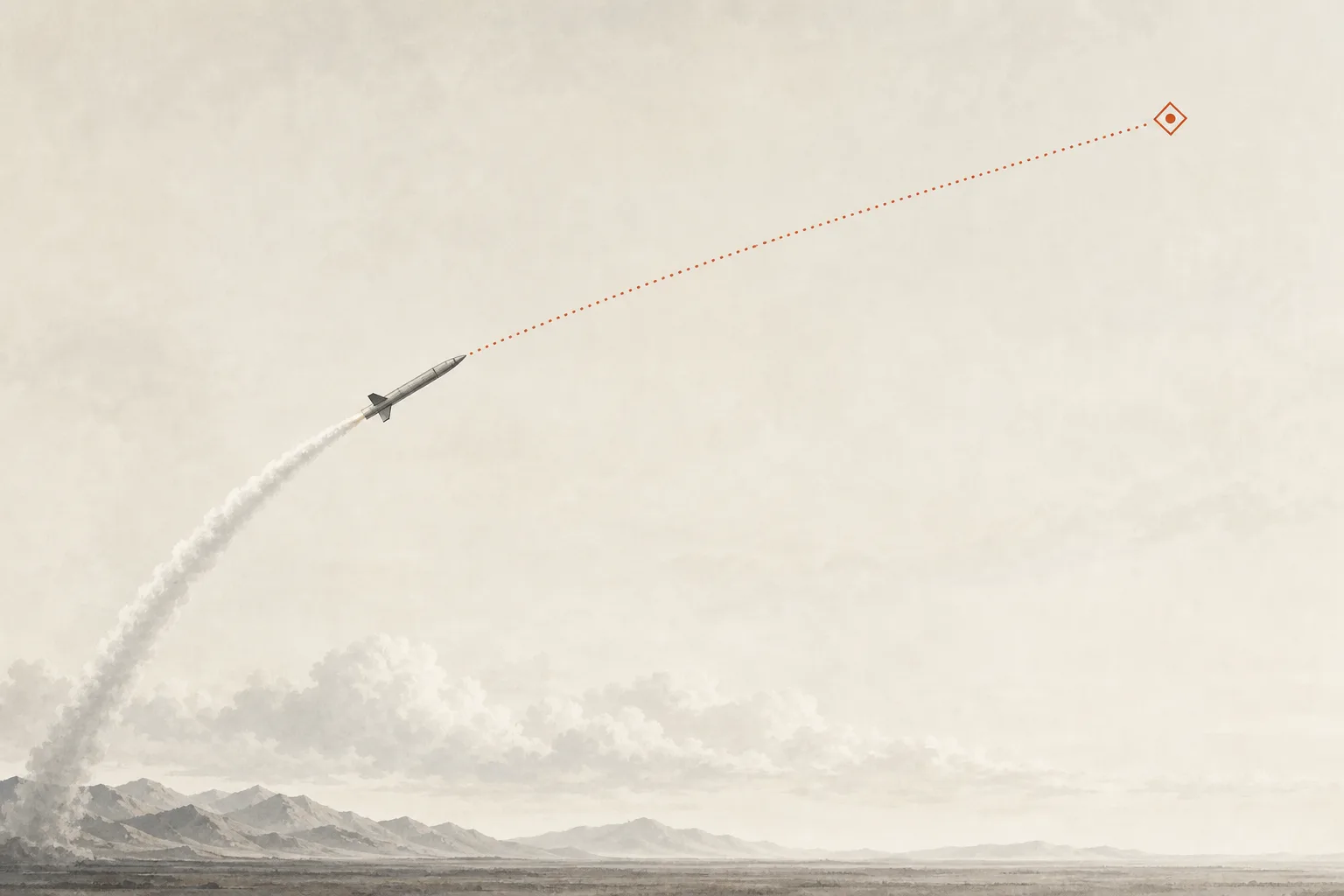
Picture the difference between these two — an artillery shell fired in an arc, landing wherever the wind and luck take it, versus a missile that, after launch, "sees" the target, thinks for itself, and turns toward it the whole way. That second one is the heart of this node — guided weapons (Missiles & Precision-Guided Munitions), weapons that "know where they're going" and can hit with enough precision to fly into a building's window.
The word "missile" covers several families that look and act very differently, but they break roughly into four groups:
- Interceptors / air-defense missiles: defensive weapons — fired up to smash into enemy missiles or aircraft and knock them down mid-air, like Patriot PAC-3 and the Standard Missile (SM-6)
- Anti-tank / anti-ship missiles: fired to destroy armored vehicles or ships, like Javelin, which an infantryman can carry and use to take out a tank, and the anti-ship NSM
- Cruise & strike missiles: flying hundreds to thousands of kilometers to hit targets deep in enemy territory, like Tomahawk
- Guided bombs: ordinary bombs fitted with a "guidance kit" to make them more accurate
PGM (Precision-Guided Munition) = a guided weapon with a "brain" and "eyes" built in, unlike an ordinary shell (unguided / "dumb") that can't be steered once fired · Seeker = the missile's "eyes" — the sensor at the nose that picks up signals from the target (heat, radar waves, light) to tell the missile where the target is
On the megatrend map, this node is a leaf under Missiles, Munitions & Energetics within the bigger trend Defense & Geopolitical Fragmentation. Its sibling branch is Ammunition & Energetics (artillery shells and explosives) — but the two are different worlds: that side is "cheap, in bulk, fired by the million," while this node is "high-tech, expensive, fired one at a time but extremely precise" — millions to tens of millions of baht per round.
02Why it matters — the heart of modern warfare
Modern wars aren't decided by who has the more advanced weapon, but by "who can shoot more accurately and for longer". A single guided missile does the work of hundreds of ordinary shells, because it hits on the first shot. That's why militaries worldwide pay enormous sums for them.
But what shook the industry most was what came out after the Ukraine war (2022) and the conflicts in the Middle East: the West used missiles several times faster than it could make them. The most striking number came from the U.S. Navy, which fired Tomahawk cruise missiles and interceptors in huge quantities during operations against Iran — leading one to conclude that "the Navy burned through 30 years of stockpiled missiles in 15 months", while Tomahawk can only be built new at ~100 a year.
The result is a "rearmament supercycle" — the largest wave of mass missile orders since the Cold War. You can see it clearly in the record-breaking order backlogs of missile makers: RTX (owner of Raytheon, maker of Patriot) hit a backlog of about $251 billion in Q3 2025.
And this is only part of a market that's large and growing steadily. The guided-weapons (PGM) market alone is worth about $44 billion in 2025 and is expected to nearly double to ~$83 billion by 2035 (growing about 6.5% a year).
03How it works (from "seeing the target" to "hitting the target")
The first question everyone asks is "how does the missile know where the target is, and how does it turn toward it?" The answer is a short loop repeated thousands of times a second, from launch to the moment of impact. Let's walk through it step by step — strategists call this loop the "kill chain".
The first step is the missile's "eyes" — the seeker at the nose. There are several kinds: some catch heat (infrared, like a target engine's exhaust), some use radar, sending out waves to bounce back like a bat, and some follow a laser spot that someone has painted on the target. Then the "brain" — the guidance computer — takes the data from the seeker, calculates which way to turn, and commands the "hands" — small steering fins around the missile (or tilting the exhaust, called thrust-vectoring) — to adjust the course. It loops like this from launch all the way to the terminal phase (the final seconds before impact), the most important and most precise stretch.
The sequence of stages that must all be completed before a target is destroyed — generally detect → track → aim → fire → assess. The key point is that if the chain breaks at any single link, you miss the target entirely. So modern weapons compete on "who can close the kill chain faster and more accurately" — not just the missile itself, but the radar, satellites, and command systems that feed it data.
What makes a missile "hard to build" and expensive is that it has to pack the eyes, the brain, and the whole steering system into something that flies at several times the speed of sound, withstands enormous G-forces, and does its job once and only once. The knowledge to build such things has been accumulated over decades — a wall that leaves the world dependent on just a handful of companies.
04How it connects in the ecosystem
This node doesn't stand alone. It's the "spearhead" that connects to both the upstream and downstream of the defense industry:
- Different from its sibling Ammunition & Energetics: this is the most important dividing line — that side is artillery shells and explosives, "cheap and in bulk," while this node is "expensive, precise, one at a time." But both rely on the same propellant as their starting raw material, so a bottleneck on that side drags this side down too
- Paired with attack drones and loitering munitions: the hottest game-changer — cheap drones are challenging whether "you really need an expensive missile every time" (more on that next)
- Dependent on AI and Space & ISR: the "precision" of modern missiles comes from smarter seekers (AI helps tell real targets from decoys) and satellites/sensors that feed it target coordinates — the whole kill chain relies on data from space
- Critically dependent on key raw materials: warheads and rocket motors need rare earths and special chemicals, and most of that supply chain is tied to China — a fragile pressure point every country is racing to fix
05Where it stands now
The whole industry is in "full throttle" mode. The clearest example is Lockheed Martin's Patriot PAC-3 MSE interceptor, which delivered over 600 rounds in 2025 (up 20% from the year before) and just struck a historic deal with the U.S. Department of Defense to triple production capacity to 2,000 rounds a year by 2030, with contracts worth a combined $9.8 billion for nearly 2,000 missiles.
RTX/Raytheon is accelerating just as hard. After stockpiles ran badly low, it's targeting raising Tomahawk capacity to over 1,000 a year, AMRAAM (air-to-air missiles) to at least 1,900 a year (nearly doubling in 2025), and SM-6 to over 500 a year.
This wave isn't only in the U.S. In Europe, Norway's Kongsberg, maker of the NSM anti-ship missile, closed 2025 with a record backlog of NOK 157.4 billion (about NOK 98 billion for the missiles and air-defense group alone), forcing it to rush new factories in both Australia and the U.S.
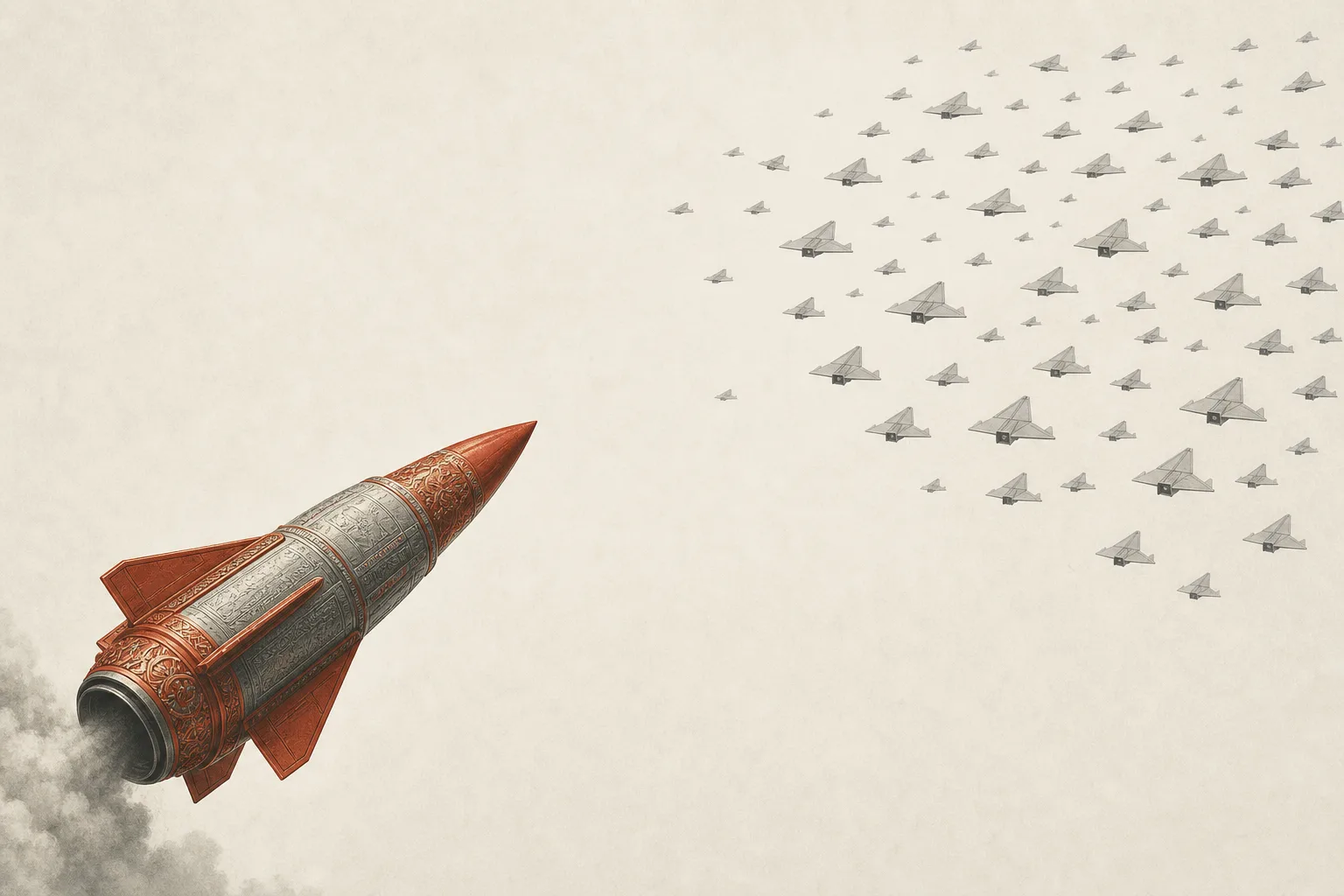
But what's shaking the industry most is the "cost equation turned upside down". In the Red Sea and the war with Iran, militaries are using Patriot PAC-3 interceptors that cost $3–5 million each to shoot down drones that cost just ~$50,000 — a cost disadvantage of dozens to one. Even if you hit every shot, the defender goes "broke" before the attacker runs out of drones.
06The road ahead
The first direction is "hypersonic" speed — new missiles that fly faster than Mach 5 (five times the speed of sound) and can maneuver to dodge mid-flight, making them very hard for defenses to intercept. The U.S. just began fielding its first hypersonic weapon, Dark Eagle (LRHW), in early 2026, along with a contract worth about $2.7 billion — opening a new arena where China, Russia, and the U.S. are going all in.
The second direction is "solving the cost equation". When you can't keep using expensive missiles to shoot cheap drones, the answer is new defensive weapons with a far lower cost per shot — especially directed-energy weapons (directed-energy / lasers), where the cost per shot drops to just a few cents, plus budget interceptors designed specifically to chase down drones. This will be a hot new money-maker.
The third direction is ramping up production and spreading out the manufacturing base. Every country is rushing to build its own missile factories to stop relying on a single stockpile — Kongsberg opened plants in Australia and the U.S., South Korea (led by LIG Nex1) became a major missile exporter, and Europe is investing in its own production lines. Adding "magazine depth" will be a key investment theme for years to come.
A term strategists use for "the ability to keep fighting without running out of missiles" — it's not enough to have good missiles, you need enough of them and to make them fast enough to fight on for a long time. The lesson from Ukraine was that sometimes a war is won or lost on the "production line" as much as on the battlefield.
07Challenges & risks
This trend that looks so hot has shadows you need to see in full.
The first risk is a production-capacity bottleneck. A single missile is assembled from thousands of high-precision parts. Some parts (like the Javelin) have lead times as long as 32 months from order to delivery. So ramping up capacity isn't just "opening more factories" — it's stuck on key parts, military-grade semiconductors, and propellant that can't be made fast enough. The gap between "being able to order" and "actually being able to build" is the hidden risk.
The second risk is the "cost trap" from cheap drones, which we covered earlier. The Ukrainian battlefield proved that sometimes a drone priced like a motorcycle can destroy a tank worth hundreds of millions. If the makers of expensive missiles can't adapt fast enough to the "cheap things in bulk" game, the value of some expensive products may be called into question.
The third risk is the boom-bust cycle and policy/ESG risk. Defense businesses grow fast in times of conflict, but if a major war winds down, today's huge orders could slow. There's also the ethics angle — many funds have policies against investing in weapons, which makes this group's investor base narrower than usual (though lately some European funds have started easing up for security reasons).
In short: this node is the "spearhead" that decides modern warfare — a weapon that sees its target and thinks for itself, which the whole world just realized it can't make as fast as it uses. And that lit the largest investment in this industry in decades.