Megatrend · Cloud & Digital Infrastructure
The invisible glue that lets a hundred apps actually talk to each other
A single company today runs an average of 100+ online software tools (SaaS) — each one hoarding its data in its own box, refusing to talk to the others. This lesson is about the 'plug' called API and the 'switchboard' called iPaaS that wire all those apps together. It's the layer that used to be the most boring part of software, and suddenly became the most valuable — because AI agents need it to actually 'do' anything.
01What it is (API and iPaaS)
Picture an office: the sales team uses Salesforce for customers, accounting uses a separate invoicing app, HR uses yet another payroll system, marketing has its own email tool. Every app works fine inside its own box — but the moment a new customer signs, that person's data has to travel from Salesforce into accounting, into shipping, into after-sales service. If nothing connects them, someone sits there copy-pasting the same data back and forth all day. That's exactly the problem this node solves.
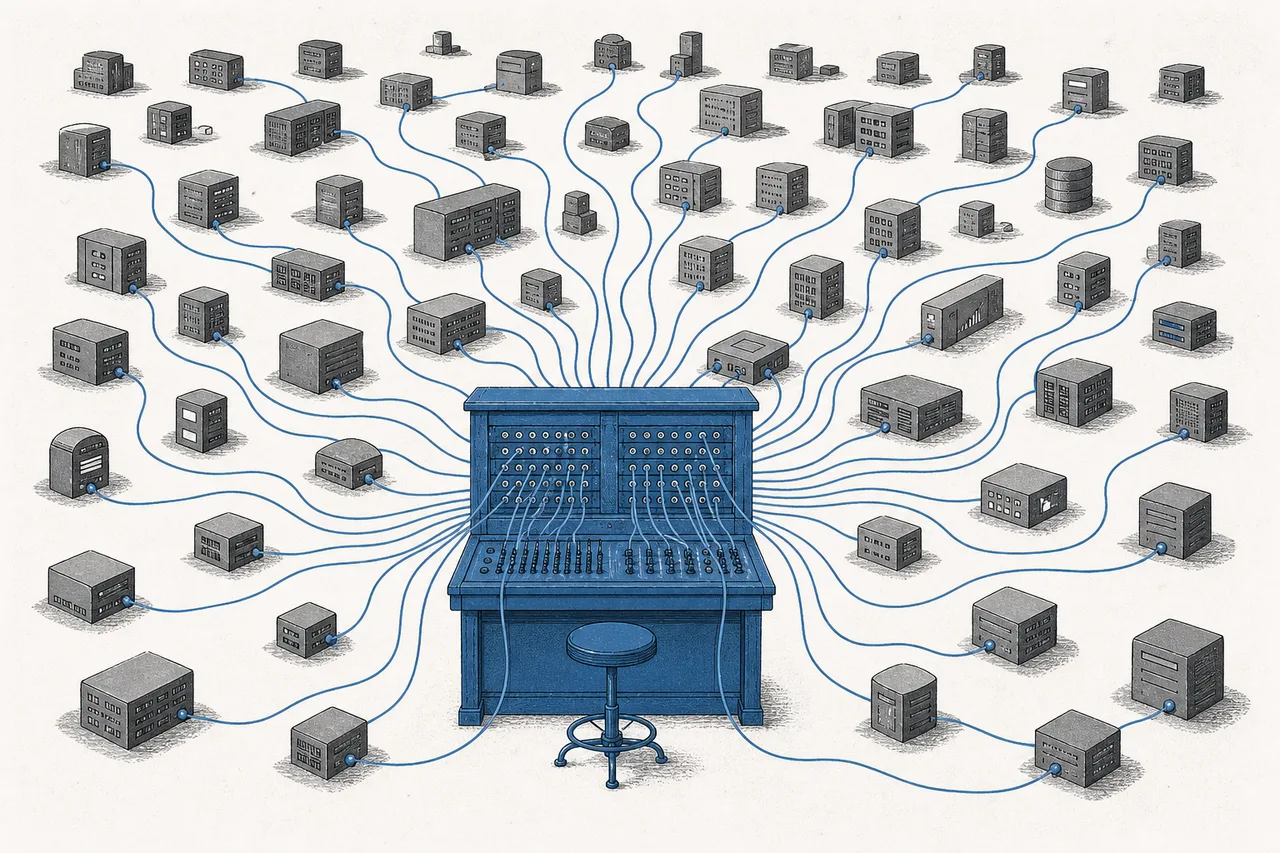
The core comes down to two words. First is API — think of it as a standard 'plug' each app holds out, telling you: 'if you want data from me, or want me to do something, connect here, this way.' Second is iPaaS — a central cloud platform that acts as the 'switchboard,' wiring up the plugs of hundreds of apps without writing new code every time.
API (Application Programming Interface) = the standard 'plug / socket' one app opens up so other apps can pull its data or tell it to do something · iPaaS (Integration Platform as a Service) = a central cloud platform that wires multiple apps together (the switchboard) · API Management = the 'gatekeeper' layer that controls who can call an API, how often, whether it's secure, and how it gets billed — these two layers work as a pair
On the megatrend map, this node sits under Cloud & Digital Infrastructure. It's the 'connective tissue' — not the apps you see on screen, but the pipes and wiring that let all the apps you do see work as one.
02Why it matters
It starts with a number that sounds almost unbelievable: the average company today runs more than 100 SaaS apps (Okta's 2025 report shows the average crossing 100 for the first time). Big organizations (over 5,000 employees) average a striking ~131. Every one stores its data separately, and none were built to talk to each other in the first place.
When apps don't talk, the damage isn't just an annoyance — Gartner estimates that about 30% of what organizations spend on SaaS is 'dead money' (unused licenses, duplicate features, overlapping apps), roughly $90 billion globally. And McKinsey research finds knowledge workers lose nearly 2 hours a day just hunting for information scattered across different apps. So connecting apps isn't a luxury — it's clawing back the money and time that were leaking away.
That makes this market big and fast-growing. The iPaaS market sits at around $16–18 billion in 2025, and most research houses see it compounding at ~25–30% a year, reaching hundreds of billions of dollars by the early 2030s. The neighboring API Management market grows too, from ~$8 billion (2025) to roughly $19–21 billion by 2030 — together, these two layers are one of the fastest-growing corners of enterprise software.
03How it works — the switchboard
The heart of the mechanism is 'centralizing the connections.' Instead of wiring every pair of apps directly (with 100 apps, that becomes thousands of lines you can't maintain), iPaaS sits as a central hub where every app plugs in (via API) at one place. The hub then translates between languages, reshapes the data, sets the rules ('if A happens, send it to B'), and controls all the traffic.
The API Management layer is the 'guard and tollbooth' that sits astride this traffic — it checks whether whoever's calling an API has permission (security), limits calls so the system doesn't crash (rate limiting), logs who called how much, and if a company wants to sell its API as a product, it can bill by usage. Together, these two layers are the 'nervous system and traffic rules' for the entire software city.
04How it connects in the ecosystem
This node is the 'glue layer' that sits in the middle, so it connects to almost everything inside and outside the Cloud category:
- The direct neighbor is Horizontal SaaS: the more SaaS apps the world has (CRM, HR, finance), the bigger the 'apps don't talk' problem → the more demand for the connecting layer. You could say SaaS sprawl is the fuel for iPaaS
- Rides on Hyperscale Cloud (IaaS/PaaS): every iPaaS and API gateway runs on the clouds of AWS, Azure, Google — and these cloud providers also have their own connecting tools and APIs (both the foundation and a competitor)
- Becomes the 'hands' of Agentic AI: this is the hottest relationship — an AI agent can think for itself, but to actually 'do' something (book a ticket, send an invoice, update a customer record) it always goes through an API. So this layer becomes the path agents use to get work done in the real world
- Lays the rails for Digital Finance & Tokenization: modern finance is pure API — payments, identity verification, money transfers all run through the APIs of companies like Stripe/Twilio, which makes this node fintech's infrastructure too
05Where it stands now + who holds the field
The standout feature of this field is that many of the most valuable pieces are private companies — or bought up and hidden inside giants, not on the stock board under their own name. The reason: the connecting layer is extremely 'sticky.' Once an organization has wired hundreds of apps through one platform, moving off it is nearly impossible — so the big players keep buying up the good companies to add on.
The clearest example is Salesforce buying MuleSoft in 2018 for $6.5 billion, the largest integration acquisition ever. Today Salesforce's 'Integration & Analytics' group (MuleSoft + Tableau) brings in about $5.78 billion in fiscal 2025. On the other side, Boomi was carved out of Dell and sold to the funds Francisco Partners and TPG at ~$4 billion (still private), while Workato raised its latest round at a company value of ~$5.7 billion — both iPaaS leaders that aren't listed on the stock market.
On the other side is the 'API-first' group — companies whose business literally is an API. Twilio (messaging/voice API) powers nearly a trillion digital communications a year, while Stripe (private, payments API) processes over 500 million API requests a day — numbers that show the digital economy really runs on APIs, not just pretty words.

06The new wave: AI agents need APIs
This is why a once-boring layer suddenly got hot. Today's AI no longer just 'answers questions' — it's becoming AI agents that do the work for us. And the catch is that no matter how smart the AI, it can't do anything in the real world without 'hands.' For an agent to book a ticket, issue an invoice, or update a customer record, it always has to call that app's API. Put simply: the API is the hand of the AI.
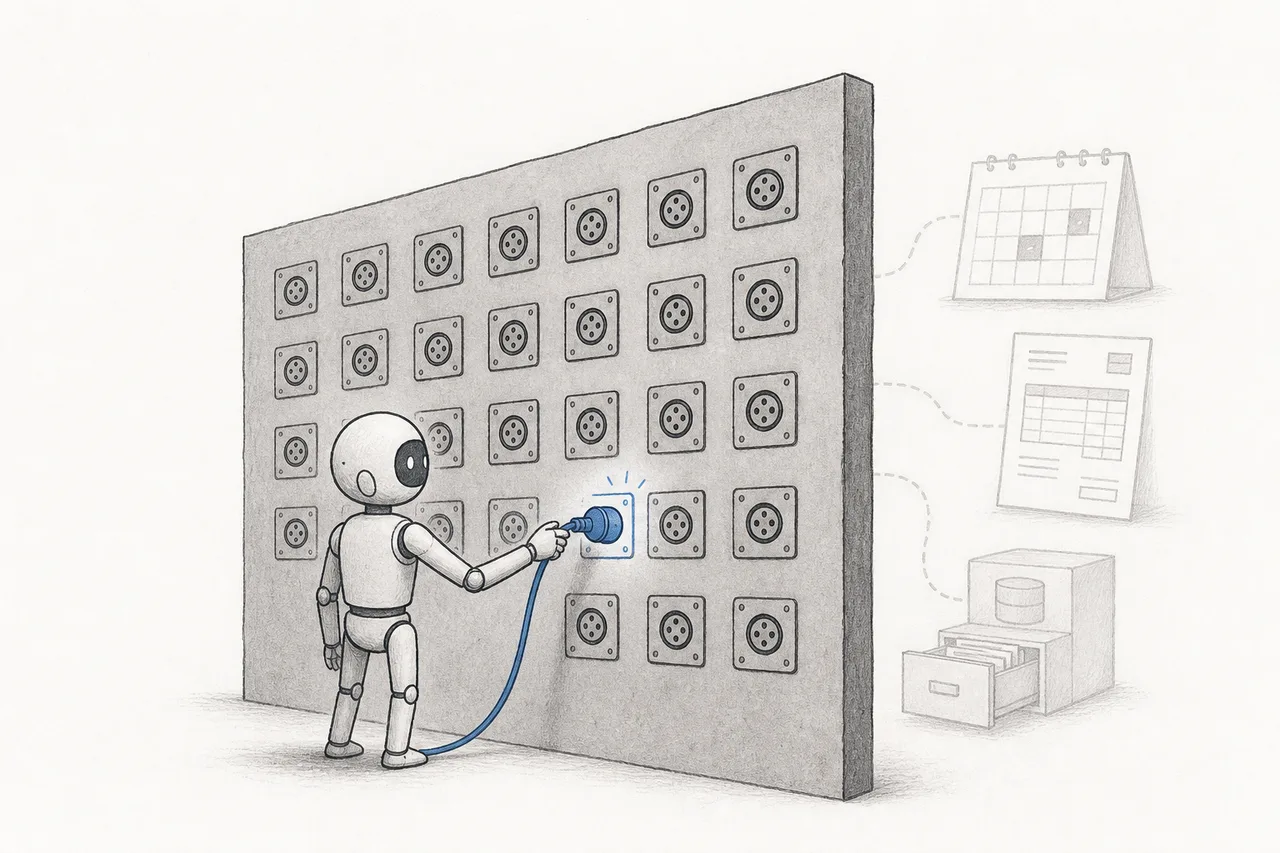
2025 brought a major turning point: a new standard called MCP (Model Context Protocol) that lets AI agents discover and call tools/APIs in one standard way — and in April 2025, both Google and OpenAI announced support for MCP, making it the common language of the agent era. As a result, nearly every iPaaS platform rushed to build MCP in, because whoever controls the 'connecting layer' controls 'the path the AI takes to get work done.'
Tool-calling = the ability for an AI to call an external 'tool' (i.e. an API) to actually act, rather than just typing out an answer · MCP (Model Context Protocol) = a common standard that lets an agent connect to tools/APIs without writing a new integration every time (agent-to-tool) · A2A (Agent-to-Agent, launched by Google in April 2025) = a standard for one agent to talk to another agent — a layer that sits above MCP
The size of this wave is real. Gartner expects 40% of enterprise apps to have AI agents embedded by the end of 2026 (up from under 5% in 2025), and by 2027 over 50% of enterprise AI agents will rely on MCP-style standards to connect across systems — every additional agent means more API calls. So demand for this layer is tied directly to the agentic AI boom.
07The road ahead
The first direction is iPaaS morphing into the infrastructure layer for AI agents. From simply 'wiring apps together,' this layer is becoming 'the place agents come to pick up tools.' So the new competition isn't who can connect the most apps, but who can let agents call them more safely, more auditably, and more reliably — because letting an AI operate real systems on its own raises the stakes far above just pulling data.
The second direction is the growth of 'machine-to-machine traffic'. As AI coding agents start managing infrastructure themselves and agents increasingly call APIs in place of humans, the volume of API calls will surge in a way human usage never could (IDC expects agent usage at Global 2000 giants to grow roughly 10x from 2025 by 2027) — and the API Management market that polices this traffic benefits along with it.
The third direction is consolidation toward the cloud and SaaS giants. As the connecting layer grows more important, the big players (Microsoft, Google, Salesforce) want to bundle it into their own packages — good for customers who get everything in one place, but pressure on independents who have to prove they 'connect to everything, neutrally' better than whatever comes free with one cloud.
08Challenges & risks
The appeal of the connecting layer comes with risks you have to see clearly.
The first risk is getting bundled and swallowed by the cloud/SaaS giants. When Microsoft, Google, and Salesforce throw in connecting tools and APIs with their core platforms, independents can get squeezed into being a feature in someone else's package instead of a standalone business — which is why many of the good pieces (MuleSoft, Apigee) ended up acquired rather than growing on their own.
The second risk is AI possibly changing how 'connecting' works entirely. Technology like MCP makes plugging an agent into a tool so much easier that new players designed specifically for agents (agent-native) are emerging. If these standards turn 'connecting' into something basic that anyone can do, the value once concentrated in traditional iPaaS platforms could scatter — a tool that was once a moat might turn into a commodity.
The third risk is security and dependency. A layer that sits astride the data of every app means that if it's breached, it's like opening every door at once. And the more you let AI agents call APIs to operate real systems, the higher the risk that an agent makes a mistake or gets tricked into doing something it shouldn't — so governance becomes both a risk and a new money-maker for the API Management layer.
In short: API & Integration is the story of the 'glue' nobody notices — until it comes loose. It's the layer that turns a hundred apps into one usable tool, and it's now becoming the path the whole world's AI uses to get work done. Understanding this layer fully means understanding why something 'invisible' is one of the places where the power and profit of the cloud era concentrate.