Megatrend · Cloud & Digital Infrastructure
The software every company on Earth “rents” instead of “buys”
CRM, payroll, design tools, online meeting rooms — the software every industry uses in the same way is now sold almost entirely as a “monthly subscription,” not a one-time purchase. That one change in how you charge built the most profitable, most predictable businesses in the history of capitalism — but it's now facing a question that could shake the whole model: if AI does the work instead of people, do we still pay for the same number of “seats”?
01What it is
Think of any company — a restaurant, a hospital, a factory, a bank — and they all share one set of things they “do the same way”: they have to track customers, pay their staff, do the accounting, meet and talk as a team, and design materials. None of this depends on what business you're in — these are the “shared functions” every industry has in common.
Horizontal SaaS is the software that handles those shared functions and sells to every industry the same way. “Horizontal” means wide, across every field — Salesforce sells CRM to restaurants and banks alike; Workday sells HR systems to factories and hospitals alike. The opposite is Vertical SaaS, which goes deep into a single industry (software built just for dental clinics, say).
And “SaaS” stands for Software as a Service — the heart of it is the word service. You don't “buy” a program and install it on your machine like the old days; you “rent” it over the web and pay a monthly or yearly subscription. The software runs on the vendor's cloud, updates itself automatically, and works the moment you open a browser.
In the old days, companies like Oracle or SAP sold a perpetual license — you paid one big sum to “own” the software forever, then paid ~15–20% a year for support · SaaS changed that to a subscription — you pay a little every month and keep using it as long as you pay; stop paying and you lose access. That small difference is exactly what flipped the economics of the entire software industry.
On the megatrend map, this node sits under Cloud & Digital Infrastructure at the “application layer” — the top layer that the people doing the actual work touch every day. Below it sit servers, cloud, and networks, but this is the layer customers pull out their wallets for, because it gets the job done.
02Why it matters — the predictable revenue machine
To see why this model is so powerful, you have to look at what it replaced. In the old software world (perpetual license), revenue came in “big, irregular lumps” — this year a major customer buys once and you get a huge check; next year nobody buys and you go dry. Revenue fell like rain in bursts, hard to predict. Investors hate that kind of uncertainty.
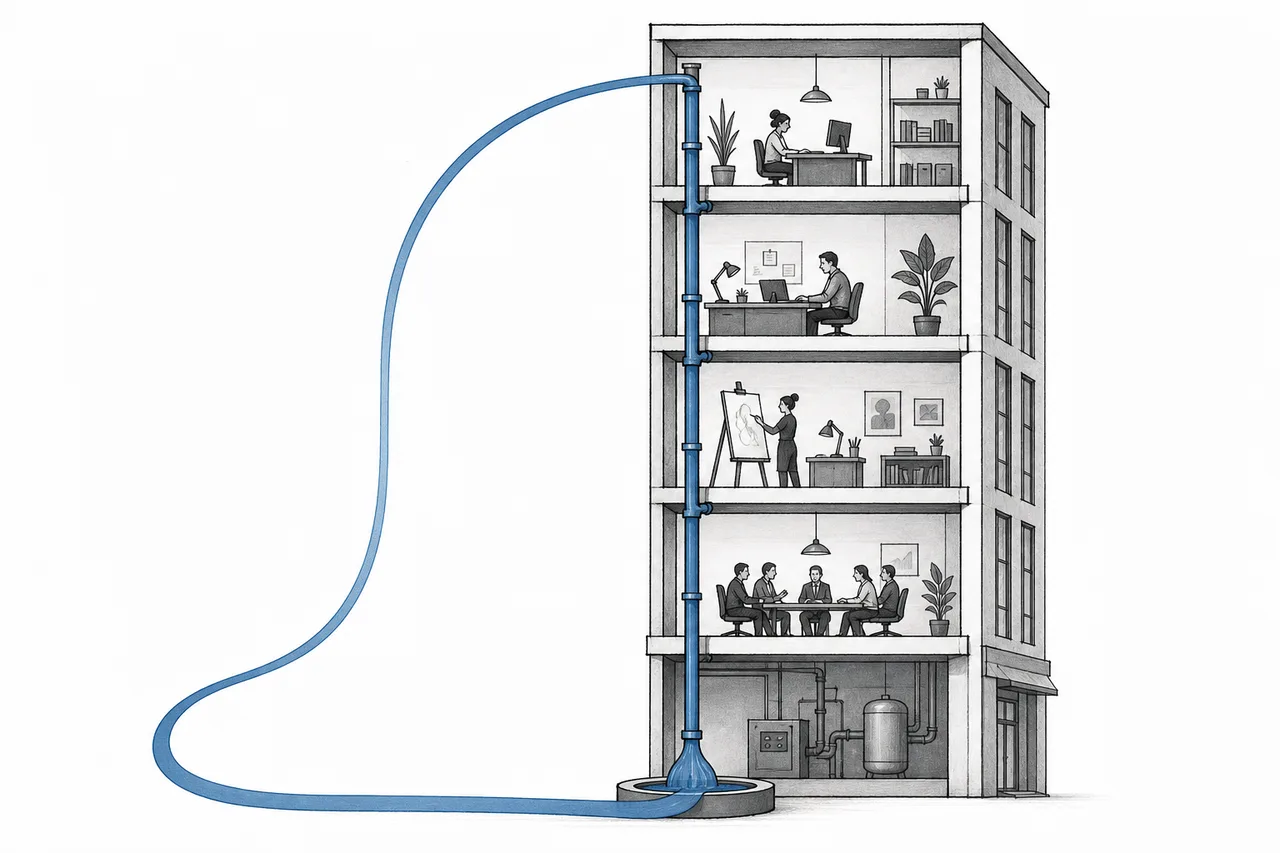
SaaS turned that rain into “running water” — a steady flow every month, because customers pay the subscription again and again without a break. Revenue like this is called recurring revenue, and it's so predictable that investors will pay a premium to own these stocks.
The market is large and still growing. The global SaaS market was worth about $408B in 2025 and is expected to reach ~$465B in 2026, with a trend of roughly 13% annual growth for another decade.
But what investors really fall in love with is the margin. Once the software is written, the cost to serve one more customer is nearly zero — just open a new account on the same server. The result: mature SaaS runs a gross margin of 75–85%, far higher than most businesses on Earth (in the old license days, margins sat in the mid-60s).
03How it works (the land–use–expand–retain wheel)
A good SaaS model isn't just “win a new customer” and done. It works as a flywheel that, the more it spins, eats more revenue per customer over time. There are four beats:
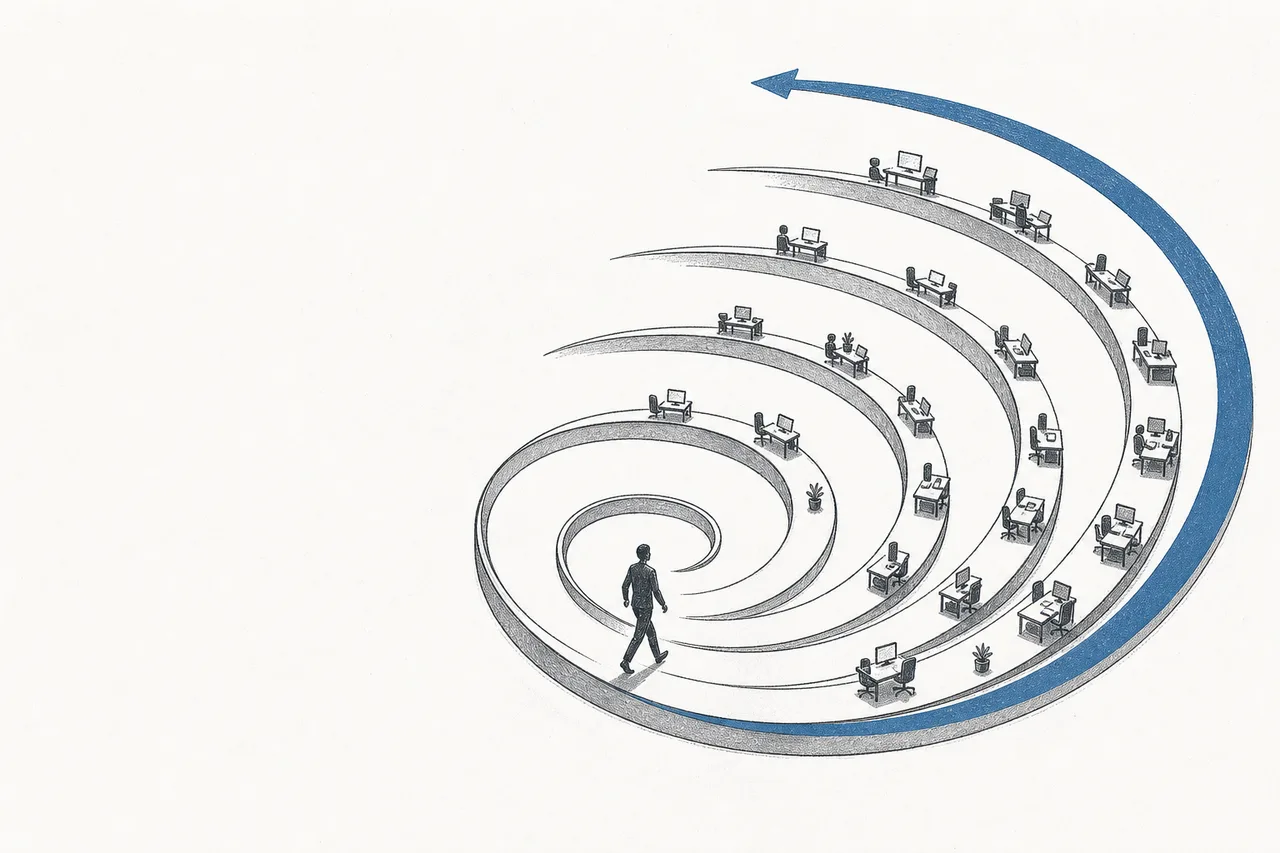
The number that measures “how well this wheel is spinning” is net revenue retention (NRR) — it answers the question, “the same customers as last year, are they paying us more this year, or less?” If NRR is above 100%, it means revenue grows even if you win no new customers at all, because existing customers buy more — this is the real magic of SaaS.
So why don't customers leave? The answer is “switching cost”. Once a whole company has put its customer data, sales history, and team documents into Salesforce or Workday until it's the lifeblood of how they work, moving out isn't just swapping a program — it's rebuilding the entire organization's workflow and retraining everyone. That cost is expensive and painful, so most people choose to “stay” — and that's the strongest moat this business has.
04Ecosystem — where it sits
Horizontal SaaS doesn't float on its own — it's the top layer sitting on several infrastructure layers, and it's tightly tied to other trends:
- Sits on Hyperscale Cloud: every SaaS runs on a cloud giant (AWS, Azure, Google Cloud) — SaaS vendors pay them server rent, then collect subscriptions from customers on top
- Twin of Vertical SaaS: same business model (subscription), but horizontal sells wide across every field while vertical goes deep into one industry — two sides of the same coin
- Meets AI Applications & Copilots: this is the hottest junction — most AI copilots are “embedded” inside the SaaS people already use, so these two layers are deeply intertwined
- Challenged by Agentic AI: agents that run multiple steps on their own until the job is done are both an opportunity (you can sell something new) and a threat (if an agent does the work instead of a person, you may not need to buy as many “seats”) — the core of the next chapter
An easy way to remember it: Hyperscale Cloud is “the land and the electricity,” Horizontal SaaS is the “ready-made office building” every company rents to go to work in, and AI copilots are the “assistants who come sit in the offices” of that building — which layer earns the most is the big question of this era.
05Where it stands now + the players
Today Horizontal SaaS is a “mature” industry — no longer new. But it can still grow two ways: (1) expanding into countries and companies still on old software, and (2) selling AI features to existing customers at a higher price. The question hanging over the industry in 2025–2026 is whether AI “adds” value to this layer or “swallows” it.
The biggest of them is Microsoft, which sells horizontal enterprise software across every function (Microsoft 365, Teams, Dynamics). Microsoft Cloud revenue grew to $168.9B in FY2025 (+23%), Dynamics 365 (CRM/ERP) grew 19%, and AI features like Microsoft 365 Copilot charge $30 per person per month, with about 15 million seats already paying.
The direct rival is Salesforce, the king of CRM, with full-year FY2025 revenue of $37.9B (+9%), of which $35.7B came from subscriptions — and the company betting biggest on AI agents (Agentforce). ServiceNow — the system for IT management and enterprise workflows — brought in $13.28B with a renewal rate as high as 98%, reflecting a switching cost almost no one escapes.
06Future — will AI kill or strengthen the “seat” model
This is the question that keeps the whole industry up at night. For decades, SaaS charged per-seat (per person, per month) — the more employees use it, the more you pay; simple and predictable. But Agentic AI brings a dangerous question: if an AI agent can do the work in place of an employee, does the company still need to buy a “seat” for everyone?

There's a scary logic hidden here: if a SaaS company makes its own product so good it really can replace people, it's shrinking the very “headcount” it charges for — in effect, designing its own revenue to fall. People in the industry call this “the per-seat trap.”
The fix now emerging is shifting how you charge toward usage / outcome (by how much is used, or by results) — instead of counting people, you charge per “job the agent completes.” Salesforce led the way with Agentforce, charging $0.10 per agent action, and also offers bundles of credits and seats to choose from — Salesforce now runs three pricing models at once, because nobody yet knows which one will win.
The other view is that AI will “strengthen” more than “kill” the incumbents, because whoever already owns the data and the workflow (Microsoft, Salesforce, ServiceNow) has a huge advantage in “bolting AI on” and charging extra — Salesforce's Benioff even told investors that AI agents are a “very high-margin” opportunity, and Gartner expects 40% of enterprise apps to have an AI agent embedded by the end of 2026 (up from under 5% in 2025). So the heavy lifting falls to the existing leaders, not newcomers.
07Challenges & risks
The appeal of Horizontal SaaS — high margins, recurring revenue, sticky customers — comes with risks you can't afford to miss.
The first risk is the collapse of the “per-seat” model. If agents let companies cut the number of seats they buy and vendors don't adjust their pricing in time, the once-precisely-predictable revenue could wobble. This isn't a far-off theory — it's already happening in 2025–2026, and nobody knows the final answer yet.
The second risk is saturation and competition. Most shared functions (CRM, HR, accounting) already have market leaders. Developed-market demand is starting to feel “full,” so growth has to lean on upselling existing customers (NRR), which gets harder when AI makes customers question every bill — and new rivals “built with AI from day one” may offer something cheaper and smarter.
The third risk is getting your value siphoned off by the AI owners. If all the intelligence comes from a handful of AI models (OpenAI, Anthropic, Google), SaaS vendors could become a thin “mask” wrapped around someone else's model — the real value flowing to the model owners and the cloud owners underneath, not the app layer on top.
In short: Horizontal SaaS is the story of turning “buy outright” into “rent monthly,” flipping the economics of the entire software industry — building the most profitable and predictable businesses in the world. But now a new wave (AI agents) is questioning the heart of the model: the “seat.” Understanding who survives and who gets swallowed in this wave is understanding where one of the biggest pools of money in the digital economy is about to move.