Megatrend · Electrification & Mobility
The urban mine: digging lithium out of dead batteries
Every dead EV battery is an 'ore' you can mine without opening a pit — crush it into powder, pull out the lithium, nickel and cobalt, and turn it back into new cells, closing the loop so you lean on mines less. The idea is beautiful, and in the long run it gets very big. But 2024–26 was a painful lesson that the timing came too early: EVs aren't dying yet, there aren't enough batteries to feed the plants, metal prices fell — and pioneers like Li-Cycle went bankrupt.
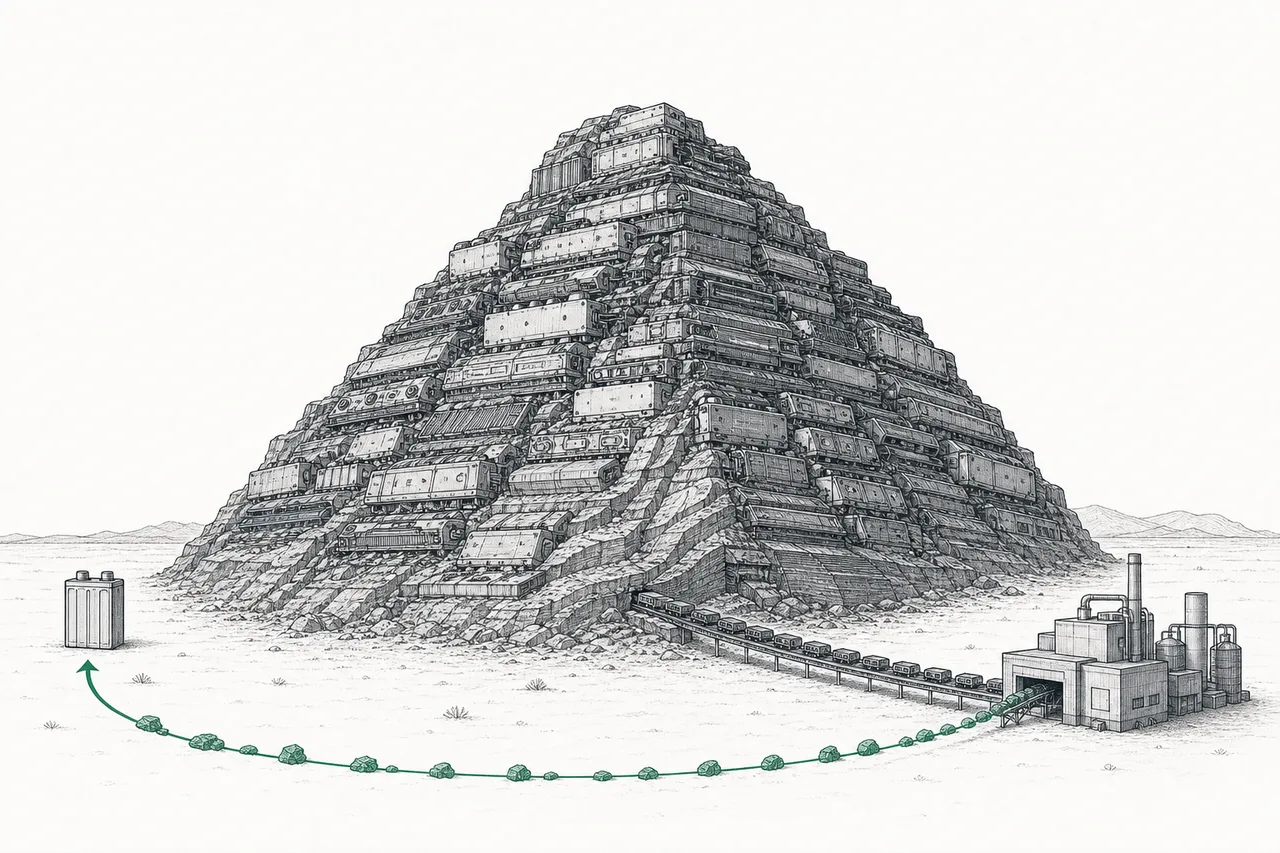
01What is it?
Picture an EV that's run for 15 years until its battery has degraded too far to go on. But inside that battery pack, there's still a dense load of lithium, nickel, cobalt, manganese and copper — the same set of metals mining companies around the world blast through mountains to get. The simple question: why throw it away, when these metals aren't 'used up'? They're just in the wrong place.
This is the heart of Battery Recycling & Circularity — a sub-theme under the Electrification & Mobility megatrend that 'closes the loop' for batteries. Instead of a straight line (mine ore → make cells → use → throw away), you bend it into a circle: use → collect → extract metals → make new cells. The principle is simple: every gram of metal you recover is a gram you don't have to dig from a fresh mine.
The opposite of 'use it and toss it' — you design materials to be reused again and again. For batteries, it means the metal in an old EV becomes the raw material for a new one, cutting reliance on mining a little more with every loop.
But before you get excited, one honest caveat: this node's definition says it plainly — it's a 'supply chain layer'. It's a downstream joint in the battery industry, not a star that makes money easily. And as we'll see, it just lived through one of the most painful 'lessons in timing' in the entire clean-energy trend.
02Why the 'urban mine' matters
There are three stacked reasons the whole world wants this to work.
Layer one — raw-material security. Lithium, cobalt and nickel are concentrated in a handful of countries, and almost all the refining sits in China. Recycling is a way to build a 'mine inside your own country' without any ore in the ground. Every ton you recover lowers your geopolitical risk — which is why this node is tightly bound to the Critical Materials & Supply Chain trend.
Layer two — the market size that's coming. The lithium-ion battery recycling market was worth roughly $13B in 2025. Many research firms expect it to grow to $80–115B by 2035 (a CAGR of about 22–24%). The logic is straightforward: the tens of millions of EVs sold this decade eventually become a pile of batteries someone has to deal with.
Layer three — the legal mandate. This is the variable that turns recycling from a 'green option' into a 'requirement'. The EU Battery Regulation states that by the end of 2031, recyclers must recover 95% of cobalt/nickel/copper and 80% of lithium. And tougher still: new batteries sold in Europe must contain a minimum share of 'recycled material' (16% cobalt, 6% lithium/nickel from 2031, rising further in 2036) — meaning the law itself creates demand for recycled material.
03How it works (the closed loop)
The process has four steps. And the single most important term to remember is 'black mass'.
Step 1 — collect. Gather two kinds of material: genuinely dead batteries (end-of-life) and 'factory scrap' — the cell offcuts trimmed off during manufacturing. Bring it in, sort it, and discharge it safely first.
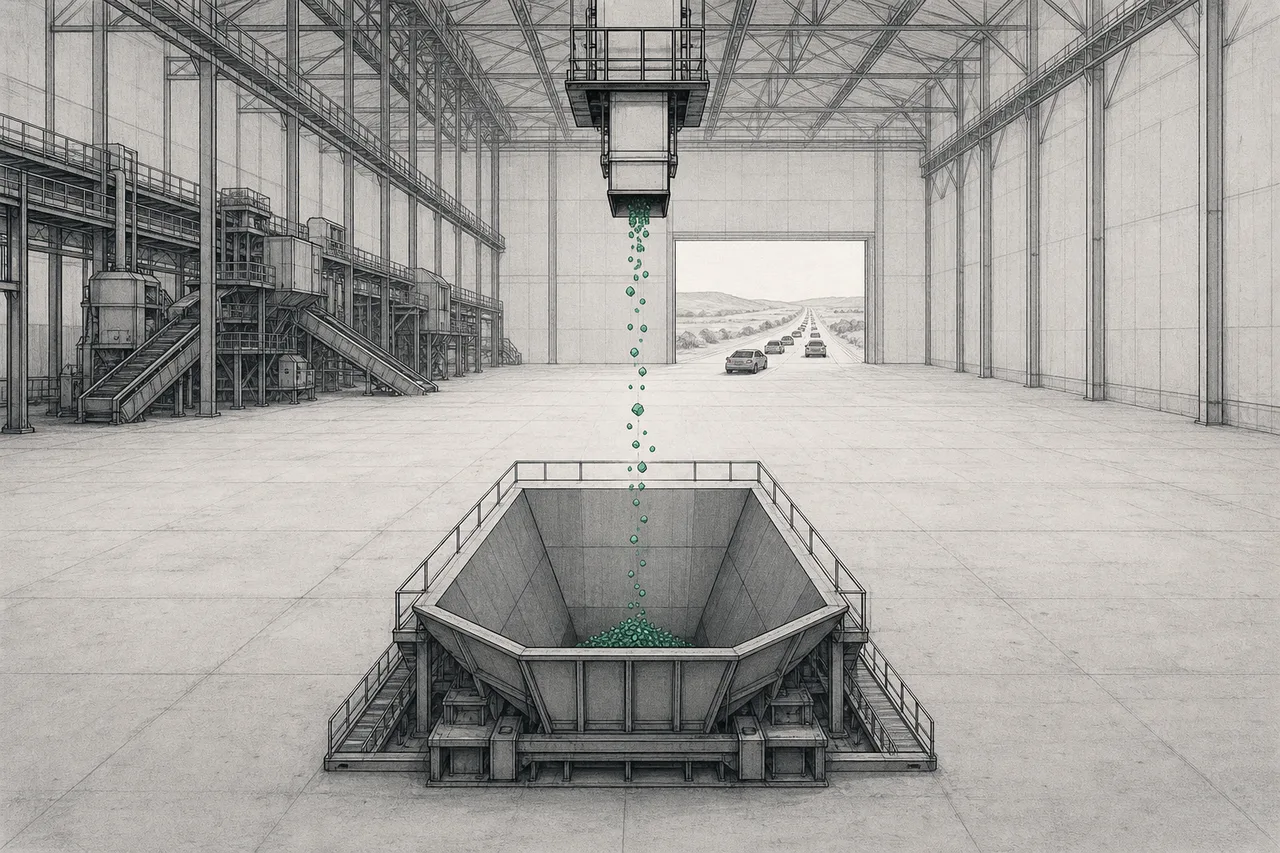
Step 2 — crush it into powder. Grind the cells down, separate out the aluminum/copper/plastic shell, and you're left with a black powder densely packed with valuable metals — this is black mass, the heart of the whole industry.
Step 3 — extract the metals. Separate the black mass into its elements chemically. The two main methods are hydrometallurgy (dissolve in an acid solution, then precipitate one element at a time — precise, and good at recovering lithium) and pyrometallurgy (melt at high heat — simpler, but it tends to lose lithium into the slag). The best technology today recovers over 95% of the lithium.
Step 4 — back into new cells. The recovered lithium, nickel and cobalt get sent back as raw material for the cathode/anode, feeding the cell plant. The loop is complete.
The black powder you get after crushing battery cells and separating out the metal shell and plastic — a 'concentrated ore' that packs lithium, nickel, cobalt and manganese into one place. The value of black mass depends on the chemistry of the source battery: NMC-type cells (with nickel/cobalt) are worth a lot, while LFP-type cells (lithium iron phosphate, no cobalt) yield black mass that's about 65% cheaper — a point that matters enormously to the economics of the whole field.
04Where it sits in the EV world
This node is the 'endpoint' of the EV supply chain, and it's tightly tied to its neighbors:
- Feeds back into Battery Components & Materials: the extracted lithium/nickel/cobalt flows straight back as raw material for cathodes/anodes — recycling is an 'alternative upstream' for the materials layer
- Feeds Battery Cells & Pack Manufacturing: the big cell plants are now building their own recycling lines, because their own 'manufacturing scrap' is the easiest feedstock to get
- Reduces reliance on Critical Materials & Supply Chain: every ton recycled is lithium/cobalt you don't have to dig and refine anew — recycling and mining are both 'competitors' and 'partners in the same security goal' at once
- Tied to Energy Transition & Power Demand: EV batteries that aren't fully dead yet (~70–80% capacity left) get a 'second life' as energy storage before being recycled — a fork that's become a new lifeline for the field (we'll see just how important shortly)
The point to stress: recycling is a 'supply-chain joint', not a finished product consumers pay for directly. Its revenue is the price of the metals it extracts minus the cost of collecting + crushing + extracting. That means the profit of this whole industry gets squeezed from both sides at once — metal prices (revenue) and feedstock price/volume (cost). And that's the root of the 2024–26 disaster we're about to tell.
05Where it stands now + who the players are
This is the part that has to be said most honestly: 2024–26 was the 'great reset' for the battery recycling industry. The long-term thesis is still right on every point. But the timing came several years too early — and investors who believed the promises got badly hurt.
The core problem is 'the feedstock hasn't arrived'. EVs last 12–15 years, so the real wave of dead batteries won't show up in force until after 2040, even. So most of today's feedstock (probably about two-thirds through 2030) is just factory scrap, not dead cars. The result: US recycling plants built capacity to take batteries equal to ~1.3 million EVs a year, but only ~341,000 cars' worth will actually arrive by 2030 — running at barely a quarter of the capacity they built.
Making it worse is falling metal prices — when lithium/nickel prices drop, so does revenue per ton, while the world's shift to LFP batteries (no cobalt) made black mass less valuable. Black mass prices fell from about $5,100/ton (2023) to ~$4,200 (2025). In short: little feedstock, low sale prices, high fixed costs = losses.
The results were concrete, and brutal:
- Li-Cycle — the market's darling pioneer, went bankrupt in 2025. Its Rochester hub project stalled half-built, and ultimately Glencore bought its assets out of bankruptcy (a credit bid of about $40 million) in August 2025
- Ascend Elements — another rising star, filed for bankruptcy in April 2026
- Umicore — the European giant halted construction of a battery-materials plant in Canada, pushed a big European recycling plant out to 2032, and took an asset write-off of about $1.7 billion. Its recycling business was still losing money in 2025
- Redwood Materials — didn't fall, but pivoted its business to 'energy storage' from second-hand EV batteries, feeding AI data centers (pulling Google in as an investor), until it became the company's fastest-growing unit, overtaking its own core recycling business
So who's still 'winning'? The short answer is China — where huge EV volumes + mandatory collection + domestic refining make the economics work, especially for players that vertically integrate (vertical integration), doing everything from cell to recycling inside one company. The clearest example is CATL's Brunp, which recovers up to 99.6% of nickel/cobalt/manganese and 96.5% of lithium, holding high margins because its own cell plants are waiting to take the output. China's battery recycling market has already reached roughly $78B.
06The road ahead
If the thesis is still right but the timing was wrong, the real question is 'when does the real material arrive' — and there are three directions to watch.
Direction one — the feedstock wave does come eventually, but slowly. The EVs sold in the first half of this decade will start retiring gradually from the late 2030s onward. Whoever 'survives the desert' of this stretch will meet a market overflowing with feedstock 10–15 years out — so this is a game of 'long financial runway', not quick profit.
Direction two — 'second life' becomes a bridge. Before recycling, an EV battery with 70–80% capacity left can be used for energy storage. And the exploding power demand from AI data centers has made this market grow so fast it's become a new lifeline — Redwood's case, aiming to deploy 20 GWh of storage by 2028, is a signal that the industry's near-term revenue may come from 'second life' before 'recycling' at all.
Direction three — law drives demand. When the EU mandates 'minimum recycled content' in new batteries from 2031, and China advances its own collection standards, demand for recycled material gets 'ordered' into existence rather than waiting for the market to choose it — which may be the most powerful economics-flipping factor in the next round.
07Challenges & risks
The 2024–26 lesson lays out this node's risks clearly. And they are four, deeply rooted.
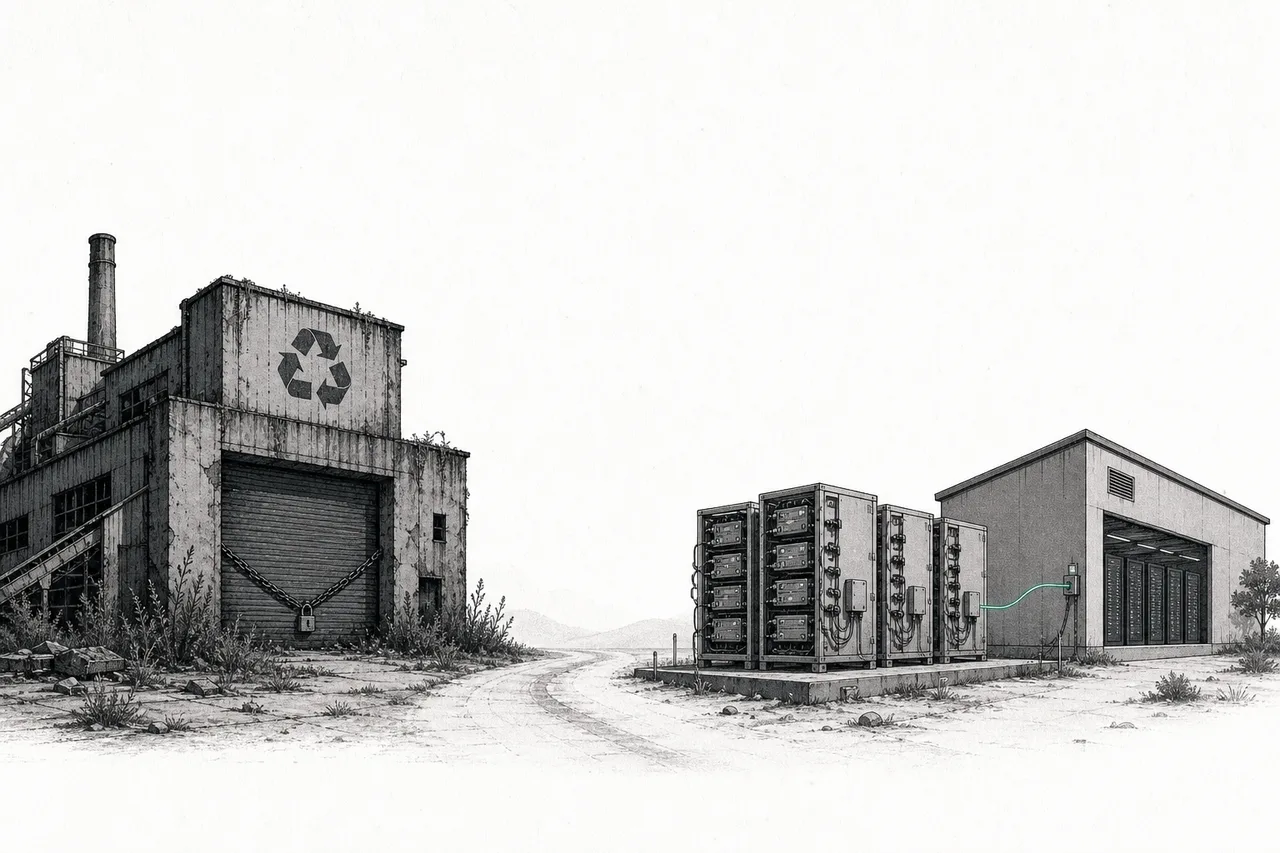
One — feedstock can't be rushed. This is the master risk. EVs are more durable than many people think (12–15 years), so the wave of truly dead batteries gets pushed back. Plants that built capacity ahead of time can't run full, carrying fixed costs into losses — a problem that will stay with the field for years.
Two — metal prices are destiny. Revenue is tied directly to the prices of lithium/nickel/cobalt. When prices fall, the economics break instantly. And the world's shift to LFP (no cobalt, black mass ~65% cheaper) squeezes Western recyclers' margins even further.
Three — the economics still don't work outside China. Many recyclers in Europe/Korea buy black mass at high prices but sell the extracted materials cheap, because the downstream market is weak — margins are negative. Meanwhile China, vertically integrated and handling huge volumes, turns a profit. That gap is the structural risk for Western players.
Four — the Li-Cycle lesson. The story of Li-Cycle (and Ascend) warns that in a still-young industry, 'runway' (cash) matters more than a correct thesis. A company that burns cash building capacity to wait for feedstock that doesn't arrive in time will die before it sees the day the thesis comes true.
In short: the urban mine is an idea that will eventually be right — a world with billions of EVs has no choice but to recycle batteries. But along the way, this field just learned an expensive lesson that 'right thesis' and 'right timing' are two different things. And in clean-energy technology, being too early can sometimes hurt just as much as being on the wrong path.