Megatrend · Electrification & Mobility
The most expensive part in an EV — and the battle China has already won
The heart of an electric car isn't the motor or the software — it's the 'battery cell,' which eats up roughly 30–40% of the whole vehicle's value. So whoever can make cells cheapest and best controls the entire EV game. And today the answer is startlingly clear: two Chinese companies together hold more than half the world market, while the Korean and Japanese giants are bleeding heavy losses — in the middle of a price war and a glut of capacity.
01What it is (cell → module → pack)
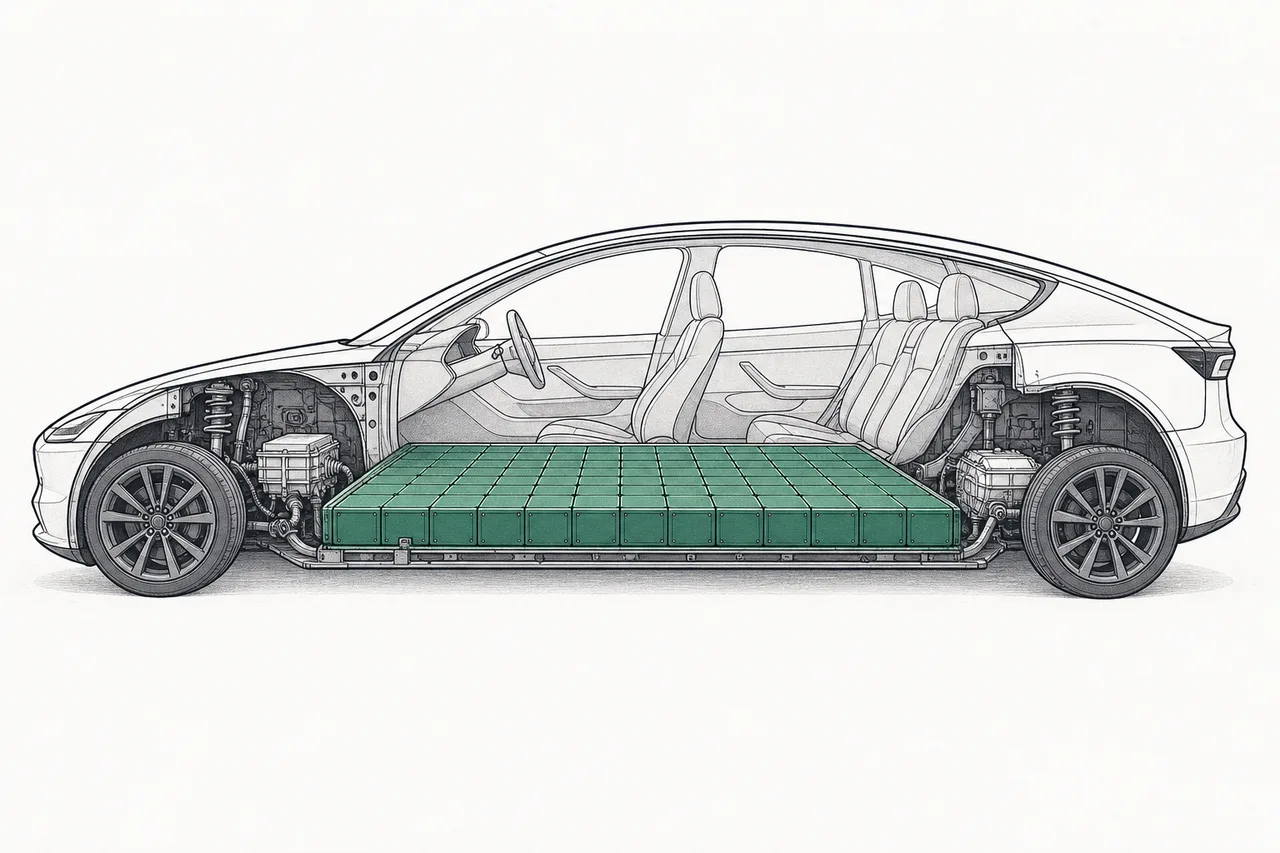
When we say 'EV battery,' it's actually not one solid block — it's something assembled in three layers. This node — Battery Cells & Pack Manufacturing — is the layer that makes the 'cell' and assembles it into a 'pack.' It's a sub-theme under the Electrification & Mobility megatrend, and the layer that eats the most value in the entire EV supply chain.
Picture building a wall:
- Cell = the brick: the smallest unit that can actually store and release electricity. It comes as a cylinder (like a fat AA battery), a flat pouch, or a box (prismatic) — this is the 'hardest' part and the source of almost all the cost
- Module = the wall: tens to hundreds of cells bundled together into a group, with temperature and voltage controls
- Pack = the building: several modules combined into one box, fitted with a battery management system (BMS) and cooling, then dropped onto the car's floor
A new trend is cutting out the 'module layer' entirely — it's called cell-to-pack (CTP): put the cells straight into the pack to cut weight, cut cost, and add space for energy. CATL owns this idea, and Tesla goes further with a structural pack that makes the pack part of the car's structure itself.
This node splits into two sub-categories that run side by side through the whole lesson: (1) Incumbent Li-ion Cell Makers — the big lithium-ion cell makers that rule the market today (CATL, BYD, LG, Panasonic, Samsung SDI), and (2) Next-gen Cells — next-generation cells like solid-state and silicon-anode that aren't in real commercial production yet, but could flip the game in the next decade.
02Why it matters — it's the 'heart and the money' of the car
Why everyone's fighting to make battery cells sums up in one sentence: it's the most expensive part in an EV. The battery pack eats roughly 30–40% of the whole car's price, and inside that pack the 'cell' is the biggest cost of all — about 77% of the pack cost. The rest is the casing, wiring, cooling, and BMS.
This is what worries the big automakers: if you buy your cells from someone else, you hand over the single biggest chunk of profit in the car. So carmakers try to make cells themselves (Tesla's 4680, VW, Toyota), or at least lock in long-term deals with cell makers.
Within the cell itself, the cost concentrates in the cathode — the positive side that stores lithium, which eats about half the cell cost because it uses expensive minerals like lithium, nickel, and cobalt. This is exactly where this node ties tightly to Battery Components & Materials and Critical Materials & Supply Chain.
Globally, this market is big and growing fast. The amount of EV battery installed worldwide jumped from 901 GWh in 2024 to 1,187 GWh in 2025 (+32%), and the total battery market is expected to reach around $330 billion by 2030.
03The two chemistries that decide it all: LFP vs NMC + the price graph falling off a cliff
To understand the battery war, you have to understand the 'chemistry' of two cathode families that decide everything — price, safety, range, and most of all who has the edge.
- LFP (lithium iron phosphate): mostly iron and phosphate, no expensive nickel or cobalt, so it's cheaper, safer, and more durable. The downside is it stores less energy per weight (slightly shorter range) — this is the chemistry China masters and pushes
- NMC (nickel-manganese-cobalt): stores more energy per weight (longer range, lighter) but is more expensive because it uses pricey minerals, and runs hotter — this is the chemistry Korea and Japan are good at
It's 'how much electricity you can store per weight/volume' (measured in Wh/kg). The higher it is, the farther a car can go without hauling a heavy battery. NMC used to win here, so it was the standard for premium EVs — but once LFP improved until its range was 'good enough' and it was much cheaper, most of the market tipped to LFP.
The big story of 2025 is LFP overtaking NMC for the first time — from less than 10% share in 2020 to over 55% of the world EV market today, and over 80% inside China itself. The reason is simple: an LFP pack averages around $81/kWh while NMC sits at ~$128/kWh — nearly 30% cheaper.
This falling price graph is the engine of the entire EV trend — because the battery is the main cost, when $/kWh drops, EVs keep getting closer to gas-car prices. In 2025 the average lithium-ion pack fell to $108/kWh (from $117 in 2024), and pure EV packs hit $99/kWh — below the '$100/kWh' line long seen as the point where EVs get as cheap as gas cars. China is cheapest at ~$84/kWh, while North America and Europe cost about 44% and 56% more.
04The giant-factory game (gigafactory)
Battery cells are a true 'scale game': the more you make, the lower the cost per unit, because machinery, R&D, and raw-material bargaining all get divided by enormous volume. That gave rise to the gigafactory — a giant plant that can make tens of GWh a year ('giga' = a billion, hinting at a scale so large you measure it in billions of watt-hours).
But when everyone rushes to build gigafactories at once, you get the classic problem: overcapacity. Installed capacity worldwide is now around 4 TWh and will hit ~6.7 TWh by 2030, while actual 2025 demand is only around 1.6 TWh. China alone has nameplate capacity as high as ~4,800 GWh — about 4 times the demand of all the world's automakers combined.
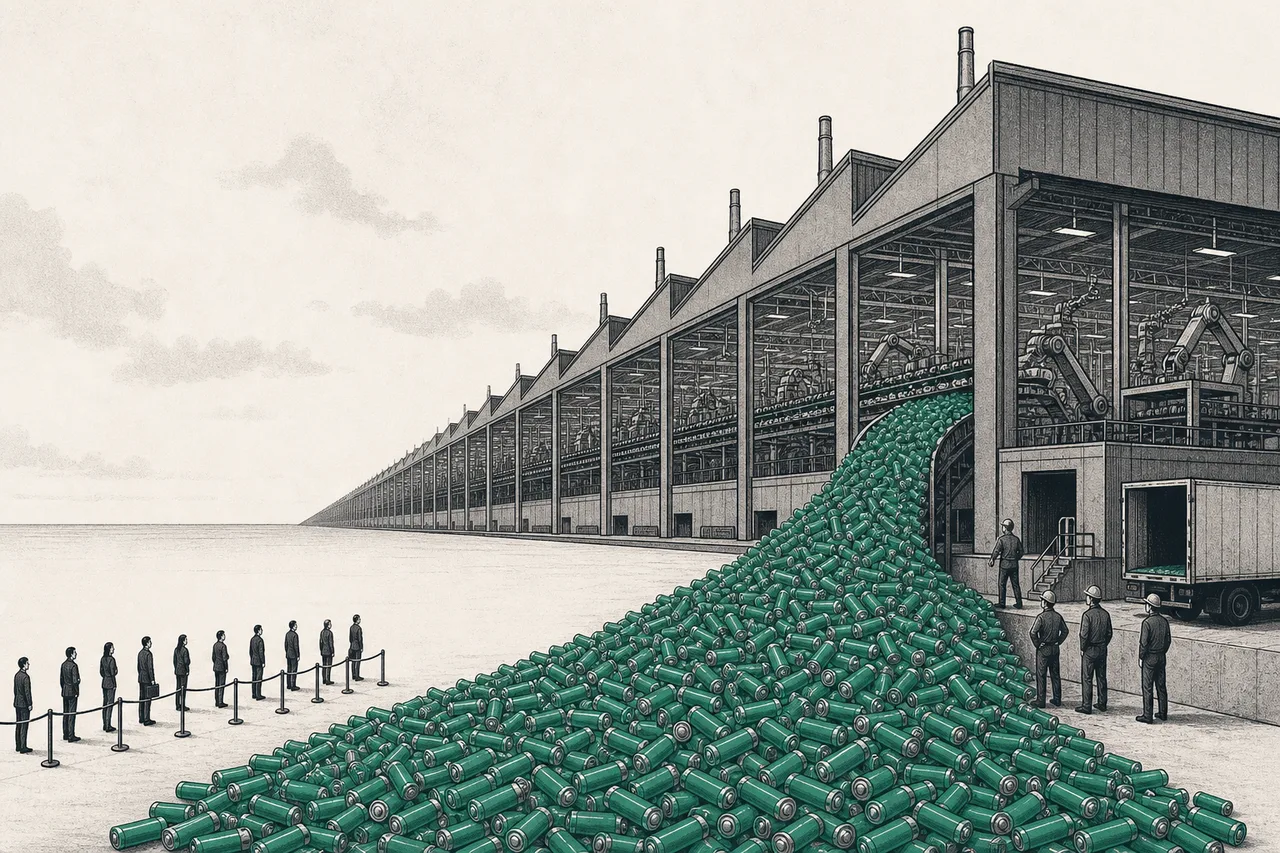
The result is a brutal price war. When supply overflows, factories have to cut prices just to keep the lines running. In China, batteries are about 30% cheaper than in North America, and fast-growing demand plus price cuts means even big LFP makers may sell at near a loss. China's industry association has gone so far as to warn against new capacity expansion if industry-wide utilization falls below 60%.
05How it connects in the EV ecosystem
The battery cell sits right in the middle of the entire EV supply chain — with things flowing in and things flowing out:
- Takes raw materials from Battery Components & Materials and Critical Materials & Supply Chain: cathode, anode, electrolyte, lithium, nickel — this is the 'upstream' that sets half the cell cost
- Feeds cells to Passenger EV OEMs: EV makers are the main customers, and the battery is 30–40% of the car, so whoever controls the cell holds enormous bargaining power over the automakers
- A sibling of Energy Storage: the same cell (especially LFP) is also used to store electricity on the grid (BESS) — and it's this market that 'cushioned' Korean makers' sales while EVs slowed
- Drives the whole Electrification & Mobility trend: if batteries don't get cheaper, EVs will never get cheap enough to replace gas cars — the cell is the 'door-opener' for the entire transition
And importantly, it loops back to Energy Transition & Power Demand in both directions: a gigafactory eats enormous power (it depends on electricity), but at the same time the battery is a key tool for storing renewable energy — it's both a user and a driver of the energy transition at once.
06Where it stands now — China wins, Korea hurts
This is the most dramatic part, because the 2025 picture is startlingly clear: China dominates the battery-cell game completely. Chinese companies together control about 69% of the world EV cell market, with CATL (39.2%) and BYD (16.4%) alone making up more than half the world.
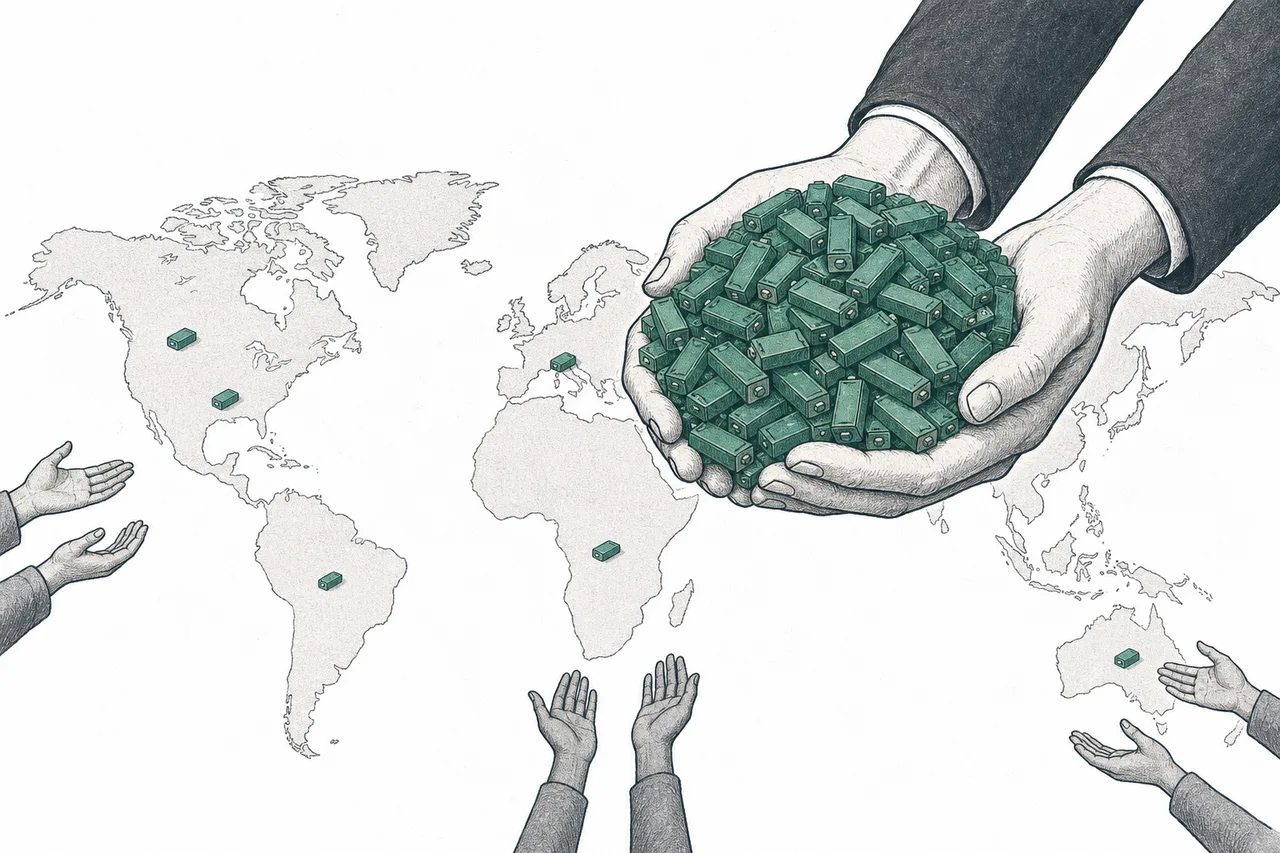
CATL isn't just big — it makes enormous profits too. In 2025 it had revenue of about $61 billion and net profit of $10.5 billion (up 42%), shipping 661 GWh of batteries — against the price war, no less. Because its scale and lowest-in-the-industry costs keep it profitable at the very point where others run losses.
The other side of the coin is the pain of the Korean players that once led on NMC technology. The big three — LG Energy Solution, Samsung SDI, SK On — lost a combined $2.2 billion in 2025 (excluding US tax credits). Korea's utilization rate slipped below 50% for the first time (see the company-by-company breakdown in Incumbent Li-ion Cell Makers). They bet the wrong way — building a business on premium NMC batteries while the market tipped to the cheap LFP that China does better. And Japan's Panasonic, tied to Tesla, faces the same pressure.
Korea's one lifeline right now is fast-growing Energy Storage (BESS), which softened the losses in Q4 2025 — plus the hope that markets outside China (US/Europe) that shut China out will open a way back. This is the arena of Incumbent Li-ion Cell Makers, now being reshuffled across the whole board.
07The new wave: when do solid-state and silicon-anode arrive?
While conventional lithium-ion cells compete on price, another battlefield is taking shape — this is the node's second sub-category: Next-gen Cells (Solid-state / Silicon-anode), the technology that, if it works, would 'reset' the entire board.
The new wave runs in two streams — solid-state, which swaps the liquid electrolyte for a solid one (the big prize, but still far off, led by QuantumScape with VW/PowerCo backing), and silicon-anode, which upgrades the negative side (anode) to hold about 10× more energy (and reaches real cars and devices sooner) — two paths that are the two faces of the Next-gen sub-category, running side by side.
An ordinary lithium-ion battery uses a liquid electrolyte to carry charge — which is flammable and caps energy density. Solid-state swaps that for a solid electrolyte, making it safer, able to pack in more energy (target ~450–500 Wh/kg versus ~250–300 today), and faster to charge. The problem is — making it in large numbers at an affordable price still can't be done.

The state today is 'pre-commercial' — there are pilot lines, but no one is yet producing millions of cells for sale. Toyota plans to start pilot production in 2026 and small-scale production around 2027–2028, claiming 900–1,000 km of range and a 10–80% charge in under 10 minutes. Samsung SDI has an S-Line pilot line targeting real production in 2027 at ~500 Wh/kg density.
The iron rule of solid-state is 'promised for a decade, delayed the whole time' — the technology is hard to mass-produce without the solid electrolyte layer cracking or the cost shooting up. So even though 2027–2028 is a key milestone, the product will start in expensive premium cars first, not mass-market cars right away.
What's interesting is that this bet could be the 'way back' for the Korean and Japanese players — if China has already won the cheap-LFP game, the leap to solid-state, which leans on advanced materials expertise, could be the arena where Toyota and Samsung SDI hope to lead again. Then again, China (CATL included) is investing in solid-state just as heavily.
08Challenges & risks
Battery cells are a trend that's 'sure to grow' but 'hard to profit from' — and here are the three main risks.
The first risk is overcapacity and the price war. When China has many times more capacity than world demand, prices get pushed down and down. Good for car buyers, brutal for makers — even China's LFP leaders run near a loss, and Korea actually loses money. Being the 'fast grower' in this market doesn't guarantee profit unless you're the lowest-cost and largest-scale player.
The second risk is concentration in China. When ~69% of the world's cells come from one country, the whole world depends on a single chain. That lights the geopolitical fuse — the US and Europe are putting up tariffs and subsidies to build their own chains, but costs 40–56% higher than China make 'decoupling' expensive and slow. The risk is that if China restricts exports of technology or raw materials, the entire global EV industry shakes.
The third risk is uncertainty in next-generation technology. Solid-state may arrive later than promised (it always has), or it may come early and make the enormous lithium-ion capacity already built obsolete. Whoever misreads the timing — too early or too late — gets hurt either way. Korea's lesson of betting wrong on NMC is a reminder that in this business, 'picking the wrong chemistry' carries an enormous price.
In short: the battery cell is the single part that decides whether an EV can get cheap enough to replace a gas car. And today, China is far ahead in that game, with cheap LFP and a gigafactory scale no one can match. So the big question of the next decade isn't 'will EVs come' but 'who will profit from their heart' — and whether a new wave like solid-state can change that answer.