Megatrend · Electrification & Mobility
The real action isn't the cell — it's the "powder" inside
Everyone talks about "the battery" like it's a single black box. But a battery cell is actually a precisely engineered sandwich of four material layers — cathode, anode, separator, and electrolyte. The most expensive layer, and the one that sets the entire "chemistry recipe," is the cathode — it eats up nearly half the cost of a cell. And this is the layer China dominates even harder than the cell itself. This is the story of a black powder the whole world is fighting over.
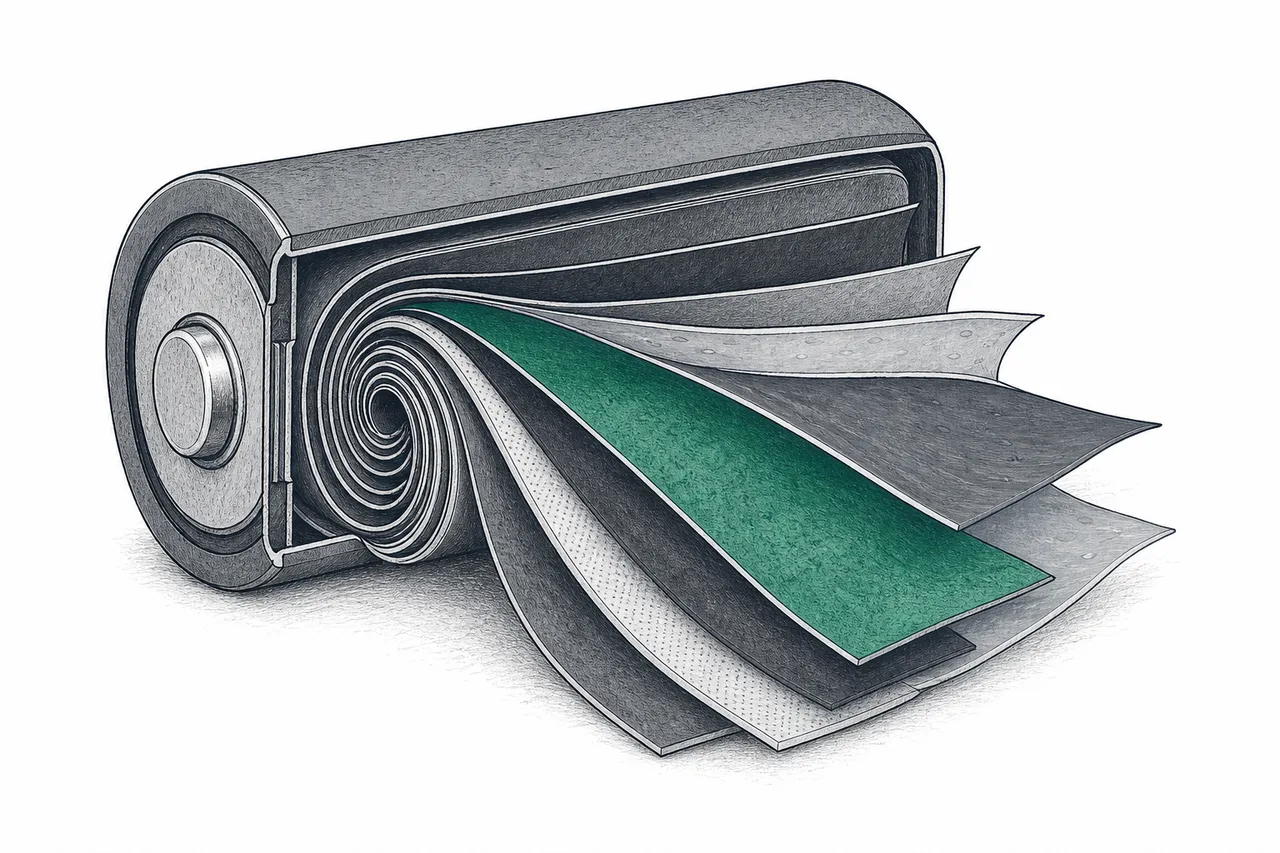
01What is it? (four material layers)
Picture the battery in your phone or EV as a "black box" that stores electricity — but cut it open and you find no box at all. You find thin foils coated in black powder, rolled up together in a spiral, like a Swiss roll. This node is about those "powders" and "foils" — the materials that go inside the cell, not the cell itself.
Every lithium-ion (Li-ion) cell in the world is built from four key materials, each with its own job:
- Cathode — the positive electrode: the metal powder that acts as the "lithium reservoir" and sets the battery's whole chemistry recipe (like NMC or LFP). This is the most expensive and most important layer — the star of this story
- Anode — the negative electrode: almost all of it is made from graphite (a form of carbon), which acts as the "parking lot" for lithium ions while charging
- Separator — the insulating barrier: a micron-thin plastic film that keeps the cathode and anode from touching (if they touch = short circuit, fire) while still letting ions pass through
- Electrolyte — the ion-carrying liquid: the liquid filled in to act as the "expressway" for lithium ions running back and forth between the two electrodes
Don't confuse these three: the raw minerals dug out of a mine (lithium, nickel, natural graphite) are Critical Materials · once those minerals are processed into ready-to-use powders and foils (cathode/anode/separator/electrolyte), that's this node · once those materials are assembled into a finished cell, that's Battery Cells · this node is the "middle," where the most value hides.
On the megatrend map, this node sits under Electrification & Mobility as the "materials layer" of the battery supply chain — and as you'll see, it's where both the value and the bargaining power concentrate especially hard.
02Why it matters — the value lives in the powder
One number explains everything: in a single battery cell, the cathode eats roughly 40% of the cost (and up to ~50% in high-nickel recipes) — more than the cell assembly, more than the factory, more than anything. Put simply, when you buy an EV, the biggest chunk of your money goes to "cathode powder" without you ever realizing it.
That makes "cathode active material" (CAM) the value center of the whole industry. The CAM market alone is worth around $38 billion in 2025 and is projected to reach $65 billion by 2030 (CAGR ~11.5%) — and that's before counting separators and electrolytes, each a multi-billion-dollar market in its own right.
And what makes this node "strategically expensive" isn't just the money — it's the concentration. Everyone knows China dominates EV cell production (CATL + BYD together are over half the world). What many don't know is that China dominates the materials layer even more than the cell itself — about 87% of the world's cathode-material capacity is in China, and on the anode side it's even heavier, as the next chapter shows.
03How it works — the anatomy of a cell
The heart of a battery is one simple thing: shuttling lithium ions back and forth between the cathode and the anode. When charging, ions run from the cathode to park at the anode; when in use (discharging), they run back from the anode to the cathode — that's really all there is to it. This back-and-forth is "charging and discharging," and the four material layers all exist to make that run fast, safe, and repeatable for thousands of cycles.
This is where the "chemistry recipe" comes in — and it's set by the cathode alone. Right now two big camps are fighting over the market:
- NMC (nickel-manganese-cobalt): stores more energy per kilogram (goes farther) but uses expensive metals like nickel and cobalt
- LFP (lithium-iron-phosphate): about one-fifth less energy per kilo, but around 30% cheaper per kWh, more durable, and needs no nickel or cobalt at all
The big story of 2025 is LFP overtaking NMC for the first time in the global EV market — rising to nearly half the market (and as high as ~79% in China) from under 10% in 2020, because price is king in the mass market. This chemistry shift ripples through the whole materials chain, because LFP and NMC use completely different "cathode powders."
04Where it sits in the EV supply chain
The easiest way to understand where this node sits is to see the battery chain as a three-stage conveyor belt: mine → materials → cell. This node is the middle "materials" stage — it takes mined minerals and processes them into ready-to-assemble powders and foils.
- Upstream — Critical Materials: mining and refining raw minerals (lithium, nickel, cobalt, natural graphite). This node depends directly on this stage; if minerals run short or get export-controlled, the materials production line stalls instantly
- Downstream — Battery Cells: gigafactories take our cathode powder, anode foil, separator, and electrolyte and roll and assemble them into finished cells. This node is their "inner supplier"
- Final destination — EV OEMs and Energy Transition: cells go into electric vehicles and into grid energy-storage systems. Every time EV or ESS demand grows, materials demand grows with it
And there's an important loop growing fast: Battery Recycling — when a battery reaches end of life, "recycling" means pulling lithium, nickel, and cobalt back out to make new cathode material. Over the long run it could become an alternative source of raw material that partly cuts the reliance on mining (and the reliance on China).
The point to grasp is that this node is a "deeper" bottleneck than most people see. When the news says "battery shortage," people picture the cell factory. But the real bottleneck usually sits one layer deeper — at the cathode powder and the graphite anode, which is what the next chapter is about.
05Where it stands now + who dominates
The big picture for 2025–2026 is one phrase: China dominates almost every materials layer — and harder than the cell itself. Let's go layer by layer:
Cathode — China controls about 87% of the world's cathode-material capacity. In the fast-rising LFP market, China is almost a complete monopoly; major LFP producers like Hunan Yuneng and Wanrun are all Chinese. In the high-end NMC (high-nickel) market, the leader is China's Ronbay (~30% of the high-nickel market), followed by the Korean camp (LG Chem, EcoPro, POSCO Future M, L&F), and only Belgium's Umicore (~11.5%) is a genuinely large Western player.
Anode/graphite — this is where China's grip is most complete: over 95% of the world's battery-grade graphite comes from China (synthetic graphite >95%, spherical 85–90%). The leader is BTR, the world's No. 1 in anodes for 15 years running, with over 22% share. The Western side trying to build an alternative includes the US's Novonix, which just secured a DOE loan and is scaling a synthetic-graphite plant in Tennessee — but it's still tiny next to China.
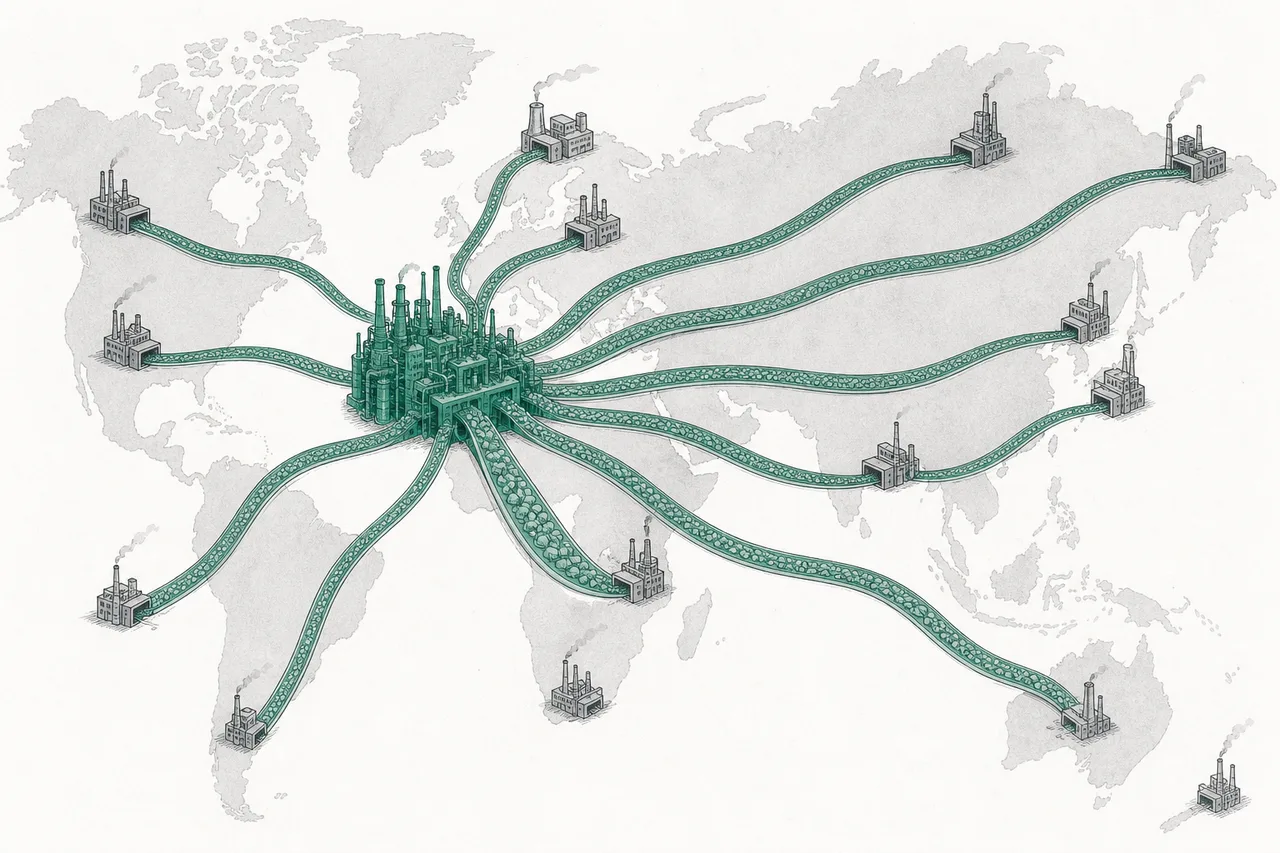
Separator — this is the layer where Japan and Korea still compete well, because it takes hard micron-thin film technology. The market is about $6.4 billion in 2025 (growing to ~$14 billion by 2030). The top five (Asahi Kasei, SK IE Technology, Semcorp, Toray, Entek) together hold about 60% of capacity.
Electrolyte — the market is about $6.8 billion in 2025. China dominates on volume (Tinci, Capchem, and Guotai-Huarong together hold about 35% of the world, and China controls over 70% of LiPF6, the key salt), while Japan stays strong in the premium segment (Mitsubishi Chemical, UBE, Soulbrain).
This concentration has already become a geopolitical weapon. In late 2025 (effective Nov 8, 2025), China announced export controls on cathode materials, synthetic graphite, and battery technology, while the US hit back with anti-dumping tariffs on Chinese graphite as high as 93.5% (over 160% in total) — the battery-materials war is truly opening up.
06The future — silicon anode
If there's one thing that could change the materials-layer game this decade, it's switching the anode from "graphite" to "silicon". The idea is simple: one silicon atom captures many times more lithium than carbon (graphite) does, which means an anode with silicon in it can store far more energy — pushing a cell's energy density from today's ~200–300 Wh/kg toward ~400 Wh/kg, while also charging faster (some claim charging to 80% in under 5 minutes).
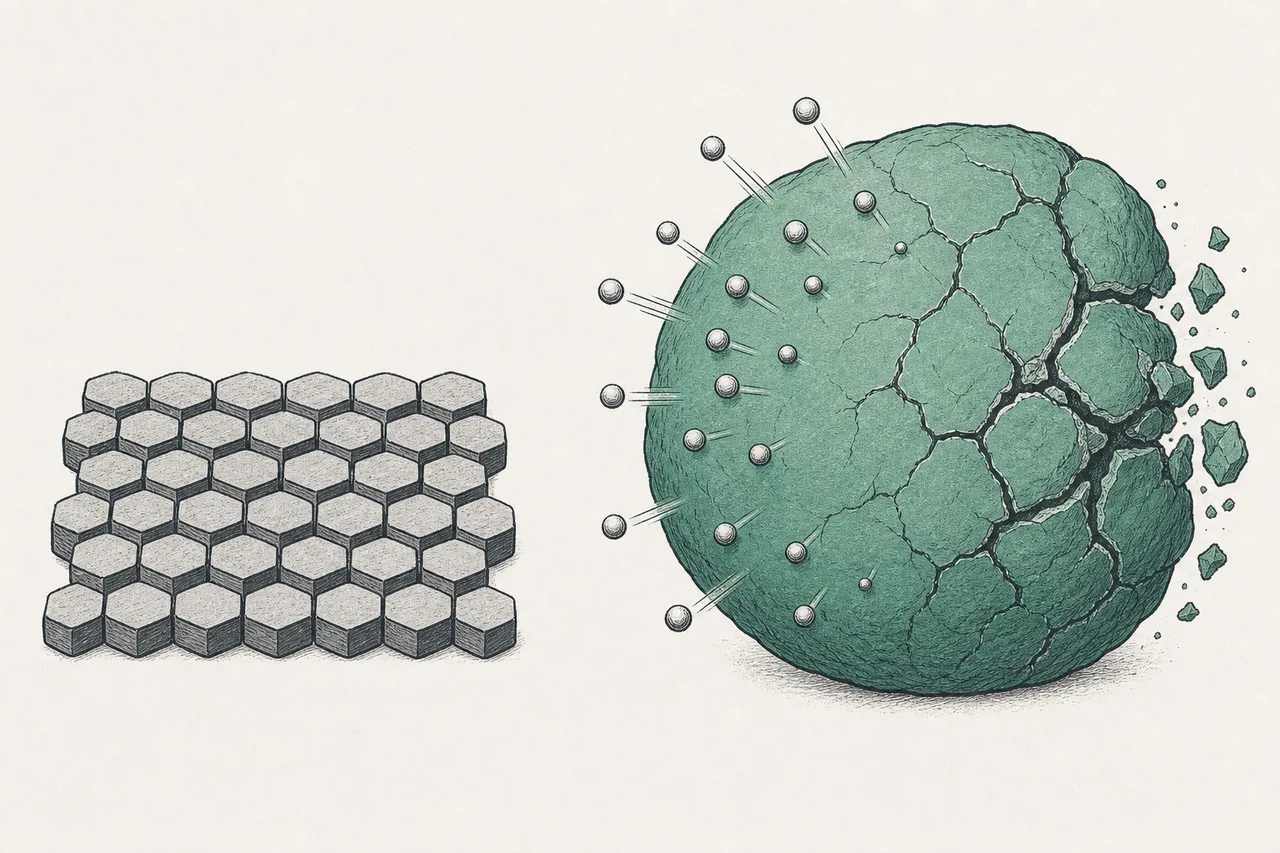
But silicon has a big problem: when it takes in lithium, it swells by up to ~300%, then shrinks when discharging. Do that over and over and it cracks and degrades. That's why pure silicon can't be used. The industry's answer is the "silicon-carbon composite" — blending a controllable amount of silicon into graphite.
2025 is the year this technology started "hitting real factories":
- Sila Nanotechnologies opened the first US automotive-scale silicon-anode plant (its material is called Titan Silicon) in Washington state, aiming to scale to ~50 GWh by 2028
- Group14 began producing its EV-grade material SCC55 in South Korea and Washington, claiming over 50% more energy, and partnered with BASF to release a "drop-in" material that existing cell factories can use as-is
Beyond silicon, another direction is solid-state (swapping the liquid electrolyte for a solid, for safety and higher energy), which would shake up both the electrolyte and separator layers — but it's still in its commercial infancy. The point is: every time the "chemistry recipe" shifts, the winners and losers in the materials layer can flip across the whole board.
07Challenges & risks
This node is appealing because the value is high. But it comes with its own particular risks you need to understand.
The first and biggest risk is concentration in China. With China controlling ~87% of cathode and over 95% of graphite anode, the latest export controls (Nov 2025) proved this isn't just a trade story — it's a geopolitical card that can really be played. Anyone outside China (Europe/US/Korea/Japan) has to rush to build its own supply — but chasing China's cost and scale is genuinely hard.
The second risk is thin margins and price wars. Most cathode material is a commodity priced on metal prices (lithium/nickel) plus a "processing fee" — so when lithium prices crash (as in 2023–2024), materials makers face both inventory losses and squeezed margins. China running excess capacity and pricing low only pressures players outside China harder.
The third risk is technology uncertainty. LFP overtaking NMC in 2025 is a live lesson that the "winning chemistry" can change fast. Anyone who bet heavily on the wrong recipe (like piling into NMC just as the market turned to LFP) gets hurt — and the coming silicon anode/solid-state could flip the winners again. So this node has to "bet on technology" constantly, not just expand capacity.
In short: next time you hear the word "battery," picture the four black powders inside — because that's where the money, the power, and the real technology race of the EV era are hiding. And as the world tries to cut its reliance on China, this overlooked "middle" node is becoming one of the most important battlegrounds in the chain.