Megatrend · Electrification & Mobility
The vehicles that work for a living aren't going electric to save the planet — they're going electric because it's cheaper
Electric sedans sell on emotion and image. But buses, delivery vans, and trucks are 'tools that earn a living' — owners buy them purely on the numbers in a spreadsheet. Cheaper fuel and cheaper repairs are the only reasons that matter. That's why some commercial vehicles are going electric shockingly fast, while others are so hard that startups are going bankrupt one after another.
01What it is (and why it's not like a sedan)
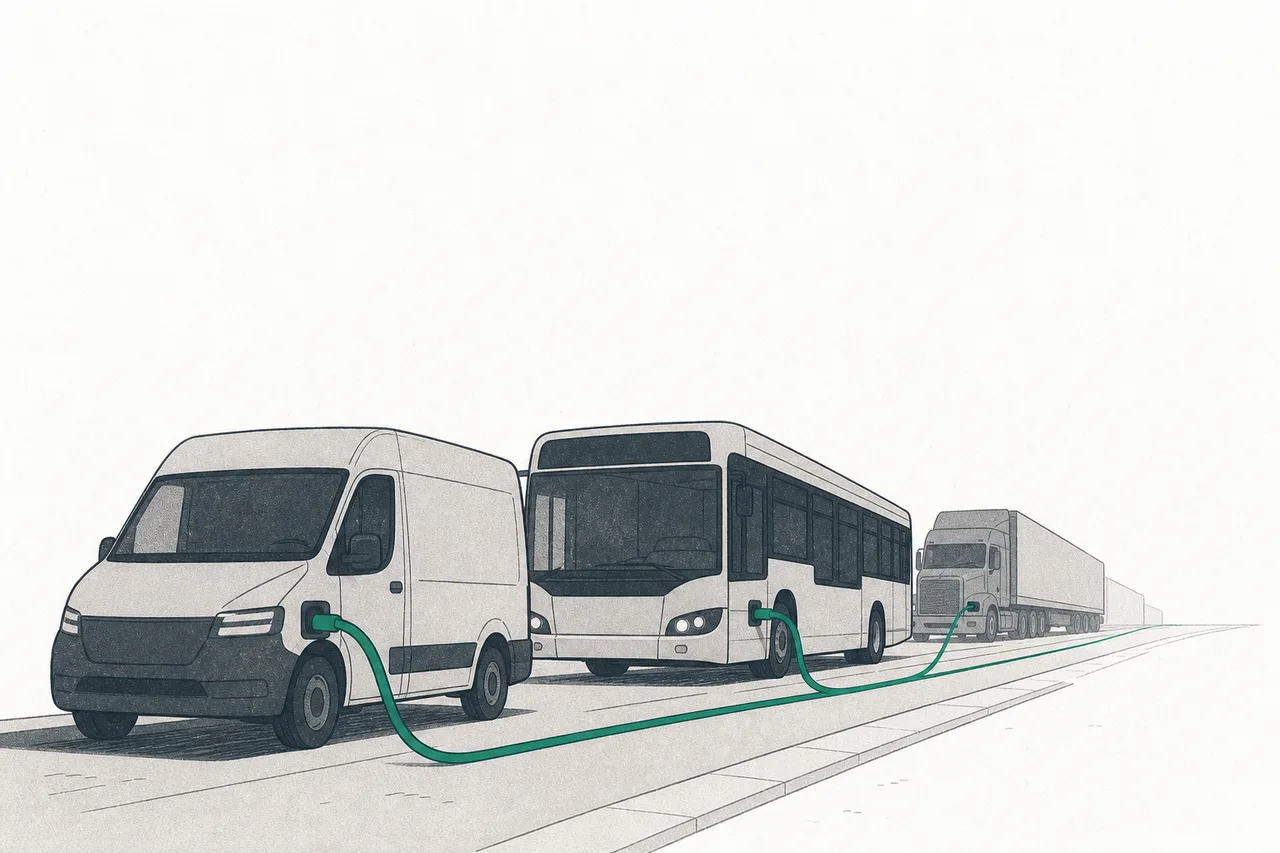
When people say 'electric vehicle,' most picture a sleek Tesla or a sedan gliding along quietly. But this node is about a completely different world — vehicles that work for a living: buses carrying passengers, vans delivering parcels all day, and heavy trucks hauling containers across cities. In short, the commercial and freight vehicles that have switched from diesel to electric power.
It sounds like just a 'bigger EV,' but it's actually a completely different problem from the electric sedan — and that difference is the heart of this whole lesson.
People buy a sedan on emotion — design, image, how it feels to drive, acceleration. Commercial-vehicle owners are the opposite. They're accountants who see the vehicle as a money-making machine. The only question they ask is, 'How much will this vehicle earn me, and how much will it cost over its whole life?' Nobody buys a truck because it looks cool. Everything is measured in numbers.
Total cost of ownership = the vehicle price + energy + maintenance + depreciation, summed over its entire working life — not just the price tag at purchase. This is the 'sacred number' that decides everything in the commercial-vehicle world — an electric vehicle costs more to buy, but if its TCO is lower thanks to cheaper fuel and repairs, fleet owners switch right away.
On the megatrend map, this node is a sub-theme under Electrification & Mobility, branching off clearly from Passenger EVs (Passenger EV) — because the buying logic, the speed of the switch, and the technology required are entirely different stories.
02Why it matters — the TCO game
Why do fleet owners switch even though an electric vehicle costs more to buy? Because commercial vehicles drive a lot — a bus or a delivery vehicle covers hundreds of kilometers every single day. The more they drive, the bigger fuel and repair costs become — bigger even than the price of the vehicle itself. And this is exactly where electric wins outright.
Look at the real numbers: the 'fuel' cost of a diesel runs about $0.15–0.25 per mile, while an electric vehicle's electricity is just $0.03–0.06 per mile — 60–80% cheaper. Maintenance is about 40–50% cheaper too, because an electric motor has far fewer moving parts than a diesel engine — no oil changes, no complex gearbox to break.
The result is what the industry calls the 'TCO crossover' — the point where an electric vehicle's accumulated lifetime cost drops below a diesel's. For mid-range fleets with subsidy support, the payback is just 2–3 years. And by 2030, some estimates say electric trucks will be cheaper than diesel over their lifetime in most U.S. states even without subsidies.
But this word 'worth it' has an important trap: in many markets it still leans heavily on policy and subsidies. The U.S. tax credit (IRA) gives up to ~$40,000 per commercial vehicle, and the EU offers 20–30% purchase support. If those policies disappear, the TCO crossover slips further out right away — hold on to this point, because it'll come back in the risks chapter.
03The difficulty ladder: bus → van → truck
This is the heart of what makes this node interesting — 'commercial EVs' don't all go electric at the same time. Each segment is climbing a different rung of the 'difficulty ladder,' and the gap between the bottom rung and the top is enormous.
Rung 1 — city buses (the easiest): this is the segment that's already almost fully electric in China. City buses are perfect for electric — they run fixed routes, the distance is known, and they return to the depot every night so they can charge easily. China has more than 680,000 electric buses, making up about 30% of its total bus stock (versus ~2% in Europe) — and strikingly, nearly 70% of China's electric buses were already in service before 2020.
Rung 2 — delivery vans / last-mile (last-mile): urban delivery vans can switch fast too, because they run predictable distances and return to the distribution center every day. The global electric-van market is about $19.2 billion in 2025, expected to grow to $31.5 billion by 2030 (~10% a year), with Asia-Pacific leading at over 45% of the market.
Rung 3 — long-haul heavy trucks (the hardest): this is the peak no one has reached. The problem is pure physics — driving hundreds of miles takes an enormous battery. An LFP battery for a long-haul heavy truck can reach about 13 tons (29,627 lb). That added battery weight eats into the payload that should be carrying freight. Research estimates you'd need 27% more electric trucks than diesel to move the same amount of cargo — plus long charging times and a TCO that's still more than 2× costlier than diesel today.
04Where it sits in the world of Mobility
This node doesn't stand alone — it's one piece of a bigger machine called Electrification & Mobility, tightly tied to its siblings in the same trend:
- Battery Cells & Pack is the heart: commercial vehicles carry batteries many times bigger than a sedan's — a single long-haul truck may use a 600–900 kWh battery (a typical sedan, just ~60 kWh). So every advance in energy density and battery price hits this node more directly than anyone
- Lives or dies on Charging Infrastructure: heavy trucks need megawatt-scale charging (MCS) that's only just being built. Without a charging network along freight routes, long-haul vehicles can't survive — a bottleneck as big as the battery itself
- Competes with / complements hydrogen & fuel cells: for the heavy, long-haul jobs where batteries don't yet work, hydrogen is seen as an option — it refuels fast and doesn't require lugging a heavy battery, but at the cost of roughly half the energy efficiency. These two technologies will fight over 'Rung 3'
- A different problem from Passenger EVs (Passenger EV): they're siblings in the same trend, but the buying logic (TCO vs emotion), the speed of the switch, and the infrastructure needed are entirely different — which is why it's broken out into its own node
05Where it stands now + the players
2025 was the year this node's picture came into much sharper focus. On the bright side, global electric-truck sales broke past 400,000 units — more than doubling from the year before, about 9% of all truck sales — and China holds over 90% of this market. In China, 1 in 4 new trucks is already electric.
On the expensive-lesson side, 2025 was also the year the 'startup dream' shattered. Nikola, which once soared to a $30 billion valuation when it went public via SPAC in 2020, filed for bankruptcy in February 2025 after a scandal over deceiving investors (its founder was prosecuted, and the company had paid a $125 million settlement to the SEC) — it became the symbol of a wave of commercial-EV startups collapsing one after another, alongside others that had failed before it.
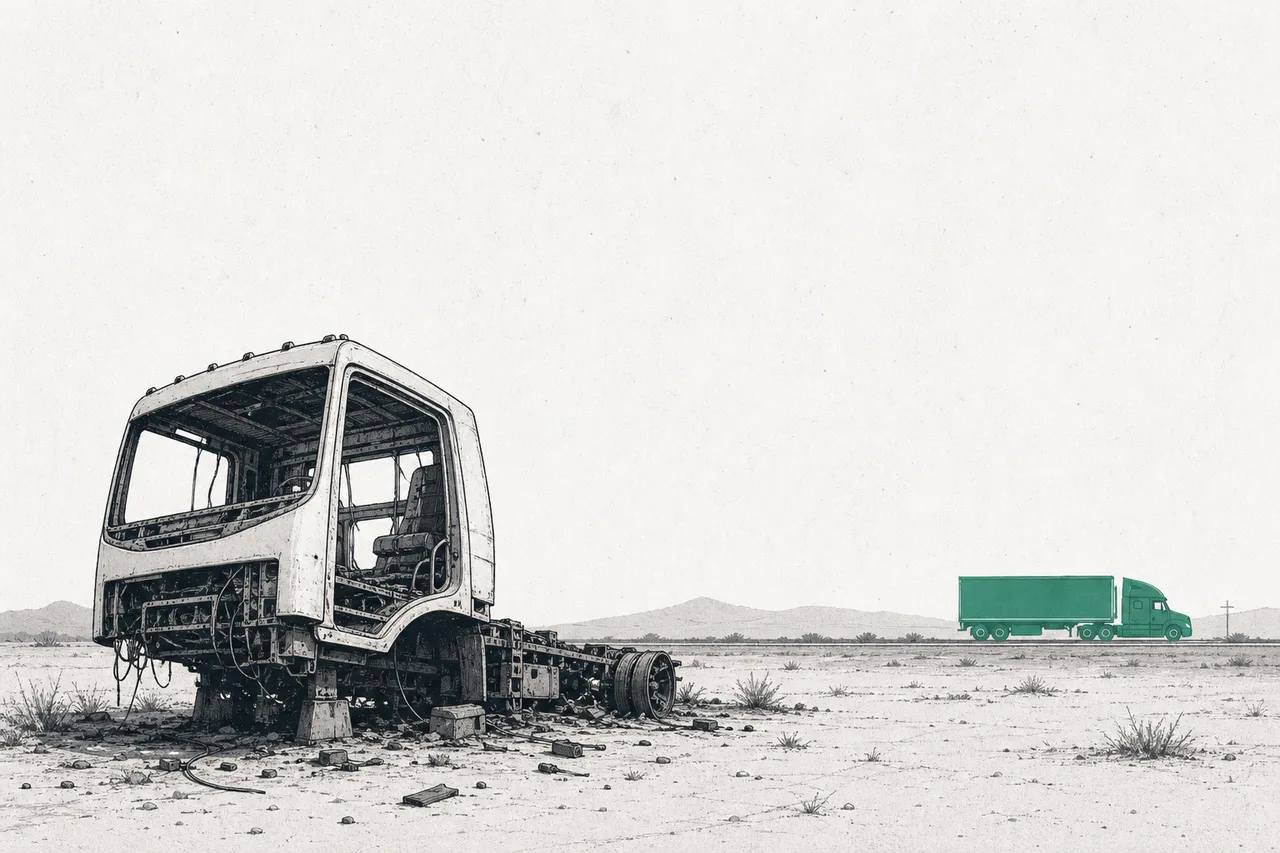
The lesson is clear: the survivors and market leaders are not flashy startups, but the giants that have built trucks for decades and have real fleet customers — plus the battery giants from China.
There's one detail worth noting: three European rivals that normally battle each other fiercely (Volvo, Daimler, Traton) actually joined hands — setting up a joint venture called Milence to build a megawatt-scale truck-charging network across Europe, targeting 1,700 charging points by 2027. Because everyone knows 'no place to charge means no market' — however hard they compete, the infrastructure has to be built together first.
06The road ahead
The first direction: the easy segments will 'finish the game' first. City buses and urban delivery vans will become almost entirely electric in many markets within a few years, with China as the template. China's own commercial-EV market is expected to grow from $36.9 billion in 2025 to $77.2 billion by 2030 (~16% a year) — and by 2035, ~60% of new trucks in China are projected to be electric.
The second direction: the battle over Rung 3 (long-haul trucks) will be decided by three things — lighter, cheaper batteries; megawatt-scale charging (MCS) that's just starting to roll out; and options like battery swap (battery swap), which works well in China (sales of swap-capable vehicles grew 94% in 2024) because it cuts downtime to about the same as refueling diesel. Hydrogen, meanwhile, stays the backup card for the heaviest jobs batteries can't handle.
The third direction: the proof of Tesla Semi. 2026 is the year the Semi starts real volume production. If it works to spec (500 miles + megawatt charging), it'll be a key piece of evidence that battery-only long-haul trucks are 'genuinely possible,' not just theory — but if it stumbles, it'll reinforce that Rung 3 is still a peak no one can reach.
07Challenges & risks
The appeal of this node — 'switching because it's worth it, not because it's a fad' — comes with its own specific risks you need to understand fully.
The first and heaviest risk is that 'Rung 3' may be harder than it looks. Long-haul trucks are still up against a wall of physics — heavy batteries eat into payload (you need ~27% more vehicles than diesel to move the same cargo), charging times are long, and TCO is still more than 2× costlier than diesel. If battery and charging technology don't take a leap, the most profitable segment (long-haul freight) could electrify far slower than the market expects.
The second risk is the dependence on policy and subsidies. In many markets the TCO crossover still relies on tax credits and purchase support. If governments pull that support (as is becoming a live issue in the U.S.), the economic case wobbles instantly — and once the 'worth it' is gone, fleet owners who decide by the numbers are just as ready to slow the switch right back down.
The third risk is charging not keeping up. Even if the vehicles are ready, without a megawatt charging network along freight routes, long-haul vehicles can't run. Building this infrastructure is slow, expensive, and needs enormous electricity — tying this node inseparably to Charging Infrastructure and to power-generation capacity.
The fourth risk is the lesson from the startup wreckage. The story of Nikola and its peers warns that building a commercially usable truck is far 'harder than raising money.' The winners are usually those with a manufacturing base, a fleet-customer base, and the deep pockets to endure until the technology matures — not those who pitch the best.
In short: commercial EVs are the story of a revolution driven by the calculator, not by ideology. Vehicles that return to base every night have almost all switched because it's worth it, while vehicles that have to cross the country are still stuck on the physics of batteries — understanding this node fully is understanding why each kind of 'electric vehicle' moves at speeds as different as the sky and the abyss, and why, in a world decided by TCO, hype and promises are never enough.