Megatrend · Energy Transition & Power Demand
The clean fuel that got over-hyped — then reality came to collect
Hydrogen was once sold as a dream that would power our cars, heat our homes, and decarbonize the whole economy. By 2024–2025, reality arrived: big projects around the world were cancelled or delayed by the dozen, because 'clean' hydrogen was still too expensive. But the story doesn't end there — it's shrinking back to the jobs it can actually do: heavy industry that electricity can't reach, and a new twist no one saw coming — fuel cells powering AI data centers.
01What it is (the colors of hydrogen)
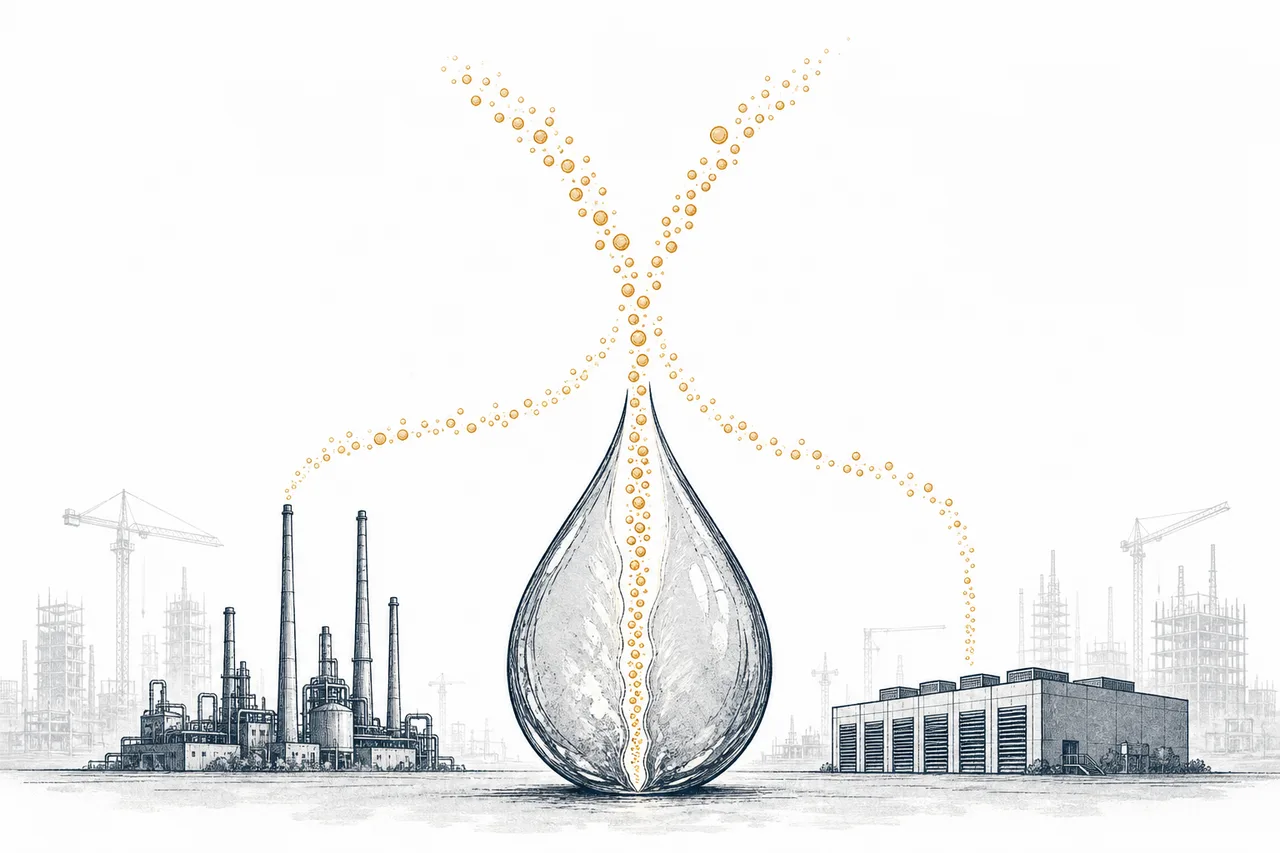
Hydrogen (H₂) is the lightest gas in the universe, and burning it gives off energy with no carbon — all you get is plain water. That's why many people call it the 'dream fuel' of the decarbonization era. But the trap is in the word 'clean' — because the H₂ gas itself is clean, while the way you make it can be filthy.
So the industry refers to hydrogen by 'color' to say what it was made from. This is the first thing to understand before anything else:
- Grey hydrogen: made from natural gas in a process that emits huge amounts of CO₂ — cheap but dirty, and this is almost all of the hydrogen the world uses today
- Blue hydrogen: same as grey, but it captures the CO₂ it emits and buries it underground — partly cleaner, but still leaning on natural gas
- Green hydrogen: uses electricity from renewables (solar/wind) to 'split water' into H₂ — perfectly clean but very expensive. This is the dream hero of the whole story, and the one now running into reality
Running electricity through water (H₂O) to split it into hydrogen (H₂) and oxygen (O₂). The machine that does this is called an electrolyzer. If the electricity comes from sun/wind → you get 'green' hydrogen; if it comes from coal → it's not much different from grey. The heart of it is 'where the electricity comes from.'
This node sits under the Energy Transition & Power Demand megatrend and covers the whole chain: electrolyzers, fuel cells, and the industrial-gas companies that actually make and ship H₂ today. Its definition is plain and honest: 'mostly policy-dependent, and most pure-play players are still losing money' — this whole lesson is about the gap between that promise and that reality.
02Why it matters — the jobs electricity can't do
First, let's clear up the biggest misconception: hydrogen is not the answer to decarbonizing everything. For ordinary cars, batteries win hands down. For home heating, a heat pump is far cheaper and simpler. Selling the dream that hydrogen would do these two things is the root of the latest disappointment.
Its real value is in the 'hard-to-abate' heavy work that electricity can't reach — industries you can't decarbonize just by plugging them in. And this isn't some small future market: it's what the world already uses hydrogen for today — nearly 100 million tonnes a year.
Look at who actually uses hydrogen today, and it tells you very clearly where the 'real' market is — and it's not where the media likes to point:
See the picture clearly? Oil refineries need H₂ to refine, fertilizer plants need it to make ammonia (half the world's food comes from fertilizer made with hydrogen), and modern steel mills are starting to use H₂ instead of coke. All of this already needs hydrogen — so the real challenge isn't 'how do we create a new market,' it's 'how do we turn the grey hydrogen already in use into green without sending the price through the roof' — and that's exactly where everything is still stuck.
03How it works — split water, then turn it back into power
The heart of this technology is a single reaction that runs both ways. Forward, it 'splits water' to store energy as hydrogen. Backward, a 'fuel cell' combines hydrogen with oxygen to generate power again. Take a look at this first:
Now we get to the number that explains everything — cost. Grey hydrogen is made for about $1.5–2.5 per kg, because natural gas is cheap. But green hydrogen still runs about $3.5–6 per kg once you strip out subsidies — 2–3x more expensive. When both give you the exact same gas, what plant is going to pay double?
If an electrolyzer 'splits water into hydrogen with electricity,' a fuel cell is the reverse — it takes H₂ and combines it with O₂ from the air to give you electricity + water + heat, with no combustion and no smoke. It's like a battery you 'refuel' instead of recharge — and this is the technology now flipping the game in AI data centers, which we'll get to in the next chapter.
04Where it sits on the energy map
Hydrogen isn't a solo player. It's a 'connector' in a much bigger energy system. Under the Energy Transition & Power Demand megatrend, it stands alongside siblings like Solar and Firm Power & Transition Fuels, in a relationship that's both partner and rival at the same time:
- Depends on Solar and renewables as its raw input: green hydrogen is only cheap when clean electricity is cheap, so its fate is tied directly to the price of solar/wind — electricity is 55–70% of the cost
- Acts as a 'long-duration battery' for the grid: when sun and wind flood the grid with surplus power, you use the excess to split water and store it as H₂, then generate power back when supply runs short — a form of storage that lasts for weeks, unlike batteries that last only hours
- A new partner for AI data centers: this is the path no one expected — fuel cells are becoming an 'install-it-yourself, on-site' power source for data centers that can't wait for a grid connection (deep dive next chapter)
- Depends on critical materials: high-efficiency electrolyzers and fuel cells need platinum/iridium, which are rare and expensive — a hidden bottleneck
The key thing to understand is that hydrogen doesn't compete directly with solar or nuclear. It sits at their 'output' end — it takes the clean electricity they produce and carries it to places wires can't reach (ocean-going ships, aircraft, steel furnaces). That's why even when it stumbles, it doesn't go away — because for some jobs in the economy, there's no other option.
05Where it stands now — the great reset
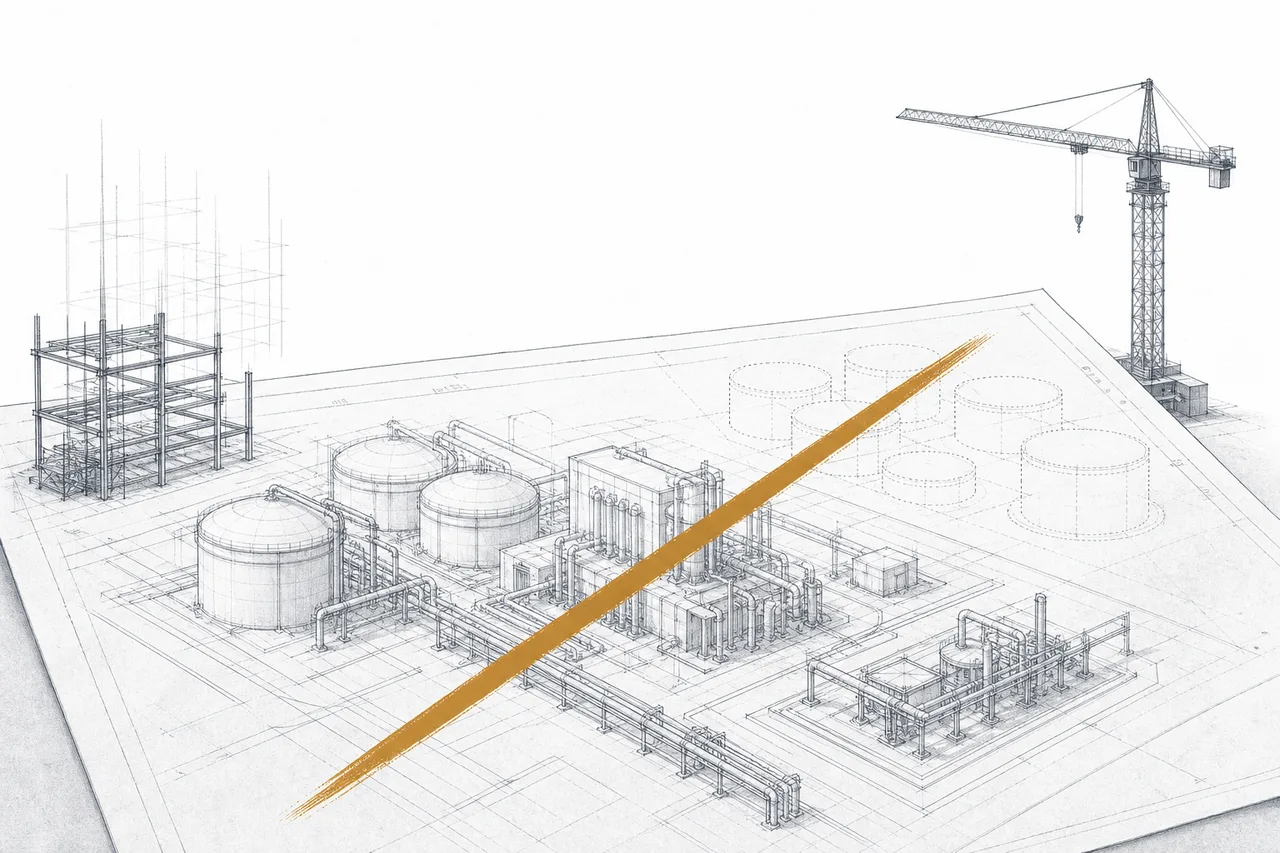
If one word describes hydrogen in 2024–2025, it's 'reset.' The dream that ballooned in 2020–2022 hit three walls of reality at once: costs didn't fall as hoped, demand didn't show up as promised, and subsidies ran late. The result was a wave of project collapses.
The most painful numbers come from BloombergNEF: back in 2020 they expected green hydrogen to fall to ~$1.4/kg by 2030. But by 2025 the forecast had instead gone 'up,' to ~$4–6/kg — the cost curve ran the opposite way to what everyone believed. And out of roughly 1,600 projects planned worldwide, they estimate only ~30% will get built by 2030.
When costs don't fall, projects collapse. In 2025 alone, about 60 large projects were cancelled, wiping out roughly 4.9 million tonnes a year of planned capacity. The list is all giants: BP cancelled a $36 billion project in Australia, Air Products shelved three in the US, and Equinor and Shell pulled out of a Norway–Germany pipeline. The number that captures it best is the IEA's: announced clean-hydrogen production potential for 2030 shrank from 49 to 37 million tonnes/yr in a single year — the first time this figure has ever dropped.
Amid all this gloom, the pure-play players that were once the stars took a heavy hit — but some found a way to survive. And this is where the story gets interesting again.
Notice the sharp dividing line: the ones who got hurt bet on expensive green hydrogen for a market that doesn't exist yet (Plug, Nel). The ones who survived either already have a real money-making business (Linde, Air Products) or found a new market willing to pay a premium for 'speed and certainty' over cheapness — that's Bloom Energy and AI data centers.
06The road ahead — what's left that actually works
After the reset, hydrogen isn't dead — it just got 'humbler' and shrank back to where it makes real economic sense. There are three directions worth watching.
The first direction is fuel cells powering AI data centers — the biggest surprise of 2025. AI data centers are ravenously hungry for power and need it now, but connecting to the grid takes years. Bloom's fuel cells install fast and deliver stable power on-site, so they became a shortcut. Between October 2025 and January 2026, the fuel-cell industry signed a total of $7.65 billion in data-center power contracts — more than all the data-center revenue of the entire prior decade combined.
The second direction is heavy industry with no alternative. Steel, fertilizer, and ship/aircraft fuel still have to rely on hydrogen. Giant projects like Saudi Arabia's NEOM ($8.4 billion) are pushing ahead to produce green ammonia for export — proof that where sunshine is extremely cheap and there's a real long-term buyer, large green projects can still 'happen.' It just has to be the right location and a tight deal.
The third direction is electrolyzer costs gradually falling. The price of PEM electrolyzers dropped from ~$1,500/kW (2020) to ~$800–1,100/kW (2026), down about 45%. That's genuinely good news, but it's still not enough — because most of green hydrogen's cost is the 'electricity,' not the 'machine' — so it only gets cheaper when clean electricity gets cheaper first.
The bottom line on the future: hydrogen is shifting from 'the hero that decarbonizes everything' to 'a specialized tool that does a few heavy jobs very well' — and the irony is that the thing actually making money now (fuel cells for AI) has almost nothing to do with the environmental reasons once used to sell the dream.
07Challenges & risks
This is a node to look at with the clearest eyes possible, because its appeal comes with risks that are concrete and put in real numbers.
The first risk is the 'cost gap' that hasn't closed. As long as green hydrogen ($3.5–6/kg) stays double the price of grey ($1.5–2.5/kg), buyers have no business reason to switch unless they're forced by law or lured by subsidies. This isn't a small problem that disappears in a year or two — it's structural.
The second risk is heavy reliance on subsidies. In the US, the 45V tax credit goes as high as $3/kg, which can close almost the entire cost gap — but that also means many business models are alive only because the government pays. The Senate just extended this credit through the end of 2027, which buys breathing room, but policy uncertainty is a sword hanging over the whole industry. A policy change = a whole business plan can collapse.
The third risk is 'demand that never came'. The most painful lesson of this round was that producers built capacity waiting for buyers, but the buyers willing to pay a premium never showed up in the numbers hoped for — hence the wave of 60 cancellations and Nel having to idle a factory. Investing in this group means clearly separating 'real demand someone has already signed to buy' from 'demand in a presentation slide.'
In short: hydrogen is the classic lesson of a technology that got over-hyped, then had reality come to collect. It won't power your car or heat your home anytime soon. But it'll live on quietly — in the fertilizer plants that grow the world's food, in the new-generation steel furnaces, and — as no one expected — in the fuel-cell racks beside the AI data centers powering the model you use every day. Understanding why the 'dream fuel' had to humble itself into a 'specialized tool' is understanding just how hard and how choosy the real energy transition is.