Megatrend · Electrification & Mobility
The gas station of the EV era — and why it's harder to build than anyone thinks
An EV can only run if there's somewhere to 'refuel' it — yet building charging is one of the hardest businesses in the entire EV wave to make money in, because it's caught in a 'chicken-and-egg' trap: the investment is expensive, but there still aren't many users. The 2024–2026 story is Tesla's plug becoming the standard, pure-play operators like ChargePoint still losing money while EVgo is just starting to turn a profit — and China building a charging network bigger than the rest of the world combined.
01What it is
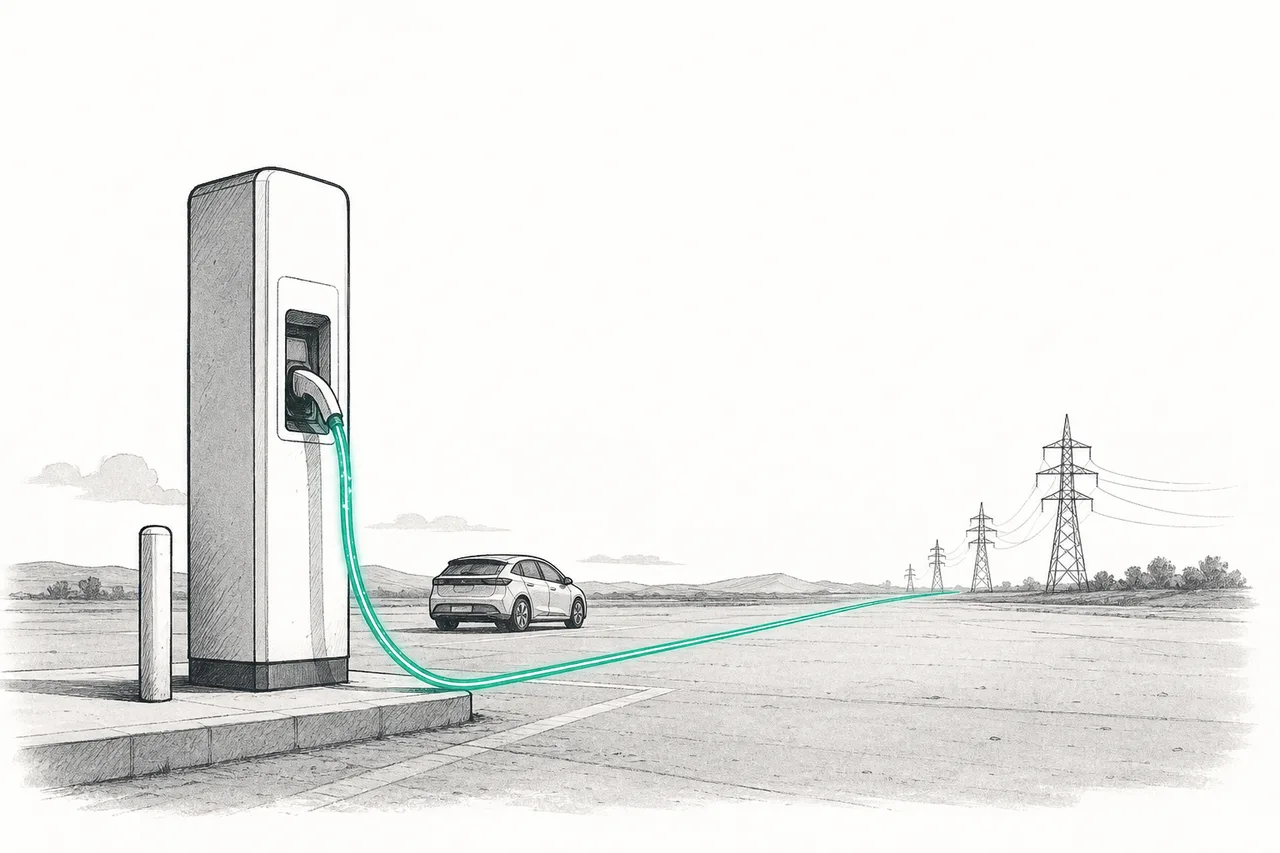
Picture a gasoline car — it's instantly worthless without a gas station. EVs are the same. This node is about the 'refueling stations of the electric age' — both the chargers themselves (hardware) and the networks that operate them (network operator) that let EVs charge away from home.
But it differs from a gas station in one way: charging doesn't always happen at a station. Most charging in the real world happens at home and work — plugged in overnight. So this node spans two very different worlds: the cheap, slow chargers at homes and malls, and the DC fast charging on highways that costs as much as a 'mini substation' — and that's the star of this whole drama.
Hardware OEM = the companies that make the charger itself (e.g. ABB, Delta) · Network operator (CPO — Charge Point Operator) = the companies that install, own, and run a network of charging points and bill per session (e.g. ChargePoint, EVgo, Tesla Supercharger). Some do both; some do just one.
On the megatrend map, this node is a sub-theme under Electrification & Mobility, and its definition pins its position clearly: it sits 'downstream of the electricity meter' — it takes power from the grid and serves it to cars. The upstream side (generating and transmitting electricity) belongs to the energy megatrend. That's an important dividing line, because the biggest problem with fast charging usually isn't the charger itself — it's 'where does the electricity come from'.
02Why it matters — the layer EVs can't do without
The simplest reason: no place to charge, no one dares buy an EV. The fear of 'not finding a charger in time' (range anxiety) is the single biggest wall stopping ordinary people from switching to electric. So charging is an infrastructure layer that has to arrive alongside the cars, not after them.
And it's a big, fast-growing market. The global charging-infrastructure market was around $40 billion in 2025, and many research houses expect it to reach roughly $125 billion by 2030 — growing more than 25% a year, one of the highest rates among all energy infrastructure.
But the number that tells the story best is 'chargers per car'. Worldwide, there's now an average of about 11 EVs per public charger, and in 2025 alone the world added roughly 1.8 million new public chargers. This is one of the biggest infrastructure-building races in history — on par with wiring up a whole country for electricity or laying its oil pipelines.
03How it works — slow AC vs fast DC + the chicken-and-egg trap
The technical heart of this is a single question: 'where do you convert alternating current (AC) into direct current (DC)'. A car's battery can only store electricity as DC, but the power from a wall socket is AC. Who does the converting is what separates slow charging from fast charging.
- AC charging (slow — home/mall): send AC straight into the car and let the 'onboard charger' convert it to DC itself. That converter has to be small enough to fit in the car, so it can only handle around 7–22 kilowatts (kW) — a full charge takes many hours, which suits leaving it plugged in overnight
- DC fast charging (fast — highway): move the big converter out to the charger itself instead, then push DC straight into the battery, skipping the car's converter entirely. Because the unit is big and well-cooled, it can drive 50–350 kW and charge to 80% in 20–60 minutes — but the trade-off is hugely expensive hardware
That speed really does cost. An AC home charger runs just a few thousand dollars, but a single DC fast charger can hit $80,000–$250,000 in real installed cost, because you have to run high-voltage wiring and sometimes build a whole new step-down transformer — it's a 'mini substation' more than just a plug.
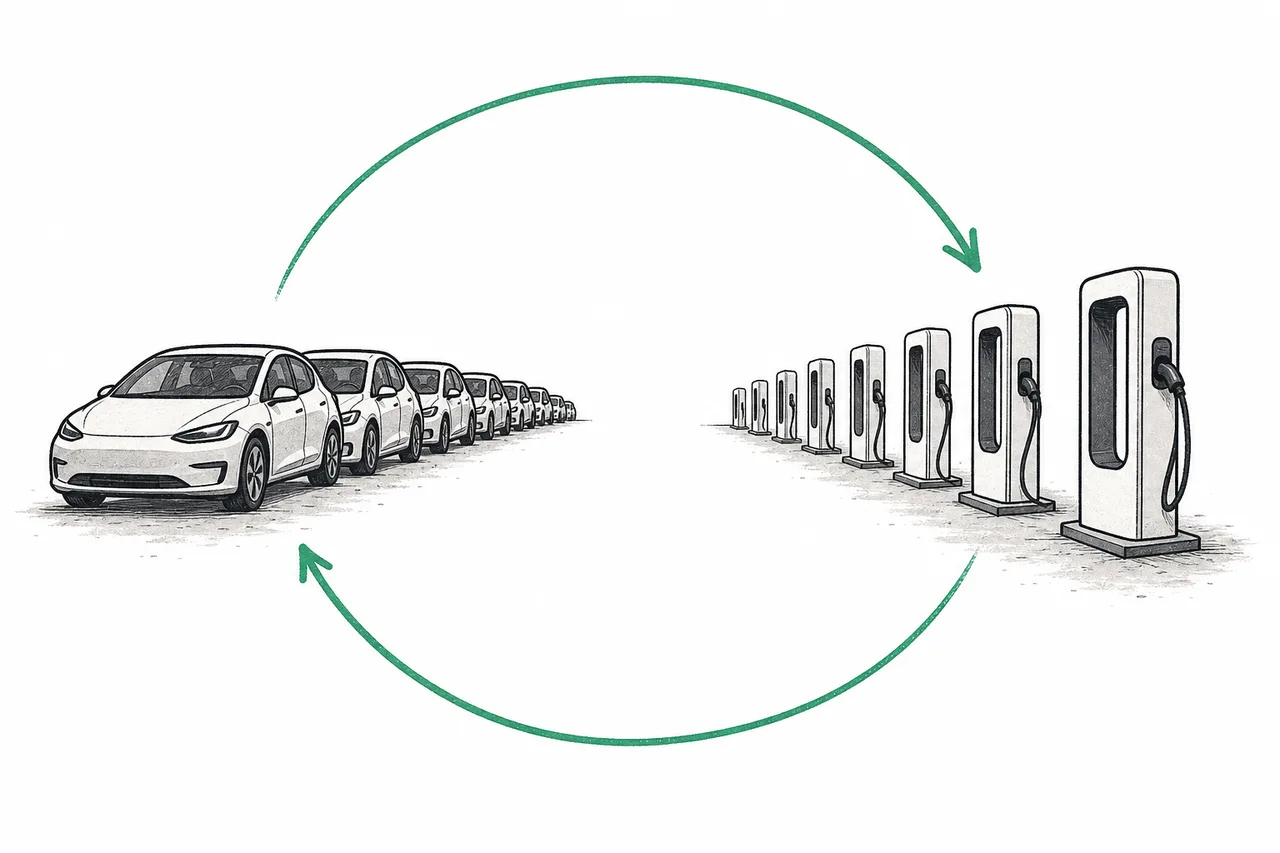
And this leads us to the problem that makes this business brutal — 'chicken-and-egg'. People won't risk buying an EV because there are still few chargers, but no one wants to invest in building chargers (very expensive) because there are still few cars and thin usage. The loop just spins on itself.
The number that explains why it loses money so easily is 'utilization'. The biggest cost of a fast charger is the demand charge on its electricity bill (a fee the utility charges based on the 'peak power' you reserve, not the energy you actually use), which can eat up 23–85% of operating cost. So if a charger sits idle all day, the cost per session is enormous — but once usage gets dense, the cost per session drops fast.
This is the heart of the whole lesson: a fast charger is a business where 'almost all the cost is fixed'. You have to invest heavily upfront, then wait for enough people to show up. In the early days, with few cars on the road, it loses money by design — only those who survive until utilization climbs to 30–50% start to turn a profit.
04Where it sits in the EV world
This node is the 'refueling layer' that joins two worlds — the world of cars and the world of electricity. Look up and look sideways, and you can see who it leans on and who it serves:
- Part of Electrification & Mobility: charging is the infrastructure layer that makes every other node in the EV trend 'actually usable' — however good a car is, it's worthless if it can't be charged
- Runs in parallel with electric vehicles (EV OEMs): this is the real chicken-and-egg pair. Car sales and charger counts have to grow together. Sometimes the carmaker even has to go build chargers itself (like Tesla) to unlock sales of its own cars
- Sits downstream of the grid (Grid & Transmission): a fast charger is a 'big load' that suddenly latches onto the power lines. The real bottleneck to expansion usually isn't the charger — it's getting the power allocation from the utility and upgrading the transmission lines
- Teams up with energy storage (Energy Storage): the answer to demand charge is to put a big battery at the station, charge it up when power is cheap, then release it when crowds arrive, cutting the peak draw from the grid
- Connects to the battery in the car (Battery Cells): how fast a car can take a charge depends on its battery and electrical architecture (like an 800-volt system). A 350 kW charger is meaningless if the car can only take 50 kW
05Where it stands now + the players
In 2024–2026, three big things happened at once — the standards war ended, the pure-play operators struggled to survive, and China pulled away from the rest of the world.
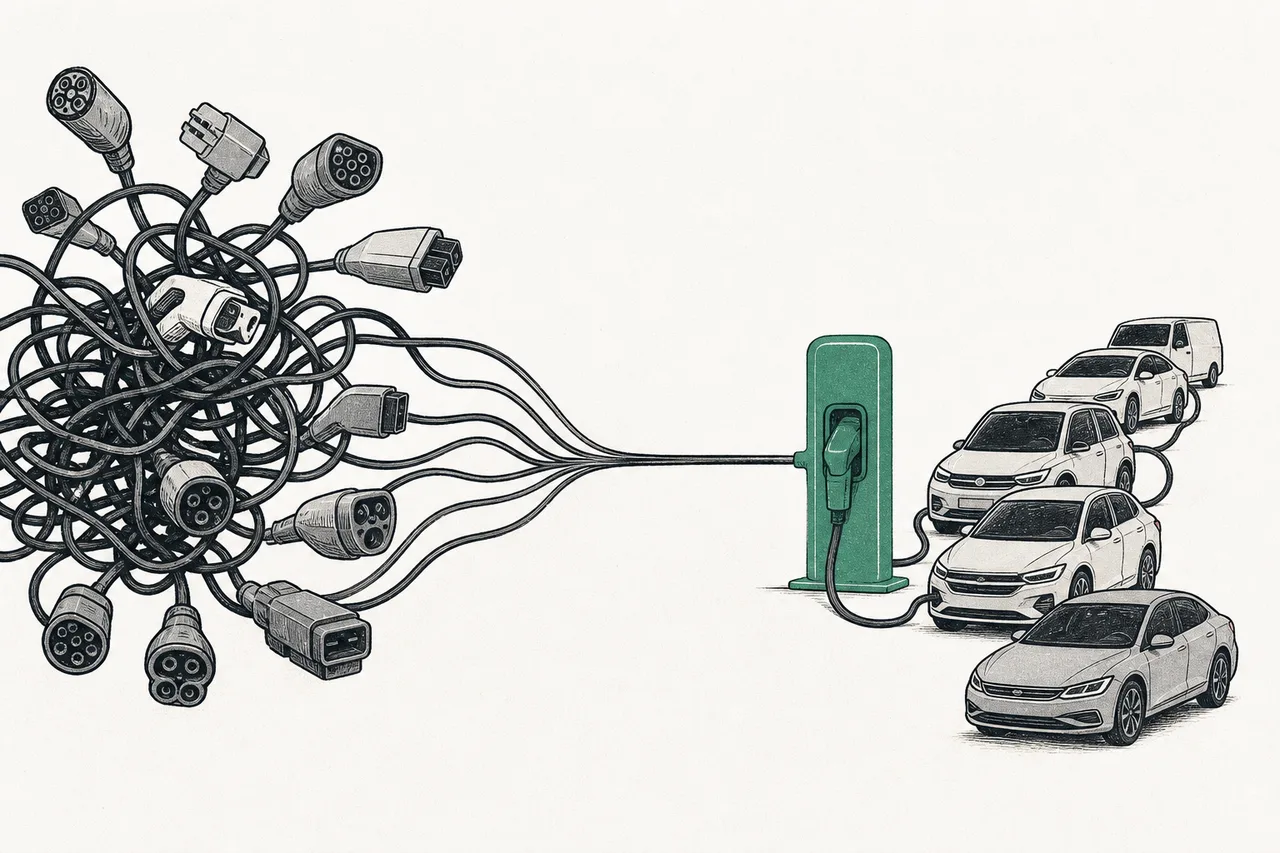
Story 1 — Tesla's plug won. For years America had a messy mix of charging plugs, until in June 2023 Ford became the first to announce it was switching to Tesla's NACS plug — and then, like dominoes, GM, Rivian, Hyundai, Mercedes, Toyota and nearly every brand followed, more than a dozen of them. In 2024 the standard was officially certified as SAE J3400, and on June 29, 2025 Tesla opened its Supercharger network so GM and Ford cars could actually charge there. The plug war in North America ended with Tesla as the winner.
Story 2 — the pure-play operators still hurt. Companies that run 'just a charging network', with no other business to prop them up, are the group that most clearly reflects how brutal the chicken-and-egg trap is. ChargePoint had revenue of about $417 million in FY2025 but is still losing money (a Q4 net loss of $64.6 million, even after cutting expenses 26%). Blink Charging has it worse — first-half 2025 revenue shrank to $49.4 million from $70.8 million a year earlier.
But there's light — EVgo was one of the first to turn the game around. In 2025 its revenue grew 50% to $384 million, and for the first time it posted positive adjusted EBITDA ($12 million). The electricity delivered through its network (throughput) grew 32% to 366 GWh — proving that once utilization climbs to a certain point, this model really can make money.
Story 3 — China plays in a different league. At the end of 2025, China had over 4.7 million public chargers — more than 65% of the world's total. Counting private chargers too, China's network tops 16 million. A single Chinese operator like TELD (~807,000 chargers) or Star Charge (~703,000 chargers) is bigger than the entire US public market combined (~235,000 chargers).
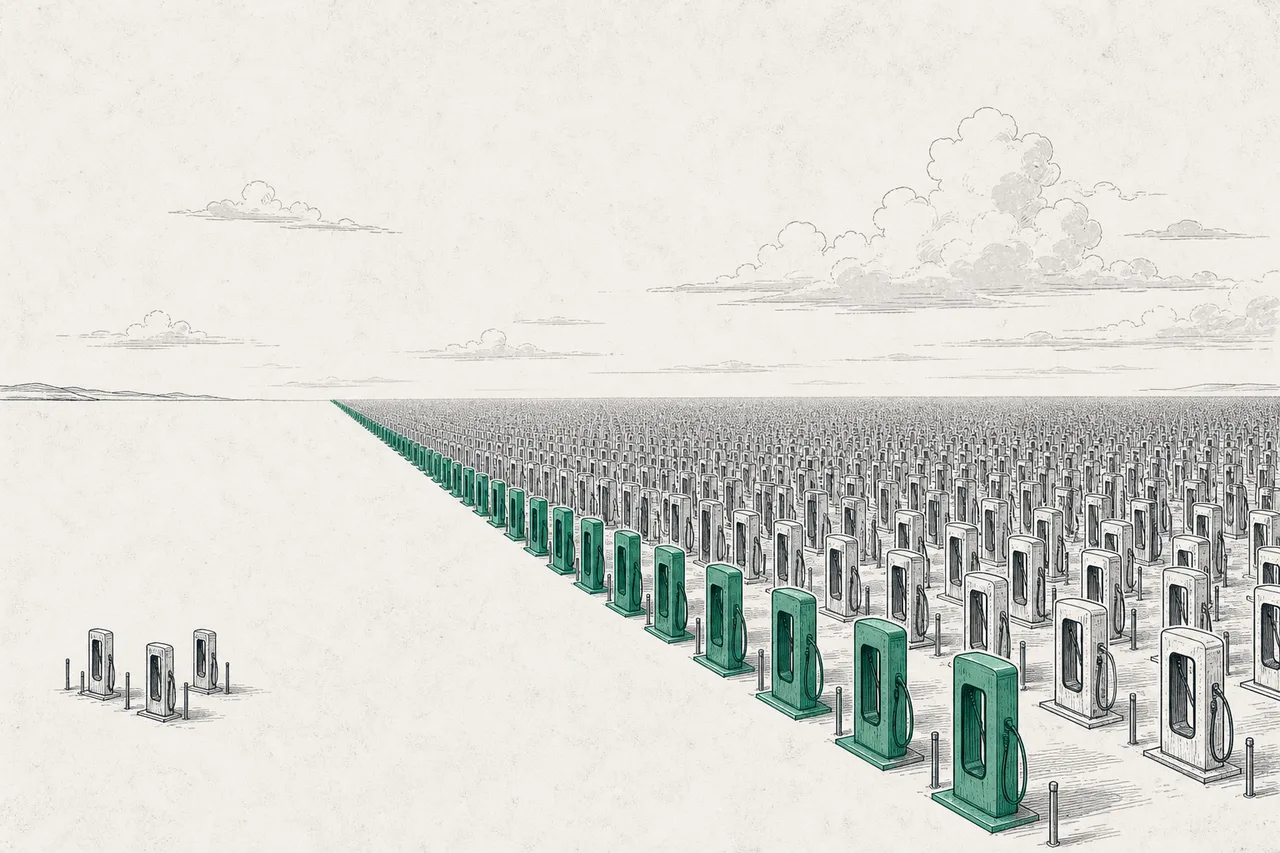
Worldwide in 2025, fast and ultra-fast chargers grew from 1.5 million to 2.2 million (+40%), with China driving almost all of that growth. Meanwhile the oil majors see this as the 'gas station of the future' — Shell targets around 70,000 public chargers in 2025 and 200,000 by 2030, while BP Pulse is pouring $1 billion into charging by 2030.
06The road ahead
The first direction is 'from losses to break-even'. As more EVs hit the road, the utilization of already-installed chargers gradually climbs — and because almost all the cost is fixed, every extra charge is nearly pure profit. EVgo's recent flip to positive EBITDA is a signal that the survivors will start entering the profit zone over the next few years.
The second direction is charging getting much faster, fast. It's now moving from the 350 kW level toward the megawatt level (1,000 kW and up), especially for electric trucks and commercial vehicles. In China, BYD has teamed up with TELD and Star Charge to push megawatt-level charging that they claim refills nearly as fast as filling up with gas — erasing the 'long wait' weakness one more notch.
The third direction is merging with the power grid. The next generation of charging stations will come with built-in energy-storage batteries and solar to dodge demand charge and ease the load on transmission. Some are even starting to do vehicle-to-grid (V2G) — letting a parked, charging car 'discharge' power back into the system when the grid is tight, turning every car into a mobile battery for the network.
07Challenges & risks
This business's appeal comes with risks baked into its very structure.
The first risk is 'utilization vs profit' — this is a business where you invest heavily upfront and then wait for people to come. If EVs grow more slowly than expected, or a soft economy makes people delay changing cars, the chargers you've already installed sit 'empty' and keep burning cash. The fragility of ChargePoint and Blink is a live lesson that having lots of chargers doesn't equal profit.
The second risk is 'the standards war is over, but there are losers'. With Tesla's NACS winning, networks that invested in the old plug (CCS) have to pay to convert. And more importantly, by opening its own Superchargers to others, Tesla forces the pure-play networks to compete against a rival that's bigger, easier to use, and propped up by a car-sales business — competition just got much harder.
The third risk is 'the bottleneck is in the wires, not the charger'. Expanding fast chargers usually gets stuck on getting power allocations from the utility and upgrading transmission lines — which take years and lie outside the operator's control. The more cars, and the faster the charging, the bigger the load slamming into the grid.
And the fourth risk is 'dependence on subsidies and policy'. Public money can cover up to ~80% of installation cost on some projects, which is what smashes the chicken-and-egg trap open — but it also means that if policy changes or subsidies shrink, the economics of many projects collapse instantly.
In short: charging is the 'gas station of the electric age' that you can't do without, yet it's harder to make money on than anyone expects, because it demands huge upfront investment and then a wait for users. The story of Tesla winning the plug war, EVgo just starting to see profit, and China having already built more than half the world is the picture of an industry crossing from a 'cash-burning phase' into a 'cash-making phase' — and whoever crosses this valley gets to own the infrastructure every car depends on.