Megatrend · Robotics & Physical AI
The one robot that really made it into our homes — and why the company that invented it went bankrupt
We've dreamed of a 'home helper robot' for decades, but to this day there's only one kind that sells tens of millions of units a year — the robot vacuum. And the most painful part: the company that invented it (iRobot, maker of the Roomba) ended up bankrupt and bought out, swallowed whole by cheaper, better Chinese rivals. This is a lesson in just how brutal a battlefield 'consumer hardware' really is.
01What it is
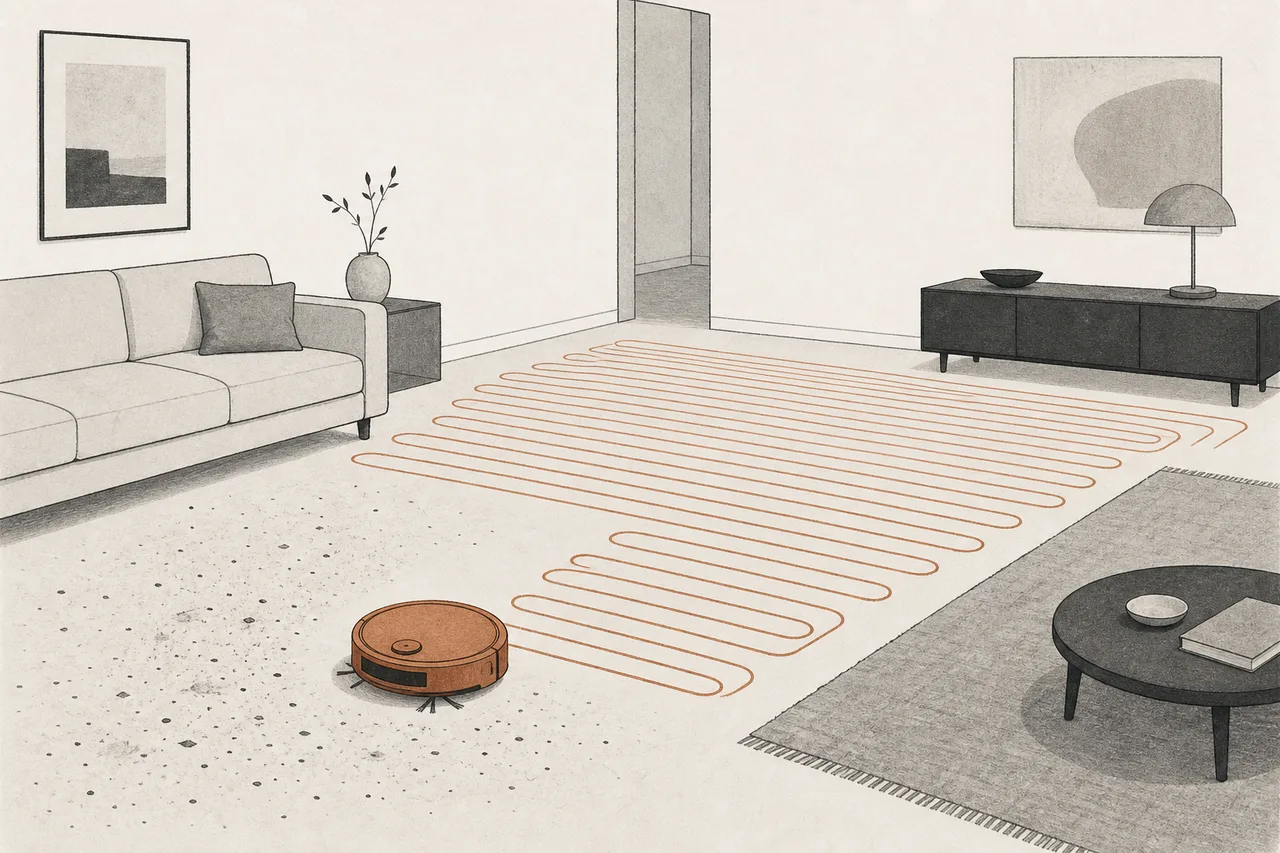
When we say 'robot,' most people picture a human-shaped machine walking over to pour them a coffee. But the robot that has actually made it into people's homes today looks nothing like that. It's a flat round disc crawling around under the sofa.
Consumer & Home Service Robots are robots sold to 'ordinary households,' not factories — the group spans robot vacuums/mops, robot lawn mowers, pool-cleaning robots, all the way to home assistant/companion robots. But one truth has to be said up front: out of all of these, only the robot vacuum has truly become a mass-market product. The rest are still niche markets, or just a dream.
A 'service robot' does a 'service' for people, rather than making things in a factory (that's an industrial robot) — it splits into professional ones (in hospitals, warehouses) and consumer/home ones you buy to use yourself at home. This lesson is about the latter.
On the megatrend map, this node is a sub-theme under Robotics & Physical AI — the 'consumer endpoint' of the whole robotics field, the point where robots finally travel from the factory and the lab into an ordinary person's living room.
02Why it matters — a robot that really gets into your home
This node matters not because it's the biggest, but because it's the 'proof' that robots can reach ordinary people at a price they can afford. Every other robotics trend (humanoids, self-driving cars) is still in an expensive experimental stage, while robot vacuums sit on store shelves for a few thousand baht and are already in hundreds of millions of homes.
The global robot-vacuum market was around $11 billion in 2025 and is expected to grow to roughly $22 billion by 2030 (about 14% a year). The shipment numbers are huge too — in just the first three quarters of 2025, 17.4 million units shipped worldwide, up 18.7% year over year.
Just as important, this node connects directly to the aging-society megatrend — as populations get older and household labor grows scarce, robots that can do housework in our place become a structural need, not just a high-tech toy.
03The one job a robot has actually nailed at home
Why did the robot vacuum succeed while the 'all-around home assistant' still can't? The answer is that it chose to do one job with a clear scope — sweep the flat floors of a home clean. That's it. A narrow, well-defined job like that is exactly what robots are genuinely good at.
The heart of what made newer models so much smarter is building a map of the home (mapping). Old Roombas used a random 'bump and turn' approach, but new ones use a LiDAR sensor (firing a laser to measure distance), sweeping it around to draw a plan of the whole room, then planning a tidy, systematic path in straight rows — covering everywhere, never doubling back, never falling down the stairs.
And here's where it becomes a business lesson — iRobot, the inventor, stubbornly refused to use LiDAR for too long, sticking with a camera method (vSLAM) that's less accurate in real homes. Meanwhile the Chinese rivals jumped to LiDAR in cheaper models — and this small technical difference later became one reason the market leadership changed hands.
LiDAR = spins a laser to measure the distance to walls and furniture, producing an accurate map that works even in the dark · vSLAM = uses a camera to see and guess its position; cheaper, but it relies on light and is less accurate in real homes — picking the wrong one of these was one of iRobot's missteps.
04Where it sits in the robotics universe
This node is just one of the many 'endpoints' of the whole robotics field. But it's deeply connected to its siblings and to other trends:
- A child of Robotics & Physical AI: home robots are the most 'tangible face' of the entire robotics megatrend — the point where factory technology reaches the consumer
- A different game from humanoids (Humanoid): a 'human-shaped home assistant' that can pick up and tidy anything is this node's ultimate dream — but it's still years away (you can read that lesson next)
- Relies on the robot's AI brain: mapping, remembering rooms, dodging obstacles, and lately 'seeing' with an AI camera — all of it comes from the software on this side
- Driven by an aging society: the older people get and the scarcer household labor becomes, the more structurally solid the demand for housework-helping robots grows
To picture it — today's home robot = 'narrow job, really works, cheap.' The humanoid = 'broad job, can do anything, but still expensive and not ready.' The two are opposite ends of the same spectrum, and the big question of the next decade is when they'll converge.
05Where it stands now + the iRobot lesson
This is both the most dramatic business story and the sharpest warning of this whole lesson.
Back in 2002, an American company called iRobot launched the Roomba — building the 'home cleaning robot' category from scratch. It was the true pioneer, selling over 35 million robots by 2020 and hitting ~$1.56 billion in revenue in 2021, its peak. The name 'Roomba' almost became the generic word for a robot vacuum.
Then everything fell apart, fast. Chinese makers that had once been mere 'contract factories' learned the technology, then released their own robots with better specs, lower prices, and faster new-model cycles. iRobot missed three big beats: stubbornly refusing to adopt LiDAR, clinging to premium pricing while rivals attacked the mid-to-low end, and getting piled on by heavy debt and import tariffs.
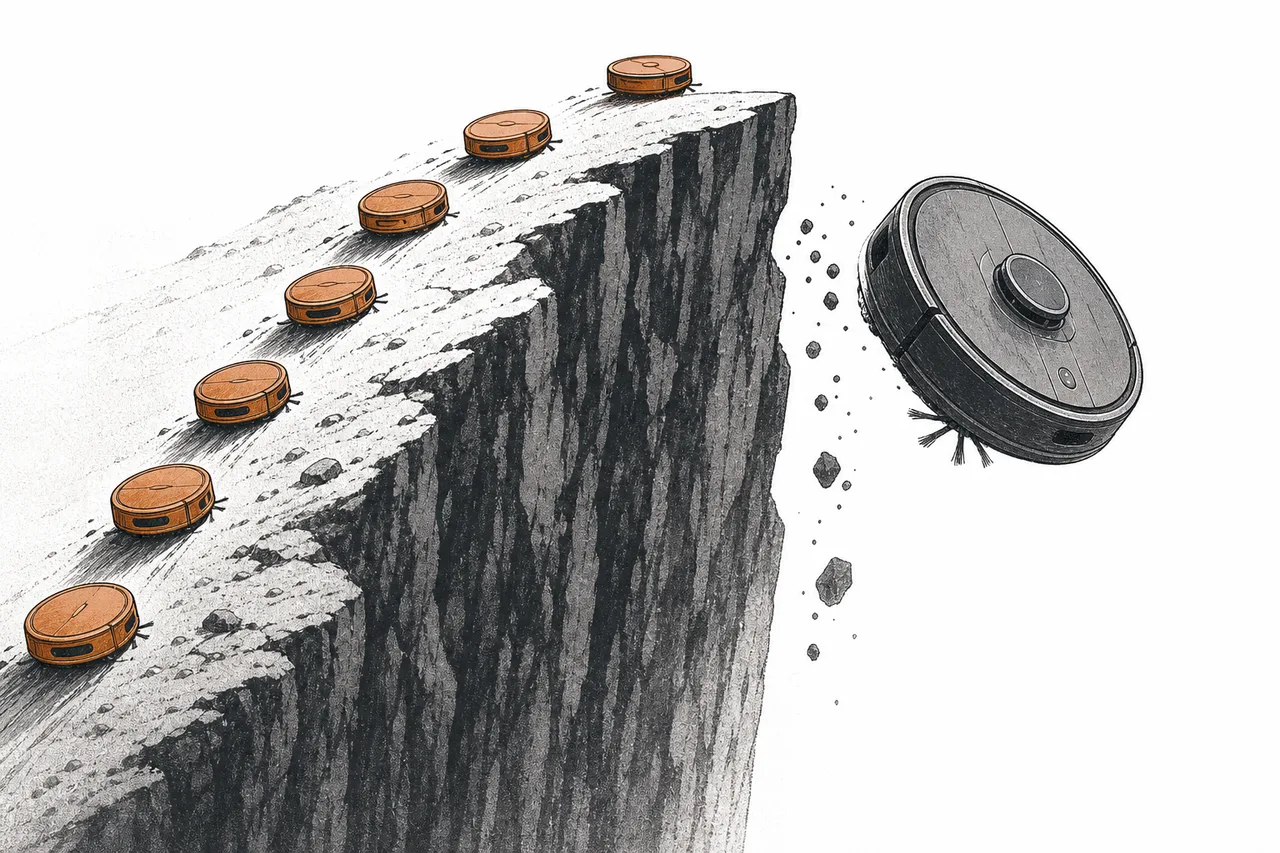
The final straw was the Amazon deal. In January 2024, Amazon had agreed to buy iRobot for $1.7 billion — a lifeline that would have cleared debt and funded R&D. But the deal was blocked by Europe's competition regulators (fearing it would monopolize retail). The deal collapsed, Amazon paid a $94 million break fee and walked away. Starved of capital, iRobot kept crumbling, revenue falling from $1.183 billion (2022) to $891 million (2023) and then sliding roughly 24% a year. The stock fell more than 80% from its 2021 peak.
A bitter ending — in late 2025, iRobot filed for bankruptcy (Chapter 11) and was bought by Picea Robotics — a Chinese company in Shenzhen that had been iRobot's own contract manufacturer and largest creditor. The pioneer was bought by its own supplier.
So who won? The numbers are clear. In Q2 2025, China's Roborock rose to number one in the world with a ~19.3% share (shipping 982,000 units in a single quarter, up 50.7%), while iRobot dropped to fifth. And more striking still — the world's top 5 are now all Chinese brands (Roborock, Ecovacs, Dreame, Xiaomi, Narwal), together holding nearly 70% of the market.
06The future — lawns, pools, and the humanoid dream
If the robot vacuum was the 'first chore' robots claimed, the question is — what's the next job? The answer is taking shape in three directions.
The first direction is the robot lawn mower (robot mower). This is the clearest 'next market.' The market is around $2.4 billion in 2025, growing about 14% a year, with Husqvarna (Sweden) as the leader. The big turning point is 'no buried boundary wire' technology — old models needed a wire buried around the lawn to mark the boundary, but new ones navigate with GPS/satellite and an AI camera instead. That makes installation far easier and opens the market wider.
The second direction is pool-cleaning robots and other specialized jobs (window-wiping, yard cleanup) — a niche group using the same formula as the robot vacuum: 'pick a narrow job, do it really well, keep it affordable.'
The third direction is the ultimate dream: an all-around home assistant robot — one that folds laundry, washes dishes, and tidies up like a person, which will arrive in the form of a humanoid (humanoid). But to be honest — it's still years away, because the 'home' is the messiest, least predictable environment there is for a robot (clutter everywhere, kids, pets, uneven floors). The robot-vacuum lesson tells us robots are good at 'one job with a clear scope,' but 'every job in the home' is a problem many times harder.
07Challenges & risks
This node is beautiful in the 'robots really reaching people' sense, but it's a uniquely dangerous business battlefield — for reasons the iRobot lesson makes plain.
The first risk is commoditization and thin margins. Once the technology spreads, every brand can make a 'good enough' robot vacuum, and competition comes down to price and features that are quickly copied. So profit per unit gets squeezed lower and lower. Consumer hardware has no 'moat' as deep as software's — anyone can be replaced.
The second risk is the ferocious competition from China. Chinese makers have the edge on cost, supply chain, and the speed of new-model releases, so much that Western brands can barely survive (iRobot is the proof). And it's a double-edged sword for the Chinese players too — they have to cut prices against each other fiercely, which eats into everyone's profits.
The third risk is the still-distant humanoid dream. Investors hoping a 'home assistant robot' arrives soon may be disappointed — the jump from a 'round disc that sweeps floors' to a 'robot that does every chore in the home' is an enormous technological leap that could take another decade or more. Money flowing in on inflated expectations runs the risk of 'arriving too early.'
In short — home robots are the story of the first robot to truly reach ordinary people. But they're also the story of a pioneer swallowed whole and bankrupted by cheaper, faster rivals. To understand this node is to understand why 'robots in the home' is exciting and frightening at the same time, and why the dream of an all-around assistant robot still has a long wait ahead.