Megatrend · Robotics & Physical AI
Robots have had bodies for ages — what was missing was a brain
We've had robotic arms, motors, and precise hands for decades. But robots could only do tasks that were "programmed exactly," inside a cage — move a part two centimeters and they're stuck. This node is about the "brain software" — the AI model that takes camera images plus human-language commands and drives the muscles (motors) on its own. It's the piece that was always missing, the bottleneck that kept robots from going from "factory machine" to "worker who can do anything" for nearly a century.
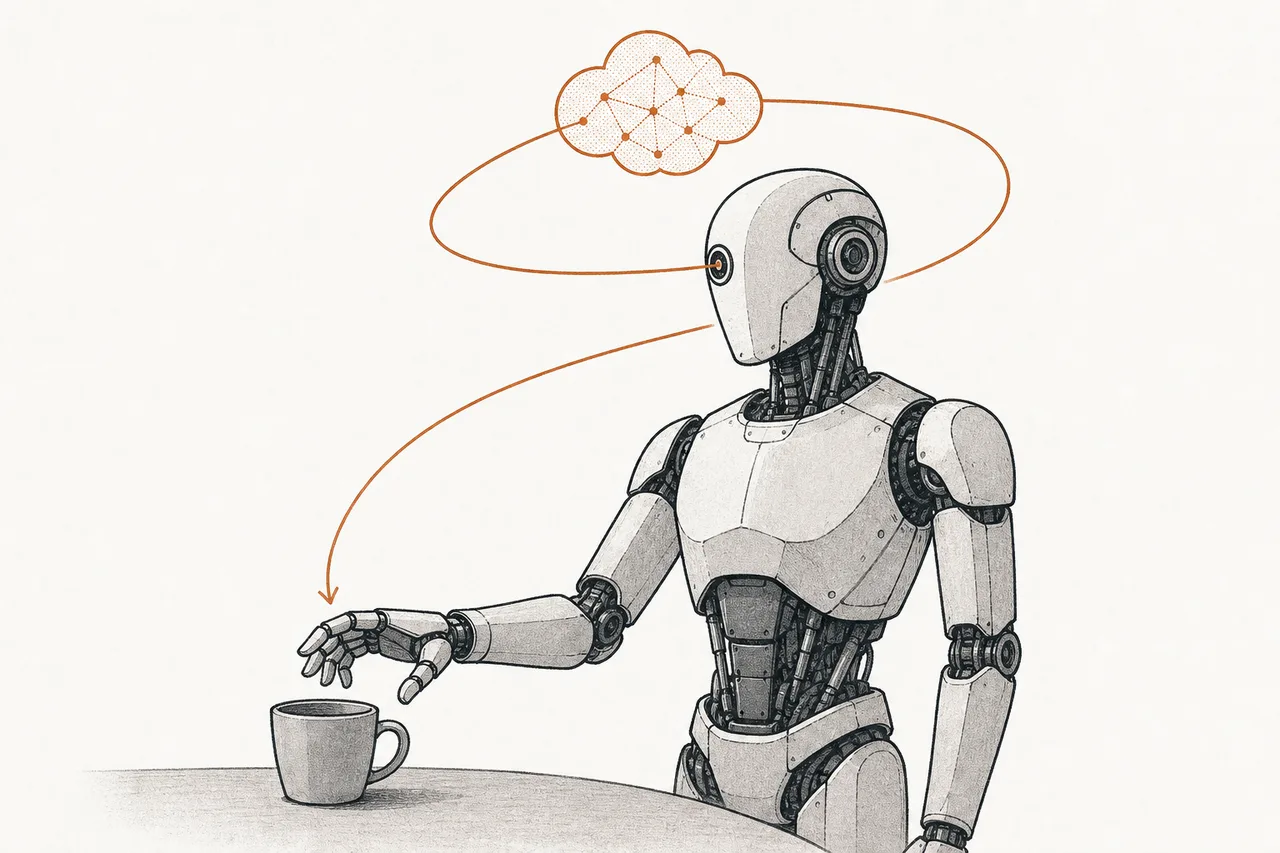
01What is it? — the robot's "brain"
Picture a robotic arm in a car factory. It can weld the same spot a million times without missing. But shift the workpiece just 2 centimeters and it'll weld into thin air, no problem. It doesn't "see" or "understand" anything — it just follows coordinates a human wrote down to the millimeter. That's been the robot for the last 60 years: great at repeating, useless in the real world.
This node is about the software that fixes exactly that — what the industry calls "Physical AI," or AI with a body. At its heart is a new kind of model called VLA (Vision-Language-Action). In plain terms: a model that takes camera images (Vision) plus a human-language command (Language) like "put the dishes in the sink into the dishwasher," and turns it directly into commands that move muscles/motors (Action) — no one has to write coordinates point by point.
VLA (Vision-Language-Action) = a model built on the big language/image models (like the one behind ChatGPT) but with a third "leg" added: the output is a physical action · Robot foundation model = a single model trained broadly enough to handle many tasks and many robots, instead of writing a separate program per task — like a "general-purpose brain" you can plug into any body.
On the megatrend map, this node is a sub-theme of Robotics & Physical AI and sits in the "platform" layer. Its definition says it straight: "foundation models/VLA for robots, simulation, and on-robot compute platforms." Put another way — if humanoids and parts and motors are the "body," this node is the "brain and nervous system" that makes that body useful.
02Why the "brain" unlocks the body
Here's a fact that sounds odd but matters a lot: the robot's body was never the bottleneck. We've built robotic hands, motors, and sensors that beat the human hand in some ways for decades. What's always been stuck is "OK, but how do you tell it to work in a world that isn't tidy?" The real world is messy — things aren't where they should be, the light changes, people walk past. You can't program for every case. That's why most robots are still locked inside cages in factories.
VLA changes that equation, because it learns "physical common sense" instead of being told step by step. And the money reflects the excitement clearly. In 2025, robotics startups raised about $13.8 billion — beating the 2021 record that used to be the peak. Counted by the broad definition (robotics + physical AI), the figure hits about $27.6 billion across more than 1,000 deals. Most of that money flowed not to the "body" but to the "brain."
Why is so much money pouring in? Because the bet is "physical labor" — work done by hand in the real world: picking, assembling, hauling, caring. The previous wave of AI (agentic AI) couldn't touch it, because it only worked on a screen. If the "robot brain" actually works, it opens the door to the whole world's labor market, not just knowledge work — and that's why investors are paying up to reserve a seat early.
03How it works — the "embodiment loop"
At the heart of Physical AI is a loop that spins very fast — "perceive → think → act" — and comes back around dozens of times a second, because the real world doesn't hold still. Things slip, hands miss, resistance changes; the robot has to keep adjusting, not plan once and barrel ahead. We call it the "embodiment loop".
The smartest — and hardest — part is the middle box (the VLA model). It builds on a big language-image model that has "read the whole internet," so it comes with common sense baked in: it knows "hold a full glass upright" or "grip something fragile gently" without being taught. Then it's trained further on real robot-motion data so it can "turn understanding into movement" — and that's the bridge connecting a "brain that knows the world" to a "hand that can work."
But here's the catch: real robot-motion data is shockingly hard to come by. So the main fix is the box at the top of the diagram — letting the robot train in a simulation millions of times first, then carry that skill over to the real thing. This approach is called "sim-to-real," and it's important enough to get its own chapter next.
04The biggest problem: a data shortage
This is the core of "why AI writes poetry better than humans but robots still can't fold laundry." The short answer is data. A language model like ChatGPT trains on internet text and images that, measured as "experience," add up to roughly 100,000 years of content. But the largest real robot-motion dataset ever reported sits at about "1 year" — a hundred-thousand-fold gap.

Why such a vast gap? Because text already exists on the web, free to scrape. But robot data "can't be scraped from the internet" — every time you want "pick up a glass once" data, you need a real robot, a real environment, and a person operating the robot (teleoperation) to demonstrate it one go at a time. It's slow, expensive, and doesn't scale. That's why researchers call it the "100,000-year data gap."
The fix the whole industry is betting on is "simulation" — building a virtual world where the robot can train millions of times in a few hours, without wrecking a real robot. Once it's trained, you move the "brain" it learned into the real robot. This swaps the scarce real data for vastly cheaper synthetic data.
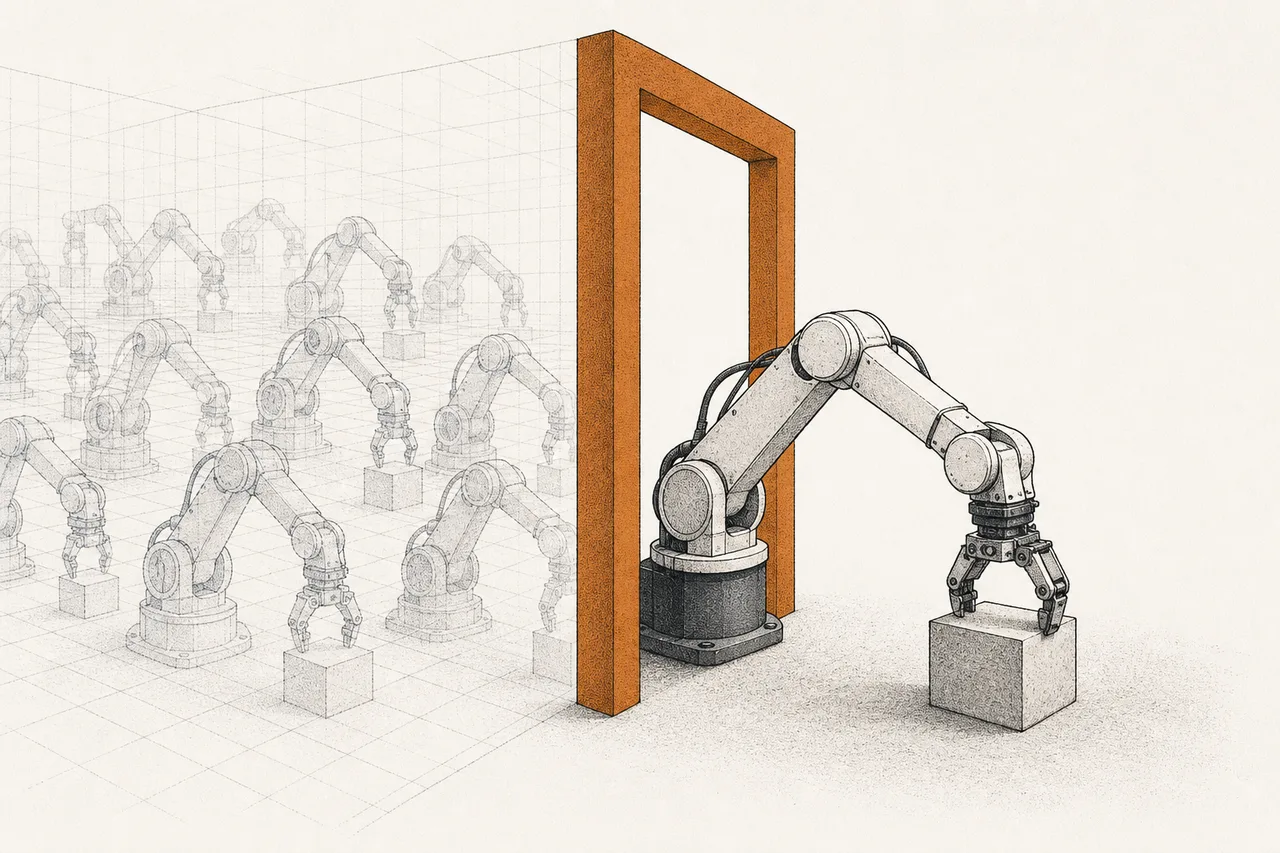
A simulation never matches reality exactly — friction, materials that flex, things that slip are all hard to simulate. When a robot that's good in the game meets the real world, its skill often "falls off." That's the sim-to-real gap. 2025 research roughly estimates that about 8 samples of simulated data are worth 1 sample of real data — simulation helps a lot, but it isn't free, and the "contact-physics gap" is still the hardest barrier.
That's why this node includes not just the "model" but the "simulation platform" in its definition — because whoever controls the factory that produces the most realistic synthetic data controls the industry's scarcest raw material.
05Where it sits in Robotics
The easiest way to understand this node is to see a robot as a "living thing" and ask which part goes where:
- The "brain and nervous system" of Robotics & Physical AI: the parent theme is the whole robot system. This node is the software layer that lets that body think and decide for itself, not just follow a script
- Commands the "body" — humanoids and parts & motors (actuation): no matter how good the hardware, it's worthless without a brain to command it — and a smart brain can't do anything without a precise enough hand. Both have to go together
- Builds on AI and Foundation Models: VLA didn't come from nowhere — it's a language-image foundation model with "legs added" so it can command. So AI's overall ability is the ceiling on the robot's ability
- Eats AI chips heavily, both for training and thinking on the robot: the robot has to think in real time while it moves, so it needs powerful, low-power onboard inference chips
And because this node is AI's "hands and feet in the real world," it reaches far beyond the robotics field — it directly helps with an aging society (a shortage of care workers), and it leans on critical materials like motors and magnets in the supply chain.
06Where it stands now + who the real players are
2025–2026 is when Physical AI jumped from research to a "real platform." The big catalyst is Nvidia, which positioned itself as the field's "pick-and-shovel seller" — instead of building robots itself, it built a full platform for everyone to use. In March 2025, Nvidia launched Isaac GR00T N1, billed as "the world's first open humanoid foundation model," paired with Omniverse + Cosmos for building simulation worlds and synthetic data, and the Jetson Thor chip for thinking on the robot.
The proof it's really becoming a "common standard" is that major industrial-robot makers like FANUC, ABB, KUKA, and Yaskawa — with more than 2 million robots installed worldwide combined — have adopted Omniverse's libraries and Nvidia's simulation frameworks to test production lines with a "digital twin" before building for real. Later models (GR00T N1.7, and the previewed GR00T N2) claim about 2x the success rate of leading earlier VLA models in new environments.
Meanwhile, the "pure-model labs" are competing fiercely. Google DeepMind released Gemini Robotics 1.5, which "thinks before it acts" and can transfer skills across different robots without retraining. Startups are especially hot — Physical Intelligence (the π model) was valued at $5.6 billion in November 2025 and is reportedly in talks for a new round pushing its valuation past $11 billion. Skild AI raised a $1.4 billion Series C, tripling its valuation to $14 billion in 7 months, with SoftBank, Nvidia, and Samsung joining in.
An important note for investors: the players at the "front" of the pure-model layer are almost all private companies not on the stock market (Physical Intelligence, Skild AI, and Figure, which makes the Helix model). So investing in this trend through the stock market usually means buying "platform and chip sellers" (like Nvidia) or large companies with a robotics team (like Google, Tesla, Baidu) rather than buying "the pure-play robot-model makers" directly.
07The road ahead
The first direction is the "world model" idea — instead of just reacting moment to moment, the robot builds a "mental model" of how the world works and "imagines ahead" what happens if it does X. Like a person picturing it before lifting something heavy. New-generation models like the one Nvidia previewed (GR00T N2 on a "world action model" architecture) head this way — and it's the key to letting robots "handle situations they've never seen."
The second direction is that the "data factory" becomes the battleground. When real data is scarce, whoever can produce the most high-quality synthetic data the cheapest (through simulation worlds + human video) gains a structural edge — which is why simulation platforms like Omniverse/Cosmos may be worth as much as the model itself.
The third direction is finding the right split between the "cloud brain" and the "on-robot brain." Heavy thinking (planning) may live in the cloud, while millisecond-fast work (balancing, dodging obstacles) has to be computed on the robot itself. Designing those two layers to work together smoothly — within the limited power and chip budget on the robot — is the big engineering problem of the next round.
08Challenges & risks
Behind the huge buzz and money, Physical AI has walls worth naming straight. The first is the one we already covered — the data shortage. As long as collecting real data still needs a person operating the robot one go at a time, and simulations still aren't "realistic enough" (sim-to-real gap), the climb from "pretty demo clip" to "works in every home and every factory" will be slower than the hype expects.
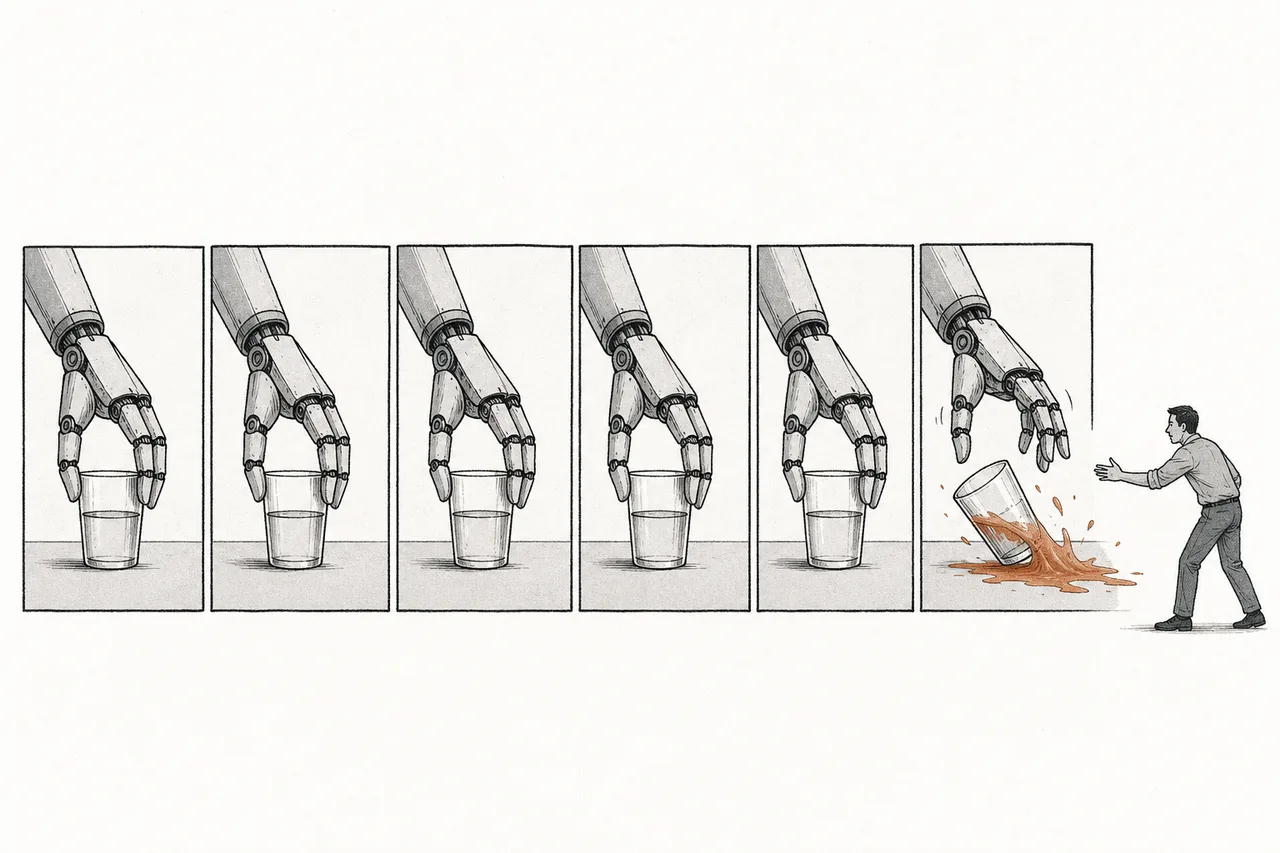
The second risk is "reliability." In the AI-software world, getting it right 95% of the time is impressive. But in the physical world, 95% means "dropping or breaking something 1 in 20 times," which is unacceptable in real work — because physical actions are irreversible: a broken glass stays broken, an injured person is really injured. The climb from "good" to "reliable every time" is the hardest, longest stretch.
The third risk is "hard to invest in, and expensive." Most of the real leaders in the model layer are still private companies whose valuations are climbing fast (Skild AI tripled in 7 months; Physical Intelligence went from $5.6B toward $11B) — a classic picture of a trend where "expectations run ahead of reality." If actual progress lags the promises, the valuation reset for this group could be severe.
In short: robots have had bodies ready for ages; what arrived only recently is the "brain" that lets them understand the world and act on their own — and the real bottleneck isn't hardware, it's scarce data and reliability that isn't there yet. Whoever solves these two first — whether with more realistic simulation worlds or models that understand physics more deeply — will decide how fast robots step out of the factory cage and into our lives.