Megatrend · Robotics & Physical AI
Humanoid robots: the boldest bet in all of robotics
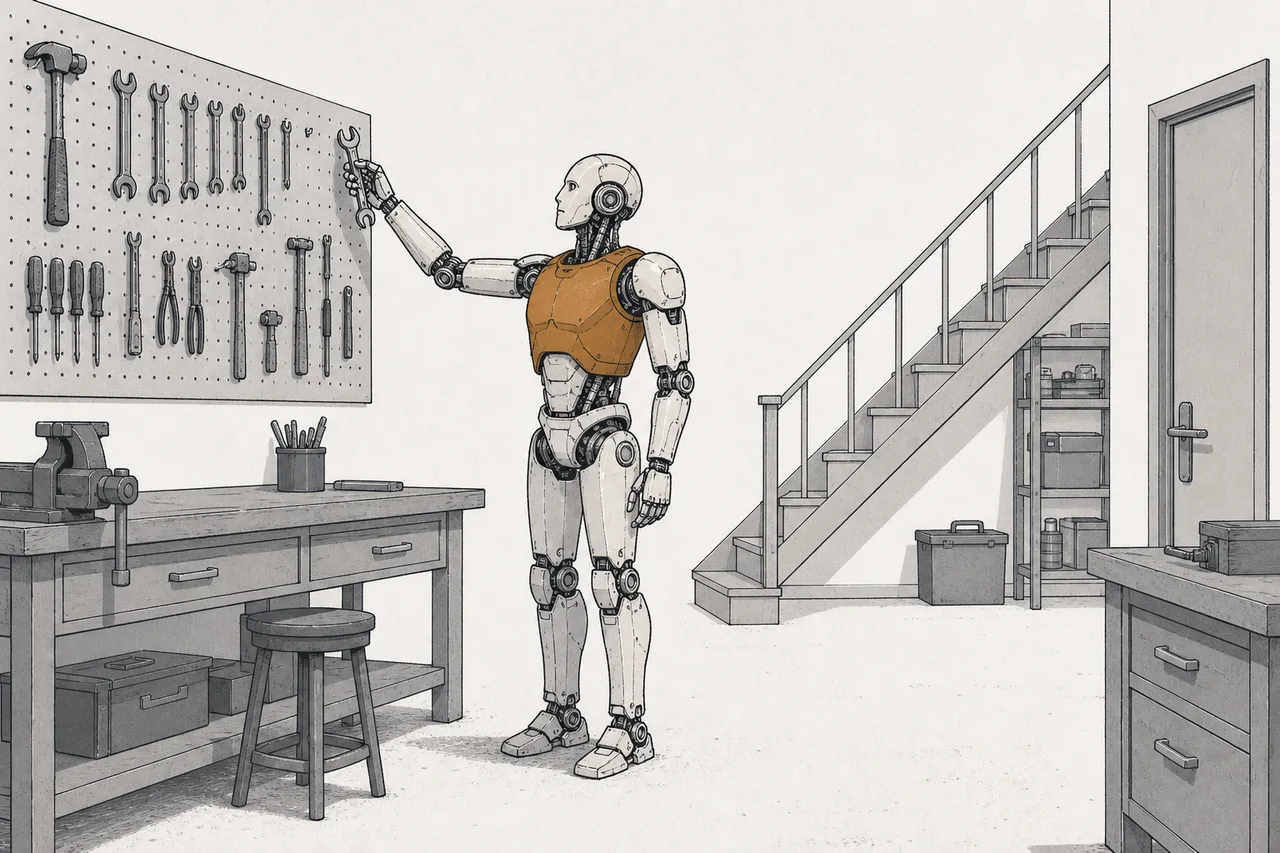
The whole world — stairs, doorknobs, hand tools, assembly lines — is designed around 'the human body.' So if you want a robot to work in our world without rebuilding every factory from scratch, the most direct path is to give it a 'human shape.' But this is the hardest problem in the field — and right now it's genuinely just beginning. There are tons of jaw-dropping demos, but the things actually in use you can still count on your fingers.
01What it is
Today's factory robots are very good — an arm can weld a car more precisely than a person. But it can only do one thing, it's bolted in place, and switching tasks means reprogramming the whole system. Humanoid Robots set up the opposite challenge: a general-purpose robot shaped like a person — two legs, two arms, hands that can grip — that can walk anywhere in our world and 'learn' new tasks without being reprogrammed every time.
On the megatrend map, this node sits under Robotics & Physical AI and is a sibling to special-purpose robots like factory robots (cobots), self-driving cars, and warehouse robots. The difference: those 'do one task extremely well,' while humanoids dream of 'doing many tasks' — which makes them both more exciting and far harder.
Most robots today are special-purpose — designed to do one job (welding, moving boxes) in an environment set up for them. Humanoids aim to be general-purpose — one machine doing many jobs, adapting to environments not designed for it. That's the key dividing line, and the reason this is still so early.
The node's definition says it bluntly: the companies building the full robot (integrators) are 'mostly still private, or just one project inside a big company' — and that one sentence is the heart of the whole story. This trend is hugely hyped, with massive money flowing in, but very little real product actually selling yet.
02Why human-shaped + why now
The first question everyone asks is, 'Why copy humans? Wouldn't another shape be better?' The answer isn't about looks — it's about the economics of the world that already exists.
Think about it: stairs, doorknobs, light switches, shelves, levers, hand tools, carts — all of it is designed around the human body. If you want robots working in existing factories, warehouses, or homes, you have two options: rebuild everything for the robot (wildly expensive), or make the robot human-shaped so it can use what's already there. The human form is a 'plug' that fits the world instantly — that's the real engineering reason.
So 'why now?' — because two forces just converged. The first is Physical AI. The problem that lingered for decades wasn't the body, it was the 'brain' — how do you teach a robot to understand a messy world? The arrival of large AI models (especially the VLA-type models we'll explain shortly) let robots start to 'understand what they see' and follow plain-language commands. The Goldman team even wrote that 'the progress in AI is what surprised us the most.'
The second is the labor shortage. Aging populations in China, Japan, Korea, and Europe mean the workforce in factories, warehouses, and care work keeps shrinking — so humanoids are positioned as a direct answer to the aging society.
03What it's made of: body, eyes, and brain
One humanoid robot is easiest to understand as 3 layers that have to work at once — just like a person: a body (that moves), senses (that perceive the world), and a brain (that decides). If any one layer is weak, the whole robot can't be used for real work.
The body layer is the most expensive. At its heart is the actuator — the 'mechanical muscle' at each joint (one robot has dozens), and these alone eat nearly half the total cost. Morgan Stanley estimates the moving parts — legs and joints — of the Tesla Optimus Gen 2 at around $21,000 out of a ~$55,000 total cost — nearly 40% just for the legs. And the motors/joints across the whole body usually add up to 40–50% of the cost.
04The hardest problems
The demos in videos look like everything's solved. But the reality is that humanoids are stuck on 4 big problems that no one has fully solved yet.
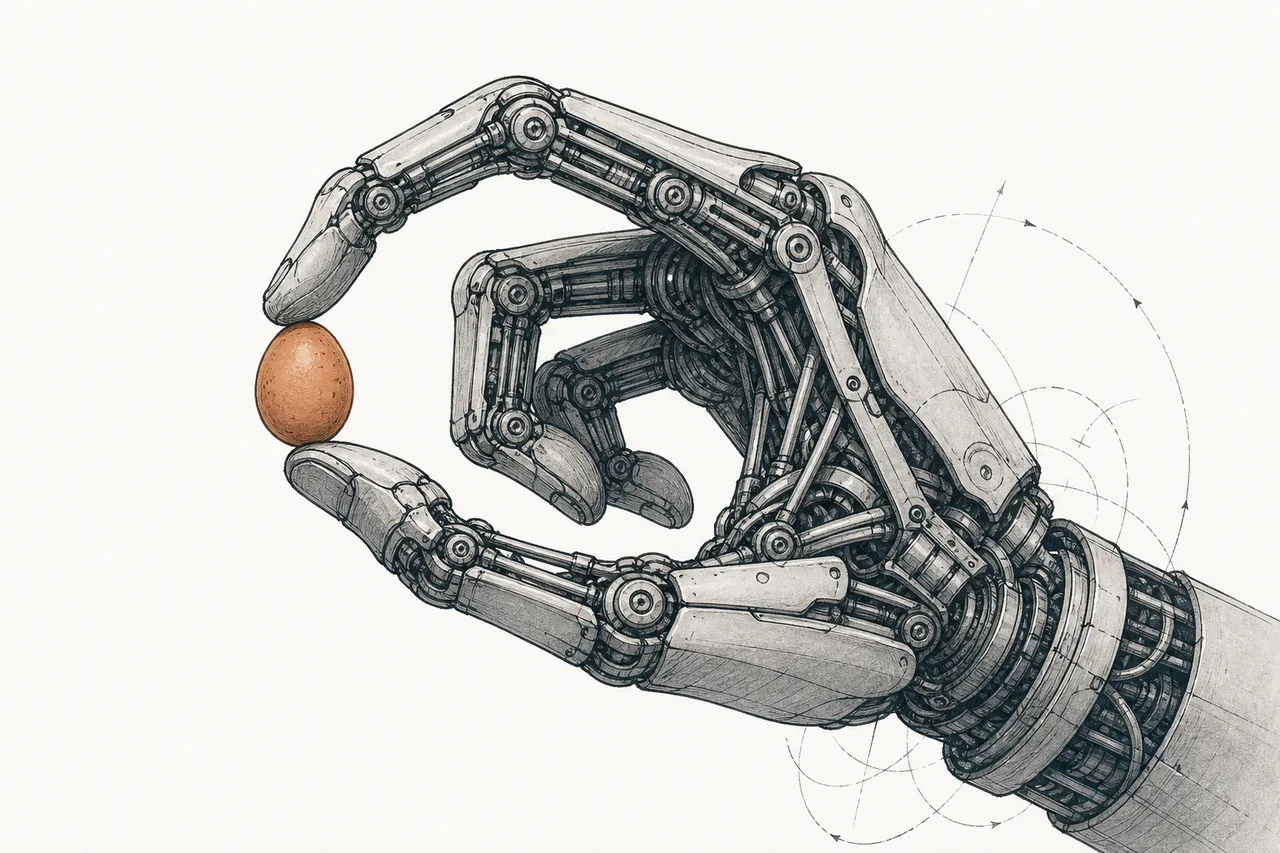
1. A dexterous hand (dexterity) — this is the brutal one. The human hand has 27 degrees of freedom (points that can move), thousands of touch sensors, and is controlled by one of the largest parts of the brain. Robot hands today range from 6 up to about 22 degrees of freedom — the Tesla Optimus Gen 3 pushed its hand to 22 (double the prior version) so it can fold laundry or use tools. But a typical 6-DOF hand still does only 60–70% of what a human hand can. 'Picking up a strange object it's never seen' is still an unfinished problem.
2. Balance and walking (locomotion) — walking on two legs over uneven ground, climbing stairs, or staying upright after a bump is a very hard control problem. It's improved a lot in recent years (Optimus walks more steadily on rough ground), but it's still far more fragile than a person.
3. Battery — a robot that runs only 2–5 hours per charge isn't enough for a full shift. The Figure 02 is around 5 hours, Boston Dynamics around 4, some just 2 — energy is the quiet but real wall.
4. Cost and brain — cost is still high (~$55,000 per unit for Optimus today, against a target price of $20,000–30,000), and a 'brain' that generally understands the real world still isn't there — most demos are still remote-controlled by a person (teleoperation) or work in a set-up environment, not a robot that 'thinks and acts on its own.'
A new type of AI model that takes in a camera's 'image + a human-language command' and outputs an 'action' directly (like Figure's Helix, or models from Robotics AI & Embodiment Software). It's the bridge that lets robots follow spoken instructions without programming each move one by one — and a big reason this trend is buzzing right now.
05How it connects in the ecosystem
Humanoids are the 'end application' that pulls everything from other trends into one place — the point where many trends meet:
- Sits under Robotics & Physical AI: the humanoid is the most ambitious form of robot — its parent bundles together every kind of robot and the actuation/perception supply chain
- Depends directly on Robotics Components & Actuation: high-precision actuators, servo motors, and sensors are the layer that eats half the cost — the bottleneck that decides how cheap a robot can get
- Driven by Robotics AI & Embodiment Software + AI: the 'brain,' VLA, is what turns a humanoid from a toy into a worker — and the raw AI (models/chips) comes from the AI trend
- Relies on Critical Materials & Supply Chain: powerful motors need rare-earth magnets, whose supply chain China controls — a geopolitical weak point
- Answers the aging society: the main long-term demand is filling in for a shrinking workforce
A point to keep in mind: the ones who make money first in this trend usually aren't the ones building the full robot, but the ones selling the parts (actuators, motors, sensors) to every camp — like a gold rush, where the people selling shovels get rich before the people digging gold. That's why many listed companies in this trend are actually parts makers, not robot builders.
06Where it stands now
2025 was the year humanoids first 'left the lab' and moved into real-world trials (pilots) — but emphasis on the word trials. The work they can actually do is still simple, repetitive jobs in factories/warehouses under controlled conditions — not a robot in your kitchen at home.
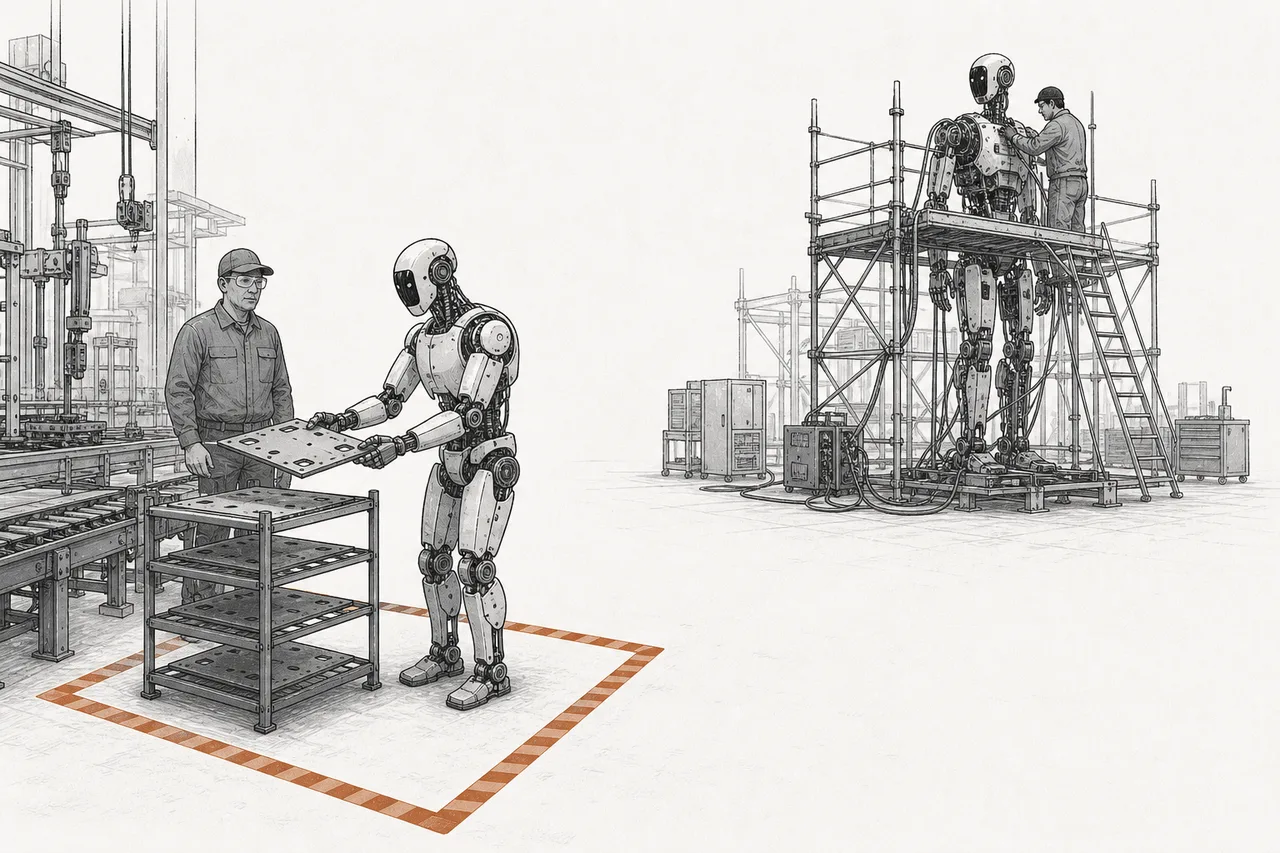
Concrete examples: Figure placed the Figure 02 at a BMW plant (Spartanburg) for 11 months, placing over 90,000 metal parts at better than 99% accuracy per shift · Agility sent its Digit robot to test at an Amazon warehouse moving empty boxes · Tesla started using Optimus in its own factory, though Musk admitted in Q4 2025 that 'most of it is still for learning, not work that produces real output.'
The big-picture numbers show both the speed and the smallness: humanoid robot deliveries in 2025 were about 50,000 units worldwide (up ~250% from the year before) — very fast, but still tiny against a workforce of billions. And importantly, China holds about 85% of deliveries and absorbs over 60% of world demand, largely because Chinese robots are much cheaper.
07The road ahead
The first direction is the 'falling-cost path.' The whole field is betting prices will plunge the way they did for batteries and solar panels — at high volume, actuators and parts get cheaper. Part of why Goldman raised its estimate is that it expects material costs to drop about 40%. If one unit really falls to $20,000, the equation 'a robot is cheaper than a year of human labor' would change several industries.
The second direction is 'the brain improving faster than the body.' The main progress from here should come from VLA software, not hardware — robots will increasingly 'learn new tasks' by watching people, or from simulation data, cutting the need to program each move. This is exactly where humanoids will gradually shift from teleoperation toward genuine autonomous work.
The third direction is 'China vs the US.' China has made robotics a national agenda, pouring in both capital and policy, and holds a supply-chain edge (motors, magnets, mass production). The US, meanwhile, leads on the AI 'brain.' This contest will decide who controls the trend's prices and standards — and it's both an opportunity (faster price drops) and a geopolitical risk.
08Challenges & risks
This trend is exciting, but you have to view it with feet on the ground — it carries its own risks that are heavier than many trends.
The first risk is 'it's genuinely still early, and the gap between demos and real work is still wide.' Videos of robots dancing, making coffee, or folding laundry are often remote-controlled or done under set-up conditions. Autonomous work in the messy real world still isn't there — don't confuse 'can do it in a clip' with 'usable for real at scale.'
The second risk is 'cost and hand dexterity.' These two walls haven't been broken. If cost doesn't fall as hoped, or hands still can't grip a wide range of objects well enough, the real market will be far narrower than the dream. And every market-estimate number (from $38B to $5 trillion) rests on the assumption that 'these problems will be solved.'
The third risk is 'a hype bubble.' Massive capital is flowing in and private-company valuations are soaring (Figure at ~$39B despite no real revenue yet) — if the path to profit is slower than the market believes, the correction can be brutal. And because most of the leaders are private, retail investors who want to play this trend usually have to enter indirectly (parts makers, or big companies with a robot project hidden inside), which dilutes the link to 'humanoid success.'
In short: humanoids are the attempt to make a robot that 'fits the human world instantly' by giving it our shape. The engineering reason is solid (the world is built for humans) and the timing has arrived (AI + labor shortage), but the real thing is still only at the pilot stage in factories, cost is still high, hands are still clumsy, and most leaders are still private and pre-revenue — this is one of the biggest long-term bets of the era, one to view with excitement and caution in equal measure.