Megatrend · Defense & Geopolitical Fragmentation
If the attacker is a thousand-dollar drone, the question is how you "shoot it down" without going broke first
If the sibling node tells the story of the "spear" — cheap, mass-producible drones and loitering munitions that fly off to kill on their own — this node is about the "shield": the systems that detect, track, decide, and destroy the other side's swarm of drones. It sounds like just "shooting them down," but the real heart of it is a cost equation: you can't fire a million-dollar missile at a $400 drone. That's exactly why lasers, high-power microwaves, jammers, and cheap interceptors have become one of the fastest-growing money-makers in the defense business.
01What it is
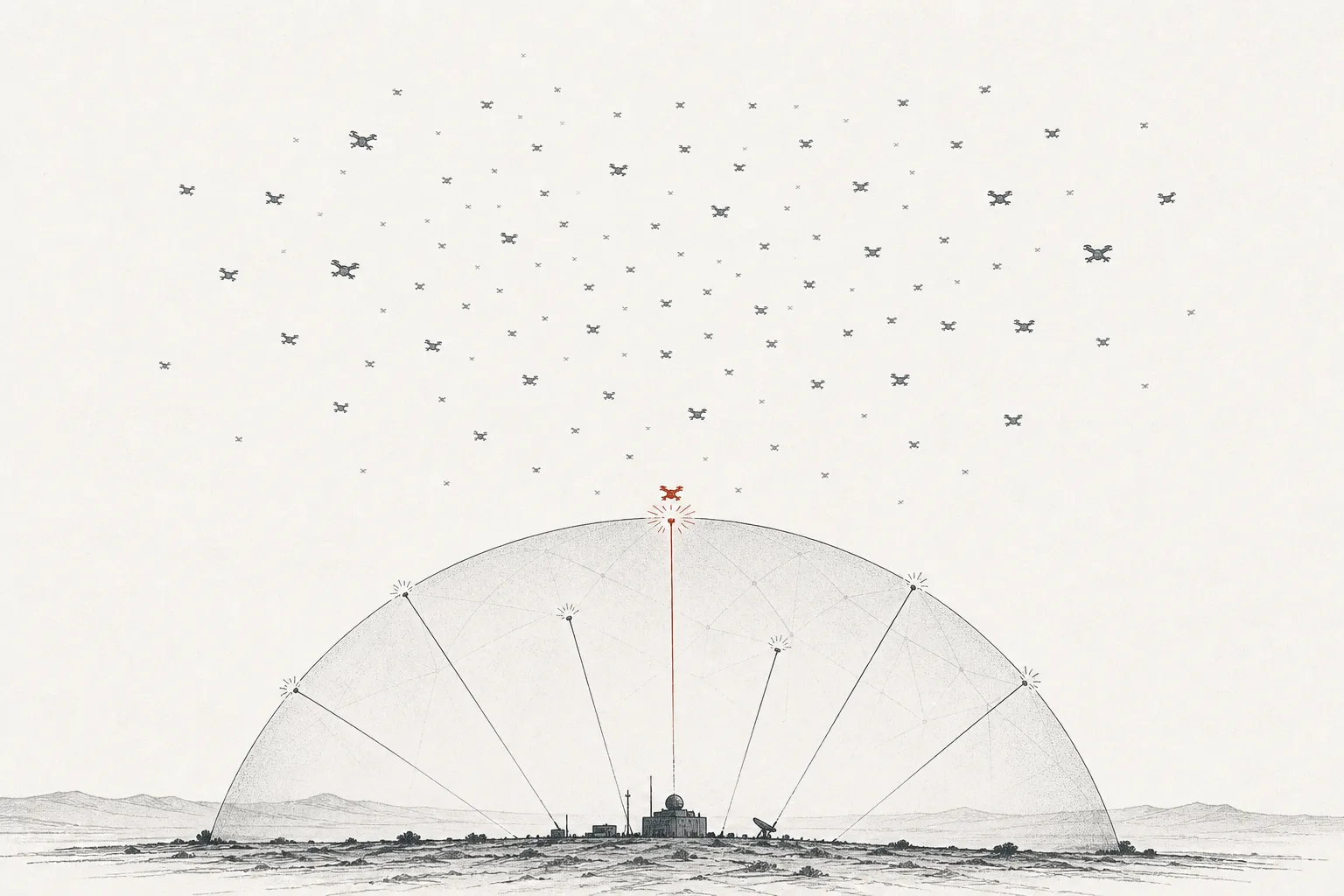
Picture this — a swarm of tiny flying machines, a few thousand dollars each, heading toward you by the hundreds or thousands, each maybe carrying a small bomb. The defender's question isn't "are these scary" (they are) — it's "how do we stop every one of them without paying a thousand times more than they cost". That's the whole problem of this node.
Counter-UAS (short for Counter-Unmanned Aircraft System), or counter-drone, is the system that detects, tracks, and destroys threatening unmanned aircraft. It's not a single product but a set of tools that work in a chain: sensors (radar · RF receivers that catch radio signals · electro-optical/infrared cameras) that "see" the drone · the brain that decides friend or foe and gives the order · and the kill mechanism, which comes in two big flavors — "soft" (soft-kill) that jams the signal or spoofs it to make the drone lose its way or crash on its own, and "hard" (hard-kill) that actually shoots it down with a laser, high-power microwave, interceptor, or gun.
The easiest way to understand this node is to see it as the "shield" paired with the "spear". The spear is its sibling node — Loitering Munitions & Combat UAS (the attacking side's drones and loitering munitions). Both sit under Autonomous Systems & Counter-Drone within the big megatrend Defense & Geopolitical Fragmentation. The interesting part: the cheaper and more numerous the "spear" gets, the more demand for the "shield" surges — the two grow together, a cat-and-mouse chase that never ends.
Soft-kill = you don't shoot anything, you play with "signals" — jamming the control link (jamming) or fooling the satellite-navigation signal (spoofing) so the drone gets lost or crashes itself · Hard-kill = you actually destroy the drone with an interceptor, gun, laser, or microwave · Directed energy = a high-power laser or high-power microwave (HPM) that "fires" a beam of energy. The cost per shot is very low because you just use electricity — no ammunition to burn.
02Why it matters — the cost-per-intercept game
There's one sentence that explains this entire industry in a single line: "you can't fire a million-dollar missile at a $1,000 drone". It sounds like ordinary logic, but this is a trap the world's top militaries are actually stuck in — existing air-defense systems were designed to shoot down expensive aircraft and missiles. Turn them on cheap drones and you end up "winning the battle but losing the cost war."
So this node's importance isn't "can you hit it" (the technology is ready) but "is it worth it once you do". And that's why money is flowing in so fast. The global counter-UAS market is around $6.6 billion in 2025, and many research houses expect it to reach about $20 billion by 2030, at an average growth rate as high as about 25% a year — one of the fastest-growing segments in the entire defense industry.
Who pays this money? The answer shows up clearly in real contracts. In late 2025, the U.S. Army signed a deal with Raytheon (RTX) worth up to $5.04 billion for the Coyote system (the interceptor) paired with the KuRFS radar — the first long-term agreement that says plainly, "this is no longer something you buy one at a time, it's a permanent program." The demand comes from two places at once: the lessons of the Ukraine battlefield, where drones became the main threat, and the tension in the Middle East, where bases and infrastructure are hit by drones again and again.
What makes this node interesting from an investment angle is that it's a "market that forces itself into being" — as long as cheap drones keep getting cheaper and more numerous (which is actually happening), every base, every airport, every big event, every piece of critical infrastructure has to have a shield. This isn't demand that fades with the economic cycle, it's a structural necessity that's only just beginning.
03How it works — the detect → destroy chain
The heart of counter-drone is a four-link "chain" that has to work without a break in a matter of seconds. If any one link breaks, the whole system fails. Let's walk through it step by step — from the moment a drone appears to the moment it's stopped, what happens.
What makes these things "hard" is link 4, because each option has a wildly different cost per shot. Jamming (soft-kill) has almost no cost per use — you just switch on a transmitter — but it doesn't work on the new drones flown by fiber-optic cable (no signal to jam) or flying themselves with AI. Shooting it down (hard-kill) is more reliable but expensive — even a budget interceptor like Coyote still costs about $100,000 a round, dozens of times more than the target drone. That's why everyone is racing for a cheaper answer — lasers and microwaves, where the cost per shot is "just the electricity bill."
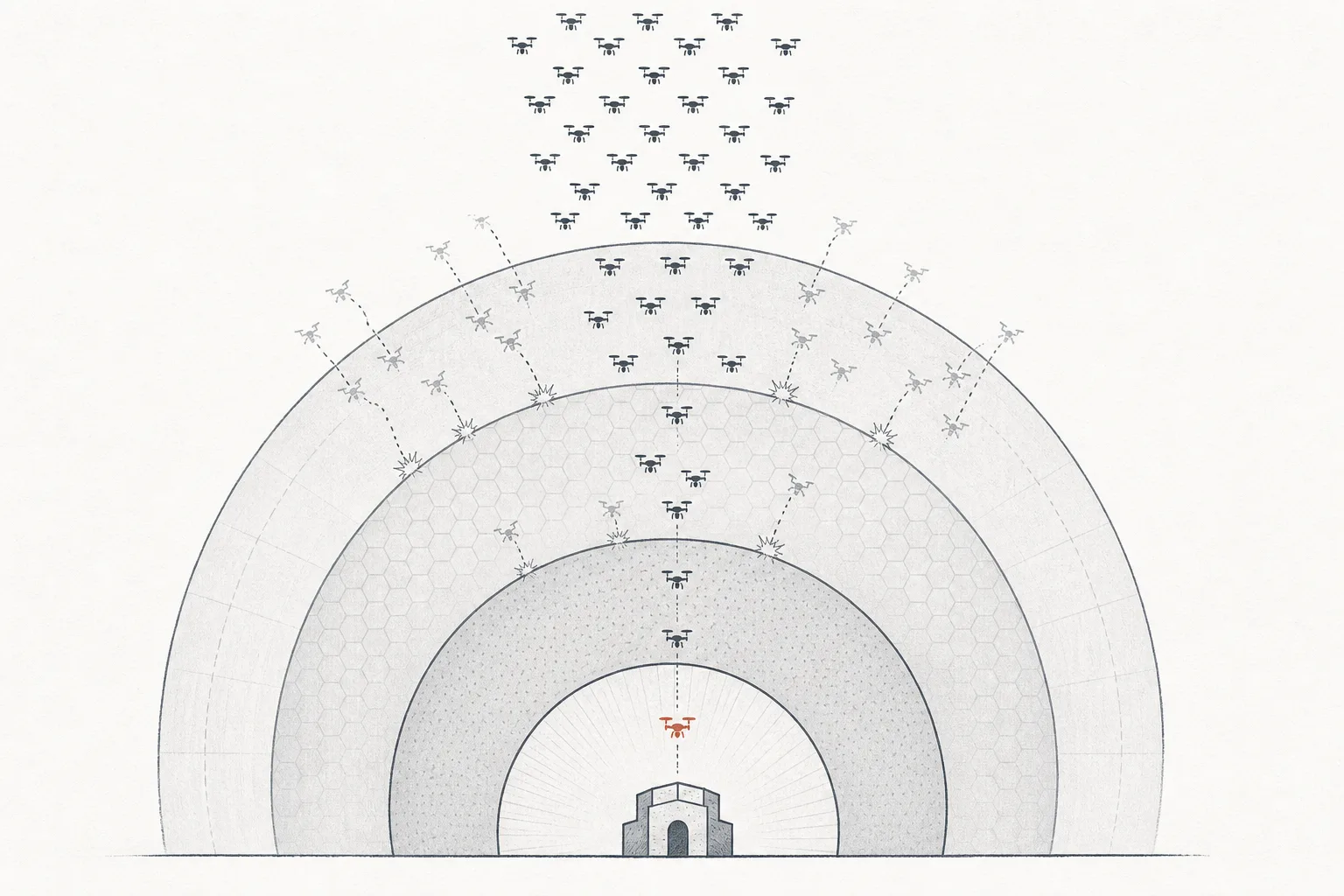
But in real life no single method "wins every case." New drones are designed to dodge one thing at a time — fiber-optics escape jamming, rain and fog cut a laser's effectiveness, a large swarm leaves a limited stock of interceptors short. So the answer isn't "one magic weapon" but layered defense — stacking several systems so one layer covers another's blind spot, and using an AI brain to pick what each threat should be stopped with most cost-effectively.
04How it connects in the ecosystem
This node sits at the "platform layer," perched on top of several technologies, and it has clear relationships with its neighbors on the megatrend map:
- The "shield" paired directly with the "spear" — Loitering Munitions & Combat UAS: these two sub-nodes are perfect opposites. The attacking side makes drones cheaper and smarter (fiber-optics, flying themselves with AI); the defending side has to keep pace — every time the "spear" advances, the "shield" has to change. This is the engine that keeps both growing
- Reinforces traditional air defense — Missiles & Air Defense: counter-drone doesn't replace air-defense systems, it fills the "bottom layer" that older systems are too expensive to handle — pricey missiles for big targets, cheap lasers/microwaves/interceptors for swarms of small drones, making a defensive pyramid with every layer covered
- Relies on AI as the brain: on a field where drones come in swarms, having a person watch a screen and fire at them one by one is impossible. AI is what lets the system "see — tell friend from foe — choose how to stop it" in seconds, and the more the attacking side's drones fly themselves with AI, the more the defending side has to fight back with AI too
- Depends on raw materials and space: sensors, radar, and electronics need rare earths and components controlled by global supply chains, while some of the detection and navigation relies on signals from satellites — which is why this node connects to both the raw-materials supply chain and the space economy
05Where it stands now
The picture right now is that money and urgency are pouring in from both sides at once — both the traditional defense giants with their big contracts and the newcomers bringing technology logic to the challenge. Start with the giants: RTX (Raytheon) is the king of the interceptor market, with the Coyote system paired with the KuRFS radar (which detects small drones out to about 16 km), and it just landed a $5.04 billion Army contract in late 2025. The new Coyote Block 3 is designed to be "reusable" to push down the cost per shot.
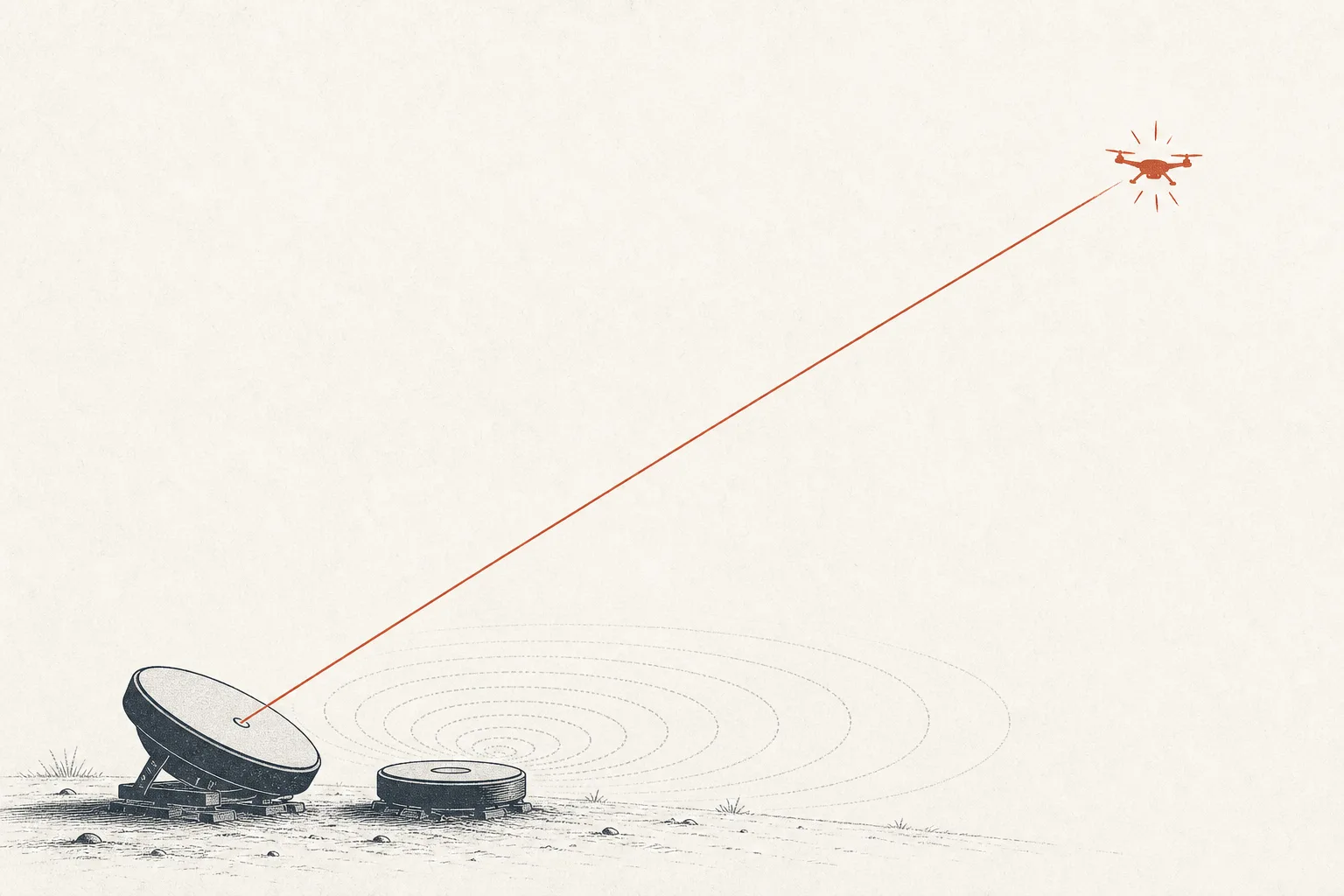
On the directed-energy side, Lockheed Martin leads in lasers with its 60-kilowatt HELIOS system (scalable to 120 kW), installed on the destroyer USS Preble, which shot down several drones in testing. The selling point is "a few cents' cost per shot" — but it has a weakness in rain, fog, and dust, which scatter the beam.
But the hottest story of this period is the rise of newcomers and specialist companies that don't come from the traditional defense lineage:
Anduril (a private company) sells the whole "layered defense" idea through its Lattice command system, which pulls together multiple sensors and kill mechanisms — from jamming (Pulsar) to kinetic interceptors (Anvil) — and lets AI choose the most cost-effective way to stop a threat. In 2025–2026 it landed a $642 million counter-drone contract with the U.S. Marines and became the first winner on an Army framework contract with a ceiling as high as $20 billion over ten years.
Epirus (private) is the rising star on the high-power microwave (HPM) side. Its Leonidas system fires a sweep of microwaves all at once that can "down many drones in a swarm at the same time" (one-to-many) — a direct answer to the large-swarm problem. In 2025 it won a second-generation (Gen II) contract from the Army worth about $43.5 million and raised another $250 million in Series D, pushing total funding past $550 million.
And the real standout on the stock market is DroneShield (DRO), an Australian company that's a true counter-drone "pure-play" — it makes both RF detectors and portable jammers (the DroneGun family). In 2025 its revenue surged to about A$216 million (up ~276%), having sold over 4,000 systems, with an order pipeline as high as about A$2,550 million — a clear example of how a small company focused on one thing can grow very fast once the drone threat becomes real.
What you need to understand is that many of the leaders on the most cutting-edge kill side (like Anduril and Epirus) are still private companies not on the stock market — a feature of a field that's still new and flooded with private capital. So for stock-market investors, the way into this trend is usually through the traditional giants (RTX, Lockheed, Kratos, AeroVironment) or a pure-play like DroneShield, rather than the private challengers directly.
06What's next — directed energy and layered defense
The first direction is directed-energy weapons gradually moving out of the lab and into the real field. High-power lasers and microwaves are the only real answer that can "flip the cost equation back" — a cost per shot low enough to shoot down cheap drones all day without going broke. Right now these are still at the early stage of real deployment (HELIOS on just a few ships, Leonidas only just delivering test units), but the direction is clear: every camp is racing to add power, range, and resistance to bad weather.
The second direction is "layered defense" becoming the standard. There's no magic single weapon, so value flows to "the thing that ties everything together" — the command system that links multiple kinds of sensors with multiple kinds of kill mechanisms and lets AI pick what to stop each threat with. This is why software (like Anduril's Lattice) may be the spot with more bargaining power than any individual piece of hardware, because it's the "brain" that every piece has to plug into.
The third direction is spreading beyond the battlefield. The drone threat isn't confined to the front line — airports, prisons, big sporting events, power plants, borders are all starting to need counter-drone systems. This is why a company like DroneShield, which makes affordable portable gear, has a pipeline spread across military, police, and civilian use — the "drone-safety" market is becoming a category bigger than just the military.
07Challenges & risks
This trend that looks so hot also has shadows you need to see fully.
The first risk is the "cat-and-mouse chase that never ends". Every time the defending side finds a way to stop them, the attacking side finds a new way to dodge — fiber-optic drones escape jamming, AI self-flying drones don't depend on a control signal, large swarms leave a limited stock of interceptors short. That means a system you buy today can go obsolete fast, and the seller has to keep investing in development non-stop — good for long-term demand, but a squeeze on each company's costs and technology risk.
The second risk is a cost equation that isn't settled yet. The directed-energy weapons everyone is pinning their hopes on still have real limits — lasers lose to rain, fog, and dust, and their power and range still need to grow, while the interceptors that definitely work are still too expensive to fire by the thousands. In this transition period, "something that really works and is cheap enough" isn't fully ready — and that's the gap the attacking side may exploit.
The third risk is the ethics and regulation of autonomous systems. The faster a system can "see — decide — fire" on its own, the heavier the question of human control (human-in-the-loop) gets — who's responsible if the AI hits the wrong target? On top of that, jamming and satellite-signal spoofing can affect nearby civilian aviation and GPS signals, putting legal limits on use in urban areas. And many funds already have policies against investing in weapons, so the autonomy issue may narrow this group's investor base and make it swing with the tides of policy.
In short: this node is the defensive answer to a threat that just changed the whole battlefield — as long as drones keep getting cheaper and more numerous, the shield that keeps pace always has to exist. And the winner won't be the one who "hits best" but the one who "stops drones most cost-effectively, time after time."