Megatrend · Defense & Geopolitical Fragmentation
The $35,000 drone that made the $5 million tank pointless
This is the story of the "attacking" side of unmanned weapons — the self-destructing drones that loiter over a target and then crash into it (loitering munitions) and the combat drones that work like unmanned fighter jets. These are cheap enough to make by the millions and "expendable" — losing one doesn't hurt. They're flipping the economics of the entire battlefield, and making "the most expensive thing" lose to "the cheapest thing you have the most of" — for the first time in decades.

01What it is
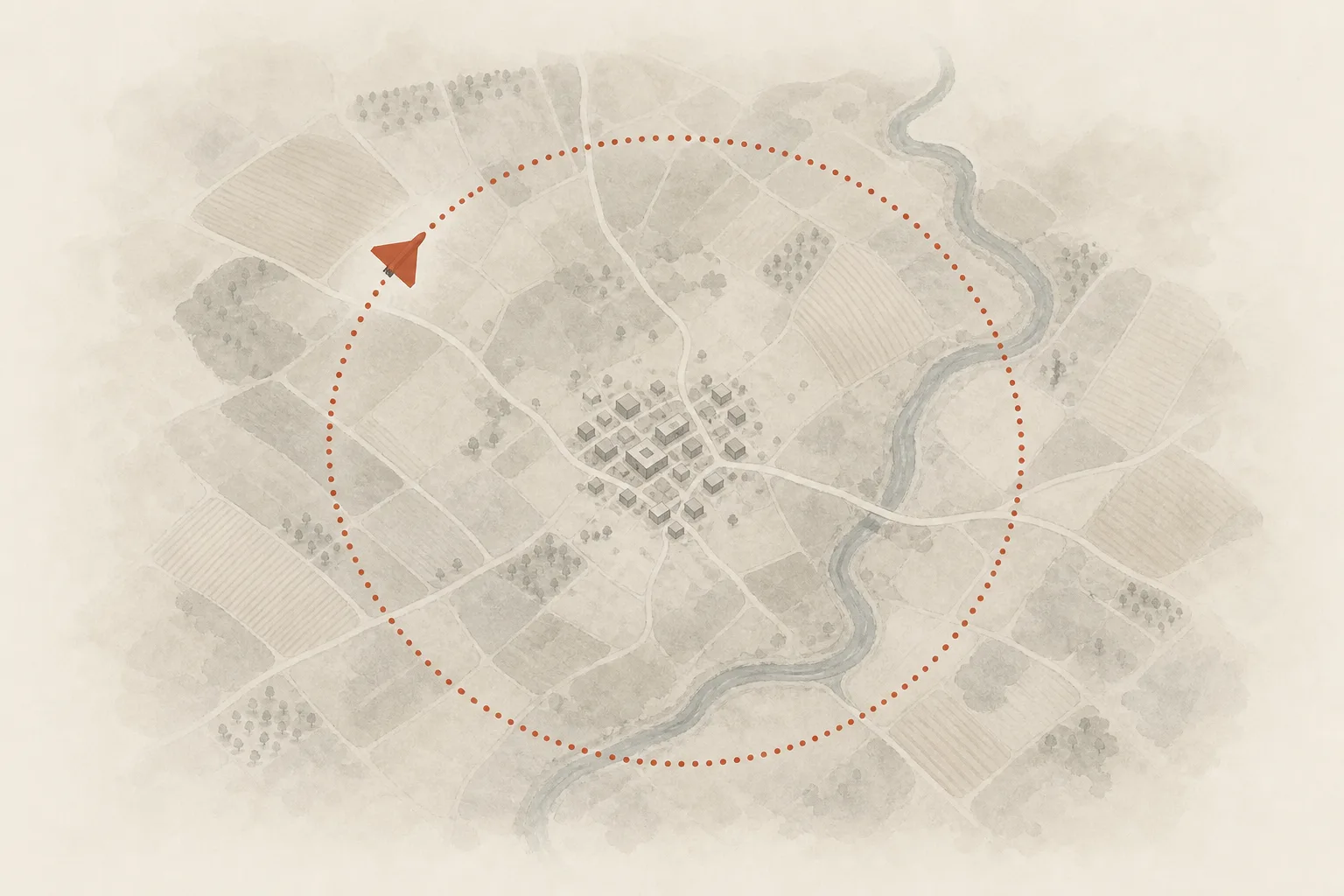
Picture a weapon that's a cross between a "drone" and a "bullet" — it takes off on its own, loiters over the target area for minutes or even hours, scans for what to hit, and once it finds a target, dives in one way, never coming back. This is a loitering munition, what some call a "kamikaze drone" — and it's the heart of this node.
This node is about the "attacking" side of unmanned weapons, which splits into two main types worth telling apart:
- Loitering munition (kamikaze drone): cheap, one-way, the airframe itself is the warhead. From the backpack-sized Switchblade in the U.S. to Iran/Russia's Shahed-136 that flies hundreds of kilometers — priced from thousands to hundreds of thousands of dollars
- Combat UAS (combat drones that return to base): armed unmanned aircraft that fly back and get reused — from large surveillance/strike drones to "wingman drones" (collaborative combat aircraft) that fly alongside manned fighters like a left wing
Loitering munition = an unmanned aircraft that can "loiter" over a target for a while before crashing in — half drone, half bullet. · One-way: not designed to return; the airframe itself is the warhead, unlike a surveillance drone that has to fly back. · Attritable = "expendable" — cheap enough that you'll accept losing it without it hurting, the opposite of an exquisite platform (a high-end, expensive machine you can't afford to lose).
On the megatrend map, this node is the deepest sub-branch under Autonomous Systems & Counter-Drone within the big trend Defense & Geopolitical Fragmentation. It's the "attacking" side of the equation — the "defending" side is the sibling right next door, Counter-UAS / Counter-Drone (systems that detect and stop drones). The two are a pair: the cheaper and more plentiful attack drones get, the more counter-drone systems are in demand. This lesson focuses on the "spear" — for the "shield," read on at the neighboring node.
02Why it changes warfare
For decades, top militaries followed one formula: build the best weapon, even if it's expensive and few in number. A few hundred cutting-edge fighters could beat a weaker side. But the war in Ukraine since 2022 has exposed a truth that shakes the textbook: when the other side has cheap things by the millions, "best" may not matter as much as "most".
The number that tells this story best is the Shahed-136 — the kamikaze drone Russia fires at Ukraine, costing just $35,000–50,000 each. But what you have to launch to shoot it down is an interceptor missile costing $500,000 to $1 million a shot. In the winter of 2025–2026, Russia fired Shaheds at an average of about 211 a day for 90 straight days — nearly 19,000 in all. However you count the cost per unit, it's vastly cheaper than the interceptors Ukraine has to burn to defend. This is a "cost war" the cheap side wins before a shot is even fired.
And this isn't just about the Shahed. Ukraine itself builds FPV drones (first-person-view drones, priced in the low thousands of baht) at a scale targeting over 7 million units in 2026, with more than 160 companies involved in production — a volume that turns the battlefield from "a clash of expensive platforms" into "a war of factories that stamp out cheap things faster." Once cheap things can knock out expensive ones again and again, what follows is defense money starting to flow a new way.
More important than the market's size is the speed of the change — this is the fastest-growing part of the defense industry. Because it doesn't just add a new kind of weapon; it questions every "expensive platform" militaries have stockpiled for decades, asking whether they're still worth it in a world where cheap things fly in by the swarm.
03How it works (loiter–crash)
The most important difference among these weapons comes down to a single word: "return" or "don't return". Let's walk step by step through how one kamikaze drone works, from launch to impact, then compare it to a combat drone that flies back to base.
What's changing the game is step 3, "identify the target". Originally a human decided, watching the video the drone sent back. But on a modern battlefield full of jamming, the signal between drone and operator often gets cut. The answer is to put an "AI brain" on the drone itself — a human picks the target from outside the jammed area, then lets the drone fly in and hit the target on its own in the final stretch, with no signal for anyone to jam. This "fly the last stretch yourself" ability (terminal autonomy) is exactly what's making cheap drones harder and harder to stop.
04How it connects in the ecosystem
This node is a "spear" that doesn't stand alone — it sits on several layers of technology and is entangled inseparably with neighboring branches.
- The counterpart to Counter-UAS / Counter-Drone: every time attack drones get cheaper and smarter, the "shield" side — radar, jammers, lasers, and interceptors — becomes more necessary. These two branches are an endless cat-and-mouse game, and usually different groups of companies
- Both complements and competes with missiles & precision-guided weapons (PGM): a $35,000 kamikaze drone overlaps with cruise missiles costing millions — some missions that once needed expensive missiles can now be done with cheap drones. So it's both a complement to and a competitor of traditional guided weapons at the same time
- Relies on autonomous AI (agentic / autonomous AI) at its core: what lets a drone "fly itself and decide for itself in the final stretch" is the AI brain that navigates and locks onto targets even when the signal is jammed — the heavier the jamming on the battlefield, the more autonomy becomes the main advantage
- Relies on critical raw materials: a drone's motors, batteries, and magnets need rare earths whose supply chain China controls — even "making cheap things in bulk" runs into the same raw-material bottleneck as the whole industry
- Close to but not overlapping with civilian drones: much of the base technology is shared, but the military side differs in durability, autonomy, and operating under jamming — and some companies cross back and forth between the two markets
05Where it stands now
The biggest story right now is that many of the real players are still private companies that aren't on the stock market — led by Anduril. In mid-2026 it raised another $4 billion, pushing its valuation to $61 billion. Its Arsenal-1 factory is designed to build the Fury combat drone with mass-production logic (targeting around 150 a year), plus the low-cost Barracuda family of cruise missiles — the very idea of "weapons that come off the line like cars." Meanwhile Shield AI (also private) owns the autonomous-pilot software Hivemind, which gets put on both its own drones and other companies'.
On the public-company side you can actually invest in, things are accelerating at full tilt. AeroVironment (AVAV) owns Switchblade — the backpack-sized kamikaze drone that's been through real combat — and as of January 2026 its funded backlog reached $1.1 billion (up from ~$727 million in April 2025), plus another ~$2.8 billion in unfunded orders. And in May 2026, the U.S. Army formally selected Switchblade for the LASSO program.
Another name is Kratos (KTOS), owner of the low-cost Valkyrie combat drone (XQ-58) — it posted total revenue of ~$1,347 million in 2025 and guided 2026 to about $1,700–1,760 million, with the unmanned-drone unit (KUS) accelerating about 31% in Q1 2026. In early 2026 the U.S. Marine Corps picked Kratos (paired with Northrop Grumman) to develop the service's first "wingman drone" — the collaborative combat aircraft arena is becoming a battlefield where old giants and newcomers compete head-on.
And behind these Western companies is Ukraine's "war factory", producing kamikaze drones and FPVs at the scale of millions a year from more than 160 companies — a real-world lab that proves "cheap things in bulk" works, and the template militaries worldwide are now copying.
06What's ahead — swarms of drones that think for themselves
The first direction is the "drone swarm" — instead of sending drones one at a time, the future is launching dozens or hundreds at once and letting them divide the work among themselves: some decoy, some scout, some crash in, with a human managing only the "overall objective," not flying each one. This is where AI becomes the heart of it — a swarm that can coordinate itself makes the defending side's interception many times harder.
The second direction is wingman drones (collaborative combat aircraft) — cheaper autonomous drones that fly alongside manned fighters, adding "numbers" without adding pilots. In 2025–2026 the U.S. Air Force selected General Atomics (YFQ-42A) and Anduril (YFQ-44A) into production, while the Marine Corps chose Kratos — and what's interesting is that Anduril's Fury prototype flew semi-autonomously using both Shield AI's Hivemind software and its own Lattice system, showing that the "brain" is becoming a swappable component.
The third direction is the race to "make it fast and cheap". The lesson from the Pentagon's pilot programs is that the will is there, but the old procurement system can't keep up with the speed of war. So the future is about who can adapt production lines and procurement fast — and that's why companies that think like car factories (mass-produce, update software quickly) have a chance to overtake incumbents who are good at long, large programs.
07Challenges & risks
This hot-looking trend has shadows you can't overlook.
The first risk is the ethics of autonomy. The more a drone can "pick a target and decide to crash in on its own," the heavier the questions of human control (human-in-the-loop), international law, and accountability when something goes wrong. Many funds already have a policy of not investing in weapons, and the "autonomous lethal weapons" issue could narrow this group's investor base and make it swing with the policy/ESG mood.
The second risk is the "shield" that follows close behind. Every time attack drones work, the counter-UAS side races to develop jammers, lasers, and cheaper interceptors to fight back. This is a cat-and-mouse game where the "spear's" advantage may be only temporary — a drone that makes money today could be rendered obsolete by a new defense system within a few years.
The third risk is that "cheap" is a double-edged sword. This node's strength is being easy and cheap to make. But that also means anyone can make it — China controls nearly the whole world's supply chain for civilian-drone parts, and cheap rivals from many countries keep thinning the profit per unit. Unlike high-end weapons with high technology walls and fat margins, the "cheap things in bulk" business may become an arena competed on "volume and speed" more than "profit per unit."
In short: this node is the lesson that sometimes what changes warfare isn't the best weapon, but the one "cheap enough to have in great numbers." The world discovered this in Ukraine — and it has ignited the biggest flow of budget and the fiercest competition the defense industry has seen in decades. Whoever controls the "brain" and the "production line" first is the one who sets the game from here.