Megatrend · Aging Population
The missing teeth of the old, and the smile the young will pay to make beautiful
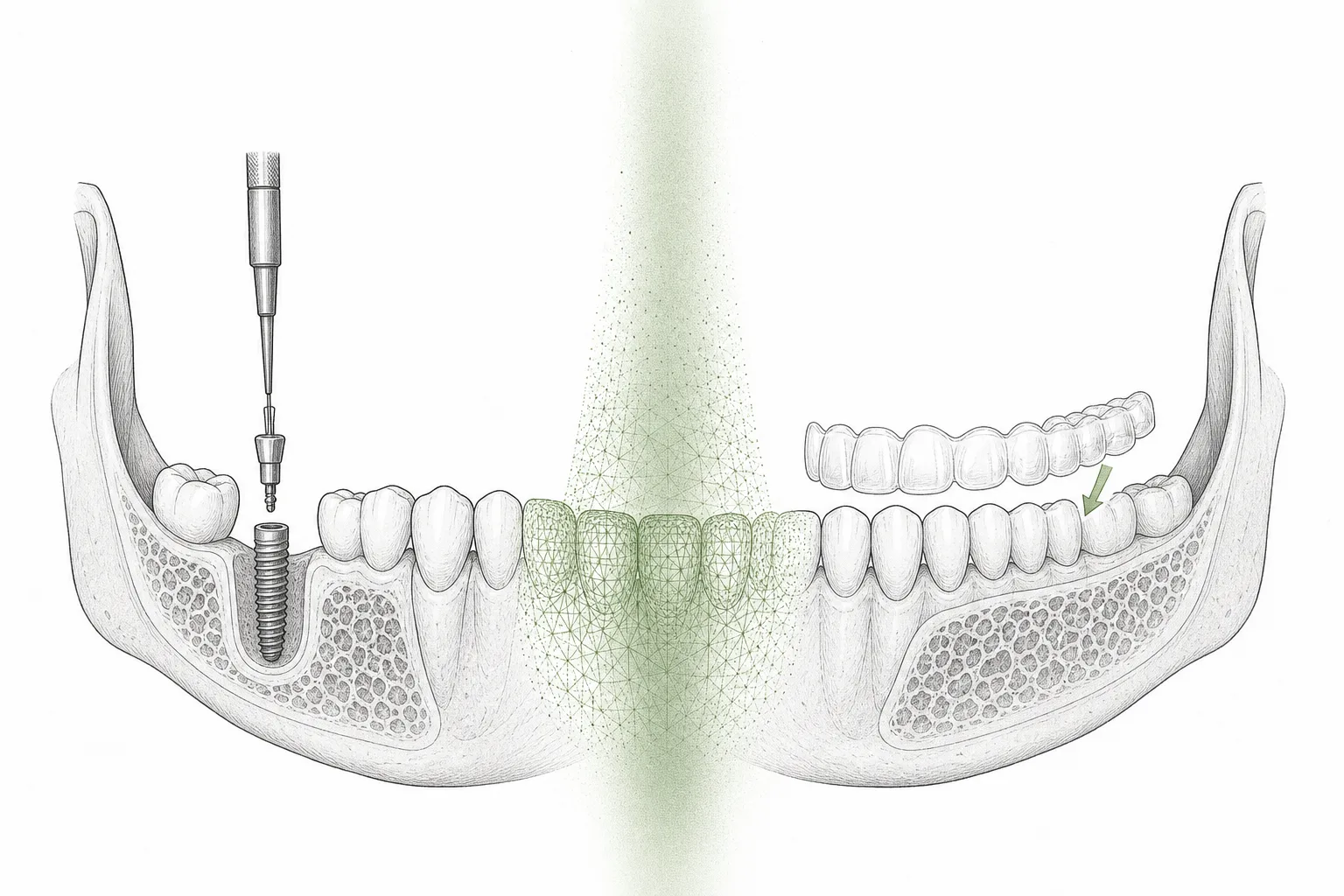
Seen through an investor's lens, dentistry is two markets that look like different stories but run on the same set of digital tools — one side is the implant, the titanium post that replaces a tooth lost to age, a market growing quietly on the aging wave. The other is the clear aligner, the Invisalign-style clear plastic tray that the young will pay thousands for the sake of looks, a market growing ~27% a year. And what stitches the two sides together is the intraoral scanner and CAD/CAM, which turns a putty mouth-impression into a 3D file in seconds.
01What it is (implants + clear aligners + digital)
Picture two people walking into a dental clinic on the same day. The first is 68, has lost two molars to age, and can't chew well — he's here to "get his teeth back." The other is 24, has a full set but a crooked smile — she's here to "make her smile better." These two are the two hearts of this node, and what's interesting is that both pay out of their own pocket — this isn't something insurance or the state covers.
Through an investor's lens, dentistry splits into three intertwined legs:
- Dental implant: a tiny titanium post implanted into the jawbone to replace a lost tooth root, with an artificial tooth (crown) on top. A market driven by the aging wave — because the older you get, the more teeth fall out
- Clear aligner: a clear plastic tray that gradually nudges teeth into place, replacing the old metal braces. Driven by cosmetics — people pay for a better smile. The most famous brand is Invisalign
- Digital dentistry: the intraoral scanner, design software (CAD/CAM), and 3D printer — the "infrastructure" that stitches the first two legs together
On the megatrend map, this node is a sub-branch under Hearing / Vision / Dental within the big trend Aging Population. It's the "teeth" among the three organs that wear out with age (ears, eyes, teeth) — its siblings are ears (hearing aids) and eyes (glasses/lenses). All three tell the same story: organs everyone has to repair someday, and usually pay for themselves.
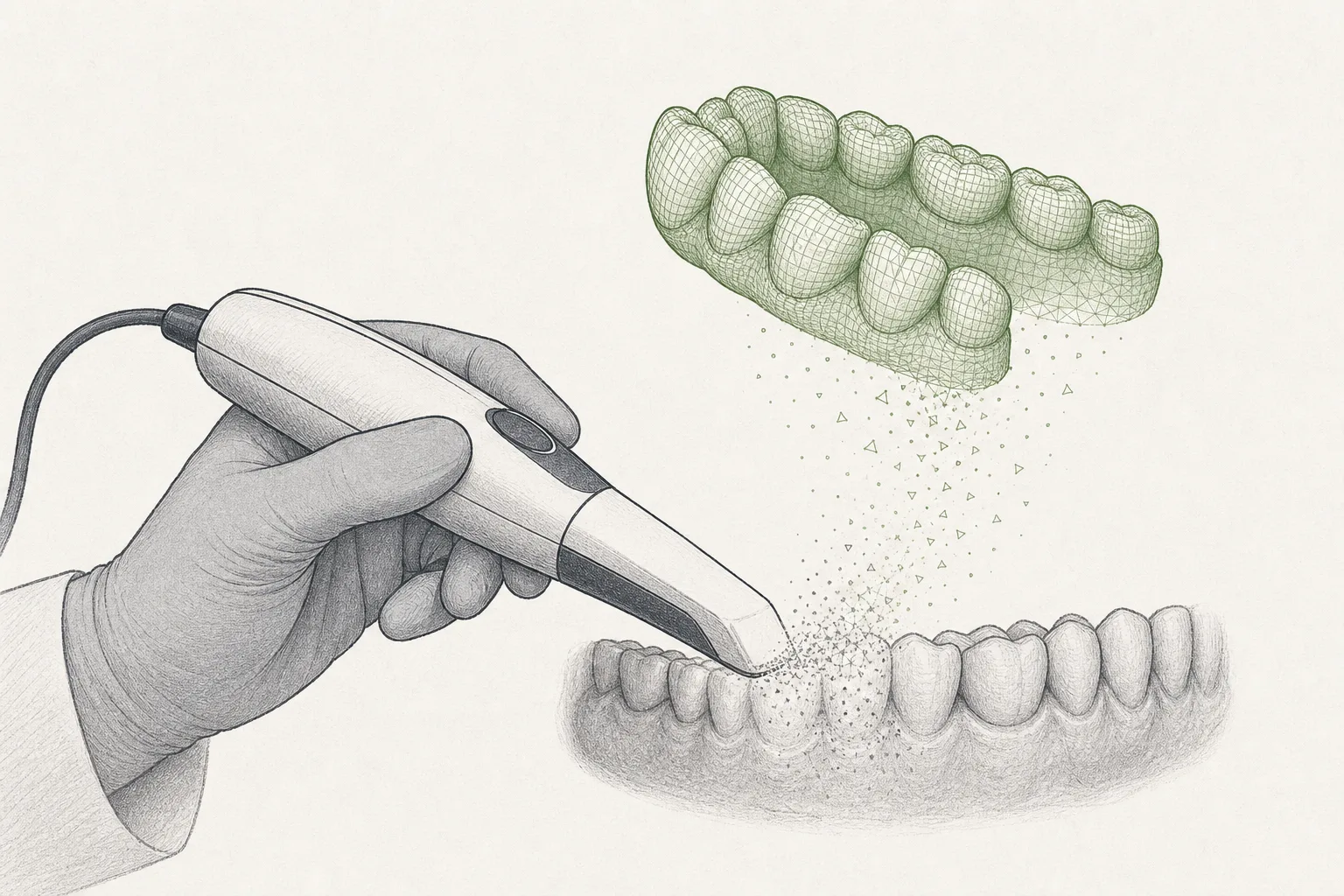
Implant = a titanium post embedded in the bone, acting as the "root" for a new tooth. Unlike a removable denture, it locks permanently into the bone · Aligner = a removable clear plastic tray, worn as a continuous series (dozens of trays), each one moving the teeth a little until they're in place · Intraoral scanner = a scanning pen that sweeps through the mouth and instantly produces a 3D model of the teeth, replacing the old putty impression — the "gateway" into both markets.
02Why it matters — two different drivers, but both big markets
What makes dentistry a good long-term business is that it has two engines that don't stall at the same time. The first engine is the aging population — teeth are an organ that surely wears down with use, and the older the world gets, the more people need implants. The global implant market is around $5.5 billion in 2025, growing about 7% a year — not flashy, but as steady as a slowly rising tide.
The second engine is beauty, and it runs much hotter. The clear-aligner market is around $8.3 billion in 2025 and is expected to reach $10.7 billion in 2026 — growing about 27% a year, nearly four times faster than implants. Because it doesn't sell to "people with tooth problems" but to "people who want a prettier smile" — a much larger and younger group.
And both engines share a "common point" that investors love: a self-pay, high-margin model. A single implant in the U.S. runs to several thousand dollars total; a full clear-aligner case is about $3,000–8,000. Insurance mostly doesn't pay, or pays only part, so the patient decides and pays out of pocket — a structure that lets makers price freely and earn handsome profits. But the trade-off is sensitivity to the economy, because it's something that "can be postponed" when money is tight.
03How it works (scan → design → a new tooth or a new smile)
What changed dentistry over the past decade is that everything starts with the same scan. Whether you come for an implant or a clear aligner, the first step is to sweep a scanning pen through the mouth and get a 3D model of all the teeth. Only after that does the path split into two.
This is why the intraoral scanner became the strategic choke point. Whoever controls the scanner in the clinic has a shot at both kinds of work, because the dentist uses the same device to route the case onward — Align Technology pours money into its iTero scanner not just because it wants to sell devices, but because every scan is a "gateway" that may end in an Invisalign order. Dentsply Sirona, for its part, has the Primescan scanner paired with CEREC software that designs and mills a crown in a single visit — in mid-2025 the company claimed AI cut crown design time by 62%.
04Where it sits in the ecosystem
This node doesn't float on its own. It's one of three organs that wear out with age under Hearing / Vision / Dental, and it connects to other trends in ways that make sense:
- Alongside ears (hearing aids) and eyes (glasses/lenses): all three are "organs that wear out with age, that people pay for themselves" — and all three are tilting more toward "consumer products." Hearing aids become AirPods, glasses become AR glasses, teeth become a matter of beauty you buy again and again
- Tied to Biotech & Genomic Medicine / Medtech: an implant is a medical device embedded in the body, requiring clinical certification and biomaterials — its world is much closer to medtech than to fashion products. Meanwhile, the future of "regrowing teeth" at the cellular level (regenerative dentistry) will come from the biotech side, which one day may compete with the metal implant
- Relies on digital and AI: the heart of the field now is the digital workflow — scan, design with AI-assisted software, then 3D print. The smarter the software and faster the printer, the lower the cost per case, and the more the market expands to people who once couldn't afford it
05Where it stands now
The picture now is a highly concentrated market locking horns over digital. On the clear-aligner side, the market leader is Align Technology, owner of Invisalign, which is almost a generic term for clear aligners. In 2025 the whole company brought in about $4 billion in revenue, of which the aligner-tray side was about $3.2 billion. In Q4 2025, tray revenue was $838 million, up 5.5%, with a record 677,000 new cases — but the growth figures are starting to soften versus the post-COVID peak, signaling that the market is filling up and competition is heating up.
On the implant side, the premium market leader is Straumann of Switzerland, strong on its clinical-evidence base and end-to-end digital system, and it has also pushed down into the value segment through its Neodent brand. Next is Envista (owner of Nobel Biocare on the implant side and Spark on the aligner side), whose revenue grew 14.4% in the latest quarter.
The most watch-worthy event of 2025 is that former rivals shook hands — Align and Straumann, who had been suing each other over aligner-tray patents, agreed to settle everything, with Straumann paying $35 million and signing a 5-year deal to distribute 5,000 of Align's iTero scanners — a deal that says clearly that the "scanner" is the real battlefield, not the plastic tray.
Another force shaking the board is the rise of Chinese players, especially Angelalign, which is pushing into overseas markets with lower prices — until September 2025 Align had to file with the U.S. ITC to block imports of Angelalign's aligner trays, alleging patent infringement — a sign that the technology wall around clear aligners isn't as high as around implants, and that China is catching up fast.
06The road ahead
The first direction is clear aligners keep growing, but the game shifts from "who thought of it first" to "who controls cost and channel better". A market growing ~27% a year keeps pulling in new players, and Invisalign's first patents have already expired, letting rivals make clear trays more cheaply. So the contest moves to treatment-planning software, scanners, and clinic networks — more than the plastic tray itself.
The second direction is 3D printing stepping in to replace milling. Crowns and aligner trays used to be sent to a lab to be milled from a block of material, but 3D printers are letting clinics print dentures, crowns, and aligner trays themselves, on site, cutting time and cost. Many players in this area are still private companies (like SprintRay), but it's a wave that will change the economics of clinics across the whole field.
The third direction is China and emerging markets — both as makers catching up fast (Angelalign, Smartee) and as a vast consumer market whose middle class is starting to pay for beauty and dental care — at once a huge growth arena and the birthplace of cheap rivals.
07Challenges & risks
The first risk is intensifying competition in clear aligners. Once the patents expire and a plastic tray is no longer a hard thing to make, new players (especially from China) keep pushing prices down. The fact that Align had to run to the ITC to block Angelalign reflects that even the market leader feels the pressure — the handsome margins it once had may get squeezed over time.
The second risk is the lesson of direct-to-consumer (DTC) that collapsed spectacularly. During COVID there was a wave of ordering clear aligners online without seeing a dentist, led by SmileDirectClub, once a rising star. But in the end it filed for bankruptcy in September 2023 with nearly $900 million in debt and shut down that December, leaving tens of thousands of customers stranded mid-treatment (the New York Attorney General had to recover $4.8 million for over 28,000 consumers) — the lesson being that cutting the dentist out of the equation to lower cost is risky on quality, safety, and trust.
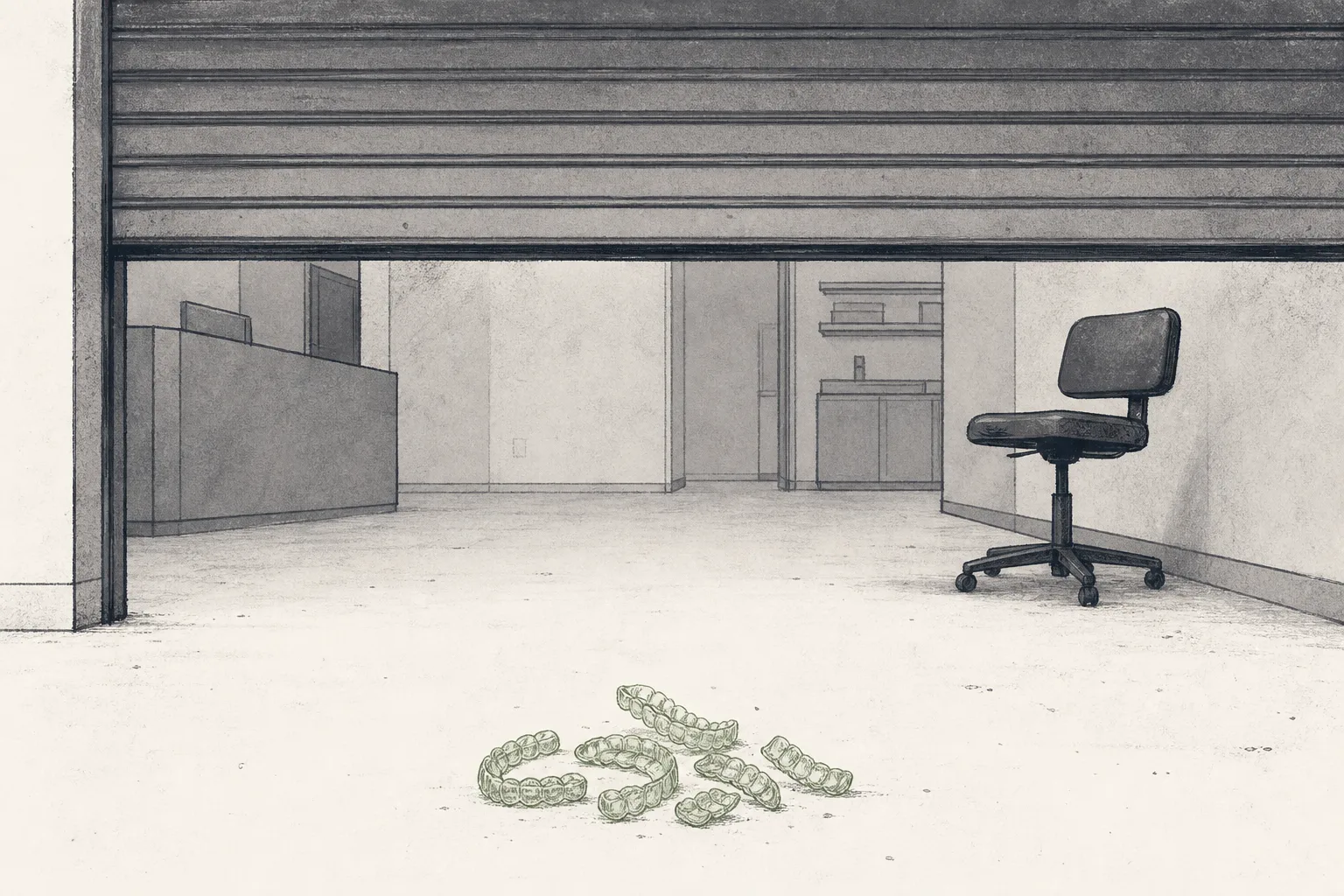
The third risk is the economic cycle (consumer discretionary), especially on the beauty side. Clear aligners, and part of implants, are things that "can be postponed" when money is tight — people put off making their smile, put off getting a tooth implanted — unlike a blood-pressure drug you can't stop. So the strength of "self-pay, high margin" is a double-edged sword: it shines in good times but sales fall fast in bad ones, and the clear-aligner (cosmetic) side is clearly more sensitive than the implant (more necessary) side.
In short: dentistry is one of the few markets getting a tailwind from two directions at once — an aging world makes people need new teeth, and a culture that values looks makes people pay for a prettier smile. The digital scanner is the thread that stitches these two stories together. Understanding this node fully means understanding why a "tiny scanning pen in a clinic" is the spot the industry's giants fight to control.