Megatrend · Aging Population
Three organs that 'wear out' with age — and almost everyone pays out of pocket
Ears, eyes, teeth — three senses that decline with age in ways you can't avoid, and almost everyone eventually needs something to help. What makes it interesting as a business is that most people pay for it themselves, because insurance and the state often don't cover it — creating markets with strong pricing power, few players, and constant repeat purchases. The trade-off: the risk is tied straight to the consumer's wallet, and new tech waves like AirPods are starting to shake the hearing-aid market.
01What is it? (the three senses that wear out)
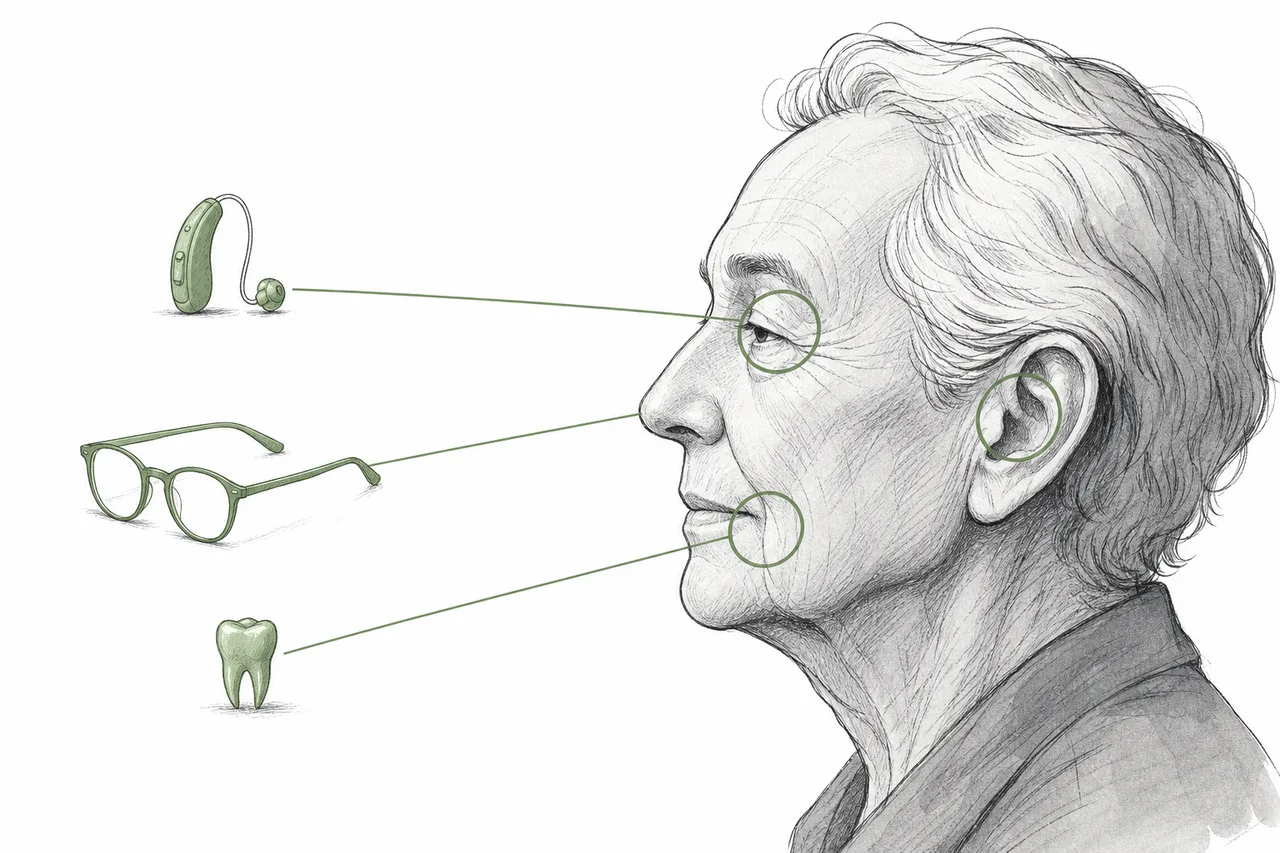
Think of the body like a car you've driven for years. The parts that 'wear out with use' aren't the big engine — they're the small things you use every day: the ears that have listened your whole life, the eyes that have focused millions of times, the teeth that have chewed every meal. Almost everyone will eventually run into trouble with these three — rich or poor, in any country. That's the heart of this node.
On the megatrend map, this node sits under Aging Population — the category of "things that sell as your senses and teeth decline." It splits into three branches that tell different stories but share one core:
- Ears (Hearing): hearing aids and cochlear implants — a market with few players and high margins, but being reshaped by over-the-counter hearing aids you can buy yourself and by features in AirPods
- Eyes (Vision): glasses, lenses and contacts, dominated by a single empire in EssilorLuxottica, plus the "intraocular lens" (IOL) that replaces a clouded lens in cataract surgery
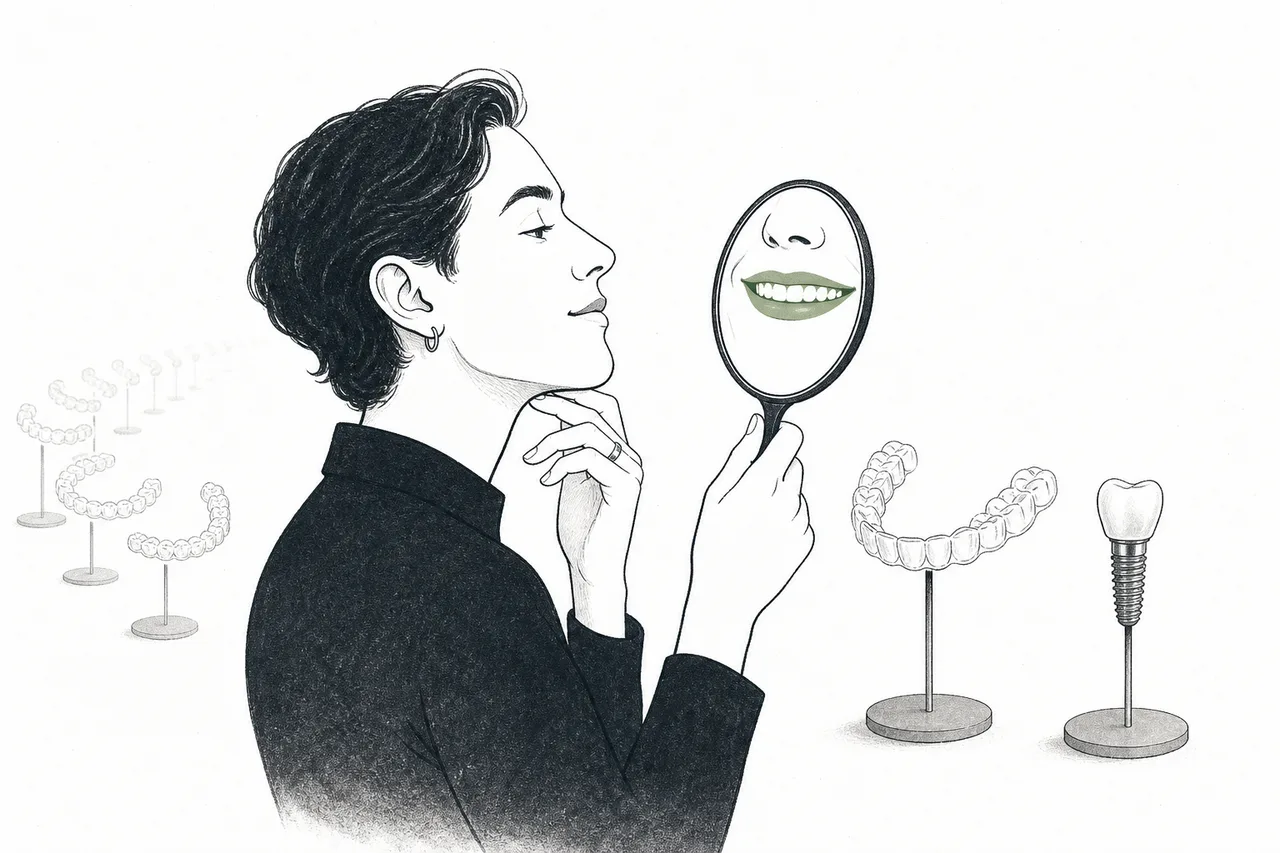
- Teeth (Dental): implants and clear aligners — a market shifting from "treatment" to "beauty you choose to buy," with people paying again and again
Each branch has its own lesson (being written): Ears · Eyes · Teeth — but this piece tells all three together, because it's really one story: "organs that wear out with age, that people have to pay for themselves."
02Why it's a good business: durable demand + paying out of pocket
The first draw of this node is demand you can't avoid that grows with age. The world is aging fast — the global population aged 60+ will roughly double, from about 1.1 billion in 2025 to over 2.1 billion by 2050. Every person in that group is a customer who's about to have a problem with their ears, eyes or teeth. It's not a question of "if" but "when."
The second draw, and the more important one, is "who pays". Unlike drugs or heart surgery, which the state and insurers usually cover, most ear-eye-teeth products are out-of-pocket and many are "elective." The clearest example: in the US, Medicare pays nothing toward hearing aids — patients foot 100% of the bill. A prescription pair runs $2,000–$8,500 (about $3,300 on average) — the price of a small used car.
Put the three markets together and you get a group worth tens of billions of dollars and still growing — hearing aids around $9 billion, implants ~$5.5 billion, intraocular lenses ~$4.8B, and the fastest-growing clear aligners at around $8.3 billion. That doesn't even count EssilorLuxottica's eyewear empire, which brings in nearly €29 billion a year on its own.
03The mechanism: why "paying out of pocket" creates pricing power
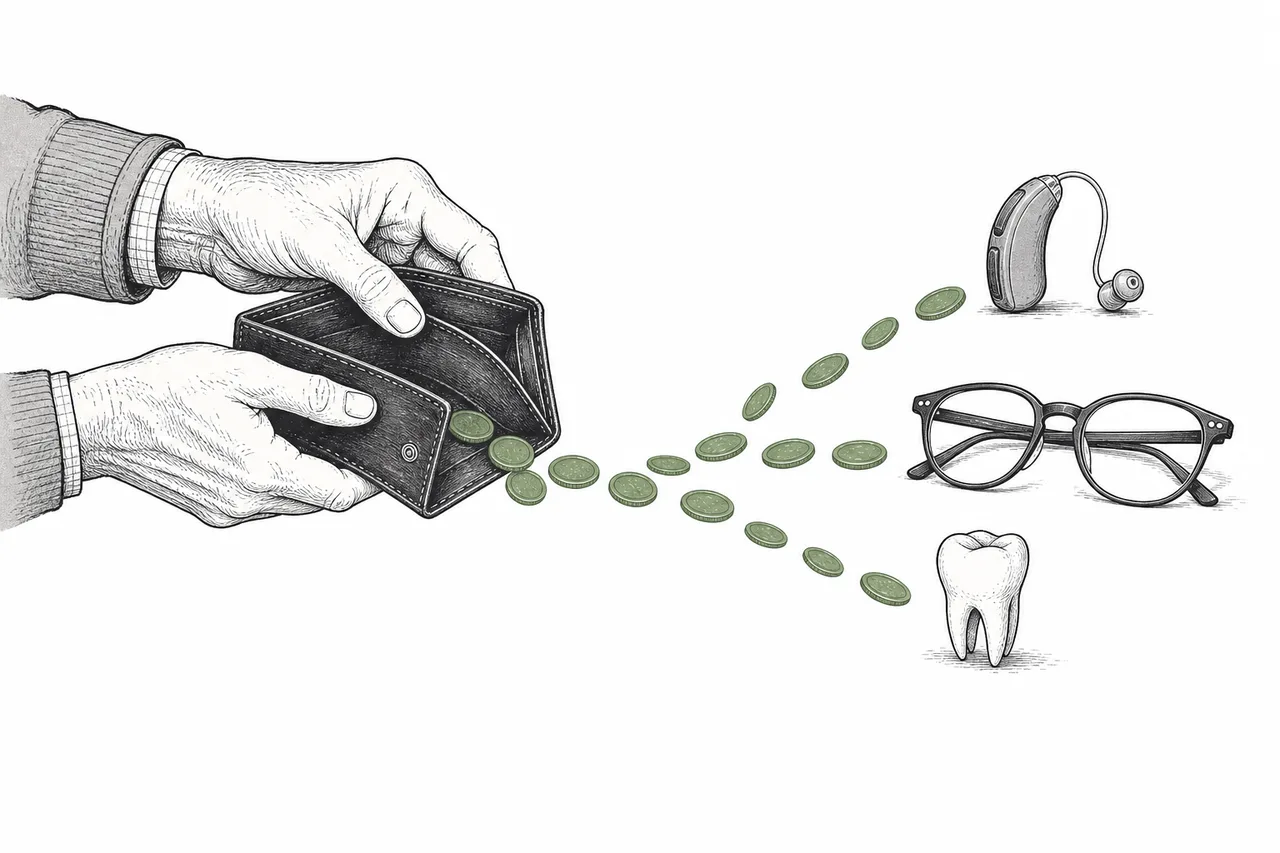
What makes all three markets look alike is a "self-paid repeat-repair model." Whether it's ears, eyes or teeth, the story follows the same rhythm: a sense slowly declines → people pay to get their life back → the device has a limited lifespan or fashion changes → they buy again. Round and round it goes.
Why is this structure so attractive? Because when the patient pays themselves (rather than an insurer squeezing the price), and the product ties directly to "quality of life" or "looks," makers can charge high prices and hold good margins. Add in that the device has to be replaced every few years (hearing aids every 4–5 years, fashion glasses almost yearly, clear aligners running dozens of trays per case), and the revenue becomes the "recurring" stream companies love.
Elective = a product or service the consumer "chooses to buy" of their own will, usually out of pocket (clear aligners, brand glasses, premium hearing aids) · Reimbursed = what insurance or the state pays for (cataract surgery in the public system) · the "out-of-pocket" part earns fatter margins and lets you set prices more freely, but it's also more sensitive to the economy, because it's the kind of thing people can "put off" when money's tight.
04Ears — an oligopoly being shaken by AirPods
The hearing-aid market is a classic example of an oligopoly (a market of few players) that's been highly profitable for a long time — just 5 big makers, WS Audiology, Sonova, Demant, GN Store Nord and Starkey, together held about ~92% in 2024. Most are European companies (Danish/Swiss), holding tight to the technology, the retail channels and the hearing experts (audiologists).
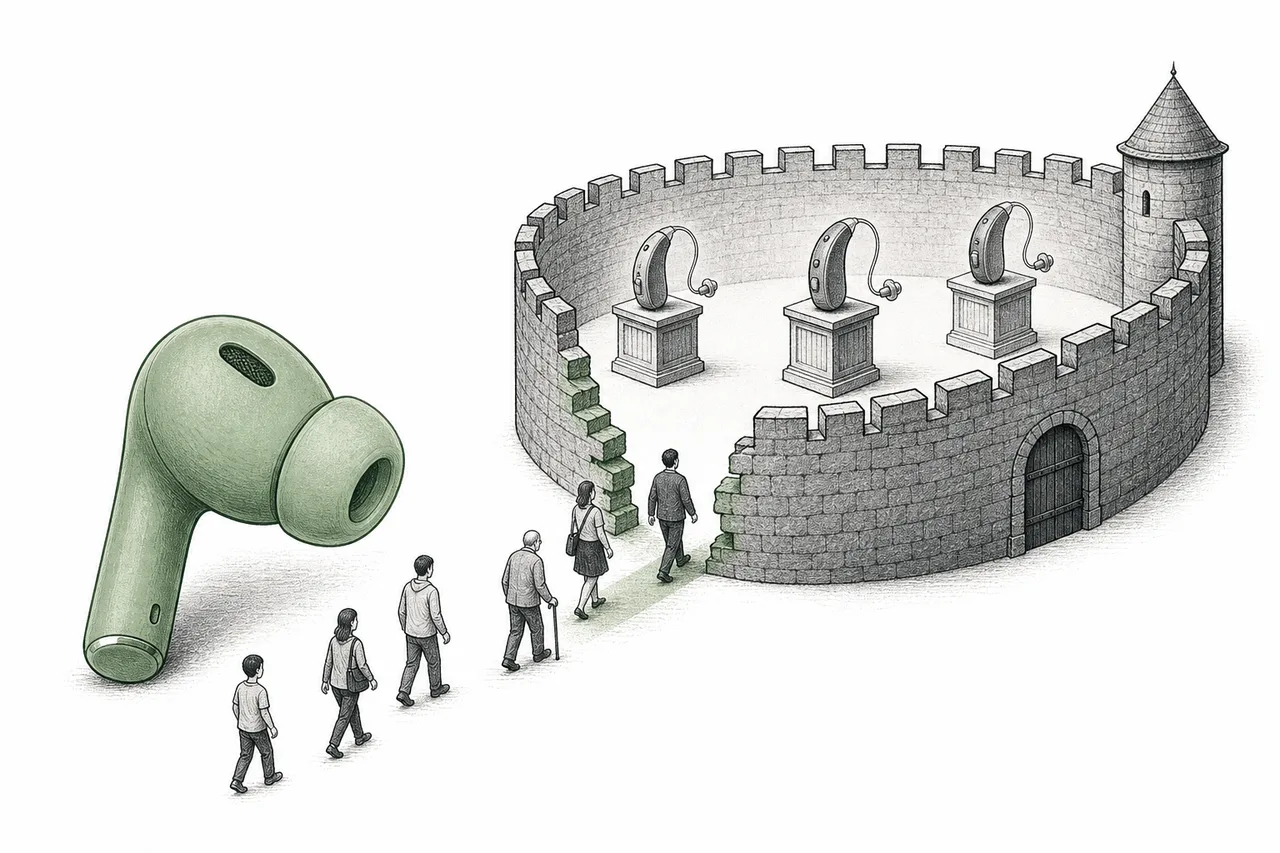
But the comfort of this oligopoly is now being challenged from two directions at once. The first is over-the-counter (OTC) hearing aids, which the US opened up to sell without a prescription from late 2022 — many times cheaper than the prescription kind.
The second, more disruptive direction is Apple. In September 2024 the FDA cleared AirPods Pro 2 to act as OTC hearing aids via a software update — meaning earbuds that hundreds of millions of people already own suddenly became hearing aids for mild-to-moderate hearing loss. This hits the industry's weakest spot: about 1 in 4 adults who should use a hearing aid don't — because they're expensive, embarrassing, or hard to get.
For the "real deal" with severe loss, there's still the cochlear implant — a surgically implanted device that stimulates the hearing nerve directly. This market is a different segment (medical, very expensive, often covered by insurance), led by Australia's Cochlear — an example of the "high-end" side that AirPods can't reach (go deeper on ears → ?node=20050100).
05Eyes — an eyewear empire + lenses inside aging eyes
If ears are a story of an oligopoly being shaken, eyes are a story of near-perfect monopoly. Almost every time you buy glasses, there's a very good chance the money flows back to a single company — EssilorLuxottica, the French-Italian giant born from merging a lens maker (Essilor) with a frame-brand owner (Luxottica).
The key to this empire is vertical integration — controlling everything from upstream to downstream: it makes its own lenses, designs and makes its own frames (including as a manufacturer for luxury brands like Ray-Ban, Oakley, Chanel), and most important, it owns its own retail stores — over 13,500 worldwide (LensCrafters, Sunglass Hut), plus around 4,100 franchises. The result: one company controls the price across the whole chain — over half its revenue (~53%) comes from high-margin direct-to-consumer sales.
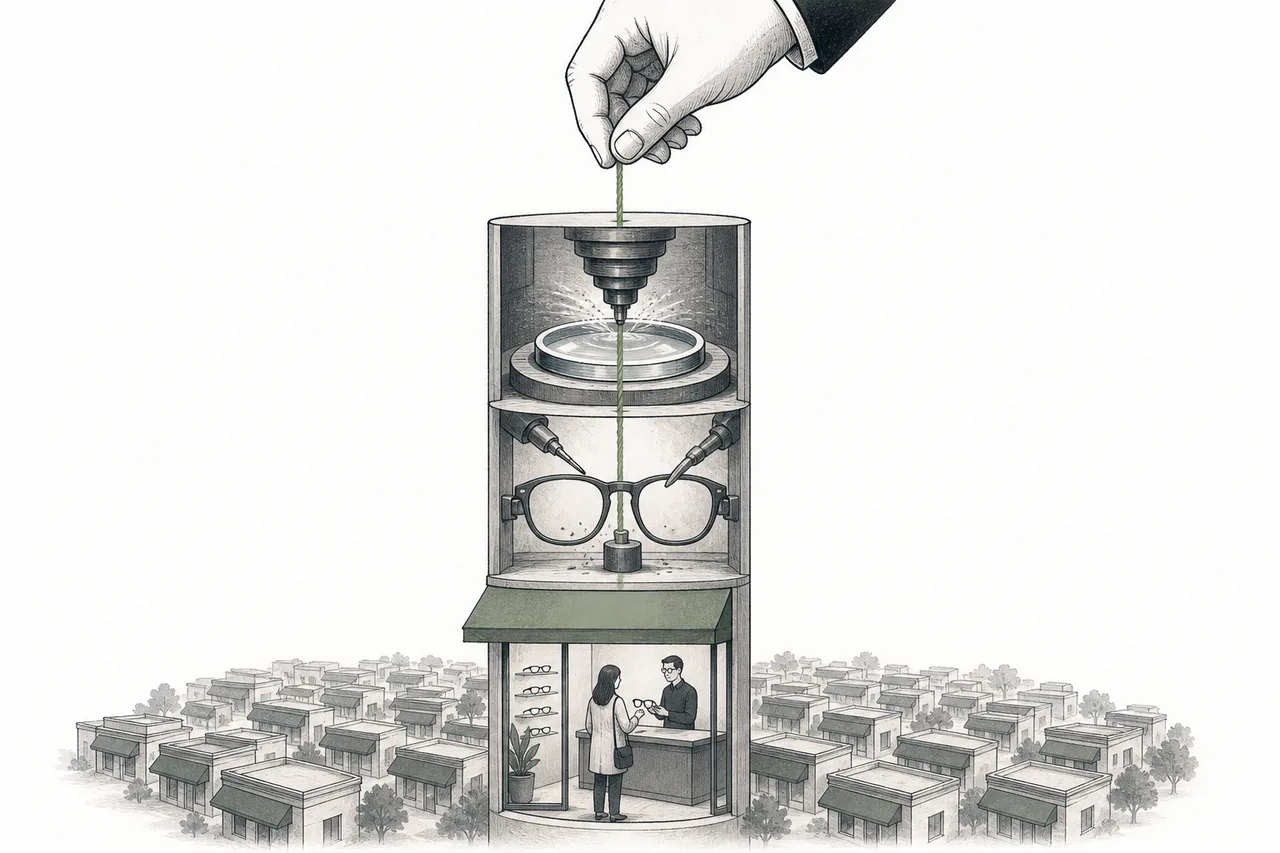
EssilorLuxottica holds about 20% of the global glasses-and-lenses market (around 28% if you count "vision care" broadly), with €26.5 billion in 2024 revenue and an expected ~€29 billion in 2025 — roughly 3 times its nearest rival. This is the "eyewear tax" the whole world pays without realizing it.
The other half of the "eyes" story happens inside the eyeball. As people age, the eye's natural lens clouds into a cataract — the world's leading cause of treatable blindness. The fix is to remove the clouded lens and replace it with an intraocular lens (IOL). The IOL market is around $4.8B in 2025, led by Alcon, which sells tens of millions of lenses a year worldwide — a huge volume that reflects the aging wave and the cataract-surgery demand rising every year.
Beyond glasses, "eyes" also covers several clinical treatments — glaucoma, managed with eye drops and minimally invasive surgical devices (MIGS), and the retina, treated with injections into the vitreous (anti-VEGF drugs like Eylea/Vabysmo), which are really the heart of the eye lesson (see → Eyes).
06Teeth — implants & clear aligners, the "beauty" market you buy again
Teeth is the branch redefining itself in the most interesting way — from "treating illness" increasingly to "beauty you choose to buy." And that makes it an even better business, because people pay more for looks than for necessity.
The first leg is the dental implant — a titanium post planted in the jawbone to replace a missing tooth root. This market is around $5.5 billion in 2025, growing ~7% a year, and very concentrated — Switzerland's Straumann held over 32% in 2024 on the back of a deep clinical-evidence base and an end-to-end digital system, followed by Envista (owner of Nobel Biocare).
The second, hotter leg is clear aligners — clear plastic trays that gradually push teeth into place, replacing the old metal braces. This market is around $8.3B in 2025 and is expected to reach ~$10.7B in 2026. But what makes investors' eyes light up is the ~27% annual growth rate — the fastest in the entire ear-eye-teeth group.
The market leader is Align Technology, owner of Invisalign, which is practically a generic term for clear aligners (Q4 2025 aligner revenue ~$838 million). But competition is heating up — Envista (Spark brand) has risen to second, while Straumann is pushing aggressively into clear aligners through acquisitions (ClearCorrect, DrSmile) and invested in Asian players like Smartee and India's Toothsi during 2025.
07How it connects in the ecosystem
This node doesn't float on its own. It's one of many branches under Aging Population, and it connects logically to other trends:
- Sibling to Medical Devices for the Aging Body: both are "devices that sell as the body declines," but this node focuses on senses and teeth that consumers pay for themselves, while Medical Devices focuses on joints/heart devices that insurance usually covers — the dividing line is "who pays" more than "which organ"
- Complements Chronic-Disease Pharma: age-related chronic diseases (diabetes) speed up vision decline (diabetic retinopathy) and gum decline — chronic health and the senses walk hand in hand
- Meets Spatial Computing: this is the exciting link — when glasses become "a computer on your face" (smart glasses), as EssilorLuxottica does with Ray-Ban Meta, the line between "corrective glasses" and "AR device" starts to disappear
- Depends on Biotech & Genomic Medicine: the future of treating hearing and vision decline at the cellular level (gene therapy, regrowing the hair cells in the ear) will come from the biotech side, which may one day replace some of these devices
08The future & the risks
The clearest future direction is an aging wave that will push demand for decades. As the 60+ population doubles by 2050, the number of people who need hearing aids, glasses, lenses in the eye and new teeth will rise with it, unavoidably. This is the steadiest demographic "tailwind" of any megatrend.
The second direction is fusing with consumer technology — AirPods as a hearing aid, Ray-Ban Meta as AR glasses, scanning teeth with a phone instead of taking a mold. The line between "expensive medical device" and "everyday item" is fading, which will expand the market a lot — but it changes "who profits."
And that leads to the risks — which turn out to be the dark side of every strength:
The first risk is being disrupted by big tech (especially on the ears side). The AirPods story isn't just one more competitor. It's a company with billions of customers and near-zero marketing cost walking into a market that used to be closed. Incumbent hearing-aid makers may get squeezed into being "premium gear for severe cases," while big tech eats the mild-loss market — and the fat margins they used to enjoy could shrink.
The second risk is the economic cycle (consumer discretionary). Because most of it is paid out of pocket and "can be put off," when the economy tightens people delay their aligners, delay replacing their brand glasses, delay getting that implant — unlike blood-pressure pills, which you can't stop. So the "out-of-pocket" strength is a double-edged sword: high margins in good times, fast-dropping sales in bad ones.
The third risk is competition and cheap rivals, especially in clear aligners, where the technology barrier isn't that high. New entrants (including from China and cheap direct-to-consumer services) are pushing prices down, and the leaders' patents are expiring one by one — a market growing 27% a year always attracts a rush of newcomers.
In short: ears, eyes and teeth are the three organs everyone will repair someday, and one of the few markets where consumers willingly pay out of pocket for quality of life and looks. That makes it a durable, high-margin business — but as it gets ever closer to a "consumer product," it opens the door to big tech, cheap rivals and the economic cycle to come shake it up. To truly grasp this node is to understand why "the earbud in your pocket" keeps a century-old hearing-aid company up at night.