Megatrend · Aging Population
The earbuds in your pocket are keeping a 100-year-old company up at night
1.5 billion people worldwide have ears that are starting to fade, and that number will hit 2.5 billion by 2050 — yet most still won't wear a hearing aid, because it's expensive, embarrassing, and hard to get. This market was for decades a quiet kingdom of just a few European companies selling devices at hundreds of thousands of baht a pair. Until the day Apple turned AirPods into a hearing aid for $249 — this lesson walks through how "the device that gives hearing back to an aging world" works, who controls it, and why it's one of the fiercest battlegrounds where medtech and consumer-tech are colliding.
01What it is (hearing aid vs cochlear implant)
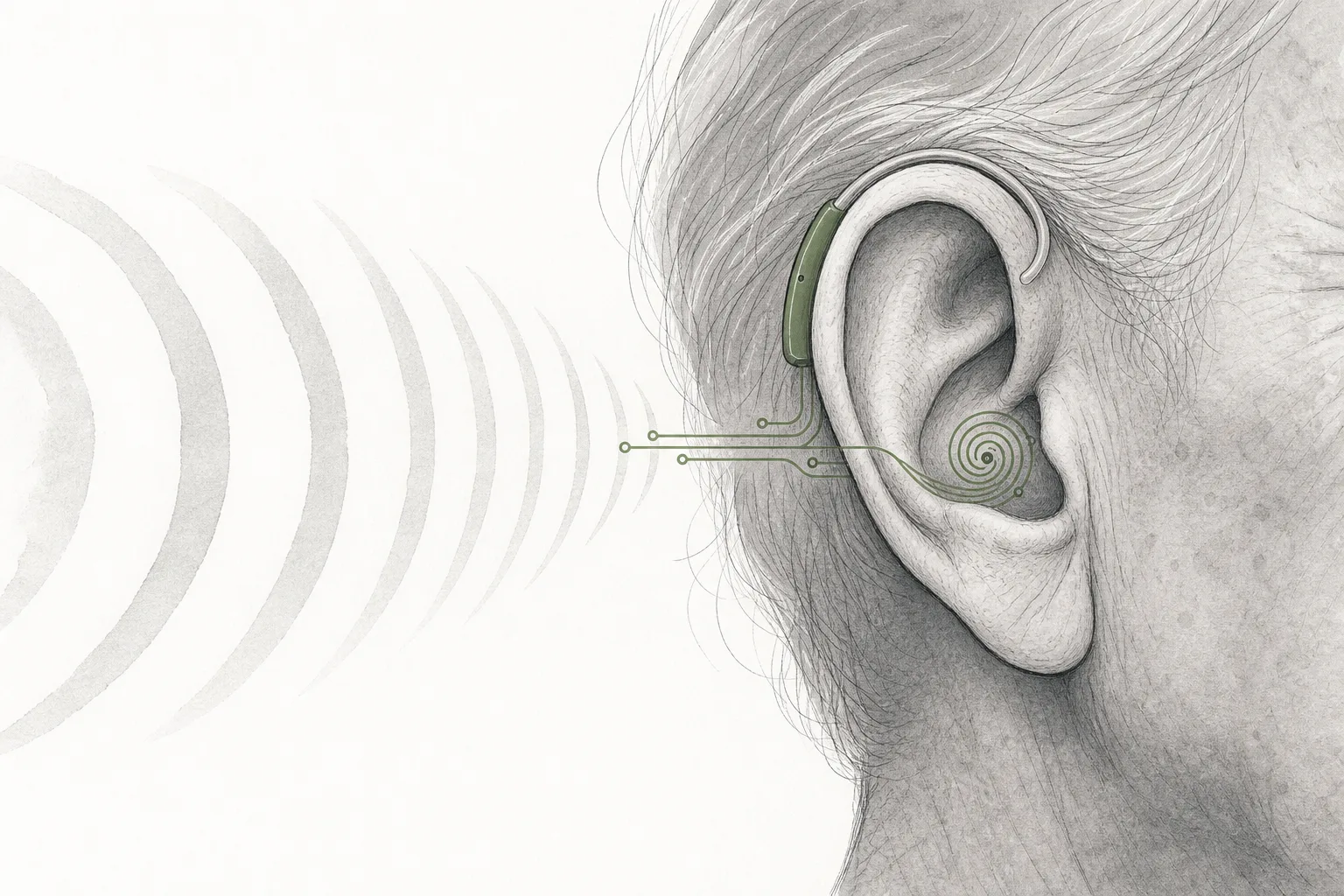
Think of your ear like a microphone wired into your brain. As you age, the tiny hair cells in the inner ear that convert sound into electrical signals slowly die off, one by one — and they don't grow back. The result: speech gets hard to make out, especially in noisy places. This is age-related hearing loss, which almost everyone will face one day. This node is the group of devices that "repair" that microphone.
It splits into two clearly different worlds, by how severe it is:
- Hearing aid: for people whose ears still hear but not clearly (mild–moderate–moderately severe). It's a smart sound amplifier that picks up sound, tunes it, and pushes it into the ear louder and clearer — no surgery, you put it in and take it out
- Cochlear implant: for people whose ears are "badly broken" beyond what a hearing aid can handle (severe loss–deafness). It's a surgically implanted device that bypasses the dead hair cells and stimulates the hearing nerve directly with electricity — a completely different principle from a hearing aid
On the megatrend map, this node is a sub-branch under Hearing / Vision / Dental within the bigger trend Aging Population. It stands alongside two siblings telling the same story — "sensory organs that wear out with age": Vision and Dental. All three share one heart: most people have to pay out of pocket to fix them. But "hearing" is the branch being hit hardest by the wave of consumer technology.
Cochlea (the inner ear) = the snail-shaped organ in the ear whose hair cells turn sound into nerve signals · Sensorineural hearing loss = hearing loss from damaged hair cells/nerves (the most common type in older people, and one that drugs can't fix) · DSP (Digital Signal Processing) = the digital signal-processing chip, the heart of the modern hearing aid that separates speech from noise in real time
02Why it matters — a world of fading ears + low access
This node's demand is tied to an unavoidable demographic fact: the world is aging, and the ear is one of the first organs to fade. The World Health Organization (WHO) estimates that about 1.5 billion people now have some level of hearing loss, and that number will surge to 2.5 billion by 2050 — or 1 in 4 humans on Earth. Of those, around 700 million will need serious hearing rehabilitation.
But what makes this market "more interesting than usual" is the enormous gap between the people who should use one and those who actually do. In the U.S., only about 1 in 5 to 2 in 5 adults (roughly 20–39%) who should wear a hearing aid actually do — the rest put up with ears that can't hear clearly. The three main reasons: expensive, embarrassing, and hard to get. Prescription hearing aids once cost an average of about $4,600 a pair in 2018 (down to about $2,700 in 2025 as the market opened up), and in the U.S. Medicare pays nothing at all.
Why does this matter beyond just "hearing better"? Because a large body of research points to untreated hearing loss being the number-one "modifiable" risk factor for dementia. Among middle-aged people, those who let their hearing fade and leave it untreated have several times the dementia risk of people with normal hearing — because a brain that doesn't get sound to stimulate it declines faster, and people who are hard of hearing tend to withdraw from society. This makes a hearing aid not just a "convenience," but a long-term investment in brain health — a policy reason why many countries are starting to push for wider access.
03How it works (sound → chip → ear)
The heart of both devices starts the same — take sound in, process it with a chip — but the "exits" are polar opposites. A hearing aid sends the amplified sound into the ear along the natural path, while a cochlear implant bypasses the broken ear and fires electricity straight into the nerve. Let's trace it step by step.
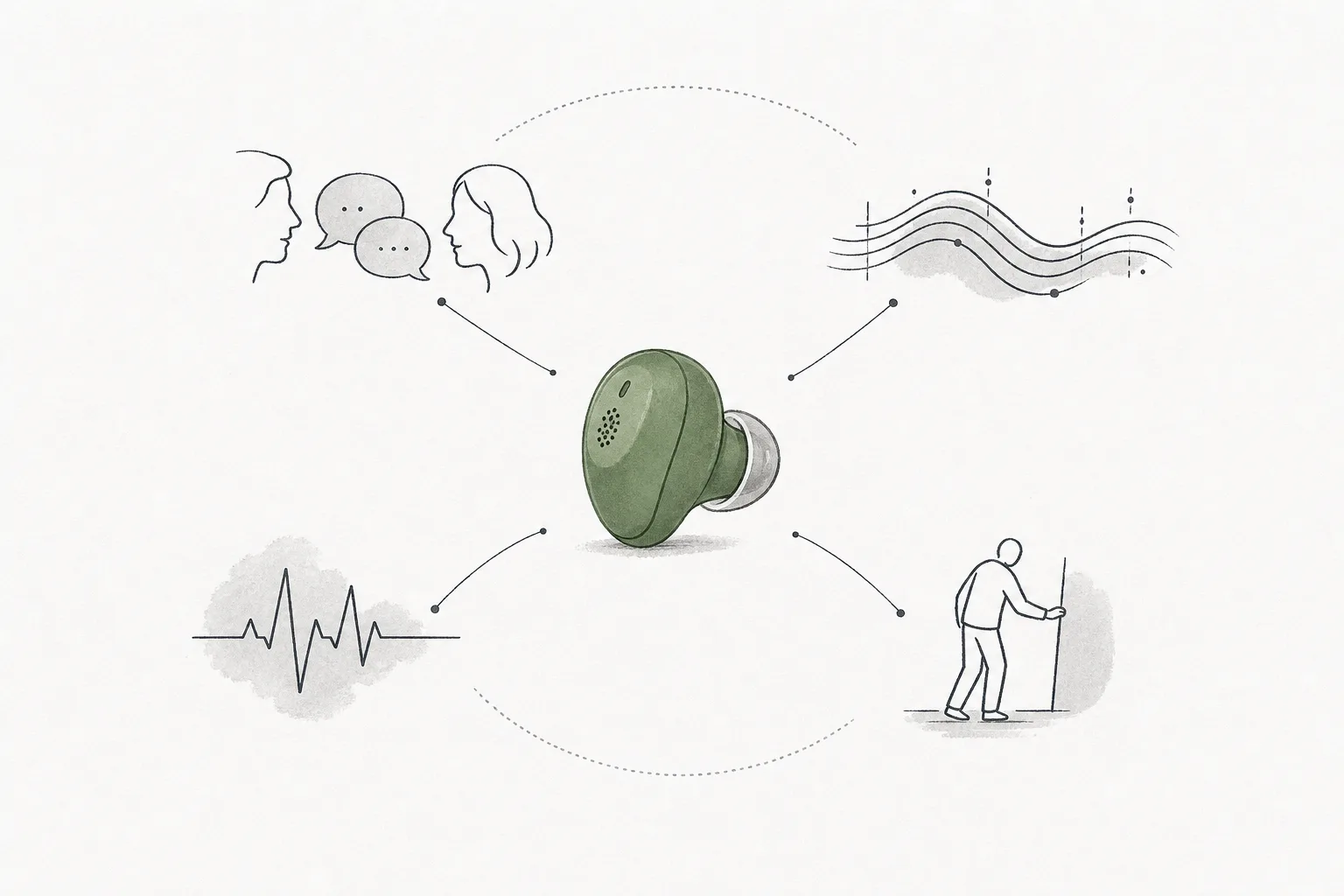
What makes the modern hearing aid "hard" and expensive isn't amplifying sound (that's easy) — it's separating speech from noise. In a restaurant with ten tables of people talking, a normal brain can choose to hear only the person in front of you. But a faded ear can't — and this is the battlefield where DSP chips and AI change the game. Newer generations embed a neural network in the chip to "guess" which sound is the speech the user wants to hear, then pull it to the front in real time. This ability is exactly what separates a $3,000 device from a cheap amplifier — and it's the very point where on-device AI is moving in to make the "smart hearing aid" real.
04How it connects in the ecosystem
This node doesn't float on its own. It's one of the three branches of Hearing / Vision / Dental, and it links to other trends in logical ways:
- A sibling of Vision and Dental: all three are "sensory organs that wear out with age, that people pay for themselves" — but hearing is the branch shaken hardest by consumer-tech. While vision is ruled by a channel empire (EssilorLuxottica) and dental leans toward "beauty you can choose," hearing has become a battleground between doctors and Apple
- Leans directly on on-device AI: what makes flagship hearing aids beat the competition is the processing chip that filters sound with AI in microseconds without needing the internet — the smaller, more power-efficient, and smarter the chip gets, the better the hearing aid. That's why ear companies talk about "chips" as much as "sound"
- May one day be replaced by Biotech & Genomic Medicine: research into gene therapy and hair-cell regeneration in the ear, if it succeeds, could treat the root cause instead of just fitting a compensating device — both a hope for patients and a long-range risk for device makers
- Tied to Robotics & Physical AI and smart hearables: once a hearing aid becomes "an earpiece you wear all day," it starts acting as a personal assistant — translating live, reading out messages, detecting falls. The line between "medical device" and "smart wearable" is fading away
05Where it stands now
The most shocking thing about this industry is its concentration. The entire global hearing-aid market (worth about $9.0–10.5 billion in 2025) is controlled by just five makers — WS Audiology, Sonova, Demant, GN Store Nord, and Starkey — together holding about 92% in 2024. Almost all are European companies (Swiss/Danish) that have held the technology, the retail channels, and the audiologist networks tightly for decades. Sonova, owner of the Phonak brand, is number one with about a 25% share.
The "severe" side — cochlear implants — is a different arena: smaller (worth about $2.3–2.9 billion in 2025) but growing much faster (estimated ~15% a year) and even more concentrated. There are only three serious players: Australia's Cochlear (about 32% share, number one in the world), Austria's MED-EL (private), and Advanced Bionics (part of Sonova). In this market insurance usually pays, and the walls of technology and clinical credibility are very high — Apple can't reach it.
But the picture of a "comfortable oligopoly" is starting to shake. The turning point was September 2024, when the FDA approved Apple's AirPods Pro 2 to act as an OTC hearing aid through a free software update — $249 earbuds that hundreds of millions of people already own suddenly became hearing aids for mild-to-moderate loss. Compare that to prescription devices averaging about $2,700 a pair. This is an attack on the industry's softest spot: the 80% who won't wear one because it's expensive and embarrassing.

Meanwhile the incumbents aren't standing still. They've fled upward into the "premium + AI" game — in late 2024 Sonova launched the Phonak Audéo Sphere Infinio, using an AI chip to separate speech from noise in real time, while Cochlear launched the smart cochlear-implant system Nucleus Nexa in 2025 — a sign that both sides are racing to bet on AI to defend the gap above the cheap stuff.
06The future — OTC, AI, and hearables
The first direction is the market "splitting into two tiers" more clearly. The lower tier (mild loss) becomes the arena of cheap consumer-tech — AirPods, Bose, Sony, Samsung, selling on convenience and brand. The upper tier (moderate-to-severe and cochlear implants) stays with medical players who have deep technology and doctor networks. The big question is how far the "line" will climb into the doctors' market as AirPods get better every year.
The second direction is the hearing aid becoming a "hearable" — a smart earpiece you wear all day. Not just an amplifier, but an assistant that translates live, streams music, takes calls, and monitors for falls and vital signs. The advantage ear companies have over Apple is all-day battery life and professional tuning to each person's ear — but Apple's advantage is a user base in the billions and an ecosystem. So the contest will be measured by "who can make something smart and comfortable-to-wear all day first."
The third direction is opening the untouched market (the 80%). With lower prices and less embarrassment (because AirPods made "putting something in your ear" normal), the big group that never wore one before may start entering the market. The overall picture could be "a much bigger cake, but cut up anew" — the number of users surges, but profit per device in the lower tier gets thinner.
07Challenges & risks
The first risk is being disrupted by Big Tech — and this isn't just "one more competitor." It's a company with billions of customers and near-zero marketing cost walking into a once-closed market. Incumbent hearing-aid makers risk being squeezed into "a premium product for severe cases," while the once-juicy-margin mild-loss market gets eaten by Apple/Bose/Sony — margins that used to be high could shrink across the whole industry.
The second risk is price and access — the double-edged sword of the "pay-it-yourself" structure. Having people pay out of pocket let makers set high prices and earn good profits. But it's also the reason 80% won't wear one. If governments or insurers start intervening (say, mandating Medicare coverage, or capping prices) to fix the access problem, makers' pricing power disappears — the strength of price turns into a policy fragility.
The third risk is a wave of technology that could replace the devices entirely. In the long run, if gene therapy or hair-cell regeneration in the ear truly succeeds, treating the root cause of hearing loss could replace compensating for it with a device — a distant but deep risk for a business that builds value from selling devices over and over.
In short: this node is the device that gives hearing back to an aging world. Demand is certain and grows for decades on the aging wave. But it stands on a border where medtech and consumer-tech collide — understanding this node fully is understanding why "the earbuds in your pocket" are keeping a 100-year-old hearing-aid company up at night.