Megatrend · Aging Population
The lens in your eye has an expiry date — and the whole world is hitting the replacement queue at once
The eye is the organ that "wears out" most quietly — the natural lens clouds into a cataract, pressure slowly erodes the optic nerve into glaucoma, the retina swells with fluid in the old and the diabetic, and right now children across a whole continent are going short-sighted faster than ever. None of this is one market; it's a cluster of ophthalmology — eye medicine and devices that is inescapably tied to an aging population: defensive, steady demand, few players, and every single piece either implanted in surgery or injected by a doctor. This lesson walks through where the money flows, who controls the market, and what's shaking it.
01What it is — the medicine of the aging eye
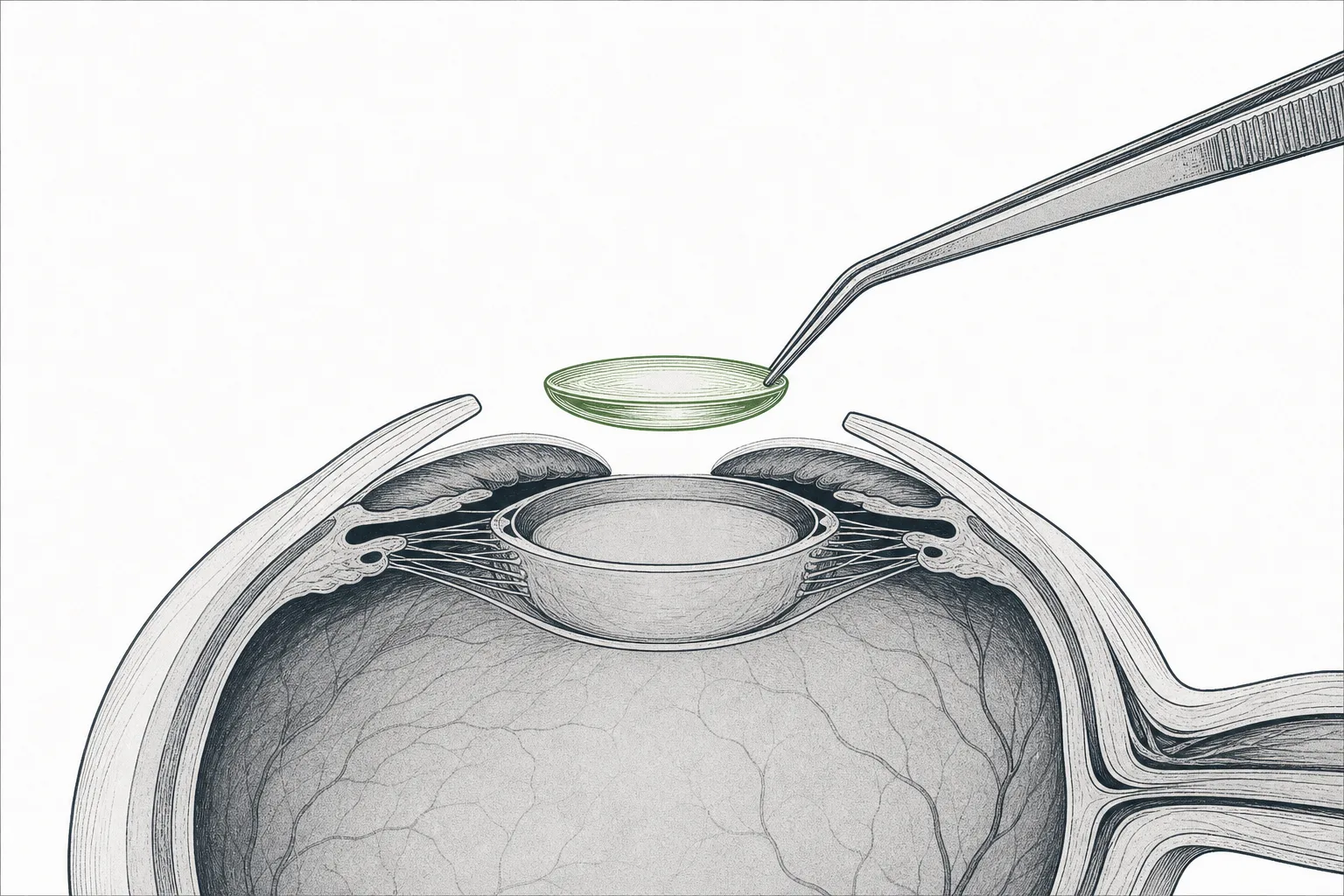
Think of the eye as a camera you've used your whole life — it has a lens (the crystalline lens), wiring (the optic nerve), and an image sensor (the retina). All three slowly degrade with age, and no one escapes it. The once-clear lens turns cloudy into a cataract; chronically high pressure inside the eye erodes the optic nerve into glaucoma; and the image sensor degenerates / swells with fluid in the old and the diabetic. This node is the cluster of companies that sell the "parts" and "drugs" to fix this camera.
On the megatrend map, this node is a sub-branch under Hearing / Vision / Dental within the big trend Aging Population. It's the "eye leg" of three organs that wear out with age — its neighboring siblings are hearing (hearing aids) and teeth (dental implants / clear aligners). But the eye has a character all its own that makes it more interesting: it has both an "implant in surgery" side that doctors perform (cataract, glaucoma) and a "wear / inject" side that consumers buy themselves or keep returning to a clinic for (contact lenses, retinal injections).
To see it simply, the "eye" market breaks into four main chunks: (1) cataract & intraocular lenses (IOL) — remove the cloudy lens, put in an artificial one · (2) glaucoma — eye drops + devices to lower pressure inside the eye · (3) retina — drugs injected into the eye to treat retinal degeneration / swelling · (4) vision correction (refractive) — contact lenses, add-on lenses, and corrective surgery, including a new wave: "myopia-control lenses" for children.
Cataract = the eye's natural lens clouding with age, making vision blurry · IOL (Intraocular Lens) = the clear plastic lens surgically implanted to replace the cloudy one that's removed; once in, it stays for life · Glaucoma = chronically high pressure inside the eye that damages the optic nerve, causing permanent blindness with no warning symptoms · Retina = the wall at the back of the eye that receives the image — it degenerates in the old (AMD) or swells with fluid in diabetics, treated by injecting drugs into the eye.
02Why it matters — demand that gets older every year
The first charm of this node is that it's tied straight to age. A cataract is almost a matter of "when," not "if" — cataracts are still the number-one cause of blindness worldwide, accounting for about 45% of all blind people (around 15 million), even though it's a disease that's "curable" with just a lens-replacement surgery. The problem is access: the world performs about 20–30 million cataract surgeries a year, yet there's still an enormous backlog of people who "need surgery but haven't had it."
The second charm is that it's a "defensive" business — people don't choose to get a cataract or glaucoma in good times or bad, and most of these surgeries and injections sit inside insurance or public funding (unlike hearing aids or clear aligners, which are self-pay and "can be postponed"). So demand is steady and predictable. On the contact-lens side, it's a "consumable you rebuy" — daily disposables get used up, customers come back every month: a recurring revenue stream companies love.
Put together as a big picture, it's a cluster worth tens of billions of dollars and growing in every chunk: the intraocular lens (IOL) market at about $4.8 billion · the glaucoma market at about $9.5 billion in drugs and devices combined · the contact lens market at about $12 billion · and the biggest of all, the age-related macular degeneration (AMD) drug market, heading toward ~$26 billion in the next decade.
What sets this node apart from ordinary fashion eyewear is that every piece passes through "a doctor's hands" or "a medical filter" — IOLs are surgically implanted, glaucoma devices are inserted into the eye, retinal drugs are injected into the eyeball every month or two. That means a high barrier to entry: you have to clear approval (FDA) and build trust with ophthalmologists — the result is a market concentrated in a few players who've been around a long time and have thick clinical evidence.
03How it works — 4 eye problems, 4 fixes
The heart of this node is that "each kind of eye problem has its own fix" — and those fixes are the products of the companies in this cluster. Let's go through them one problem at a time: where the eye degrades, and who comes in to fix it.
The biggest chunk by volume is cataract. The standard treatment uses ultrasound to break up the cloudy lens (phaco), suck it out, and put an intraocular lens (IOL) in its place — a few minutes per eye. The key is that IOLs come in different "grades": a plain single-focus lens (public / insurance pays) versus a premium lens that sees at multiple distances (multifocal / trifocal, like Alcon's PanOptix), for which patients often pay the difference themselves — and that's where the juicy margins come from.
Meanwhile glaucoma is the "silent killer," because it eats the field of vision painlessly and gradually. The old fix is daily drops to lower pressure (which patients often forget). What's coming is MIGS — inserting a tiny device to help drain fluid from the eye — and slow-release implant drugs like Glaukos's iDose, implanted once to work for years, solving the "forgot the drops" problem directly. The retina, on the other hand, is treated by injecting anti-VEGF drugs into the eyeball every few weeks — a drug market (the biotech side) more than a device market.
MIGS (Minimally Invasive Glaucoma Surgery) = small-incision glaucoma surgery, inserting a tiny tube / device to help drain fluid from the eye; faster recovery than major surgery · anti-VEGF = a drug injected into the eyeball to stop abnormal blood-vessel growth and reduce the leaking / swelling of the retina (e.g. Eylea, Vabysmo) · Myopia control = lenses / contact lenses designed to "slow" the progression of short-sightedness in children — not just correct vision to see clearly.
04How it connects in the ecosystem
This node doesn't float alone. It's one of the three legs of Hearing / Vision / Dental under Aging Population, and it interlocks with other trends in sensible ways:
- Sibling to hearing (hearing aids) and teeth (dental implants / clear aligners): all three are "organs that wear out with age and need something to help." But the eye differs in that its disease side (cataract / glaucoma / retina) is usually inside insurance, making it more defensive than the self-pay-heavy ears and teeth — the dividing line, as ever, is "who pays"
- Deeply linked to Biotech & Genomic Medicine: this is the most important link — the "retina" side is almost pure biotech. anti-VEGF injections like Eylea (Regeneron) and Vabysmo (Roche) are blockbuster products of drug companies, not eye-device makers, and the future of "curing blindness" through gene therapy comes from this side too
- Complements age-related chronic disease: diabetes is a major cause of "diabetic retinopathy" (a swollen retina) — the more people with diabetes, the more the retinal-injection drug market grows. Chronic health and eye health walk hand in hand
- Touches AI and robotics: diagnosing eye disease (e.g. screening for diabetic retinopathy from retinal photos) was one of the first tasks medical AI did better than humans, and eye-surgery machines keep getting more precise with digital guidance
05Where it stands now
The eye market right now, in one line: "the incumbents are strong, but consolidating to close the gaps". The most complete leader is Alcon — the Swiss company spun off from Novartis in 2019, doing both the surgical side (phaco machines, IOLs) and the eye-care side (contact lenses, artificial tears). In fiscal 2025, Alcon's surgical sales were about $5.8 billion, led by its flagship premium lens PanOptix Pro, just launched in the US — even as it faces pressure from new competitors moving in.
The biggest deal in the industry in 2025 was Alcon announcing it would buy STAAR Surgical, owner of the EVO ICL add-on lens (a lens implanted in the eye to correct severe short-sightedness without LASIK) — filling the "vision correction" piece Alcon was still missing, and reflecting how the big players choose to "buy" rather than "build" when entering a new segment.
The contact lens side is a field of four big players — Johnson & Johnson Vision (market leader with about a 12% share), Alcon, CooperVision (under Cooper Companies, which did about $4.1 billion in group revenue in fiscal 2025), and Bausch + Lomb. On the glaucoma side, the rising star is Glaukos, which flipped the game with iDose TR — a slow-release implant drug in the eye that won FDA approval in late 2023 and pushed sales up double digits. And on the surgical / diagnostic equipment side, Germany has Carl Zeiss Meditec, which controls retinal-scanning devices (OCT) and surgical microscopes.
The retina is the drug companies' battlefield — Regeneron with Eylea / Eylea HD (holding about a 62% share of the anti-VEGF market in 2024) clashing with Roche, which is sending in Vabysmo. Its selling point is "inject less often" (up to 4–5 months per shot), cutting the burden on patients who'd otherwise visit the clinic constantly.
06The future — premium lenses, myopia control, retinal injections
The first direction is "moving up to premium" in cataracts. Since the volume of surgeries is a matter of the public health system, companies make their profit by pushing patients toward premium IOLs (multi-distance vision, no glasses needed after surgery), where the patient pays the difference themselves — turning cataract from a "fixed-price treatment" into one with a "self-pay upgrade" element, just like teeth and glasses.
The second direction, possibly the biggest, is the myopia epidemic in children, especially in East Asia — over 80% of teenagers in South Korea and Singapore are short-sighted. This problem created an entirely new market called "myopia control" — lenses / contact lenses designed to slow myopia from getting worse (e.g. CooperVision's MiSight, the first children's contact lens approved in Japan). It's a segment projected to grow at about 26% CAGR a year — the fastest of any in the eye field.
The third direction is "inject less" in the retina. The most painful point of retinal treatment is that patients have to visit the clinic every month to get a needle in the eye. So the new round of competition is about "stretching the gap between shots" — Eylea HD and Vabysmo pushed the interval to 4–5 months, and the next step is slow-release implant devices and gene therapy, which could make "one shot lasting a year" real.

07Challenges & risks
The first risk is pricing & reimbursement pressure, because most cataract surgeries and retinal injections sit inside insurance / public funding, so the payers (governments, insurers) hold the power to push prices down and often limit how much they'll pay for premium lenses or expensive drugs — so the "self-pay" advantage isn't as full as it is for teeth or glasses.
The second risk is intensifying competition and biosimilars. Premium IOLs are starting to see competitors moving in to undercut prices (Alcon itself admits it faces "competitive pressure" in overseas markets), and on the retinal-drug side, the older Eylea is starting to lose market to biosimilars (cheaper biologic copies) after patent expiry — squeezing the margins of blockbusters that once made enormous money.
The third risk is access, which is both an opportunity and a trap. The "1 in 2 who need surgery but haven't had it" gap is enormous demand — but most of those people are in low-income countries that can't afford premium lenses. So the fast-growing markets tend to be low-price, thin-margin ones, with local manufacturers (e.g. in China and India) competing in — growth in volume that doesn't necessarily mean growth in profit.
In short: the eye is an organ almost everyone will have to "fix" someday, and one of the most demand-stable healthcare markets because it ages along with the world. This node bundles everything from lenses implanted in the eye, to drugs injected into the retina, to contact lenses children wear to slow myopia — understanding which chunk is a "device," which is a "drug," and which the patient "pays for themselves" is understanding where the eye industry's real profit is hidden.