Megatrend · Digital Finance
A bank born in an app, with no branch anywhere — yet more customers than the biggest bank in the country
Picture a bank with no branches, no tellers, no queues — just an app in your pocket. It sounds like a toy. But in Brazil, a bank like this called Nubank has 131 million customers, more than every traditional bank in the country. And most important of all — it actually makes money. This lesson explains why the "branchless bank" changed the game, who's winning, who's still hurting, and why it matters most to people who've never had a bank account in their lives.

01What it is (a bank born in an app)
When we say "banking app," we usually picture a traditional bank's app — a bank that had thousands of branches first, then built an app later. But a neobank isn't that. It's a bank that was "born in an app" from day one — no branches, no counters, no passbook. You open an account by photographing your ID with your phone, and you're done in five minutes.
"Neobank" and "digital banking" often get used interchangeably, but the definition this lesson uses is narrow and clear: we mean true digital banks, built from scratch with no branches (like Nubank, Revolut) — not old banks that simply bolted on online services. This distinction matters a lot, because the heart of the whole story is the phrase "no branches."
Neobank = a bank with no branches at all, born digital from the start. Some hold a full banking license themselves (called a challenger bank, like Monzo); some have no license of their own and instead "rent" one from another bank behind the scenes (like Chime) · A traditional bank's app, on the other hand, doesn't count as a neobank, because it still carries the cost of branches and legacy systems — a cost a neobank doesn't have.
On the megatrend map, this node is a sub-theme under Digital Finance & Tokenization — the world of money moving into apps and onto digital networks. The neobank is the "storefront" where ordinary consumers touch this trend directly: where the salary lands, where bills get paid, where the first loan happens — all of it finished inside one screen.
02Why it matters — reaching the people banks left behind
The reason a neobank isn't just a "pretty app" but a real megatrend comes down to a single number that changes everything: the cost to serve one customer.
Traditional banks have to carry branches, tellers, and ancient IT systems. Accenture's research estimates a traditional bank in the UK spends over $210 per customer per year, while a neobank does it for just $25–63 — roughly a third to a fifth as much. When the cost per head is this low, a neobank can do what's uneconomic for an old bank: open an account for people with little money.
This is why neobanks grow fastest in emerging markets — places with a huge number of "unbanked" people (those with no bank account). The World Bank's Global Findex report estimates that roughly 1.3 billion adults worldwide still have no bank account, with more than half (650 million) concentrated in 8 countries like India, Indonesia, Mexico, and Nigeria. These people are "not worth it" for a traditional branch — but very much worth it for an app whose cost per head is almost zero.
The result is an exploding user base. The number of neobank users worldwide grew from about 146 million in 2021 to roughly 350 million in 2026, and the whole neobank-services market was estimated at around $211–261 billion in 2025, with most researchers putting the average growth rate as high as ~46–49% a year (the figures vary a lot between firms, but they point the same way: "growing very fast").
03How it works (the neobank flywheel)
The business model of a winning neobank follows almost the same three steps every time, and it spins like a "flywheel" — the more it turns, the stronger it gets.
Step 1 — no branches, cost per head near zero. Because it doesn't carry branches and staff, a neobank can "take in" the customers an old bank saw as not worth it. The clearest example is Nubank: its cost to serve one customer is only about $0.80 a month.
Step 2 — start with a single product, then pull people in. Most neobanks don't launch to sell everything. They start with one flagship product that's free, or cheap enough that you can't resist — Nubank started with a no-fee credit card, Revolut with great-rate foreign exchange, Chime with a no-fee account that pays your salary two days early.
Step 3 — then cross-sell to make money. This is the step that turns a profit. Once a customer is inside the app, the neobank offers loans, credit cards, insurance, investing, even crypto. The longer a customer stays, the more products they use — Nubank's older customers use an average of 4.1 products each.
The key to the whole flywheel is the gap between "revenue per head" and "cost per head." Look at Nubank's numbers in Q4 2025: average revenue per active customer was about $15 a month, while the cost to serve was about $0.80 a month — that enormous gap is exactly the money-printer of a neobank that's pulled it off.
04Where it sits in Digital Finance
A neobank doesn't sit alone. It's a "storefront" perched on top of other technology layers, and a sales channel to its sibling sub-themes in the same Digital Finance trend:
- A storefront for Digital Lending & Alt-Credit: almost all of a neobank's profitable step is "lending" — credit cards, personal loans, secured loans. Nubank had a total loan portfolio of over $32 billion in 2025, making the line between a neobank and a digital lending platform almost overlap
- Tied to Payments Modernization: the first thing a customer uses is "paying" — transfers, card swipes, scan-to-pay. Card-swipe fee income (interchange) is the first lifeblood of a neobank like Chime
- Moving into Digital Wealth & Robo-Advisory: once a customer is inside the app, the next cross-sell is an invitation to invest — Revolut and SoFi sell stocks, funds, and crypto in the same app as the salary account
- Sits on Cloud and depends on Cybersecurity: with no branches to fall back on, everything lives in the cloud — security and digital trust are non-negotiable conditions. Customers only deposit money when they believe the app won't crash and won't get hacked
Another layer that sits beneath the neobank is what's called Banking-as-a-Service (BaaS) — infrastructure that lets any brand (even a shop or a non-bank app) offer banking services without getting a license of its own. The BaaS market was estimated at around $22–30 billion in 2025, and it's the reason a new generation of neobanks can launch faster and cheaper.
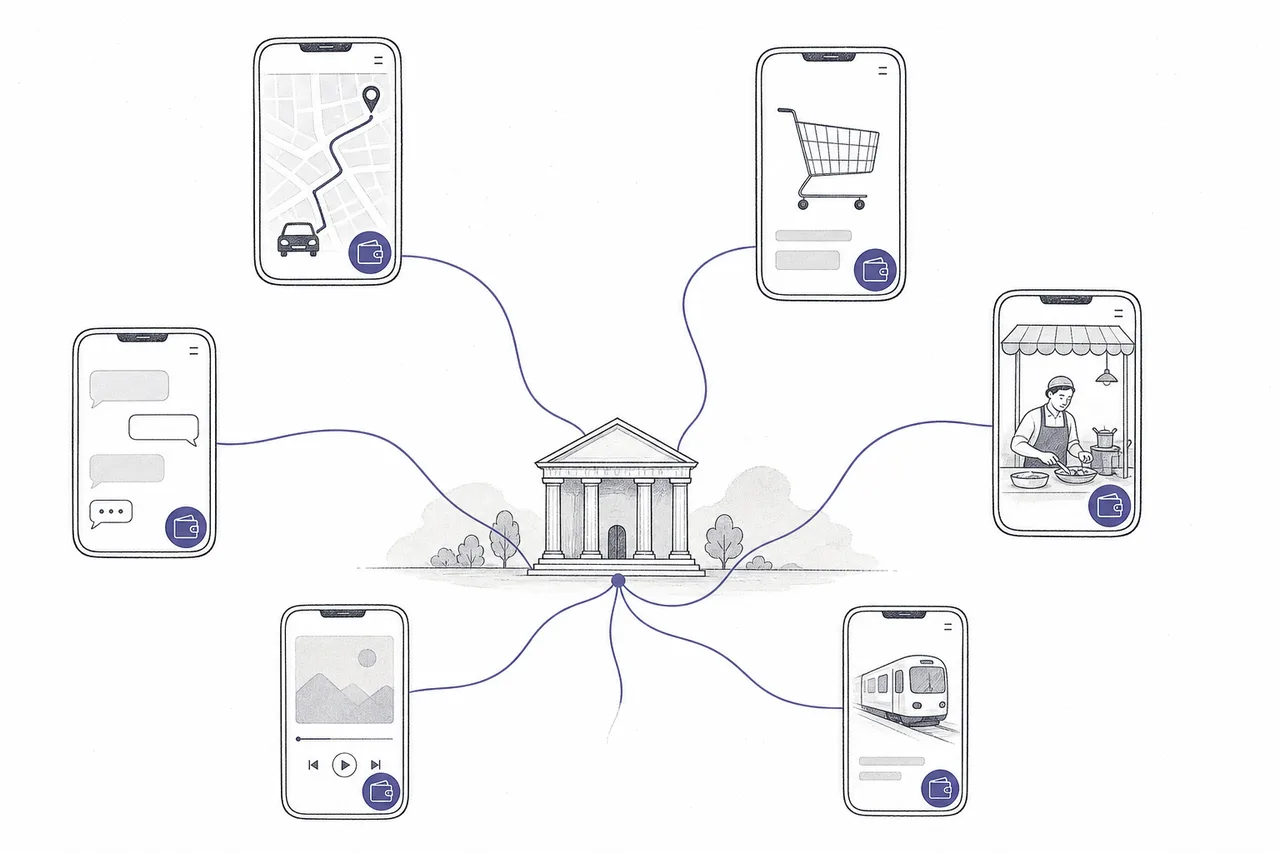
BaaS = a service that "rents out" a bank's back-end (license, accounts, transfers, cards) through an API, letting any app conjure up banking services without building a bank itself · Embedded finance = the result of it — financial services "embedded" inside non-bank apps (a ride-hailing app with a wallet, an online shop that lets you pay in installments on the spot). The line between a "bank" and a "regular app" starts to blur.
05Where it stands now — who profits, who still hurts
This is the most important part, because the whole neobank world splits clearly into two: the world that's proven it can be profitable, and the world that grows users fast but stays in the red for years.
The painful truth is — making a profit is very hard. One estimate is that fewer than 5% of neobanks worldwide are profitable, and in a study of the 25 largest neobanks, only 2 were making money. Most earn under $30 per customer per year. The problem is that pulling people in with free products is easy, but "cross-selling enough to cover the cost" is hard — especially in rich countries where people already have an old bank account.
World 1 — the proof it can be done (emerging markets). The standout is Nubank in Latin America. In 2025 it had 131 million customers (the largest in Brazil) and made $895 million in profit in Q4 (up ~50% year over year), and in early 2026 it got initial clearance from a US regulator (the OCC) to apply for a banking license in America. The reason Nubank won is that it plays in a market where people don't have accounts yet — instead of stealing customers from old banks, it created entirely new ones.

World 2 — fast growth, but profit is hard (developed markets). In Europe and the US, neobanks have to steal customers from old banks people already use, so turning a profit is much harder. But the leaders are starting to cross the line: Revolut (UK) posted a record pre-tax profit of $2.3 billion in 2025 (up 57%), has 68 million retail customers, and was valued at $75 billion. Monzo (UK) flipped to a full-year profit and passed 12 million customers. And Chime (US) went public (IPO) in June 2025 under the ticker CHYM.
06The main players in this field
This field has one special feature: several of the most important players are still private companies not listed on the stock market (like Revolut, Monzo) — so we rank players by competitive position and real market share rather than raw market cap, and clearly flag which ones are private.
07The road ahead
The first direction is "from banking app to financial super-app." Leaders like Revolut and Nubank don't just want to be a place to park money; they want to be the "one place for everything" in your financial life — accounts, loans, investing, insurance, crypto, even booking tickets and buying a phone. The more they can cross-sell, the higher revenue per head climbs — and this is the only path to profit in a saturated market.
The second direction is expanding across continents. Nubank is moving from Latin America into the US, while Revolut accelerates its push into America and Asia. Emerging-market leaders that have already proven a profitable model invading developed markets will be one of the most-watched fights in finance.
The third direction is finance "embedded" everywhere (embedded finance). With cheaper BaaS infrastructure, the future is every app — ride-hailing, online shops, even social media — carrying a "bank" inside it. The line between a neobank and a regular app blurs until it almost disappears.
08Challenges & risks
The charm of a neobank comes with risks buried deep in its own model.
The first and biggest risk is "hard to profit in rich countries." In markets where people already have a bank account, a neobank has to steal customers with free products — easy to attract people, hard to make money. The result is that most neobanks (over 95%) are still losing money. Nubank's lesson points to this: "profit comes from markets that create new customers, not markets where you fight over old ones." Play in the wrong market and you just keep burning cash.
The second risk is the "credit cycle." Because almost all of a neobank's profit comes from lending, it's tied directly to the health of the economy. If the economy worsens, people lose jobs and bad debt spikes, the profit it just earned can vanish — and the core customers of many neobanks are exactly the low-income group most fragile to a downturn. This is a risk that hasn't been tested in a full-blown, severe economic crisis.
The third risk is "competition and regulation." Traditional banks have woken up and keep making their own apps better. Meanwhile regulators worldwide are getting stricter with neobanks and BaaS (over money laundering, deposit protection, system stability). Licenses that used to be easy to get are getting harder, and trust — the thing that gives people the nerve to deposit money with a branchless app — is fragile. One big outage or hack is enough to shake it.
In short: a neobank is the story of a bank that threw out all its branches, then used the lower cost to reach the people the old system left behind. Nubank proved it can genuinely make money in emerging markets, while players in rich countries have only just crossed the profit line. To fully understand the neobank is to understand why a "bank" in this century may no longer be a building, but a tiny icon on the phones of 350 million people worldwide.