Megatrend · Digital Finance
The toll you pay every time you swipe — and the fight over the gate that collects it
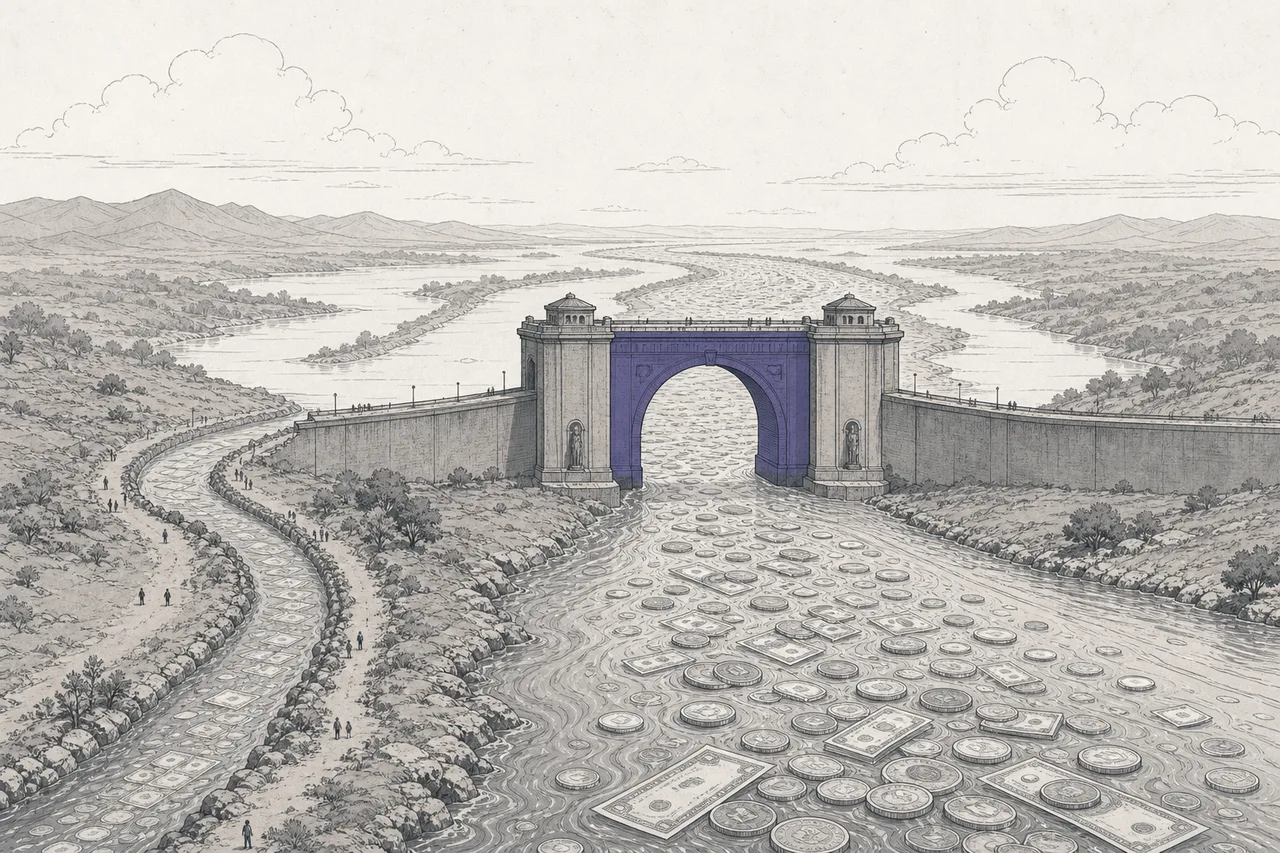
Every time you swipe a card, send money, or tap to pay in an app, a tiny sliver of money gets skimmed along the way. That's the 'toll' of the payment system. The biggest business in finance is built by the people who put up that tollgate — Visa and Mastercard earn over 60% gross margins from simply being the 'rails' money runs across. This lesson is the story of those rails: how they work, who collects the toll, and why 2025–2026 is the moment new rails — instant payments, cross-border, and stablecoins — are trying to dig a shortcut around the gate.
01What it is
Picture what happens in the split second you swipe a card to buy a coffee. The shop gets paid, you get your coffee. It looks simple — but behind it, a whole system of 'rails' sends the instruction, checks it, and actually moves the money from your account to the shop's, all in a few seconds. And every one of those rails has an owner who takes a small fee each time money runs across it.
Payments Modernization & Rails is the node about these 'money-moving systems' — both the old rails that have ruled the world for decades (the card networks) and the new rails being built for the digital era: real-time payments, cross-border transfers, and stablecoin settlement. Its definition on the megatrend map says it plainly — 'payment networks and processors for real-time, cross-border, and stablecoin settlement.'
It sits under the big megatrend Digital Finance & Tokenization — the move to put money, assets, and financial services onto 'programmable rails.' This node is the platform layer of that trend, its infrastructure layer — the pipe everything has to run through.
There are three layers to grasp up front, and we'll keep coming back to them all lesson:
- Card networks: Visa and Mastercard — the 'highway' connecting the buyer's bank to the seller's bank. This is the real tollgate
- Acquirers / processors: Stripe, Adyen, Block — the technology that lets a shop 'get paid' without wiring up to the card networks itself
- New rails: government instant-payment systems (UPI, Pix, FedNow), cross-border transfers, and stablecoins — rails trying to leap over the card gate entirely
In this industry, 'rails' means the infrastructure used to move money from one point to another — like a railway track that different trains can run on · card rails (Visa/Mastercard), instant-transfer rails (UPI/FedNow), legacy bank rails (SWIFT, ACH), and blockchain rails (stablecoins) — each with a different speed, cost, and owner. 'Payments Modernization' is the work of upgrading these rails and building new ones that are faster and cheaper.
02Why it matters — a toll on every transaction
The reason payments matter so much comes down to one sentence: it's a business that takes a tiny sliver of 'every purchase on Earth.' The sliver looks tiny, but multiply it by a colossal number of transactions and it becomes an enormous pile of money.
In 2024 the global payments industry earned roughly $2.5 trillion in revenue from the more than $200 trillion flowing through the system across about 3.6 trillion transactions. As a 'take rate' — the share the industry keeps — that's only about 0.125% of the value flowing through. Almost imperceptible. But because the base is so vast, it's one of the single biggest profit pools in global finance, and it's expected to reach ~$3.0 trillion by 2029.
Take rate = the share of a transaction's value that the middleman keeps as revenue. If you buy something for 100 baht and the payment system takes 2 baht, the take rate is 2% · across the whole industry the average is ~0.125% (because it includes huge bank-to-bank transfers that charge very little), but on card payments alone the take rate — all fees combined — can run as high as 1.5–3%. And that's exactly where the battle is.
To see how big this 'sliver' really is: just the swipe fees on Visa and Mastercard cards in the US add up to over $100 billion that businesses pay in a single year. It's a cost every shop carries quietly — and usually passes on to the price you pay.
This is why Visa and Mastercard are often called 'the toll roads of the digital economy' — a duopoly (a market with just two dominant players) that gets paid every time the world spends, without carrying any of the buyer's credit risk (the bank that issues the card carries that). It's one of the strongest 'moats' in business.
03How it works — the journey of one payment
Let's follow the 100 baht you pay for coffee. In the card system, the money doesn't run straight from your account to the shop's — it passes through at least four hops, and each hop skims its own cut. Together they're called the 'merchant discount rate', the fee a shop pays to accept cards.
The biggest fee in this chain is the 'interchange fee' — the cut the card-issuing bank takes (usually ~1–2% of the amount). The card network itself takes a much smaller 'scheme fee,' but because it collects from every transaction in the world, it gets enormously rich. The real numbers are startling: in a single quarter, Visa processed over $4.5 trillion and Mastercard about $2.8 trillion. Together the two move over $20 trillion a year.
This is where the second group comes in — the acquirers / processors. In the old days a shop had to wire up to the banks and card networks itself, which was a real pain. Companies like Stripe, Adyen, Block turned it into just 'drop in a few lines of code' or 'plug in a card reader' and start getting paid. They add their own cut on top (Stripe charges a standard ~2.9% + a fixed fee, for example) in exchange for the ease and the full toolkit. Their scale is huge too: in 2025 Stripe processed $1.9 trillion in total (+34%), while Adyen is at the €1.3 trillion level.
04Where it sits in Digital Finance
Payments is the 'bottom layer' of Digital Finance & Tokenization — the pipe nearly every neighbor in the trend has to run through. Because in the end, every financial service has to 'move money' at some point:
- Overlaps directly with Stablecoin Issuers & Distribution: stablecoins are 'dollars on a blockchain,' and they're becoming a new rail for payment and settlement — the two are almost inseparable (we'll dig in next chapter)
- Is the pipe for Digital Banking & Neobanks: digital banks like Nubank/Revolut sell a smooth payment experience, but behind the scenes they still run on card rails or instant-payment rails
- Is the rail for Digital Lending & Alt-Credit and BNPL: 'buy now, pay later' means slipping credit into the moment of payment — it has to ride on this payment rail too
- Depends on Cybersecurity & Digital Trust and Cloud & Digital Infrastructure: a system moving the world's money has to block fraud and run on cloud that can't go down — trust is this business's core asset
Of Digital Finance's seven nodes, Payments is the 'oldest and most genuinely profitable today' (Visa/Mastercard have made money for decades), while many of the others are still about the future — but it's also the node being challenged hardest by the 'new rails.'
05Where it stands now — new rails storm the old gate
The story of 2025–2026 is 'the old gate is under siege.' For the first time, the card duopoly is facing real pressure from three directions at once — government instant-payment rails, cheaper cross-border transfers, and stablecoins.
Rail one: instant, account-to-account (skip the card entirely)
In many countries, people have stopped using cards and switched to 'instant account-to-account transfer' systems that governments built for free or nearly free. These systems skip the card networks entirely — no 1.5–3% toll. The most powerful example is India's UPI: across 2025 it ran about 228 billion transactions worth over $3.4 trillion, and late in the year UPI overtook Visa in daily transaction count (~640 million vs 639 million a day). Brazil's Pix reached 71% of the population in just four years and once hit 313 million transactions in a single day.
In the US, the equivalent is the central bank's FedNow, which launched in 2023 and had nearly 1,200 institutions on board by the end of 2024 — but it's still not as widespread as UPI/Pix, because the US market is split across cards, ACH, and wire. In the eurozone, meanwhile, instant transfers already hit 23% of retail transactions in the first half of 2025.
Rail two: cross-border — the most expensive and slowest rail
Sending money across borders is still where it hurts most. The traditional SWIFT system routes through correspondent banks, each skimming a $15–50 fee per hop, making it slow (several days) and expensive. The global average cost of a remittance was still 6.49% in early 2025 — and the BIS admits the G20 target of getting it below 3% by 2027 won't be met in time. This is a huge 'gap' the new rails, especially stablecoins, are aiming at.
Rail three: stablecoins — the 'dollars on a blockchain' rail
This is the hottest story. Stablecoins let you send digital dollars across the world in seconds, at near-zero cost, 24 hours a day, without passing through a correspondent bank — a direct threat to both the SWIFT rail and the card rail. The 2025 numbers look startling: stablecoin on-chain settlement totaled around $33 trillion, more than Visa and Mastercard combined ($25.5 trillion) — but be careful: most of that figure is trading and bots, not actual 'paying for things.'
The truer picture comes from Stripe, which reports the value of stablecoins used for real payments doubled to about $400 billion in 2025, with ~60% of it B2B (companies using digital dollars to pay suppliers or manage cash across borders). The big move was the GENIUS Act, which the US passed in July 2025 — giving stablecoins a clear legal framework for the first time and unlocking institutions to use them with confidence.
And the most interesting part: instead of being killed, the card networks chose to 'embrace' the stablecoin rail — Visa launched stablecoin settlement (~$4.6B annual run-rate as of early 2026, with 130+ stablecoin-linked card programs across 50+ countries), Mastercard announced it would buy BVNK (a stablecoin infrastructure company) for as much as $1.8B, and Stripe bought Bridge to build its own stablecoin layer. They know full well: 'if you can't stop the new rail, just own it.'
06The road ahead — when AI does the shopping for you
The biggest shift in the near future isn't even about 'rails' anymore — it's about 'who presses the button to pay,' and the answer is changing from humans to AI agents. As AI assistants start to shop, book tickets, and negotiate prices on your behalf, the payment system has to build a 'new rail' that lets an AI pay safely, with an audit trail, and within set limits.

2025 was the year everyone opened this game at once — Visa launched Intelligent Commerce and Trusted Agent Protocol (with OpenAI, Anthropic, Microsoft and others) to let shops tell an 'authorized AI' apart from a dangerous bot. Mastercard launched Agent Pay and made its first real AI-driven transaction in September 2025, while OpenAI teamed up with Stripe on the Agentic Commerce Protocol that powers Instant Checkout in ChatGPT. This connects straight to the Agentic AI megatrend — because an agent that can really act for you has to be able to pay.
The size of this wave is already showing: over Cyber Week at the end of 2025, AI agents influenced $67 billion in sales worldwide — about 20% of all orders — and McKinsey estimates US consumer agentic commerce could reach $1 trillion a year by 2030.
The second shift is the merging of rails — the future isn't 'one rail wins,' but a world where the payment system automatically picks the cheapest, fastest rail (cards when you need credit or protection, instant payments when you want it cheap, stablecoins when you need to cross borders). The winner may not be the owner of any one rail, but whoever sits at the 'top layer' that can orchestrate them all — which is exactly why processors like Stripe/Adyen and the card networks are all racing to build that layer.
07Challenges & risks
A business this beautifully profitable always draws people who want to take it, and governments who want to rein it in — here are the three main risks.
The first risk is disintermediation (getting the gate skipped), the heart of the whole thing. Every time an account-to-account rail (UPI, Pix, FedNow) or a stablecoin grows, that's a transaction that doesn't pass through the card gate and doesn't pay the 1.5–3% toll. In India, where UPI dominates, the card share has genuinely shrunk. The big question is how fast the cards' lovely take-rate model gets eroded over the next 5–10 years — and the cards' answer is to 'shift to selling value-added services' (fraud protection, data, tokens) instead of just collecting a toll.
The second risk is regulation, especially around interchange. Those rich swipe fees are watched by governments everywhere. The EU has already capped interchange (0.2% debit, 0.3% credit), pushing revenue down sharply. The US has both the Durbin Amendment (capping debit) and the proposed Credit Card Competition Act trying to open up competition against the card duopoly — and even though these drag on in court, the direction is clear: 'the toll will be pressured down.' Every time a cap is imposed, the rich profit shrinks instantly.
The third risk is fraud and trust. A faster system (instant payments can't be reversed) with new players (stablecoins, AI agents) also opens new kinds of fraud. Many instant-payment systems face scams where the victim 'sends the money themselves' and can't get it back. Letting AI pay on your behalf raises a big question too: if an agent buys the wrong thing, who's responsible? That's why digital safety and trust is an indispensable foundation — a rail people don't trust, no matter how cheap and fast, is one nobody uses.
In short: Payments is the story of a tiny toll on every transaction in the world, which together adds up to one of the most beautifully profitable treasure troves there is · for the first time in decades the old gate is being seriously challenged — but the gatekeepers are smart enough to 'own the very rail that could destroy them.' Understanding this node means understanding why, every time you press the button to pay, there's a fight over the tollgate hidden behind it.