Megatrend · Digital Finance
Lending by software: when "data" decides instead of a credit score
For a hundred years, whether you could borrow came down to a single number — your credit score — and people with a "thin file" simply got turned away. Now companies like Upstart, Affirm, SoFi and Klarna are rewriting the rules: using thousands of data points and AI to decide who's trustworthy, lending through an app, and splitting a purchase into installments right at the checkout screen. This is the story of replacing "bank branches and scores" with "software and data" — and a harder question that comes with it: is this access, or a debt trap?
01What it is
Picture buying a $120 pair of shoes online. You hit pay, and a button pops up: "Split into 4 payments of $30." You tap OK, the shoes are yours instantly — no credit card, no talking to a bank — and the whole thing took 3 seconds. That's Digital Lending in the form you're most likely to run into.
Put plainly: this node is lending through software, using data instead of relying on a credit score alone, and happening outside the traditional bank branch. It's a sub-theme under the megatrend Digital Finance & Tokenization — finance being rewritten entirely as software.
There are three main forms worth telling apart, because they work in different ways:
- BNPL (Buy-Now-Pay-Later): split a single purchase into a few short installments (usually 4), embedded right in an online store's checkout — Affirm, Klarna, Afterpay (owned by Block)
- AI / Alt-data Underwriting: use thousands of data points plus machine learning to judge who's trustworthy, so you can lend faster and reach people the banks ignore for having a "thin file" — Upstart, SoFi
- Marketplace Lending: platforms that match borrowers with investors or institutions who want to lend — LendingClub, Funding Circle
is "the process of deciding who to lend to, at what interest rate, and at what risk." The whole heart of a lending business sits here — whoever judges more accurately can lend more broadly while losing less. Most of this lesson is really about how AI and data are changing the way lenders underwrite.
02Why it matters to the economy
Credit is the bloodstream of the economy — homes, cars, education, small businesses all need to borrow. And for a hundred years the "gatekeepers" were banks and the credit bureaus. If your score fell short, you were turned away. Digital Lending matters because it takes this one decision and hands it to software — making it faster, cheaper, and able to reach people the old system couldn't see.
It's bigger than it feels. The technology platforms that power digital lending alone were worth about $14B in 2025, and many research houses expect that to reach $70–115B by the early 2030s, growing around 27% a year — one of the fastest-growing segments in fintech.
If you count the money actually lent through digital channels, the figure is even larger — roughly $566B globally. It grows because it solves two pains at once: borrowers get money faster and more easily, and lenders cut branch and staffing costs sharply, because the process is almost entirely software.
What matters most for the "real economy" is that it changes who can access credit. Tens of millions of Americans are nearly invisible to the traditional credit bureaus (they're called "credit invisible" or "thin-file") — not because they're risky, but because there's not enough history to score them. New graduates, recent immigrants, people who've never had a credit card. A system that uses alternative data is the key that can actually open the door for this group.
03How it works — data instead of a score
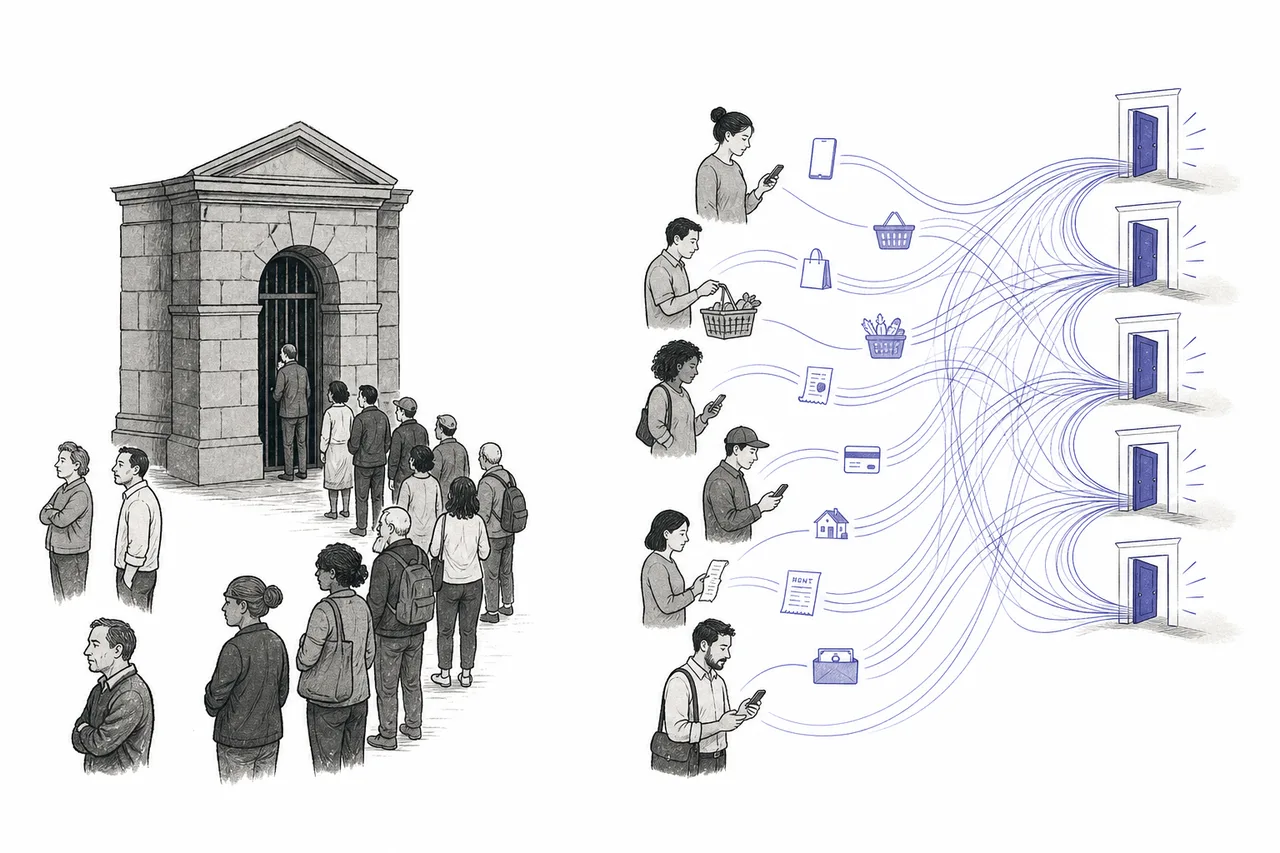
To see why this changes the game, you first need the old way. The traditional system judged you by a single number — your credit score (in the US, FICO) — built from just a few inputs like payment history and outstanding debt. It works like one door with a bar: hit the line and you pass, fall short and you're denied. The problem is that if you're "thin file," you weren't judged bad — you just didn't have enough data, and got denied anyway.
The new approach does the opposite. Instead of one number, it feeds thousands of signals into a machine-learning model — your education and field of study, occupation, income history, spending patterns, cash flow in your accounts, even your behavior in the app — and lets the model learn which patterns "tend to pay back" versus "tend to default." The result is it can tell people apart far more finely, especially the ones the old score couldn't answer for.
The pioneer here is Upstart. Its model uses more than 1,600 variables, and in Q3 2025 it originated over 428,000 loans ($2.9B), with more than 90% of loans approved automatically — no human touched them. What Upstart is proudest of is that its "ability to separate payers from defaulters" is still at its highest level — meaning the model stays accurate even as it lends more broadly.
But that speed and breadth don't come free. Once you use thousands of data points and AI, you get a new risk the old system didn't have — the model becomes a "black box" that's hard to explain when it denies someone, and it can hide bias that unintentionally discriminates against certain groups. That's exactly what regulators are watching closely.
04BNPL — splitting the bill at checkout
The other half of this story is BNPL, which you've probably already seen. It's splitting a single purchase into a few short installments, right at checkout. Most are "pay in 4, no interest," where the provider takes a fee from the merchant instead — because BNPL makes customers more willing to buy, and lifts the size of each order.

BNPL isn't a small thing — global BNPL purchase volume (GMV) hit about $560B in 2025, up ~14% year over year, with North America taking roughly 56% of it. What's striking is that just 5 US providers — Affirm, Klarna, Afterpay, Zip, Sezzle — together hold over 95% of the market. It's a highly concentrated market.
The US market leader is Affirm. In fiscal 2025 its platform purchase volume (GMV) was about $36B, revenue around $3.2B, with roughly 23 million active users. The big turning point: in the final quarter of fiscal 2025, Affirm posted its first operating profit — finally answering the long-standing question, "can BNPL actually make money?" Meanwhile Klarna, the Swedish giant, has about 111 million users across 26 countries and listed on the NYSE in September 2025 (ticker KLAR) at a valuation around $17.4B.
is "the total value of goods bought through a platform" — not the company's revenue. Affirm enabled $36B worth of purchases, but the company's actual revenue (from merchant fees plus interest) is around $3.2B. When you look at a BNPL company, you have to keep these two apart.
05What it connects to
This node doesn't stand alone. It's one piece of Digital Finance & Tokenization, and it's tightly tangled with its sibling nodes:
- Pairs with Digital Banking & Neobanks: this is the blurriest line — SoFi started in lending, then went to get a "bank charter" so it could gather cheap deposits to lend out. That makes it both a digital lender and a neobank in one. Holding a bank charter is the "weapon" that drives the cost of funding way down
- Sits on top of Payments Modernization & Rails: BNPL couldn't exist without a payment system that can seamlessly drop a "split it up" button into a store's checkout screen
- At its core is AI Applications: all of Upstart's edge comes from an AI model that judges credit more accurately — digital lending is one of the clearest cases where AI maps straight to money
Look beyond the Digital Finance bucket and it connects to other big trends too — it leans on Cloud & Digital Infrastructure as the base to run its models and crunch the data, and it depends heavily on Cybersecurity & Digital Trust, because this business is handing real money to people it only knows through data. If identity verification or fraud defense slips, the damage shows up as a dollar figure right away.
06Where it stands now + the players
2025–2026 is this industry's "prove yourself" phase. After fintech stocks got hammered in 2022 when rates rose, the question was: "does digital lending actually make money, or did it just grow on cheap money?" The answer coming out is that the players who manage credit well and have cheap funding are proving they can.
SoFi is the clearest example. In Q4 2025 its net revenue hit $1B for the first time, with net profit of $174M; it originated $10.5B in loans that quarter and passed 12.6 million members — the bank charter it went after lets it raise low-cost deposits to lend out. Meanwhile Upstart is growing hard again (revenue +71% in Q3 2025) after coming through the high-rate stretch that nearly broke its model.
07The road ahead
The first direction is that AI underwriting becomes the standard, not an option. Now that it took about 44% of the market in 2025 and proved it can raise approval rates without adding risk, even traditional banks are starting to "rent" the model from companies like Upstart — the line between "fintech" and "bank" keeps fading.
The second direction is that BNPL gets pulled into the formal credit system. Right now most BNPL debt is "invisible" because it isn't reported to the credit bureaus (people call it "phantom debt"). But the pressure to report it is rising. If BNPL one day gets fully counted in your credit score, it'll change both how users behave and the risk models across the whole industry.
The third direction is consolidation with deposits. The long game is whoever has the cheapest funding. The path SoFi and LendingClub took to grab a bank charter suggests the winners of the next round may not be "pure lending apps," but companies that blend AI-driven lending with a bank-style deposit base.
08Risk — tied to the debt cycle
Let's be straight: the appeal of this business comes with a risk baked right into it. And unlike ordinary software, it sends real money out the door — if people don't pay it back, that's a real loss.
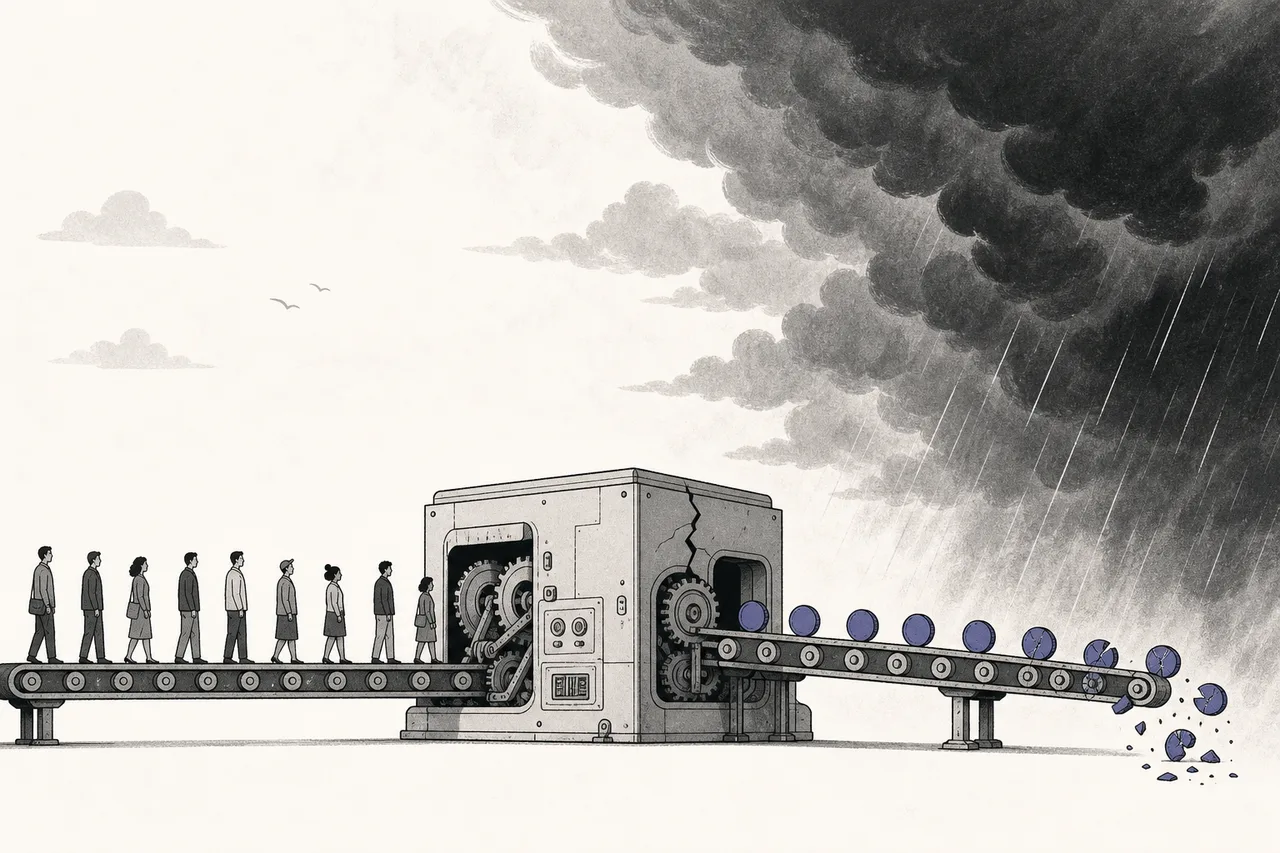
The first and biggest risk is that it's tied to the credit cycle. AI models are trained on historical data that's mostly from good times. When the economy slows and people lose jobs, defaults spike all at once — and a model that looked sharp on a clear day can misjudge in a storm. That's why these stocks swing harder with the economy than ordinary tech stocks.
The second risk is the BNPL debt trap. The ease is a double-edged sword. A CFPB report found nearly 30% of BNPL users had at least one late payment in a year, and some surveys (LendingTree) put it as high as 41% — because people tend to use several BNPL providers at once and end up "stacking debt on debt" without realizing it. And because this debt isn't reported to the bureaus, no one can see how much hidden debt households are carrying.
The third risk is rules that aren't settled. In 2025 the US regulator (CFPB) backed off from issuing rules to govern BNPL — good for companies in the short run, but it also means the rules can shift at any moment with the political winds. The other side is the black-box model: when AI decides who gets a loan, you have to be able to prove it doesn't discriminate against vulnerable groups — a problem that's still unsolved, both technically and legally.