Megatrend · Digital Finance
When the stock market moved into your phone and commissions hit zero
Investing used to be for the wealthy — people with a personal broker, a commission on every trade, and an advisor charging 1–2% a year. Then apps like Robinhood made it all 'free,' and algorithms like Betterment started building your portfolio automatically for a fee of just 0.25%. This lesson tells the story of the two models that pulled an entire generation into the market — and the truth about who's actually paying for that 'free.'
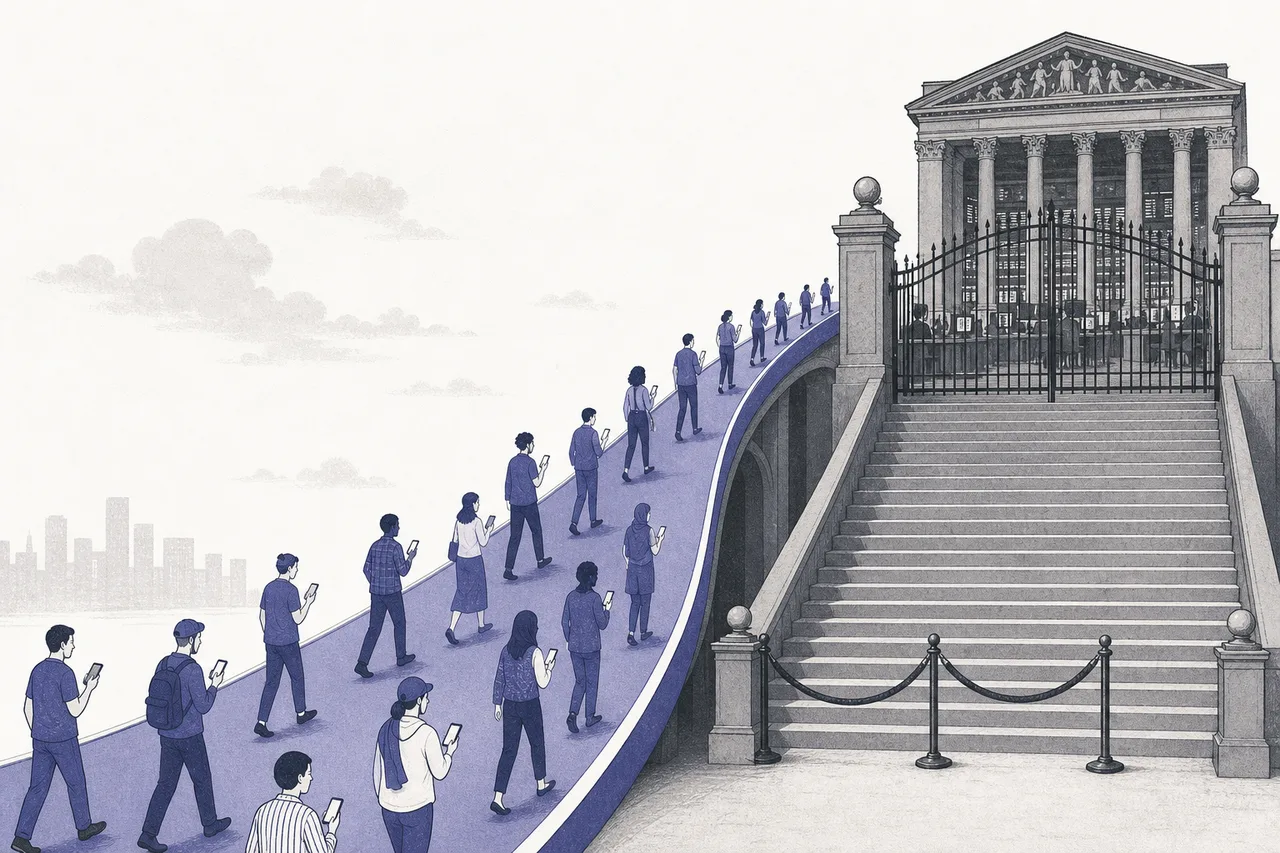
01What it is (two models)
Picture 2010. If you wanted to buy a stock, you had to call your broker or log into their site and pay a commission of about $5–10 a trade. And if you wanted someone to 'build a portfolio' for you, you needed a large enough sum to hire an advisor who took 1–2% of your money every year. Investing was a game for people with money. A decade-plus later, a 22-year-old downloads a free app, deposits $50, and buys a fractional share of Apple in three seconds — with no commission at all. That's what this node is about.
Digital Wealth & Robo-Advisory is about using technology to put 'investing' within reach of ordinary people. It splits into two clearly different models:
- Commission-free brokerage: apps that let you 'trade it yourself' — buy and sell stocks, crypto, and options for free, with no per-trade commission. The headliner is Robinhood, which lit the fuse on the industry-wide 'zero commission' war
- Robo-advisor: the opposite — you don't pick stocks yourself. You just state your goal and how much risk you can take, and an algorithm builds a diversified portfolio for you automatically and keeps it rebalanced over time, for a tiny fee of about 0.25% a year. The pioneers are Betterment and Wealthfront
Put simply: the first model is 'here's the wheel, you drive.' The second is 'get in the self-driving car and let it take you to your goal.' Both have the same aim — pull as many ordinary people into the market as possible.
When the stocks in your portfolio rise and fall unevenly, the mix you set drifts off target (say you meant to hold 60% stocks, but they ran up to 70%). Rebalancing means selling the excess and buying back what's short, to pull the portfolio back to its original mix. It's a tedious chore humans tend to forget — but an algorithm can do it automatically, every day. That's the core of what a robo-advisor sells.
Within Digital Finance & Tokenization, this node is the 'end-user' layer — the point where every financial innovation finally meets the real retail investor.
02Why it matters — investing for the masses
What makes this trend matter isn't the technology — it's that it changed 'who' gets into the market. A $5–10 commission per trade sounds small, but for someone with only $100 to invest, it's a wall — one trade already costs you 5–10%. Once that fee hit zero, an entire generation that never thought they 'could buy stocks' came in.
The numbers say it plainly. Robinhood alone had about 27 million funded customers as of 2025, and has pulled over $300 billion of customer assets onto its platform — most of them young people for whom this is their first-ever investment account.
On the robo-advisor side, the same thing happened with advisory fees. A traditional financial advisor charges 1–2% of assets a year. On a $100,000 portfolio, that's $1,000–2,000 every year. A robo-advisor does the same job (build a portfolio + rebalance) for about 0.25%, or $250 — 4–8 times cheaper. Money managed by these automated systems worldwide now stands at around $2 trillion.
This is what economists call fee compression — a permanent push downward on prices. Once someone can do the same job for a fraction of the cost, the whole industry is forced to cut prices too, and it cascades through the system. That's exactly what happened from 2012, when robos started shaking up fees, to 2019, when the industry's giant brokers all cut commissions to zero in turn.
03How 'free' makes money
The question people ask most is, 'If they don't charge commissions, how do these companies survive?' The answer is the key to understanding the whole trend — and to understanding its risks. Free brokers aren't running a charity. They've just moved where they collect the money to a place you can't see.
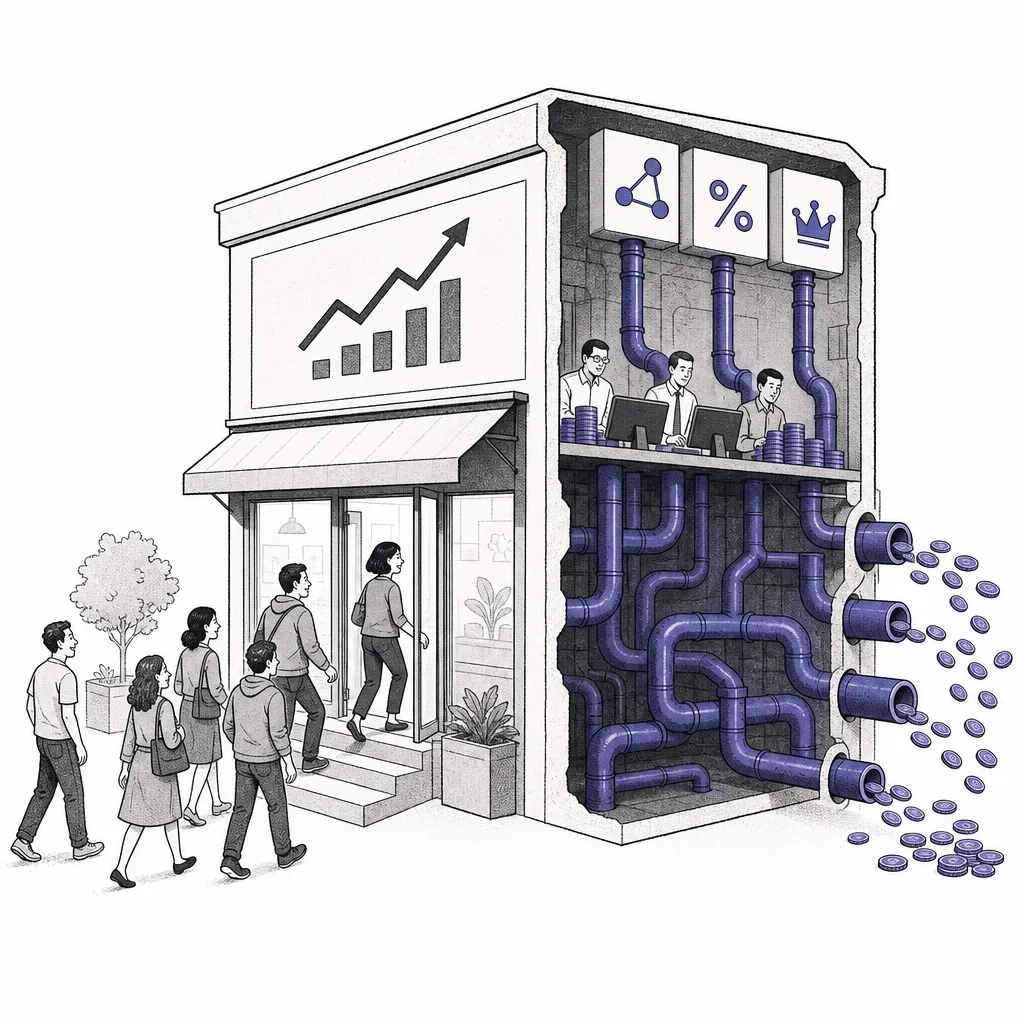
The money comes from three main channels. Follow the diagram — every time you tap a 'free' trade, it fires up this circuit:
Instead of sending your order straight to the main exchange, a free broker 'sells' that order to a big trading firm (market maker) that pays for the right to match it. These firms profit from tiny price differences across millions of orders — so the broker can let you trade 'free,' because someone is paying on your behalf in the background. The debate is that this may get you a slightly worse price without you realizing it — so 'free' isn't entirely free after all.
What's interesting is that when the market runs hot, interest income can actually be bigger than PFOF. In Q1 2026, Robinhood's revenue came about 34% from net interest (margin + cash), while all transaction-based revenue (options, crypto, stocks, futures, event contracts) added up to about 59%, and Robinhood Gold membership another 5% — which shows the real 'free' model is making money from several channels at once.
04Robo-advisors: the algorithm builds your portfolio
The other half of this trend is quieter, but manages far more money. In 2008, two startups — Betterment (New York) and Wealthfront (Silicon Valley) — were founded on the same idea: the work a financial advisor does for the middle class (build a diversified portfolio of low-cost ETFs, then keep rebalancing it) can be written entirely as an algorithm. Let a computer do it, and you don't have to pay a 1% advisor.
You answer a few questions (age, goals, how much risk you can take), and the system builds an ETF portfolio, invests automatically each month, rebalances when the mix drifts, and even does tax-loss harvesting (selling a losing position to cut your taxes, then buying something similar) — all without you touching a thing. The fee? About 0.25% a year.
But here's the plot twist few people know: the pioneers weren't the winners. Once the traditional giants saw the idea worked, they built their own robo-advisors on top of the huge customer bases they already had. The result: Vanguard Digital Advisor became the largest robo-advisor in the world (~$312 billion), followed by Empower and Schwab Intelligent Portfolios (~$90 billion), while pioneers like Betterment (~$32 billion) and Wealthfront (~$27 billion) stayed many times smaller — Wealthfront even agreed to be acquired by UBS.
The lesson here matters a lot: in financial businesses, trust + an existing customer base usually beats 'technology first.' The pioneers proved the model works, but the players who already had tens of millions of customers (Vanguard, Schwab) could overtake them just by flipping a switch — because their customers don't have to move their money anywhere.
05Where it sits in Digital Finance
This node is the 'storefront' of Digital Finance & Tokenization — the point where ordinary users actually touch the new financial trends, and it's tightly tangled up with its sibling nodes:
- Running parallel to Digital Banking & Neobanks: digital brokers and neobanks are merging — investing apps are adding savings accounts and cards, while neobanks are adding investing. Everyone wants to be the one-stop 'financial super-app'
- Pulling in Crypto Exchanges & Custody: Robinhood earns about 13% of its revenue from crypto — the line between a 'stock app' and a 'crypto app' has all but vanished
- A gateway to RWA Tokenization: Robinhood issuing 'tokenized stocks' that let you trade US equities on a blockchain 24/5 is about bringing real assets into the token world — this node is becoming the retail sales channel for tokenizing
- Driven by AI Applications: the next wave is investment advice that AI personalizes for each individual — turning the robo from a 'fixed formula' into 'an advisor that can talk with you'
Structurally, this node depends on Cloud & Digital Infrastructure (everything runs on the cloud) and leans heavily on Cybersecurity & Digital Trust — because an app holding 27 million people's investment money loses all confidence the instant it gets hacked or goes down when the market is volatile.
06Where it stands now + the players
2025–2026 is when Robinhood's story changed from 'a teenage trading app from the COVID era' into a financial super-app that makes serious money. In 2025 the company set a record with $4.5 billion in net revenue and $1.9 billion in net profit (up from $2.95 billion in revenue in 2024) — and HOOD stock jumped ~220% in a single year.
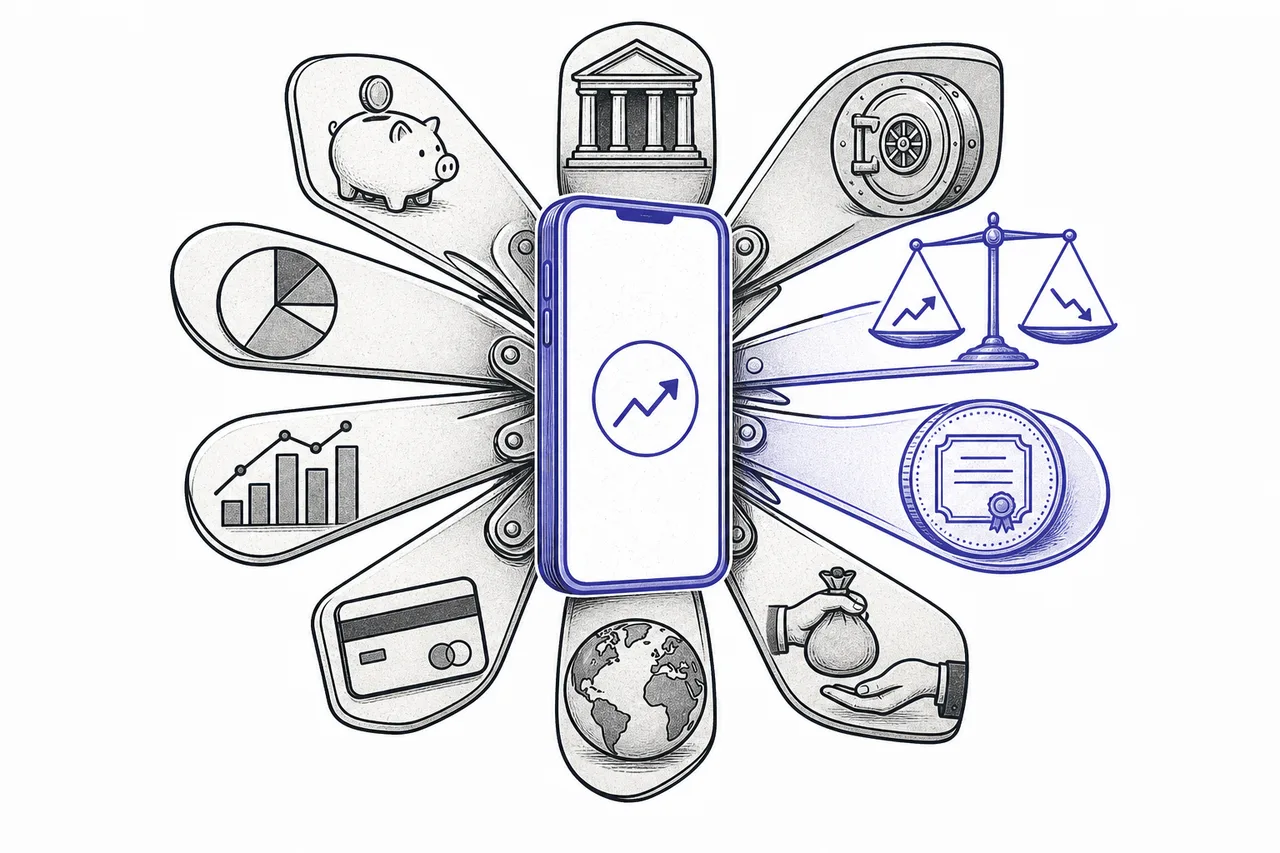
The key to the turnaround was 'branching out' the business lines — in 2025 Robinhood had 11 business lines each earning over $100 million a year, including retirement accounts, credit cards, and the two most talked-about:
- Prediction markets: trade 'event contracts' (election outcomes, sports results, and the like). In 2025, trading blew past 12 billion contracts, becoming a fast-growing new business line
- Tokenized stocks: opened up trading of over 200 US stocks and ETFs on a blockchain, 24/5, for European customers — the CEO called it 'the industry's biggest innovation in a decade'
So the overall market splits into two layers: on the 'trade it yourself' side, there's Robinhood — the standout, mid-transformation — while old giants like Charles Schwab and Interactive Brokers are far larger, more solid strongholds by assets. And on the 'let the algorithm do it' side, the old giants dominate too.
07The road ahead
The first direction is consolidation into a 'financial super-app'. The lines between brokers, banks, and crypto wallets are dissolving. The winner in the next decade is likely to be the app customers open every day to do everything money-related — invest, save, pay, borrow — all in one place. That's why Robinhood is racing to add business lines, and neobanks are racing to add investing.
The second direction is AI turning the robo from a fixed formula into an advisor you can talk to. First-generation robos used a fixed portfolio formula based on your risk level. The next wave is an AI assistant that understands your life situation, answers questions in plain language, and personalizes its advice — see AI Applications. This may be where a new player flips the game once again.
The third direction is tokenizing stocks and real-world assets. If Robinhood's tokenized stocks work and expand beyond Europe, it could change how the whole world buys and sells securities — tradeable 24 hours, divisible into tiny fractions, easier to move across borders. It connects directly to RWA Tokenization. This is the trend's biggest and most uncertain bet.
08Challenges & risks
The appeal of 'letting everyone invest' comes with risks baked right into its business model.
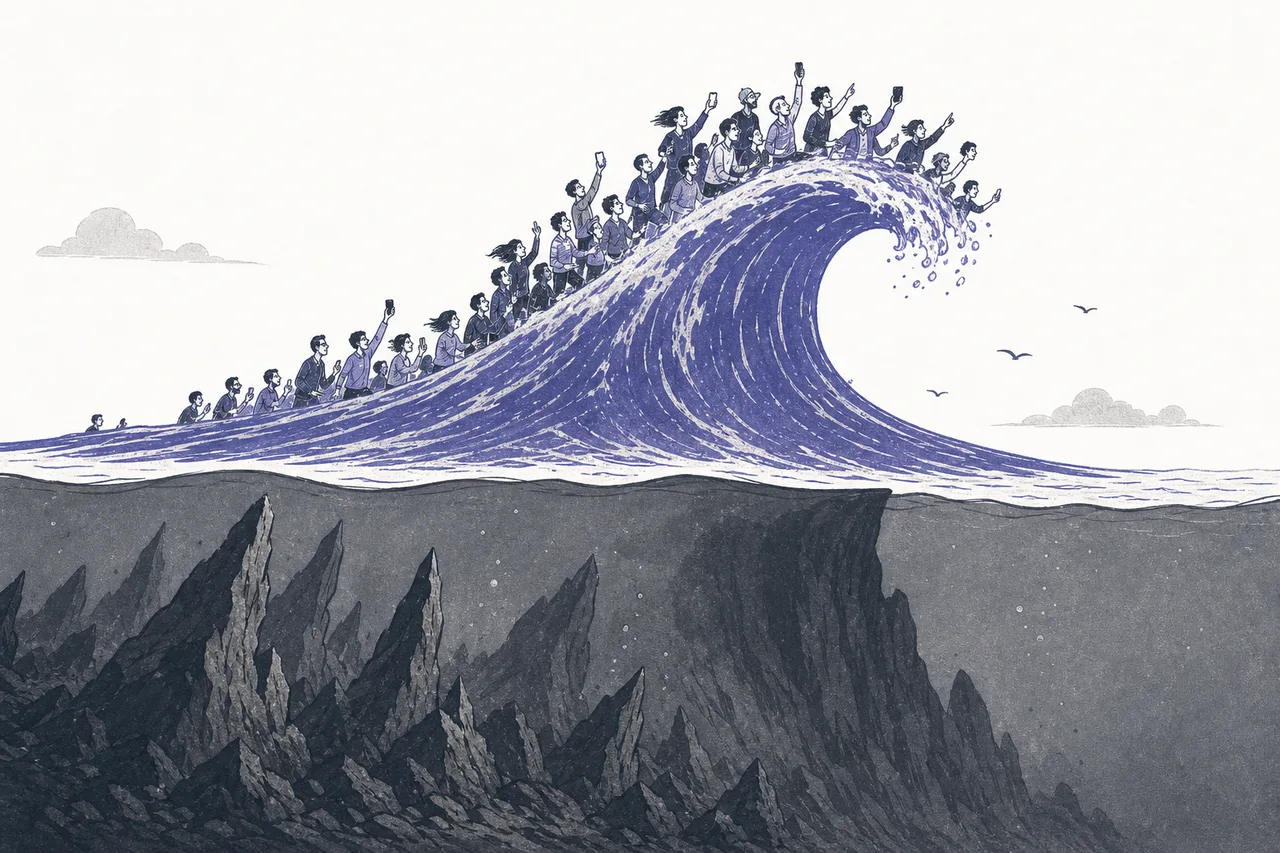
The first risk is market cyclicality. These platforms' revenue is tied to 'trading volume' and 'asset prices.' A bull market where people trade crypto and options actively = revenue floods in. But when a bear market arrives, people stop trading, portfolio values shrink, and both PFOF and asset-based fees shrink right with them — this is a business whose profits swing with the market's mood.
The second risk is rules around PFOF. The money machine of the 'free' model leans heavily on payment for order flow, but regulators worldwide are watching — the European Union banned PFOF under the MiFIR rules (fully in force June 30, 2026). In the US, even though the SEC withdrew its 'mandatory auction for retail orders' proposal in 2025, the issue isn't over. If the US one day bans it too, a big chunk of free brokers' revenue vanishes overnight.
Europe banning PFOF means the 'free trading' model that feeds on PFOF can't work there. Brokers in that market have to make money another way (charge small fees, or earn interest). This is the real test of how far 'free' can survive if its main revenue pipe is cut — and it's the single biggest policy risk for the whole trend.
The third risk is fee compression that never stops. The very thing that makes this trend good for consumers (fees keep falling) is the same thing squeezing providers' profits. Once Vanguard and Schwab can offer cheap robos, the small pioneers get squeezed until they have to sell out (like Wealthfront). In a business where the products are all alike and competition is on price, only the players with 'scale' and an 'existing customer base' survive in the end.
In short: Digital Wealth & Robo-Advisory is the story of tearing down a century-old wall that kept ordinary people out of the capital markets, with two weapons — 'zero commission' that gets people doing it themselves, and 'algorithmic portfolios' that do an advisor's job for a fraction of the price. Both have already changed the investing lives of hundreds of millions of people. The question that's left isn't 'will it happen' (it already has), but 'who will actually make money from it in the long run, now that everything's free.'