Megatrend · Digital Finance
The issuer makes money — but the one who "puts the coin in your hand" may make more
Everyone remembers stablecoin issuers as money-printing machines, because they keep all the interest from their reserves. But there's a startling truth hiding underneath: in 2024, Circle, the issuer of USDC, paid over $908 million to Coinbase — not because Coinbase created the coin, but because Coinbase is the one who "puts the coin in users' hands." Distribution is this node — the exchanges, wallets, and payment apps that pull stablecoins toward real people, and take back a big share of the "reserve interest" in return. And the most expensive question in this whole field is — where's the real moat: in "who issues the coin," or in "who reaches the users"?
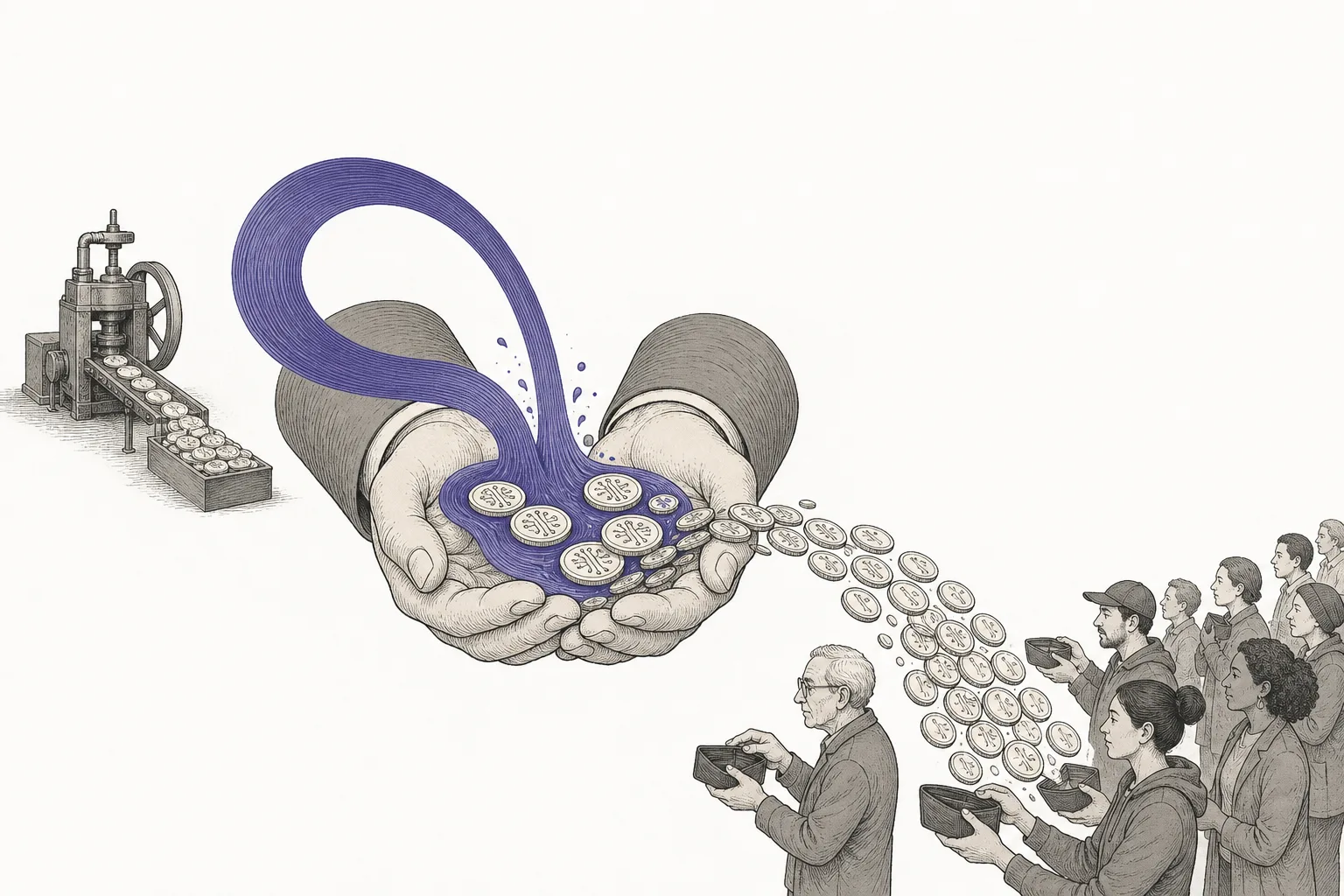
01What it is (the people who distribute the coin + share the interest)
Think of a famous soda brand. The factory that "mixes the syrup" may own the secret formula, but the one that lets you grab a can from the convenience store on every corner is the distribution network — and often it's the distributor that takes a cut just as big as the formula's owner. The stablecoin world works exactly the same way. This node is the "distribution network" of the digital dollar.
To be clear, this node is the group of businesses that do two things at once: (1) distribution — the channels where people swap real money for stablecoins, hold them, and use them, including crypto exchanges (like Coinbase), wallets, payment apps like PayPal/Venmo, trading apps like Robinhood, and card networks like Visa/Mastercard that make the coin "actually swipeable" · (2) revenue-share — because distribution has value, issuers share the interest from their reserves with the ones who help distribute.
On the megatrend map, this node sits under Stablecoin Issuers & Distribution within the larger trend Digital Finance & Tokenization. It's the "platform layer" between the issuer and the end user. Its sibling right next door is the Stablecoin Issuers — the ones who "mint" the coin and hold the reserves. The difference: issuers create the coin · this node gets the coin into people's hands — and that's the line that splits the whole story.
Distribution = the channels that let users actually access, hold, and use a stablecoin — the more coins "sit" on your platform, the bigger the balance · Reserve revenue share = an agreement where the issuer shares the interest earned on its reserves (money put into government bonds) with the distributor, usually tied to "where the coin is held" — the more held on your platform, the bigger your cut.
02Why it matters — distribution may be the real moat
There's a simple belief in this field that "whoever issues the coin owns the money-printing machine." But the real numbers tell a different story. In 2024, Circle, the issuer of USDC, had total distribution costs of ~$1,010 million, and of that, $908 million went to Coinbase alone — nearly 60% of all the reserve revenue Circle earned. Put simply, the one who issues the coin has to hand the single biggest chunk of profit to the one who distributes it.
Why does distribution have that much power? Because a stablecoin is a commodity — USDC, PYUSD, or any other dollar coin is all worth the same $1, and no one is loyal to a "coin brand." People are loyal to the app they already use. So whoever holds the "users" in hand — Coinbase with millions of trader accounts, PayPal with 439 million accounts — is the one who decides which coin gets used. Every issuer has to "court" these channels to get its coin used.
This is the "distribution > issuance" theory: issuing a coin is repeatable — anyone with reserves and a license can do it. But owning a relationship with millions of users is far harder to copy. So over the long run, the value may not land with whoever prints coins best, but with whoever "owns the screen" users open every day.
03How it works (the interest flows to whoever holds the coin)
In the issuers lesson, we saw that issuers keep the bond interest for themselves. So the question is — how does the distributor get the interest? The answer lies in "where the coin is held." Let's walk through it step by step.
The heart of the mechanism is in the words "where it's held." The most famous deal is Coinbase × Circle: Coinbase gets 100% of the interest from USDC held on Coinbase's own platform, and 50% of the interest from USDC held off-platform. That's why Coinbase does everything it can to get users to leave USDC parked on the app — every coin that "sits" on the platform is full interest into its pocket.
So why does the distributor agree to "share some back" with users (paying, say, a ~4% reward)? Because it's a coin-vacuum — the more attractive the reward, the more users move their coins to hold with you, the bigger the balance grows, and the bigger the cut of interest you get from the issuer. It becomes a cycle where the distributor invests "part of the interest" to grab "balance" away from rivals.
04How it pairs with the issuer: the Coinbase × Circle deal
This node can't be separated from the issuers — they're two sides of the same coin. The issuer has the "money-printing machine" (reserves + interest) but no "users." The distributor has the "users" but no printing machine. So the two have to join hands, and the deal that became the textbook case is Coinbase × Circle.
Coinbase and Circle originally co-owned USDC. Circle later bought back the stake but kept a long-term revenue-share agreement: Coinbase gets 100% of the reserve interest from USDC held on Coinbase, plus 50% of the interest from all the rest of USDC worldwide. The result: in Q1 2025, Coinbase earned about $300 million from the USDC deal and grabbed roughly 54% of the entire USDC interest pool (~$900 million) — even more than Circle, the issuer, kept for itself.
Viewed as an ecosystem, this node is bound up inseparably with other trends:
- Relies on Cybersecurity & Digital Trust: the distributor holds the coins of millions of users. If the platform gets hacked or funds vanish, trust collapses instantly — security is the first condition of being a "coin custodian" people trust
- Runs on Cloud & Digital Infrastructure: the trading apps, payment apps, and balance-ledger systems all run on the cloud — the more users, the more you need infrastructure that can handle massive transactions in real time
- Connects to the existing card networks: Visa and Mastercard are shifting from "the old payment rails" to stablecoin distributors — making the coin "swipeable" at tens of millions of merchants worldwide, becoming the largest distribution channel there is

05Where it stands now
The picture in 2025–2026 is a "rewards war" — competing to pay interest back to users to grab balance. PayPal launched its PYUSD Rewards program in mid-2025 at a starting rate of ~3.7%, climbing to about 4% by early 2026, paid into U.S. users' wallets every month. The interesting part: PayPal designed the reward to not rely on reserve interest alone, so it can hold the rate even as the Fed cuts — using its 439 million accounts as a weapon.
Coinbase moved too, paying a USDC reward of about 4% APY, but by late 2025 it limited that to Coinbase One members who pay a monthly fee — a way to lock users into its own ecosystem. Meanwhile, Robinhood pulled USDC into its trading app so traders' cash balances earn a yield, and Block (owner of Cash App) is gradually opening access to stablecoins — everyone using the same formula: trade "part of the interest" for "balance."
The biggest picture is the card networks jumping in fully. Visa and Mastercard, with a combined market cap of hundreds of billions of dollars, are positioning themselves as the rails for distributing stablecoins, making the coin "swipeable" at merchants worldwide. Add in the exchanges and payment apps, and this node is filled with giants who already have users rather than fresh startups — because the most important weapon on this field is a "user base" built up beforehand.
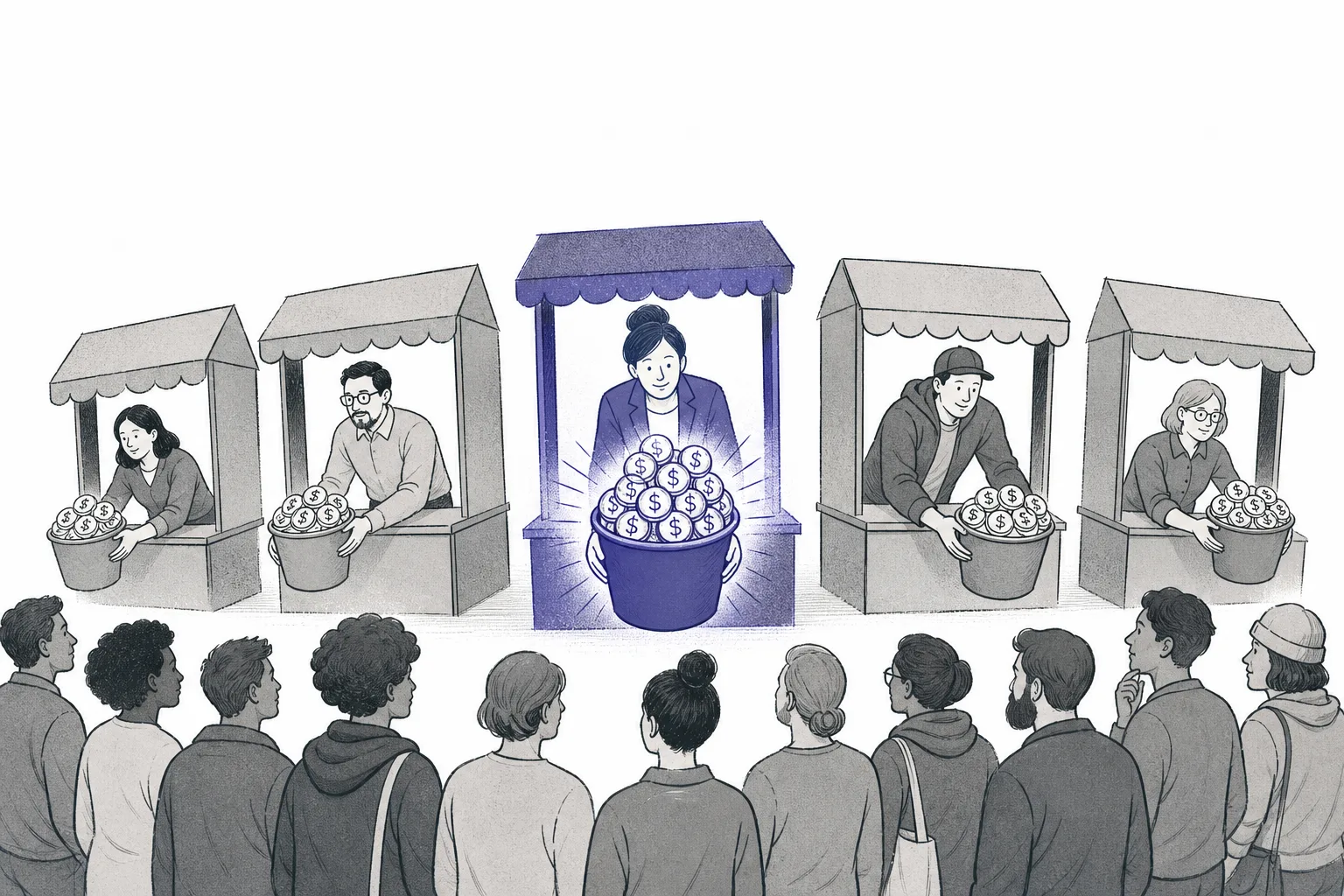
06What's ahead — the war for "balance"
The first direction is the competition shifting from "issuing the coin" to "grabbing balance." When every coin is worth the same $1, what decides the winner is whoever can get users to "keep the coin with them" the longest and the most. Rewards, convenience, and being built into the apps people use every day (paying bills, sending money, trading) become the main battleground — not the design of the coin.
The second direction is banks and big brands moving in as distributors. Once the law opens the way, banks that already have millions of customers can let them hold stablecoins right in the banking app — and so can retail brands or social platforms with enormous user bases. Anyone who "owns the screen" of users is a potential distributor, and will come asking the issuer for a share of the interest.
The third direction is "yield reaching the user" becoming normal. As long as issuers keep most of the interest, distributors have an incentive to pull that interest out and share it with users to grab balance. Over the long run this will gradually force the big chunk of interest to "flow downward" — from issuer → distributor → user — more and more, which is good for consumers but thins out the profit across the whole chain.
07Challenges & risks
The first risk is dependence on interest — the same as the issuer. All the revenue-share income comes from bond interest. If the U.S. Federal Reserve cuts rates sharply, the interest pool everyone splits shrinks instantly. A distributor that promised users a "4% reward" may find its costs higher than the cut it actually receives — a rewards war that's fun when rates are high can become a burden when rates are low.
The second risk is the balance of power between issuer and distributor. Revenue-share deals aren't fixed. When a contract expires or gets renegotiated, the weaker side can lose a big chunk of its share. An issuer that feels it's "paying the distributor too much" may try to build its own distribution channel, or turn to another distributor that asks for a smaller cut — a relationship that looks rock-solid today can flip when the interests shift.
The third risk is regulation of "rewards." The heart of the war for balance is paying yield back to users, but in the U.S. there's a new rule proposed by a regulator (the OCC) in early 2026 that could limit or ban the payment of reward yields on stablecoins by certain types of distributors. If this rule passes, the main weapon for grabbing balance could be taken away, reshaping the entire competition.
In short: this node is the story of a middleman many people overlook — the one who doesn't print the coin, but puts it in users' hands, and for that reason can claim back a big share of the interest. On a field where every coin is worth the same, the most expensive question isn't "who issues the coin best," but "who owns the relationship with the users" — and that may be the real moat of the digital-dollar economy.