Megatrend · Digital Finance
The business that holds your dollars and keeps the interest for itself
A stablecoin is a "digital dollar" — a coin pegged to exactly $1 and backed by real cash and government bonds. It's the blood that flows through the crypto world, and it's becoming a genuine rail for cross-border payments. But the secret that lets this business "print money" is a model that's shockingly simple: you deposit your dollars, the issuer buys bonds with them, and keeps the interest for itself. In 2025, a single company made over $10 billion this way — with almost no employees.

01What is it? (a dollar on the blockchain)
Say you want to send dollars to a friend on the other side of the world, on a Saturday night. Through a normal bank, the money takes 2–5 days, costs a few percent in fees, and passes through several middlemen. But send it as a stablecoin and it arrives in seconds, for a few cents, 24 hours a day, no days off. That's why people started calling it "a dollar that runs on the internet."
A stablecoin is a digital coin designed to hold a steady value of $1 at all times. Unlike Bitcoin, whose price swings wildly, a stablecoin is built to stay "still" on purpose — because it isn't meant for speculation, but to be money you spend and store value in. That stillness comes from a simple mechanism: every coin issued must be backed 1:1 by a real dollar (or a dollar-equivalent asset) — issue one coin, and you keep $1 in reserve.
Peg means "fixing" the coin to always equal $1 · Reserves are the "vault" — the pile of real assets (cash + short-term US government bonds, or T-bills) the issuer holds to back every coin. If you want to redeem a coin back into dollars, they must always have enough money to pay you — that's what makes $1 actually equal $1, and not just an empty promise.
On the megatrend map, this node sits under Digital Finance & Tokenization, and it's the deepest "infrastructure layer" of all — because stablecoins are the payment rail that almost everything in digital finance runs on: crypto trading, cross-border transfers, and on-chain finance. This node covers both sides of the story: the people who issue the coins (issuers) and the people who distribute them to users (distributors) — and we'll dig into both.
02Why it matters to the world
Because it has stopped being just a "toy in the crypto world." In 2025, stablecoins moved a combined ~$33 trillion — more than Visa and Mastercard's transaction volume combined (~$25.5 trillion). It's a milestone almost no one expected to arrive this fast.
But the more exciting number is the shift in what they're used for. Stablecoins used to be used almost entirely to "trade crypto" — a place to park money between Bitcoin trades. Today, around 60% of the flow is B2B: companies using digital dollars to move money across borders, pay suppliers, and manage cash — and ~90% of financial institutions are already using or testing stablecoins. That's why it matters to the "real world," not just the crypto one.
The reason it's grown this fast: stablecoins solve a problem billions of people actually have. In countries with weak currencies or high inflation (Argentina, Turkey, Nigeria), ordinary people want to hold dollars to protect their savings — but opening a dollar bank account is very hard. A stablecoin lets them "hold dollars on their phone" instantly. This is structural demand, slowly turning the digital dollar into financial infrastructure for the world.
03The business model that "prints money"
This is the heart of the whole lesson, and the reason stablecoins became one of the most profitable businesses in finance. The model is stunningly simple — about as simple as "a bank that doesn't pay you any interest."
Here's how it works: you hand a real $1 to the issuer, and they hand you back one stablecoin. Now they're holding your $1 in reserve. But they don't let it sit idle — they take that $1 and buy safe, interest-bearing short-term US government bonds (T-bills), and keep all of the interest for themselves. And you — the person who handed over real money — get a coin that pays you no interest at all.
The beauty of this model is that it has zero cost of borrowing. A normal bank has to pay you interest on your deposit. But a stablecoin issuer pays nothing — because you "chose" to hold the coin instead of cash (for the convenience of moving it around). That means every dollar in reserve is a 0%-interest free loan they can invest — and in an era when bond yields sit around 4–5%, that enormous pile of money turns into almost pure profit.
The real numbers make it vivid: Tether, the largest issuer, made over $10 billion in net profit in 2025 with just a few hundred employees — the highest profit-per-head in the history of finance. The reserve breakdown of each issuer (Tether holds hundreds of billions in T-bills, and so on) is covered in depth at → Stablecoin Issuers.
04Two sides of the coin: issuers vs distributors
The stablecoin business has two clearly different "roles," and this node splits into two sub-themes that map onto them exactly. Understanding the difference between these roles is understanding who takes which slice of the profit.
One — Stablecoin Issuers: the people who "create" the coins and hold the reserves. They own the money-printing machine from the last chapter — take in money, issue coins, invest the reserves, collect the interest. The main players are Tether (which issues USDT) and Circle (which issues USDC). Together these two control over 80% of all stablecoins worldwide.
Two — Distribution & Revenue-Share Partners: issuers can create coins, but someone has to "put them in users' hands" — that's the exchanges, wallets, and payment networks that let people reach and use the coins. And because distribution has value, issuers share the interest from the reserves with the distributors. The classic example is Coinbase, which helps distribute USDC and gets a cut of the interest in return.
Coinbase gets 100% of the interest on USDC held on Coinbase's own platform, and 50% of the interest on USDC held off-platform (on other exchanges, say) — which is why Circle, the coin's issuer, ends up sharing a big chunk of profit with Coinbase, the coin's distributor. The lesson: in this business, "who reaches the user" has enormous bargaining power.
And that share is bigger than you'd think — in 2024, Circle paid Coinbase ~$908 million in distribution costs, nearly 60% of all its reserve revenue, more than the profit Circle kept for itself. Which is why many believe "distribution may be the real moat" — not issuing the coin (see → Distribution & Revenue-Share Partners).
The tension between these two roles is the industry's central drama. Issuers want to keep as much interest as possible; distributors want as big a share as possible. And right now, giants like Visa, Mastercard, Stripe, and PayPal are jumping in as both roles at once — because they already have billions of "users" in hand.
05How it connects in the ecosystem
Stablecoins are the deepest "payment rail" within Digital Finance & Tokenization, so they're tightly tied to their siblings in the same trend:
- The cash for Real-World Asset Tokenization: when real assets (bonds, funds, real estate) are turned into tokens on a blockchain, people need "money" on that same blockchain to trade them — and stablecoins are that cash
- Flowing through exchanges and custodians: almost every crypto trade is paired with a stablecoin, and exchanges (like Coinbase) are both a distribution channel and a revenue-share partner
- Becoming the rail for Payments Modernization & Rails: this is the hottest intersection — stablecoins are becoming a new "rail" for real-time cross-border payments that legacy payment networks have to adapt to
And stablecoins also depend on trends outside the family, unavoidably: they run on blockchains that operate on Cloud & Digital Infrastructure, and all of their trust rests on Cybersecurity & Digital Trust — because if the system gets hacked, or the reserves get questioned, the "digital dollar" may stop equaling a dollar overnight.
06Where it stands now
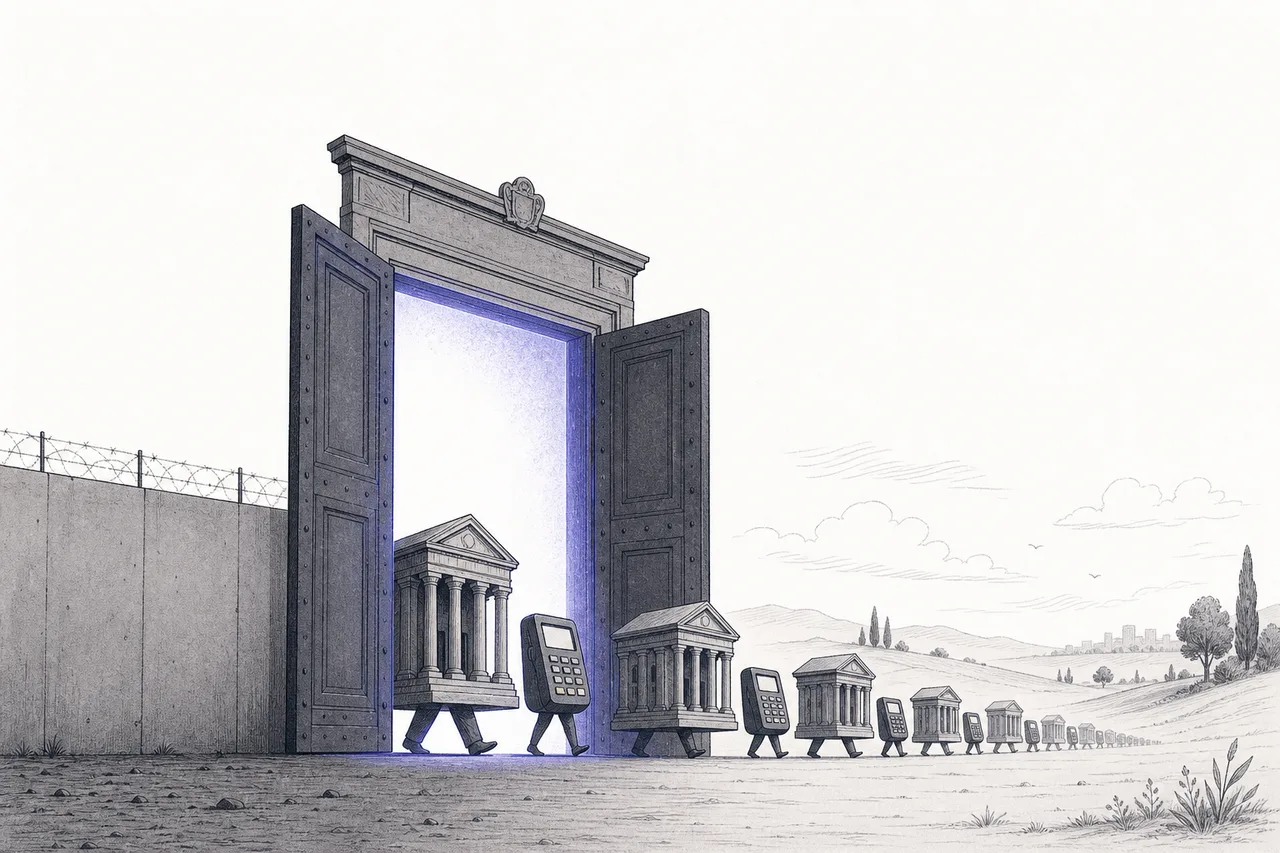
The event that changed everything was the GENIUS Act, which the US passed in July 2025. Before that, stablecoins lived in a legal gray zone. But the GENIUS Act made them legal, with clear rules for the first time: issuers must hold 1:1 reserves in cash or short-term bonds only, must be a bank or a licensed institution, and must disclose their reserves. The result: the door swung open for mainstream financial institutions to pour in.
The competition right now splits into two clear camps. Tether's USDT is the biggest giant — roughly $186 billion in circulation (~58% market share), hugely profitable, but a private company whose reserve transparency has long been in question. The other camp is Circle's USDC — smaller (~$77 billion) but selling "transparency and legality" as its pitch, and the first stablecoin whose parent company went public.
Circle's IPO (ticker CRCL) in June 2025 was the drama of the year — the stock opened at $31 and jumped 168% on day one, before running up to a 52-week high of nearly $299 (then pulling back to around $80 by mid-2026). In 2025, Circle made ~$2.7 billion in total revenue including reserve income (up 64%) — showing the "digital dollar" business really does make money, even though net profit was slightly negative, weighed down by IPO-period employee-stock costs.
And the mainstream giants are coming in for real. Mastercard announced it would buy stablecoin-infrastructure firm BVNK for as much as $1.8 billion (March 2026). Stripe reported its stablecoin payment volume doubling to ~$400 billion. And PayPal expanded its own PYUSD coin to 70 countries — the game has shifted from "crypto startups" to "a war between giant financial institutions."
07The road ahead
The first direction is the clearest: the move from "trading crypto" to "real payments", especially cross-border transfers. The world's cross-border payment market is worth several trillion dollars a year, and it's still slow and expensive. Stablecoins that arrive in seconds for a few cents in fees are a direct competitor. Some estimates suggest stablecoin payment volume could top $50 trillion by 2026.
The second direction is the arrival of banks and governments. Now that the GENIUS Act lets banks issue stablecoins, we're starting to see big banking groups move — Japan's mega-banks (MUFG, SMFG, Mizuho) are planning to issue a coin together, while the US has JPM Coin and coins from digital banks. This could fragment the market into "everyone's own coin" — and add competition for the existing issuers.
The third direction is the question of who gets the interest. Right now issuers keep almost all of it. But as competition heats up and distributors (like Coinbase) gain bargaining power, the pressure to "share the interest back with users" — or share more with distributors — will rise too, slowly thinning out the enormous profits of the old model.
08Challenges & risks
Stablecoins' appeal comes with risks baked right into how they work.
The first and most important risk to "profit" is dependence on interest rates. This entire business model leans purely on bond interest. In 2025, Tether made $10B because rates were high — but that profit also fell ~23% from the year before, as rates began to soften. If the US central bank cuts rates sharply, every issuer's revenue shrinks immediately. This is a business that's "rich when rates are high, poor when rates are low."
The second risk is losing the peg (depeg) — a stablecoin's worst nightmare. The real lesson came in March 2023, when Circle revealed that about $3.3 billion of USDC's reserves (~8% of the total) was stuck in the failed Silicon Valley Bank. USDC lost its peg and fell to $0.86 overnight, before steadying once the government guaranteed the deposits. The episode drove home that a "digital dollar" is only as strong as its reserves.

The third risk is transparency and regulation. Tether, the market leader, has been questioned about its reserves for years. Meanwhile the GENIUS Act forces issuers to hold safer assets and disclose more — which is both an opportunity (more trust) and a cost (issuers that can't adapt could be pushed out of the US market). And in the long run, if central banks around the world issue their own state digital money (CBDC), private stablecoins may have to compete directly with the "official digital dollar."
In short: stablecoins are the story of putting "the dollar" on the internet and discovering that this business — holding people's money and paying no interest — is one of the best money-printing machines of the era. The fact that it has moved from a tiny corner of the crypto world to a payment rail that Visa, Mastercard, and the giant banks have to play in is a signal that "digital money" is becoming infrastructure for the real economy — and the biggest question isn't "will it arrive," but "who gets that interest."