Megatrend · Climate Adaptation & Water
When disasters become normal, people start investing in "walls" — not just the sky
A warming planet is making floods, wildfires, and droughts more violent and more frequent — to the point where damage now hits $300–370 billion a year. We can't stop the climate, but we can defend the "places" we live in — with pumps, flood walls, buried power lines, and wetlands. This is the business of "making cities disaster-proof," and it grows every year — but it's a business where the money arrives in lumps, tied to government budgets, and most of the real players are big diversified companies, not pure-plays.
01What it is
There are two ways to deal with a warming planet. The first is "cutting the cause" (mitigation) — reducing carbon emissions, switching to clean energy, so the world doesn't heat up further. But even if we stopped all emissions today, the heat already stored up will keep producing disasters for decades. That's where the second way comes in — "adapting" (adaptation): accepting that the disasters are coming, and defending our places so they don't break when they hit.
This node is the heart of adapting to the three most destructive "acute hazards": floods, wildfires, and droughts. It's not about software or policy — it's about real, physical infrastructure you can touch: pumps, flood walls, drainage systems, fire-detection sensors, buried power lines, all the way to the crews who come to restore your home after the water recedes.
Gray infrastructure = human-built structures like concrete, walls, pumps, pipes · Green (or nature-based) infrastructure = using nature to defend, like wetlands that soak up floods, mangroves that break waves, urban gardens that absorb rain. In practice, the real thing is usually a "gray + green" mix — nature is cheaper and comes with side benefits, but some spots need concrete for certainty.
On the megatrend map, this node sits under Climate Adaptation & Water. Its definition is straightforward: making power, cities, and people able to withstand extreme events — with a warning attached: "there are very few pure-plays". Most players are utilities or large construction contractors that do this as one part of their business, not the whole thing — a point we'll come back to.
02Why it matters — defending the "place"
Look at the numbers steadily climbing. From 1970 to 2000, natural disasters worldwide caused an average of about $70–80 billion in damage a year. But by 2001–2020, that figure jumped to $180–200 billion a year. And in 2024 alone, economic damage hit roughly $318–368 billion — with over 57–60% of it uninsured, meaning homeowners, governments, and society had to carry it themselves.
Here's the interesting part: the main driver is no longer giant hurricanes or earthquakes. It's "secondary perils" (non-peak perils) — floods, wildfires, and severe thunderstorms — that strike far more often. In 2024, this group caused $136 billion in total damage. The World Meteorological Organization (WMO) reports that the number of flood disasters rose 134% over two decades. That's why the money is starting to flow toward "defense."
The economic case is crystal clear. The US National Institute of Building Sciences found that every $1 invested in disaster defense up front saves about $6 in future damage. And for river-flood defense specifically, the ratio jumps to $7 for every $1 — defending is always cheaper than repairing.
03How it works (the mechanism of defense)
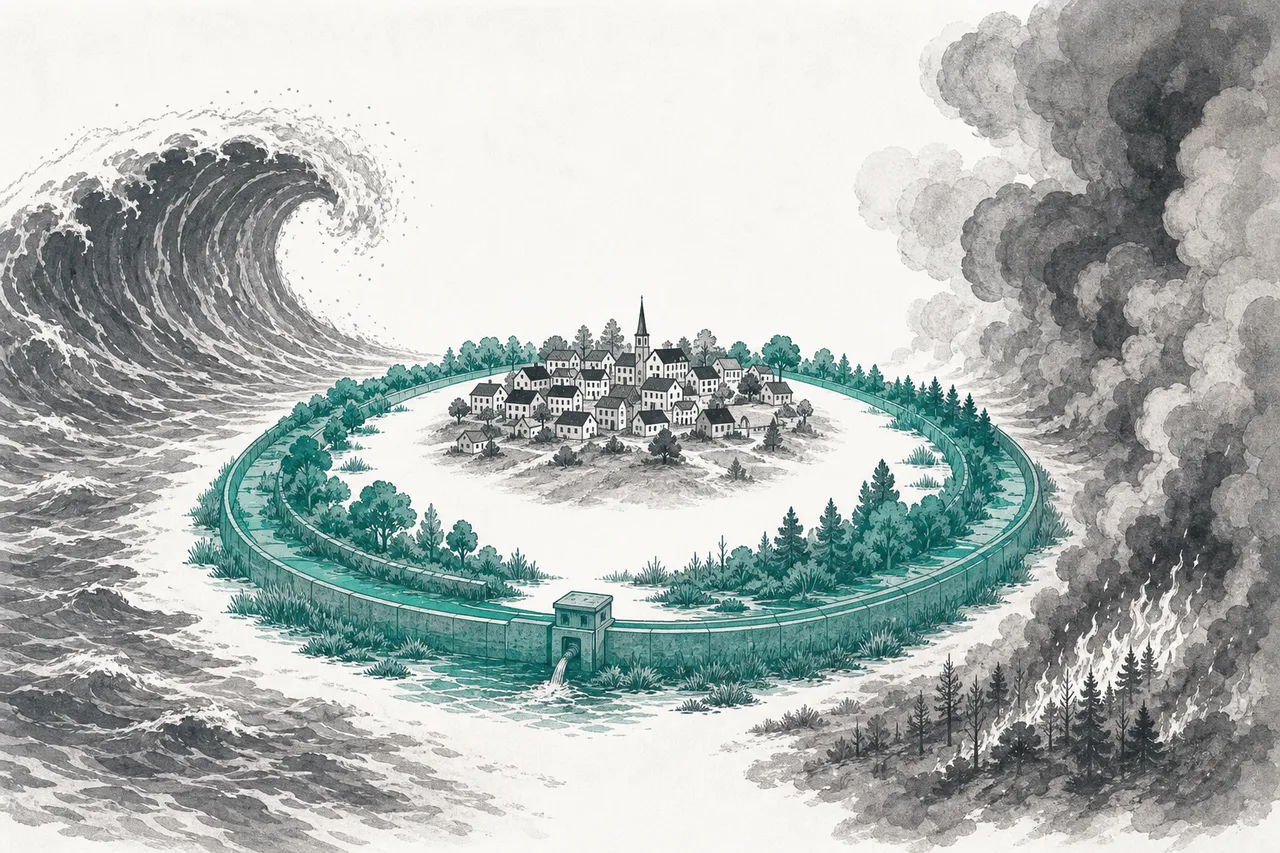
The heart of this whole node is one simple mechanism: an acute hazard rushes at a place → a defense line blending "engineering" with "nature" stands in its way → the damage that reaches the city drops sharply. It doesn't stop the hazard — it "absorbs" and "deflects" it so it destroys as little as possible.
The part that makes this engineering interesting is the "gray + green" mix. Concrete walls and pumps offer high certainty, but they're expensive and only work in one spot. Wetlands or tree lines are far cheaper and throw in side benefits (green space, lower urban heat, air quality) — but they only protect up to a point. So modern cities layer the two: nature takes the outer hit, and concrete is the last line.
04Three fronts: flood, fire, drought
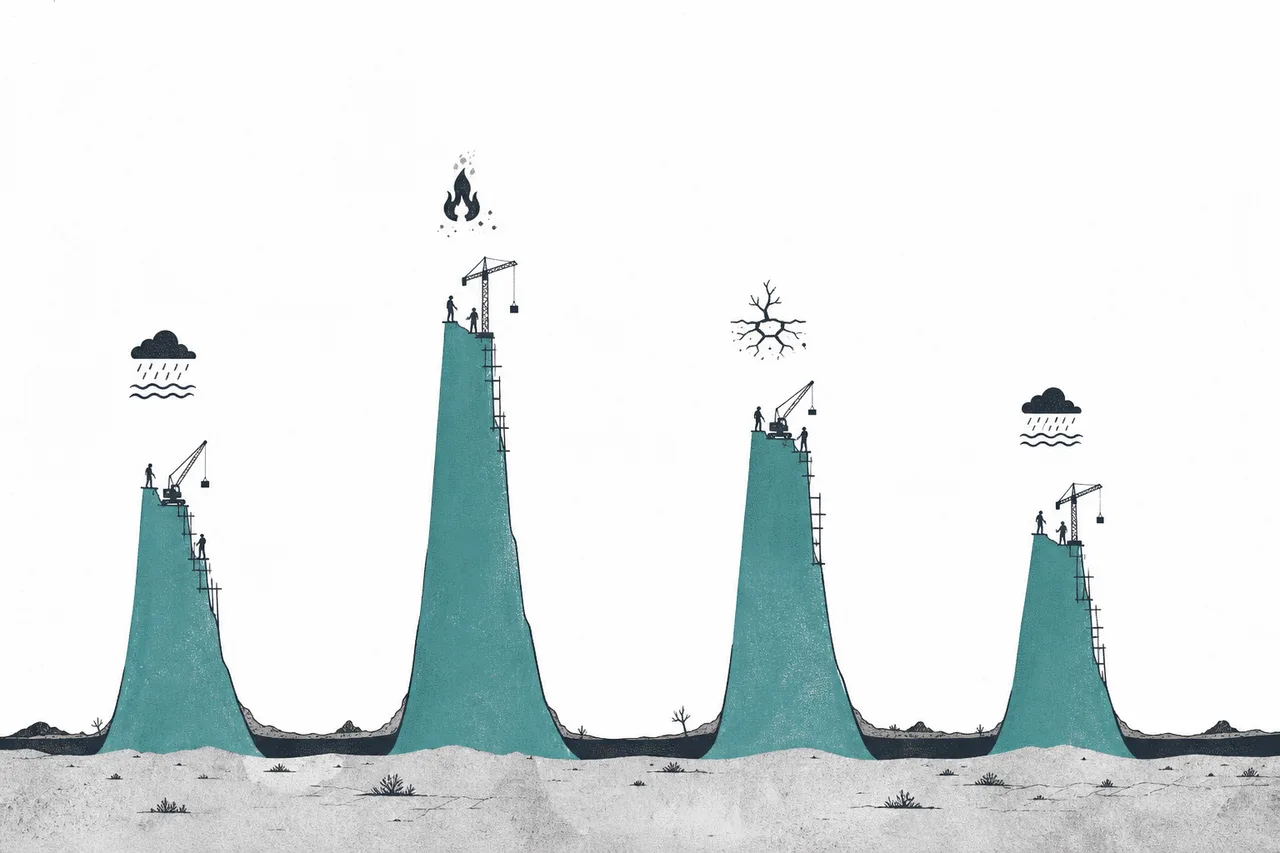
The mechanism is the same, but each hazard uses different technology and has different players. Let's go front by front.
Front 1 — flood (the biggest): this is the clearest, most concrete market. The heart of it is water control — pumps to move water out, stormwater drainage systems, flood walls and gates, and dredging to add river capacity. The flood control pump market is worth about $4.8 billion in 2025 and is expected to grow to $8.3 billion in 2034 (CAGR ~6.3%). The broader stormwater management market is worth about $17.8 billion in 2024, growing to nearly $30 billion in 2030 (CAGR ~9%).
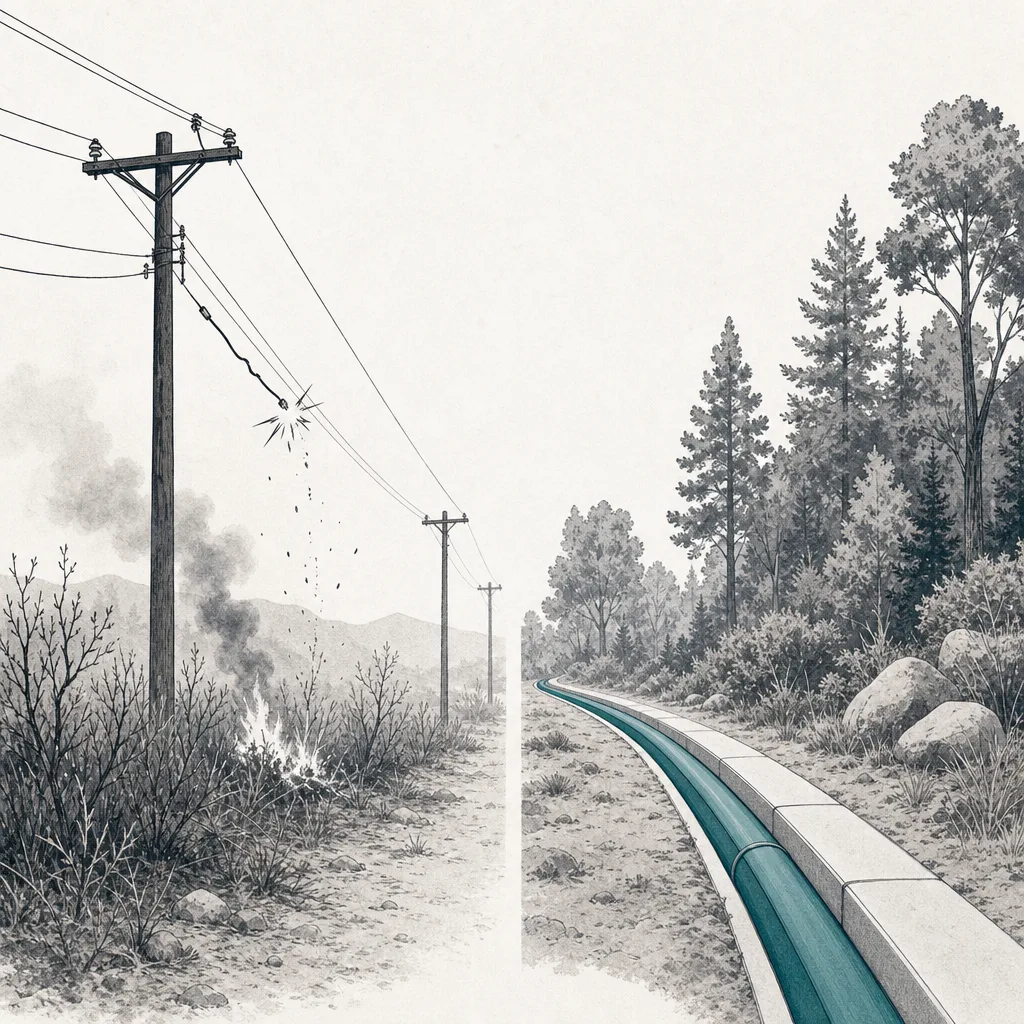
Front 2 — wildfire (the most complex): fire splits into two sides. The first is detect and extinguish — sensors, cameras, heat-sensing satellites, alert and firefighting systems. The whole fire protection market is worth about $85 billion in 2025, growing to $118 billion in 2030 (CAGR ~6.8%). But the deeper side — the "real investment theme" — is preventing fire at the source. That's because many of the biggest wildfires start from power lines that throw sparks, forcing utilities to invest enormously in "grid-hardening" (burying lines, insulating them, reinforcing poles) — which we'll dig into in the next chapter.
Front 3 — drought (directly tied to water): dealing with drought is about finding and storing water — reservoirs, groundwater-recharge systems, and most importantly water reuse and desalination, which overlaps directly with Water Utilities & Infrastructure. This front is almost inseparable from the mainstream water business — so the key players are the big water companies.
05Ecosystem — what it connects to
This node is a sibling to the other categories under Climate Adaptation & Water, and they're tightly linked:
- Overlaps with Water Utilities & Infrastructure: the drought and flood fronts use the same water infrastructure — pumps, pipes, treatment, reuse. Many players sit in both nodes
- Partners with Climate Risk Analytics & Insurance: insurers measure the "risk" and pay out when disaster strikes — better defense cuts both premiums and damage. These two are "defending" and "bearing the financial risk," two sides of the same coin
- Depends on key materials and supply chains: walls, pumps, and cables all need huge amounts of steel, copper, and concrete
- Complements Energy Transition & Power Demand: grid-hardening to prevent wildfires happens alongside grid upgrades for clean energy and surging electricity demand — same work, same contractors
The key thing to grasp is that this node has almost no "pure resilience companies." It's a demand layer that flows out to stimulate businesses that already exist — water companies, utilities, engineering contractors (EPC), and building-restoration firms. That's why the node's definition flatly calls it "utility/EPC proxies."
06Where it stands now + the players
Right now the hottest story is grid-hardening to prevent wildfires. After California utilities' power lines were blamed for several major wildfires (followed by billions in damages and lawsuits), companies like PG&E announced enormous investment plans — a 5-year capex plan of about $73 billion, averaging nearly $13 billion a year. Part of that is burying power lines in high fire-risk areas, with over 1,000 miles already buried — the largest wildfire-prevention undergrounding project ever.
All this construction work flows straight to electrical-infrastructure contractors. Quanta Services, the largest US grid contractor, closed 2025 with a record backlog of $44 billion, its electric-infrastructure segment up more than 20% year over year. Meanwhile the global transmission line market sits at about $81 billion in 2025, heading toward $112 billion in 2032.
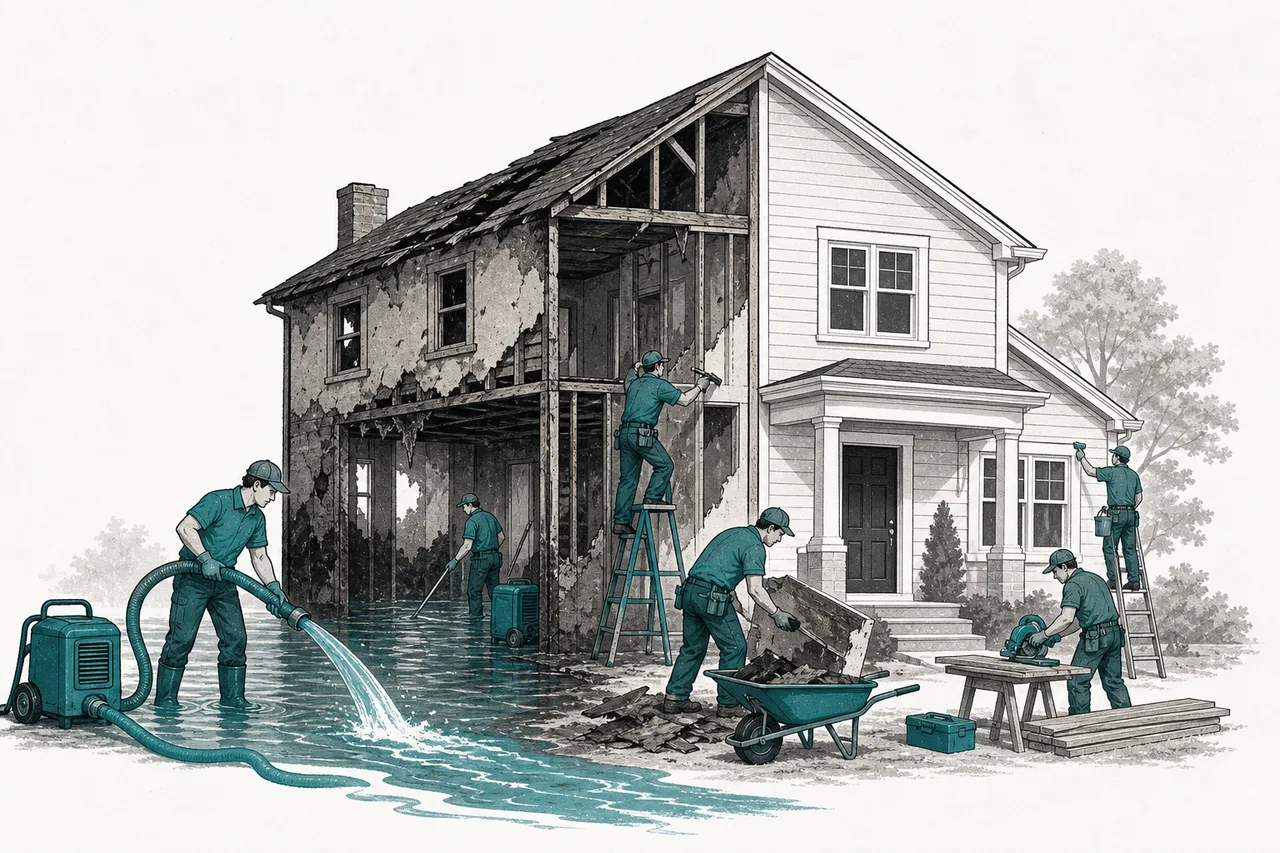
On the flood side, Xylem is the pump-market leader with its Flygt brand, with total revenue of about $9 billion in 2025. On the post-disaster recovery side, the disaster restoration market is worth about $43–45 billion in 2025, growing to $55–59 billion in 2030 — a business that "has work every time a disaster strikes."
07The road ahead
The first direction is more money over time, but still lumpy. As long as annual damage keeps climbing, the pressure on governments and utilities to invest in defense will grow — especially grid-hardening, which started in California and is spreading to other states and countries facing more wildfires (Australia, southern Europe). This work should run for years, because contractor backlogs are packed full.
The second direction is "green + gray" becoming the standard. With a $6-for-$1 payback and nature's side benefits (green space, lower urban heat), governments and cities will lean more on nature-based solutions — wetlands, rain gardens, mangroves — as both defense and quality-of-life upgrades. The challenge is that these benefits are "hard to put a dollar on," making them harder to get approved than concrete projects.
The third direction is smarter detection technology. Heat-sensing satellites, AI sensors, and fire-detection cameras are advancing fast, catching fires and floods sooner — cutting damage without building more walls. This is where technology (software/sensors) increasingly reinforces "steel and concrete."
08Challenges & risks
This node is a "real and necessary" theme, but it comes with specific risks investors need to understand.
The first risk is that the money is lumpy and tied to government budgets (lumpy & political). Most defense projects use public money, approved in rounds, usually after each disaster — not a steady revenue stream, and it can shift with politics. A budget once approved can be cut or delayed, making contractor revenue harder to forecast than a typical subscription business.
The second risk is that there are almost no pure-plays. As we've stressed throughout, nearly all the players are big diversified companies — Xylem, Quanta, MasTec, FirstService all have plenty of other business mixed in. Investing "directly in the resilience theme" is therefore hard; these stocks' returns hinge on the whole business, not just the resilience slice.
The third risk is project timing and cost. These are large, multi-year construction projects exposed to material- and labor-cost risk and permitting delays — especially grid-hardening, which has to pass a regulator's approval on how much of the cost it can pass through to electricity bills.