Megatrend · Electrification & Mobility
An EV's "engine" isn't the battery — it's one box that spins the wheels
A gas car has an "engine" at its heart. An EV has a heart too — but it isn't the battery. The battery just stores electricity. The part that actually turns that electricity into real spinning force is the electric motor + the inverter that drives it + the reduction gear. And the biggest trend in this group of components is "fusing" all three into one small box, called an e-axle. In this lesson we'll open it up: how electricity travels from this box out to the wheels, why the small magnets inside have become the most dangerous geopolitical bottleneck of all, and why a giant like Nidec — which once meant to dominate this market — just announced it's "pulling out."
01What is it?
When we talk about a gas car, we talk about its "engine" in real detail — how many cylinders, how much horsepower, is there a turbo. But with an EV, most people just say "how many kWh is the battery" and stop there. The truth is, an EV has an "engine" too. It's just quiet, small, and nobody talks about it — and that's the node we're looking at today.
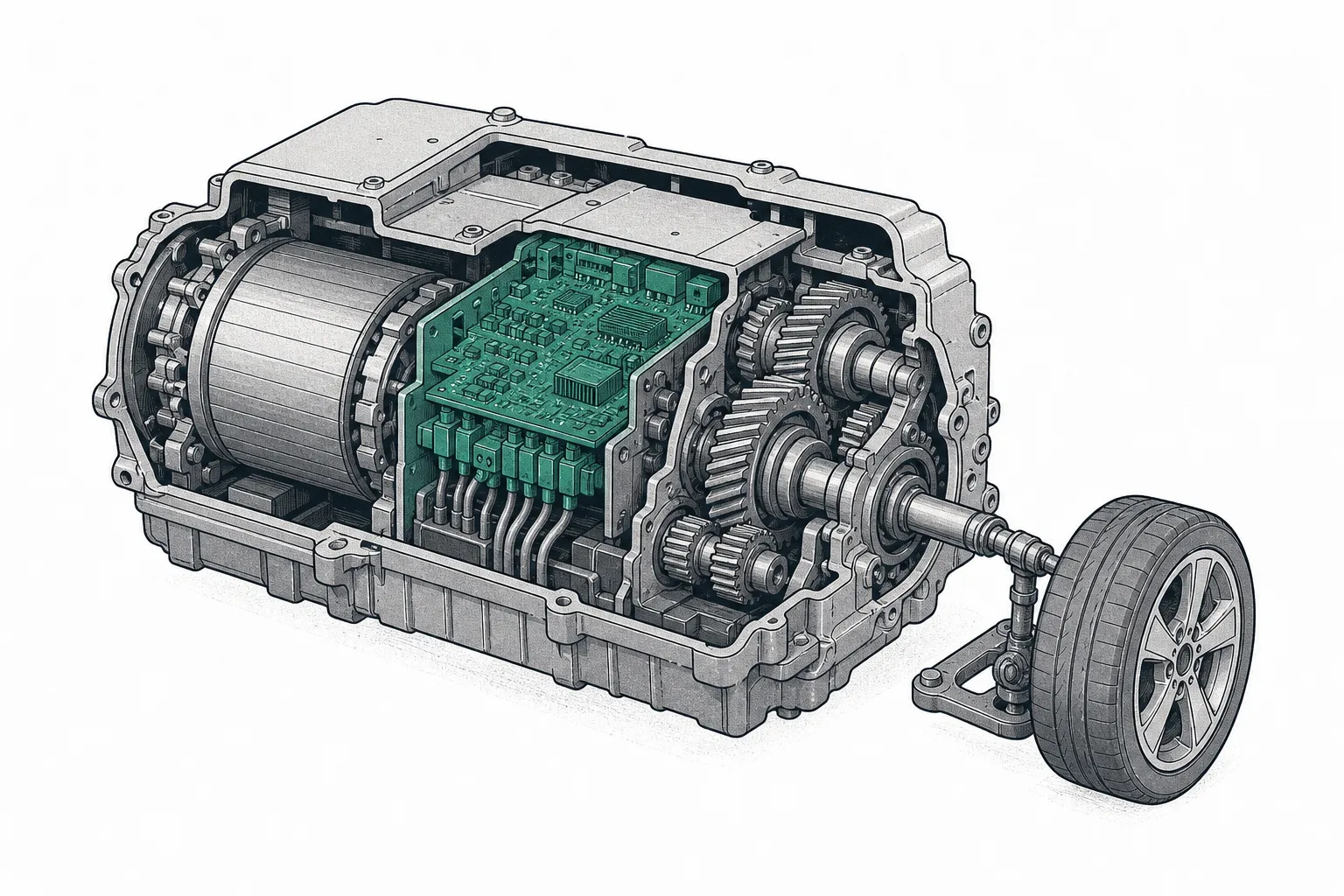
This node is the part that actually "turns electricity into motion," and it's made of three pieces that work in sequence:
- The electric motor (the muscle): takes electricity in and spins a shaft out as torque. At its heart are the "magnets" and "coils" that pull on each other to create rotation
- The inverter (the brain that commands the muscle): a box packed with power chips that converts the battery's direct current (DC) into the alternating current (AC) the motor needs, and controls how hard and how fast to deliver power — it's what decides whether the car pulls away smoothly or with a jolt
- The reduction gear: an electric motor spins very fast (tens of thousands of RPM), but the wheels want low revs and high torque. The reduction gear is what "steps the revs down" to match the wheels
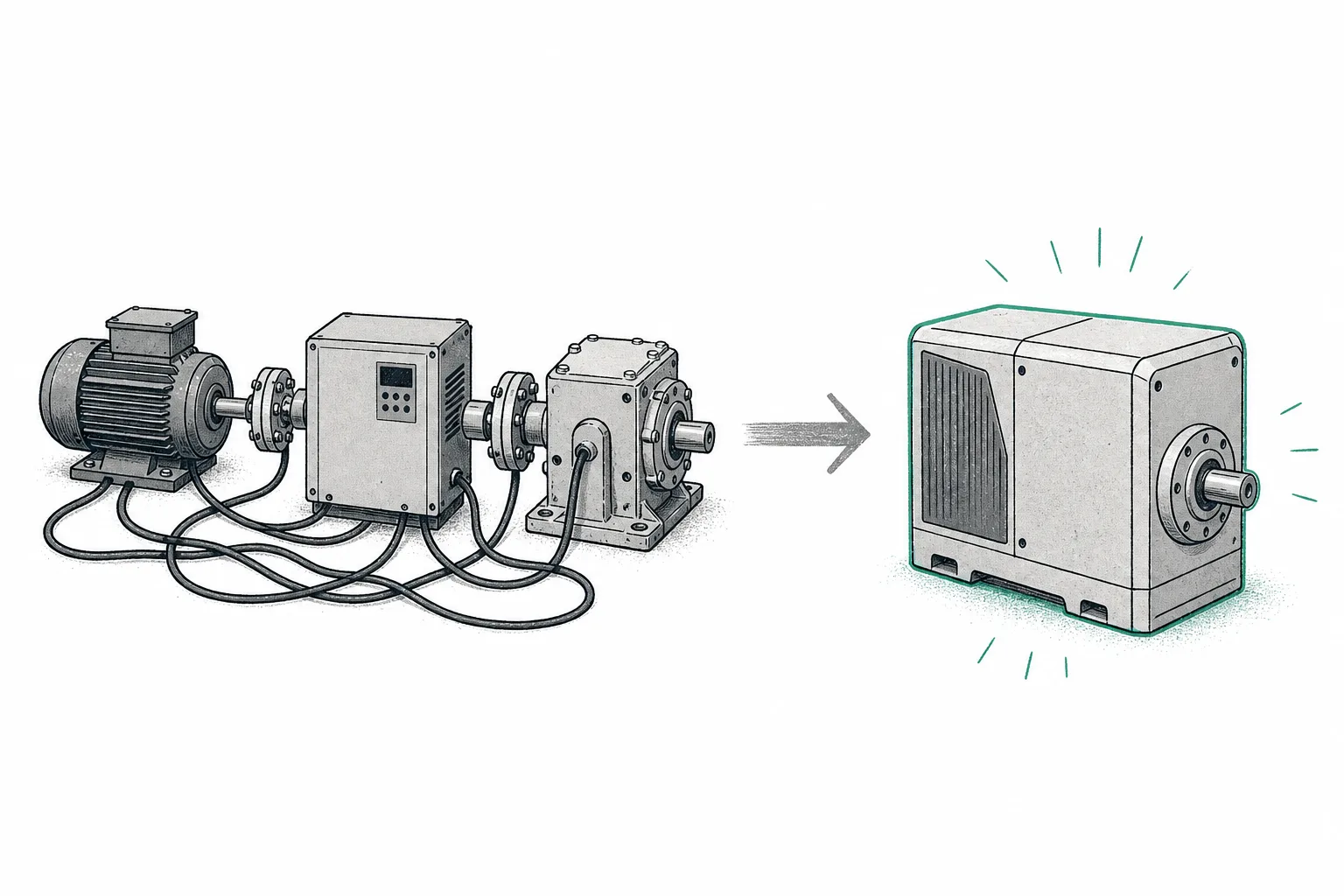
And the trend that defines this whole node is — these three pieces are being fused into one box called an e-axle (or e-drive / electric drive unit). Instead of wiring three separate boxes together, engineers pack the motor, inverter, and gear into a single case — smaller, lighter, cheaper, and with less energy lost at the joints.
On the megatrend map, this node is a leaf under EV Powertrain & Power Electronics, within the larger Electrification & Mobility trend. It has one sibling right beside it — EV Power Semiconductors (SiC / IGBT) — but the boundary is clear: that sibling is the power chips that sit inside the inverter, while this node is the motor and the whole drive box that puts those chips to use. Put simply: the sibling sells the chip, we sell the engine that chip ends up in.
e-axle = a drive unit that combines motor + inverter + reduction gear in one case · 3-in-1 = the name for fusing these three (some go further into x-in-1, also folding in the DC-DC converter, the charger, and so on) · PMSM (Permanent Magnet Synchronous Motor) = the permanent-magnet motor EVs use most, because it gives the highest torque and efficiency per size — but it needs rare-earth magnets, which become the star of the story in the chapters ahead.
02Why it matters — the EV's "engine," fusing smaller
The simplest reason first: without this node, the car doesn't move. The battery can store energy, sure, but without the motor and inverter, that charge just sits still in a box. It's as essential as the battery — only nobody puts it in the ad.
The second reason is the size of the market. Counting the whole e-axle box, this market was worth about $22B in 2025, and is expected to grow to ~$110B by 2035 — roughly 17% a year. Permanent-magnet motors (PMSM) alone were worth about $8.5B in 2025, heading toward ~$25B in the early 2030s. Every car that switches from gas to electric is another e-axle sold.
But the reason this node is truly interesting is the third one — "fusion" is the arena where the competition happens. It's not just who makes a stronger motor, but who can fuse motor + inverter + gear into the smallest, lightest, cheapest package. Collapsing it into a single e-axle cuts weight by about 20% versus wiring three boxes together, and a good e-axle hits a total efficiency as high as ~95% — compare that to a gas car's drivetrain at only around 70–80%. Electricity not lost as heat is free range added on the same battery.
03How it works (from the drive box to the wheels)
Let's trace energy's real path inside the e-axle box, from DC coming in off the battery to the wheels turning out. It's only four steps — but every step is where the technology gets decided:
Step 1 — DC enters the inverter The battery sends in high-voltage direct current (these days 400 or 800 volts). But a motor can't spin on DC directly.
Step 2 — the inverter "shapes" the electricity into three-phase AC Inside it is a cluster of power chips switching on and off tens of thousands of times a second, flipping the polarity back and forth until they form three offset waves of alternating current (three-phase) — press the accelerator harder and the chips deliver power more frequently and more strongly.
Step 3 — the PMSM motor spins The three-phase AC in the coils creates a "rotating magnetic field" that drags the permanent magnets on the rotor around in exact step (synchronous = spinning in time with the field), and the shaft turns with it.
Step 4 — the reduction gear sends force to the wheels The motor spins too fast for the wheels, so the reduction gear drops the revs and raises the torque to just the right level — and the car lunges forward.
What makes this node "hard" is that every step can lose energy — the chips in the inverter run hot, the gears have friction, the motor has resistance in its coils. The engineer's game is to squeeze the loss out of every point. And once you pack all the pieces into one box, the wiring runs get shorter, the joints disappear, and the losses fall with them. That's the engineering reason behind the whole "fusion" trend.
04How it connects in the ecosystem
This node sits at the "confluence" of several trends that feed one another — and crucially, it shares a key bottleneck with other trends in ways outsiders don't expect:
- Uses power chips from EV Power Semiconductors (SiC / IGBT) directly: the inverter in our box is the single biggest "customer" for power chips. Moving to SiC chips in 800V systems is exactly what makes the e-axle box smaller and lose less energy — we sell the box, the sibling sells the chip inside
- Shares magnets with Robotics & Physical AI (servo motors): the permanent-magnet motors in robots and in EVs use the same "NdFeB rare-earth magnet." Once humanoid robots start mass production, they'll compete for this very same magnet with EVs — two trends that look unrelated, leaning on the same raw material
- Depends on Critical Materials & Supply Chain — its most fragile point: an NdFeB magnet uses about 1–2 kg per motor, and that raw material comes from a rare-earth chain China controls almost end to end (we dig into this in the risks chapter)
- A component of the whole car in Electrification & Mobility: the e-axle works in tandem with the battery — the battery stores energy, the e-axle puts it to use. Lose either one and the car doesn't move
05Where it stands now
The most shocking story in this business just happened, in 2025–2026 — Nidec, the Japanese motor giant that once aimed to dominate the world's e-axle market, announced it's "pulling out." Its founder once said the e-axle would be the company's flagship. But in the first half of FY2025, the e-axle business lost as much as ¥87.7B (including provisions and plant impairments), until the CEO called the market a "red ocean" — a red sea where rivals fight until it bleeds — and prepared to wind down both its joint venture in China (with GAC) and in Europe (with Stellantis).
The cause was the price war in China. China's EV market is in a ferocious race to cut prices (BYD led, slashing many models 10–20% from early 2024), and Chinese makers can build the e-axle end to end at far lower cost. Foreign players selling only the "drive box" got squeezed until almost no margin was left — Nidec's case is a live lesson that a trend being right doesn't mean every company survives (just like Wolfspeed on the SiC chip side).
But the side that's still "surviving" proves it can be done. BorgWarner, the American auto-parts supplier, reported its eProduct revenue grew 31% in Q2 2025, against the grain of the industry. Meanwhile Schaeffler, after finishing its merger with Vitesco, announced a combined order backlog of about €74B and set a goal of becoming a global top-3 — this game isn't a loss for everyone, but who survives depends on how far they can flee the raw price war toward selling technology that's hard to do.
On the Chinese side, BYD is the model of the "make everything ourselves" (captive) strategy — building its own e-axle for its own cars, buying from no one, controlling cost to the maximum. And Inovance has risen as a major e-drive supplier feeding many Chinese carmakers — which is why foreign players are at a disadvantage in the world's largest market.
06The future — x-in-1 and rare-earth-free motors
The first direction is fusion going beyond 3-in-1. Once you can combine motor + inverter + gear, the next step is to absorb other electrical parts too — the DC-DC converter, the onboard charger, the power distribution unit — becoming x-in-1 (some go all the way to 8-in-1). The more you fuse, the smaller, lighter, cheaper, and the less energy lost at the joints. So the arena shifts from "who makes a strong motor" to "who fuses it most seamlessly and cheaply."
The second direction matters more, and is pure politics — motors that don't use rare-earth magnets. To escape China's shadow, carmakers and suppliers are racing to develop the EESM motor (one that excites the rotor with coils and electricity instead of permanent magnets). Renault, BMW (the iX3), Nissan (Ariya) already use it in real production, while ZF is developing a way to send power into the rotor without brushes — demand for magnet-free motors is expected to grow about 15% a year.
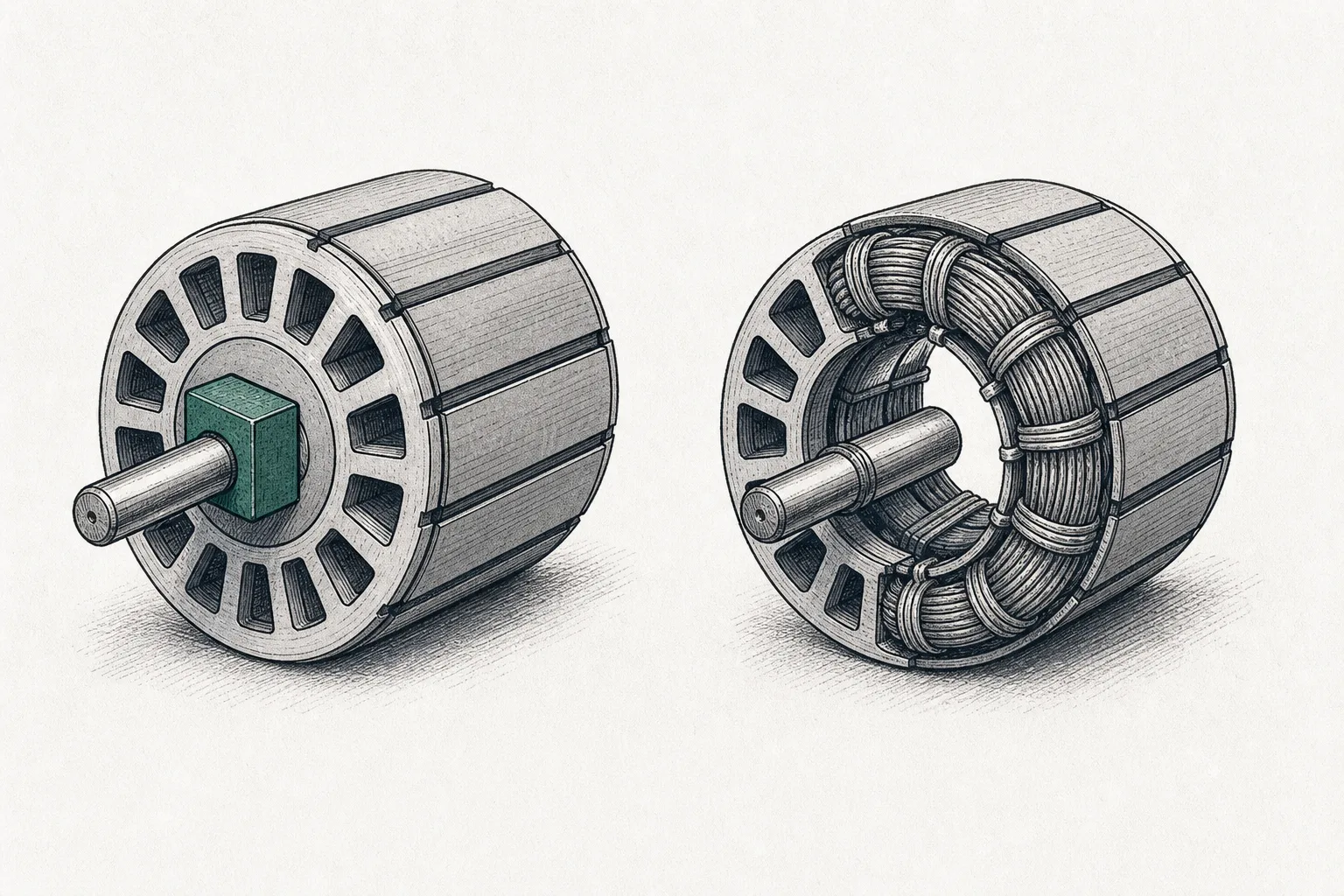
But there's a price to pay — nothing's free. A magnet-free motor like the EESM needs a "slip ring" (a rotating electrical contact) to feed power into the rotor, which takes up about 25–35% more space (roughly 90 mm), adds parts that wear out, and generally delivers about half the torque per size of a permanent-magnet motor. Peak efficiency is about the same (EESM ~95% vs PMSM ~94–97%). This is why the world won't drop magnets tomorrow — this transition takes years more.
07Challenges & risks
The first risk is the price war and commoditization. Nidec's case says it all — once Chinese makers can build the e-axle end to end at low cost, the "ordinary" drive box becomes a product competed on price alone. Anyone selling only standard hardware gets squeezed until almost no margin is left. Value flows to whoever controls "what's hard to copy" — advanced fusion, thermal management, or motor-control software.
The second risk is rare-earth magnets and dependence on China. As long as most EV motors are PMSM that need NdFeB magnets, and China controls ~90% of the magnet chain down to mining and magnet-making, this risk hangs overhead constantly. In April 2025 China rolled out export controls on rare earths and magnets (including dysprosium and terbium), and some Western carmakers had to cut production within weeks for lack of magnets — and this is a bottleneck that robots come to compete for too.
The third risk is fleeing to magnet-free motors isn't free either. The EESM solution really does cut dependence on China, but in exchange you get lower torque per size, more space taken up, and added manufacturing complexity — so carmakers have to weigh "independence from geopolitics" against "performance and cost." There's no right answer for everyone.
The fourth risk is everything is tied to the hard-to-predict speed of the EV transition. E-axle demand tracks EV sales directly. If the transition runs slower than expected (as it did in 2024–2025), whoever bet on building capacity ahead can get badly hurt — again, ask Nidec.
In short: everyone's staring at the battery. But the part that actually turns electricity into the spinning force of the wheels is the motor, the inverter, and the gear — now fusing into a single e-axle box. It's the quietest and most overlooked engine of the electric-car era — and an arena that tells us clearly that even in a "right-direction" technology, survival still depends on whether you can control the part that's hardest to copy.