Megatrend · Electrification & Mobility
The tiny chip that decides how far an EV can go
A battery just stores "electricity" — but the thing that takes that charge and switches it thousands of times a second until it becomes the spin of a motor is a power chip inside the inverter box, one almost no outsider has ever heard of. This lesson drills into the chip itself — why switching from IGBT (the silicon workhorse used for decades) to SiC (silicon carbide) lets a car go farther and charge faster, why "800 volts" became a battleground, who controls this market, why the pioneer Wolfspeed went bankrupt even though the trend was right, and why China is starting a price war that's shaking the whole industry.
01What it is — the chip that feeds power to the motor
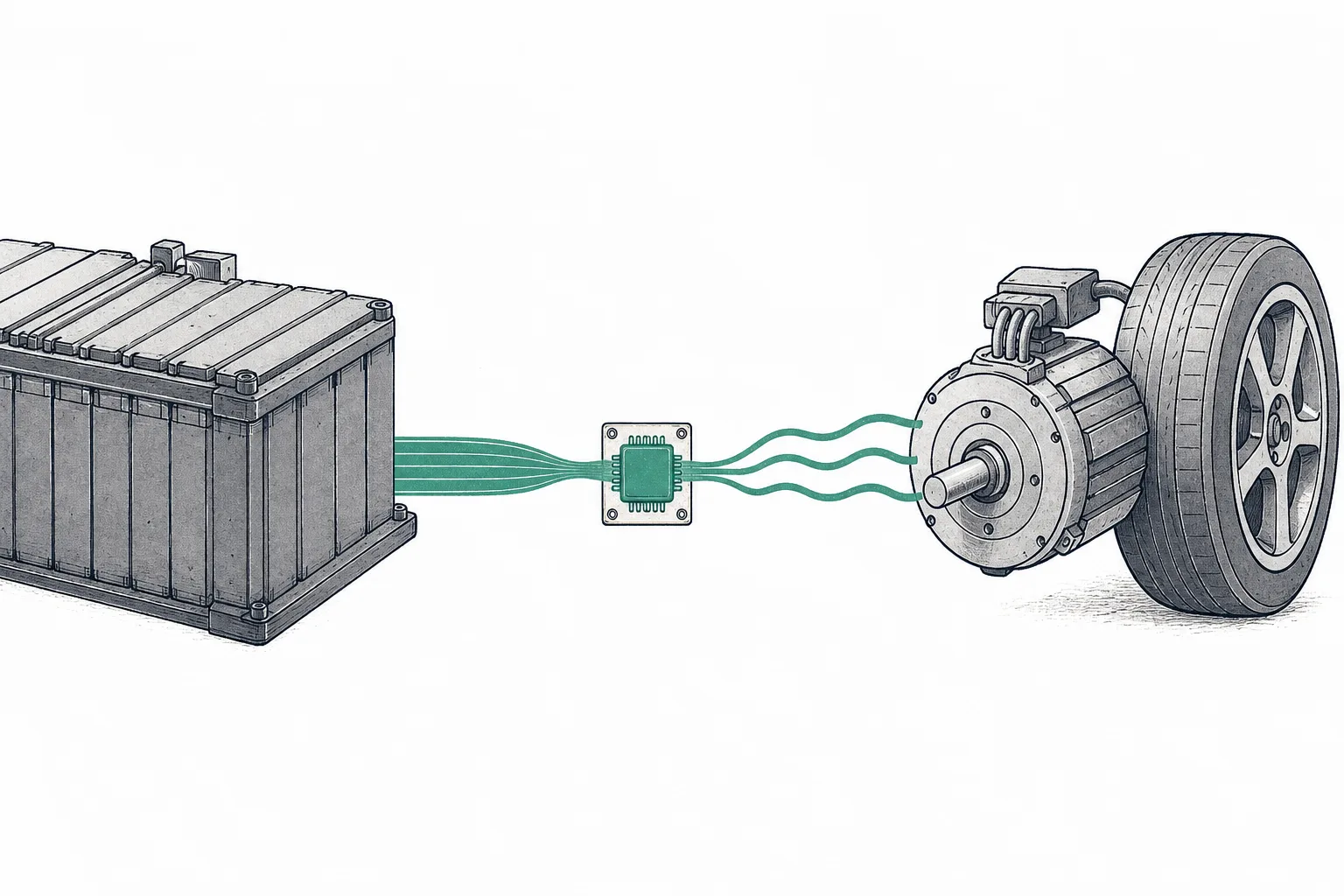
Picture it simply: an EV's battery is a "reservoir" packed with energy, and the motor is a "turbine" that needs water flowing in to spin. The question is — who opens and closes the "valve" so the water flows at just the right force and speed to turn the turbine exactly as hard as you press the pedal? The answer is the power semiconductors — a small group of chips inside a box called the inverter. And the node we're talking about is that chip specifically — not the whole box, not the motor.
It has just one job, but a crucial one: to be an electrical switch that turns on and off thousands to ten thousand times a second, to "sculpt" the direct current (DC) from the battery into the alternating current (AC) the motor can spin on. It doesn't "think" through anything complex like a computer chip — it just goes off, on, off, on, with extreme speed and precision, under hundreds of volts that a gas car never had to deal with.
On the megatrend map this node is a leaf under EV Powertrain & Power Electronics, within the larger trend Electrification & Mobility. It sits alongside a sibling, E-motors, Inverters & Drivetrain — if that one is "the motor and the box that wraps everything," this node is "the heart inside the box," the chip that actually switches the power on and off.
The whole story of this chapter revolves around the rivalry between two chip materials — IGBT (the traditional silicon chip: cheap, durable, long-used) and SiC (silicon carbide: the pricier newcomer that's better at high-power work). Their fight for position is the most expensive and fastest-growing battleground in the automotive chip world right now.
IGBT (Insulated-Gate Bipolar Transistor) = a power transistor made from ordinary silicon — cheap, durable, easy to produce, the "workhorse" that has ruled EV inverters for years · SiC (Silicon Carbide) = a chip made from a "wide-bandgap" material that withstands far higher voltage and heat, switches faster, and loses less energy — but is pricier and harder to make · In short, IGBT is "cheap and good enough," SiC is "expensive but worth it for high-power work."
02Why it matters — power that doesn't get thrown away as heat
There's an iron rule that makes this group of chips matter more than its looks suggest: every time a chip switches off and on, it loses a little energy as heat. Sounds trivial — but because it switches tens of thousands of times a second, every second the car is moving, those tiny losses add up into a big deal. Power that should have turned the wheels gets burned off as heat instead. And this is exactly where the "chip material" comes in to change the whole game.
The engineering research numbers are clear: in an 800-volt system, an inverter using SiC chips has total energy losses about 50–70% lower than an IGBT one. The real-world result: switching from 400V/IGBT to a full 800V/SiC setup lets the car go about 5% farther on the same battery (versus just ~1.2% if you go to 800V but keep IGBT) — or, looked at another way, a smaller, lighter, cheaper battery for the same range. For automakers fighting over every kilometer and every dollar of battery cost, this is do-or-die.
That's why SiC is inseparable from the "800 volt" trend. An 800V system (versus the old 400V) charges much faster and delivers more power — but at that voltage, IGBT chips run hotter and waste more, so SiC becomes almost a forced choice. Every automaker that's announced an 800V platform (Hyundai, Porsche, Xpeng, BYD's higher-end models) has turned to SiC.
The size of the market reflects this clearly. The market for all EV semiconductors is worth around $24 billion in 2025 and is expected to grow to ~$57 billion by 2032, with the SiC-chip portion growing fastest — the SiC power-device market sits at roughly $2.7–5.8 billion in 2025 and grows ~19–27% a year through 2030, driven mainly by EVs.
03How it works (DC → switch → three-phase AC)
Let's look at how this group of chips actually works. Its heart is one word: switch. Let's trace, step by step, how power travels from the battery to the motor through the chip.
Step 1 — the battery supplies high-voltage DC, a direct current (these days 400 or 800 volts) flowing in one direction. But a motor can't spin on DC directly — it needs three-phase AC that swings up and down in rhythm.
Step 2 — the power chips are the star. Inside the inverter are 6 switching chips (paired in 3 pairs, controlling 3 phases) that switch off and on tens of thousands of times a second, alternately connecting positive and negative current to each phase until they "sculpt" an AC waveform. Press the pedal harder = the chips deliver power faster and stronger. This is where the most energy is lost if the chip is poor — and where SiC beats IGBT.
Step 3 — three-phase AC enters the motor, creating a rotating magnetic field that drags the rotor around with it. The shaft turns, sending power to the wheels, and the car shoots forward.
What makes SiC win is pure physics — it switches "sharper and faster," spending far less time in the transition state (where energy leaks out as heat) than IGBT, and it tolerates higher heat, so it needs a smaller, lighter cooling system. The net result is a smaller, lighter, more efficient inverter — but a pricier one, because SiC material is far harder to grow into crystals than ordinary silicon.
04Where it sits in the ecosystem
This node is the "meeting point" between the world of cars and the world of chips — it's a power chip that happens to have its biggest customer in the EV industry. Here's how it connects to the trends around it:
- A category of power chip within Semiconductors: SiC/IGBT are members of the chip world's "power semiconductor" family — but unlike logic/memory chips, they don't compete on being "the smallest," they compete on "handling the strongest power with the least energy lost." EVs are the biggest application for this group of chips
- Feeds directly into E-motors, Inverters & Drivetrain: these chips are the "guts" of the inverter box that drives the motor — that node is the box and the motor, this node is the chip inside it. Without good chips, the motor can't squeeze out its performance
- A cost and differentiator for the whole car in Electrification & Mobility: it works alongside the battery — the battery stores the energy, this chip controls the delivery. Without either one, the car won't run
- Depends on Critical Materials & Supply Chain: the main raw material is SiC crystal, which is hard to grow and energy-intensive. Whoever controls quality SiC wafer production at low cost controls the headwaters of the whole node
- Tailwind from China NEV: China's new-energy-vehicle market, growing fast and shifting to 800V quicker than anyone, is the biggest vacuum sucking up SiC demand — and the reason China is rushing to build these chips itself
05Where it stands now
First, something to understand: even though SiC is the star of the news, IGBT still dominates most of the inverter market, because it's cheaper and good enough for ordinary 400V cars. SiC takes the share of premium cars and the fast-growing 800V cars. So the overall picture is "IGBT is the base, SiC is the fastest-growing peak" — and the fiercest fight is on the SiC side.
On the SiC side, the market is extremely concentrated. In 2024 the top five took a combined over 90% of revenue, led by STMicroelectronics (~29–33%, the market leader for years running and the partner that has supplied SiC to the Tesla Model 3 since 2018), followed by onsemi (~22%), Infineon (the #1 power-semiconductor leader overall, with ~19.5% share in 2025), then Wolfspeed and Japan's ROHM.
But the thing that's rattled the industry most is the drama of Wolfspeed — the American company that pioneered SiC material from the start and bet on "doing the whole chain itself," from growing the crystal to the finished chip. It poured a fortune into a 200mm wafer fab in New York well ahead of demand — but EV demand slowed more than expected, and combined with production delays and price-cutting Chinese rivals, it had to file for Chapter 11 bankruptcy on June 30, 2025, only emerging on September 29, 2025 after cutting its debt by about 70% (from ~$6.7 billion to ~$2 billion) — a live lesson that even with the right trend, investing at the wrong moment can hurt all the way to bankruptcy.

Another force shaking the board is China's rise. Backed by the world's largest domestic NEV market, Chinese makers have climbed fast, led by StarPower, which holds about 28% of China's NEV power-module market and was the first Chinese company to supply SiC modules to a real car (the Xpeng G9). Meanwhile BYD makes its own power chips (BYD Semiconductor), supplying its own cars end-to-end, and is already running an 8-inch SiC wafer line in Changsha.
06The future — 8-inch wafers, falling prices, China surging in
The first direction is the move to 8-inch (200mm) wafers. Today most SiC is still made on 6-inch wafers. Stepping up to 8 inches yields far more chips per wafer and a lower cost per chip — the key to bringing SiC down from premium cars into the mid- and lower-tier market. Every big player (ST, Infineon, Wolfspeed, and China's BYD) is racing to bring 8-inch lines online as fast as possible.
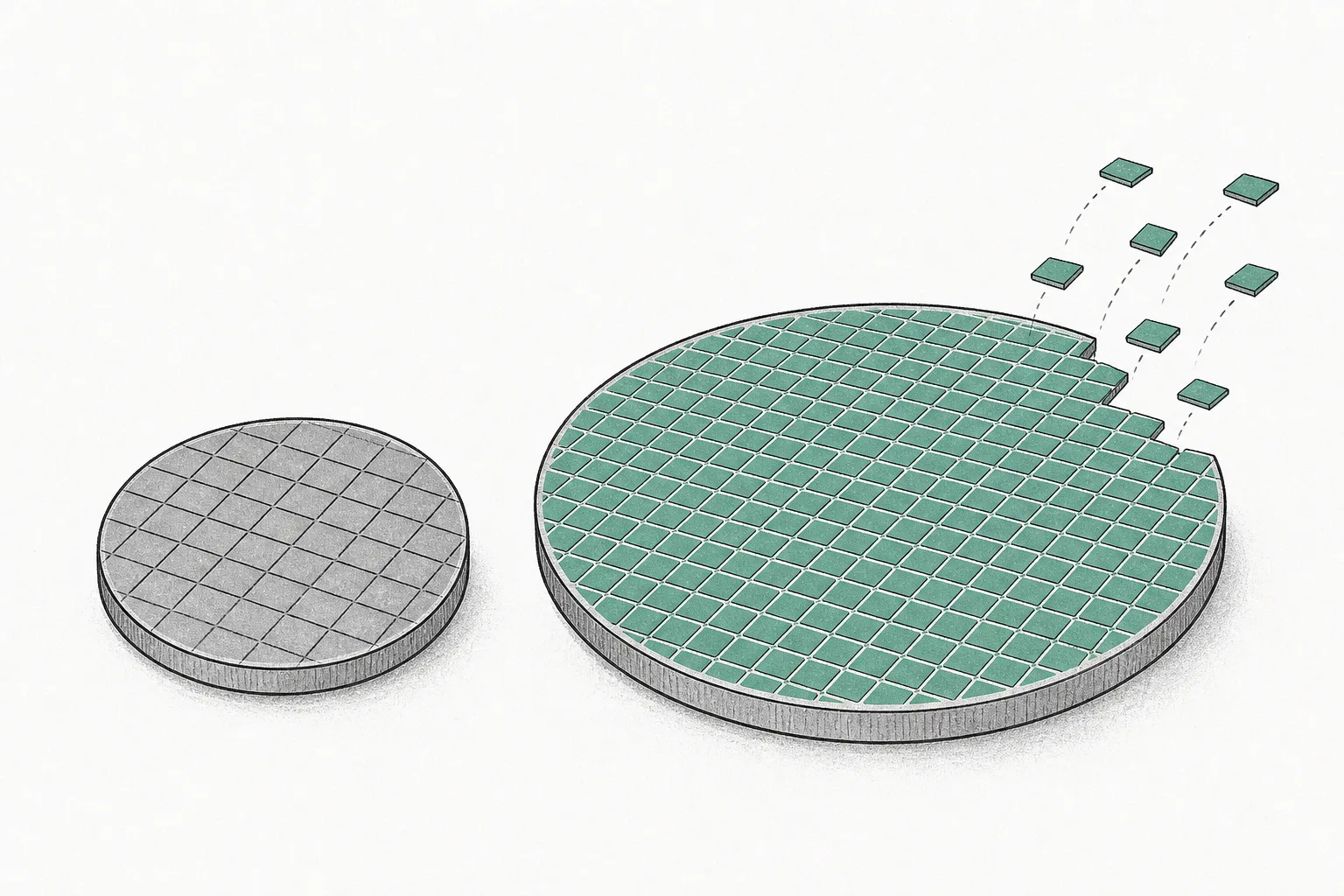
The second direction is plunging prices. Two years ago a Wolfspeed 6-inch SiC wafer cost around $1,500 each, but Chinese makers can now offer as low as ~$500 or below. Analysts estimate SiC chip costs could fall 40–50% over the next 1–2 years. The good news: SiC spreads much faster. The bad news: makers' margins get squeezed hard — especially those that invested expensively early.
The third direction is using SiC more cleverly. SiC is good but expensive, so automakers are starting to design it in only where needed — for example, the "hybrid" idea that puts both SiC and IGBT in one unit, letting SiC handle the low-load range (where it shines) and IGBT the high-current range. Tesla went so far as to announce its next-generation powertrain will cut SiC transistor count by ~75% (from 48 to about 12) to trim cost without giving up much performance — a sign that the next game isn't "pack in as much SiC as possible" but "use SiC as efficiently as possible."
07Challenges & risks
The first risk is the hard-to-predict EV cycle. The Wolfspeed case is the most live lesson — the SiC trend is right in the long run, but if you pour money into building a fab ahead of time while EV demand hasn't arrived as expected, you can be hurt all the way to bankruptcy. The power-chip business has to invest heavily years in advance, so the speed of the EV transition is the most dangerous variable.
The second risk is the price war and oversupply from China. As China builds the whole SiC chain itself (from wafer to module) and ramps capacity faster than demand, prices plunge — a wafer that was $1,500 is now ~$500. Good for users, but it crushes the margins of makers across the industry, especially the higher-cost Western ones. This is a "China shock" of the same kind that hit solar panels and batteries before.
The third risk is being replaced by China in your own market. China's NEV market is the biggest SiC demand, but China is increasingly supplying its own chips (StarPower, BYD) — so the incumbent leaders risk losing both the fastest-growing market and their long-term pricing power. The share ST/Infineon/onsemi once monopolized could be eaten away, bit by bit, in the world's biggest market.
In short: this node is the tiny chip that every drop of an EV's power must flow through — it's quiet, but it decides how far the car goes, how fast it charges, and how much it costs. The fight between IGBT and SiC, plunging prices, and the wave of Chinese makers are the three forces that will decide who owns the "valve" driving the electric-car era for the next decade.