Megatrend · Electrification & Mobility
Turning the battery's electricity into the spin of a wheel
Everyone talks about the battery as if it were the whole EV — but the battery only stores 'energy.' What actually takes that electricity and makes the wheels turn is a set of parts most people have never heard of: the electric motor, and the 'inverter' that drives it with power chips. In this lesson we'll open the hood and see how energy travels from the battery to the wheel, why swapping the chip from plain silicon to 'silicon carbide (SiC)' became the most expensive, fastest-growing battlefield in an EV after the battery itself, and why China controls both the motor and the magnet that make it spin.
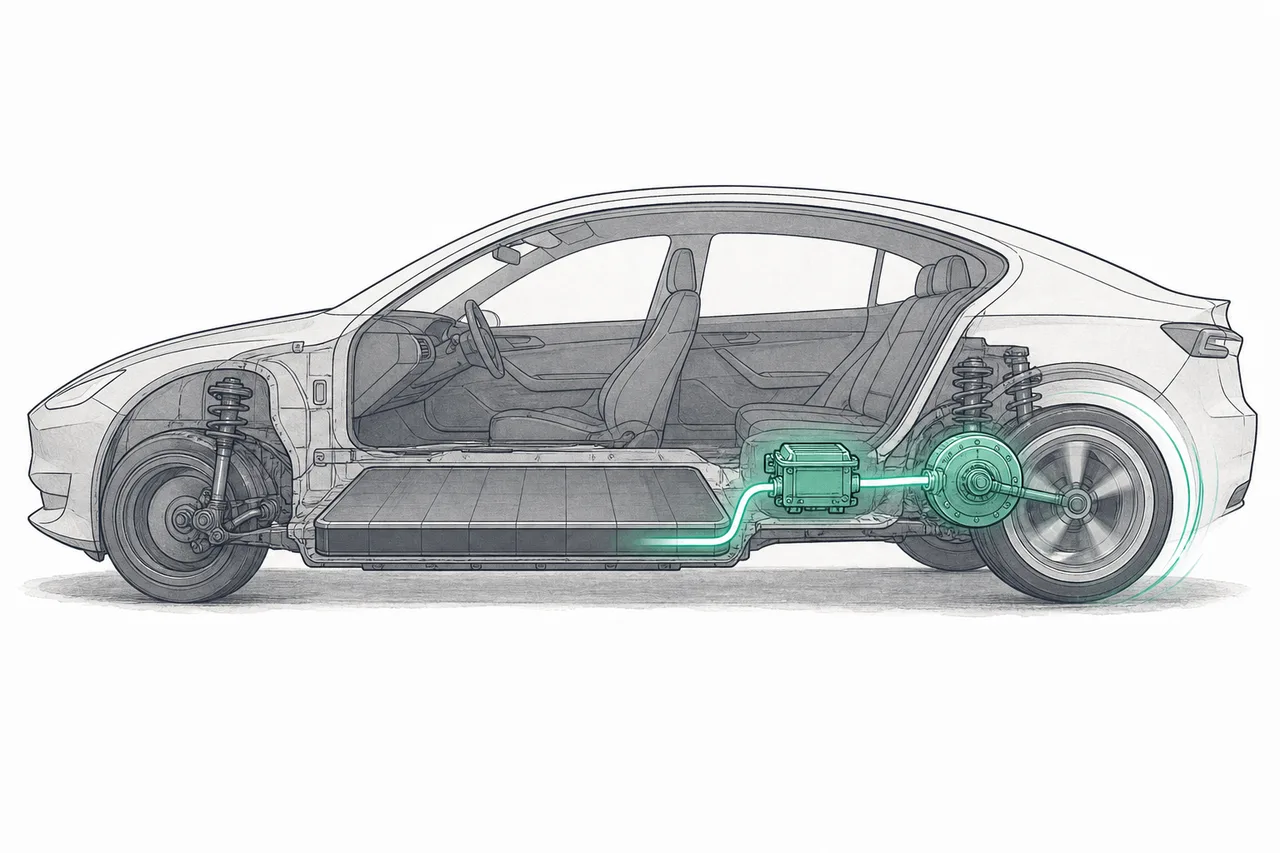
01What it is (three parts)
Picture an EV as a human body. The battery is the stomach — it stores energy, but a stomach alone can't move. You need 'muscles' to exert force, and a 'nervous system' to tell the muscles how much force, and when. The part that does this is the node we're talking about — EV Powertrain & Power Electronics, the 'powertrain and power electronics' of an electric car.
It's made of three main parts that work in a relay:
- The electric motor (the muscle): the part that turns electricity into actual spin — it takes electricity in and turns a shaft connected to the wheels. Its heart is the 'magnet' and the 'coil'
- The inverter (the brain that commands the muscle): a box packed with 'power chips' that converts the direct current (DC) from the battery into the alternating current (AC) the motor can use, and controls how much power to deliver — this is the part that decides whether the car pulls away smoothly or jerks, sips power or guzzles it
- The onboard charger (the charger inside the car): the part that converts the household AC you plug in into the DC that can be stored in the battery
On the megatrend map, this node is a sub-theme under Electrification & Mobility, and it splits into two sub-categories — we'll dig into both in this lesson, because they're two sides of the same coin:
- EV Power Semiconductors (SiC / IGBT) — the 'power chips' inside the inverter, the part that controls the flow of high-voltage electricity
- E-motors, Inverters & Drivetrain — the motor itself, the inverter box, and the 'e-axle' that bundles it all together
DC (direct current) = electricity that flows steadily in one direction; the battery stores and supplies power this way · AC (alternating current) = electricity that swings back and forth in a rhythm, the form that makes a motor spin well · The problem: the battery gives you DC, but the motor wants AC — so the 'inverter' is the middleman that flips DC into AC thousands of times a second. And this is where the 'power chip' steps in as the star.
02Why it matters — the most expensive thing after the battery
When people add up the cost of an EV, they usually only think of the battery (~30–40% of the car's price). But the part that's 'the fastest-growing and highest value-per-unit after the battery' is the power chips in this powertrain. The reason is simple: an EV uses 2–3× the chip value of a gas car (ICE) — and almost all of that increase is the 'power chips' that have to handle hundreds of volts from the battery to the motor. That's a level of power a gas car never had to deal with.
The market size tells the story clearly. The EV inverter market alone is worth around $7.8 billion in 2025 and is expected to grow to ~$30 billion by 2035. The overall EV power electronics market sits at about $33 billion in 2025, heading toward ~$59 billion in the early 2030s.
But the figure that hits hardest is the chip value per car. A typical gas car has about $500–600 of chips per car; an EV pushes past ~$1,500. The big difference is power chips — which is why semiconductor makers see EVs as a prime 'demand vacuum': the more the world goes electric, every car that leaves the factory means one more set of power chips sold.
03How it works (from battery to wheel)
Let's follow the real path of energy, from leaving the battery to spinning the wheel. There are only a few steps, but every one matters:
Step 1 — the battery sends out DC as high-voltage power (these days 400 or 800 volts) flowing in one direction. But the problem is that a motor can't spin on DC directly.
Step 2 — the inverter is the heart of everything Inside it is a group of 'power chips' (electrical switches) that turn on and off incredibly fast — thousands to tens of thousands of times a second — to 'shape' the DC into a three-phase AC wave, and to control how much power to deliver: press the accelerator deeper and the chips push power harder and more often. This is where the 'brain' lives, and where the most energy is lost if the chips aren't good.
Step 3 — the motor turns electricity into torque The incoming AC creates a rotating magnetic field in the coils, dragging the magnets on the rotor around with it. The shaft spins, sending power through a reduction gear to the wheels — and the car shoots forward.
The key thing to understand is this: 'every time a chip switches on and off, it loses a little energy as heat'. And because it switches tens of thousands of times a second, those tiny losses add up into something big — electricity that should have spun the wheel ends up as heat, thrown away for nothing. This is where the 'chip's material' comes in to change the game.
04SiC — the chip that unlocks the 800-volt era
This is our first sub-category — EV Power Semiconductors — and the whole story revolves around switching the chip material from 'plain silicon' to silicon carbide (SiC).
For years, the power chips in inverters were silicon transistors called IGBT — they work well and they're cheap. But when they have to handle high voltage at the 800-volt level, they start to run 'hot and power-hungry,' because they lose a lot of energy when switching. SiC fixes exactly that — it withstands higher voltage, handles heat better, and switches faster while losing far less energy.
The research numbers are clear: in an 800-volt system, an inverter using SiC has total energy losses about 50–70% lower than an IGBT one. The real-world effect is about 5% more range on the same battery — or, seen another way, a smaller, cheaper, lighter battery for the same range. For carmakers competing over every kilometer and every dollar of battery cost, that's a big deal.
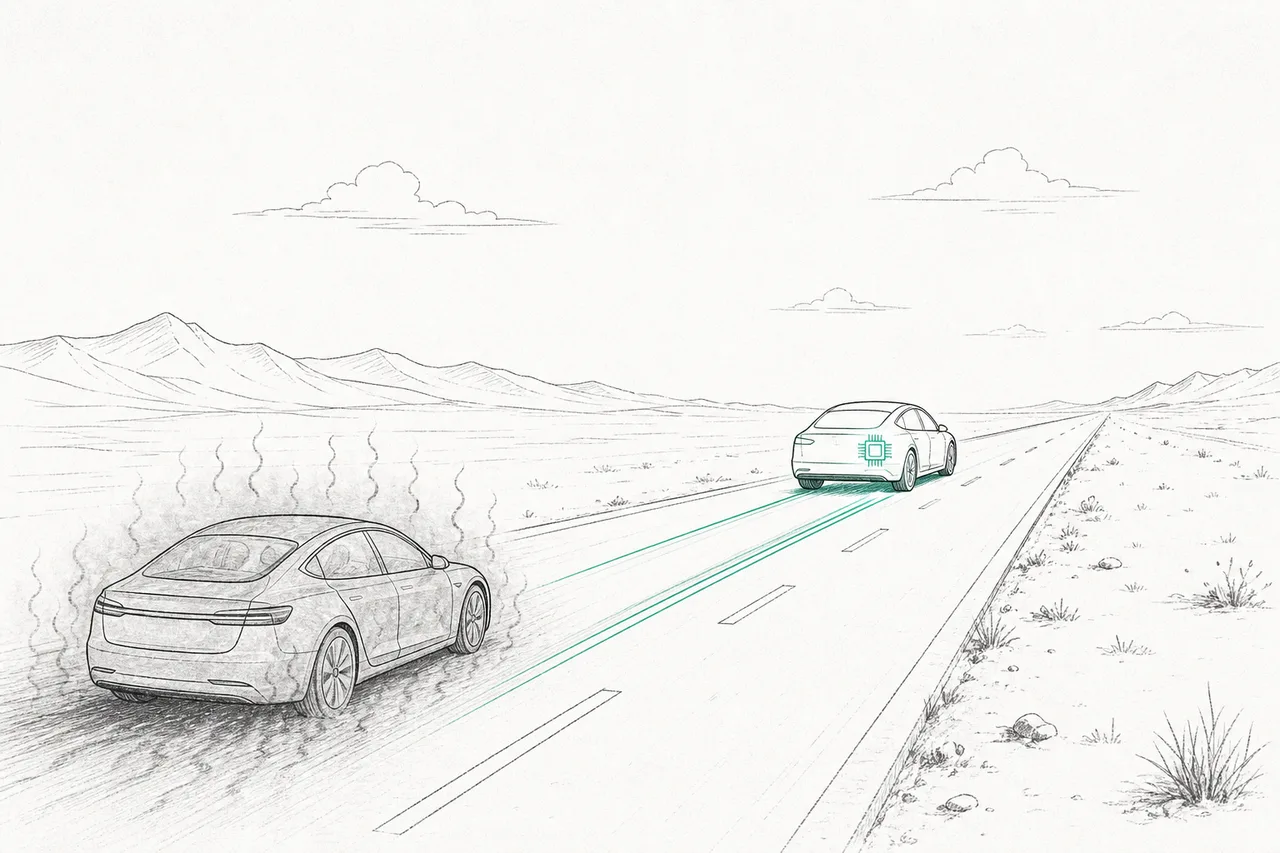
This is why SiC is inseparable from the '800-volt' trend. An 800V system (versus the old 400V) charges much faster and delivers higher power — but at 800V an IGBT chip gets even hotter and hungrier, so SiC becomes almost the forced choice. And this is why automotive took ~62% of the entire SiC market in 2024.
IGBT = a power transistor made from conventional silicon; cheap, durable, long-used, still holding ~60%+ of the inverter market in 2025 · SiC (silicon carbide) = a 'wide-bandgap' chip material that handles voltage and heat far better, switches faster, and loses less energy — but costs more · Put simply, IGBT is 'cheap and good enough,' while SiC is 'expensive but worth it for high-voltage jobs' — and the more cars head into the 800V era, the more the world leans toward SiC.
But the SiC market is just as brutal — share is concentrated in the hands of a few players. In 2024, STMicroelectronics held the No. 1 spot (~29–33%), with onsemi next (~22%) and Infineon third (~16%); the top five (adding Wolfspeed and ROHM) together control over 90% of the market. The most dramatic story is Wolfspeed — the American pioneer of SiC materials, which poured enormous money into building factories ahead of demand, only for EV demand to slow more than expected, pushing it to file for Chapter 11 bankruptcy. It emerged only in September 2025, after cutting its debt by about 70% — a live lesson that the trend can be right, but investing at the wrong moment can still hurt badly.
05Motors & magnets — the game China controls
This is the second sub-category — E-motors, Inverters & Drivetrain. If the SiC chip is the West's battlefield (the US and Europe), the motor side is, by contrast, a game that China controls almost completely.
On the motor side, the biggest trend is collapsing the motor + inverter + gear into a single box called the 'e-axle' (3-in-1) — smaller, about 20% lighter, and around 95% efficient. The e-axle market is heading toward ~$110 billion by 2035 (from ~$22 billion in 2025). Whoever can bundle it most cheaply and best wins on both cost and performance (dig deeper →).
Most EV motors are the permanent magnet type, because they give the highest torque and are the most power-efficient. Their heart is a 'high-strength magnet' made of NdFeB (neodymium-iron-boron) — and this is where the game tilts into China's hands. Because China controls over 90% of the world's NdFeB magnet production, and in 2025 about 95% of new EV motors still rely on this kind of rare-earth magnet — a single motor uses about 1–2 kilograms of NdFeB magnet.
The motor market itself is also large and fast-growing — worth about $11 billion in 2024, rising to ~$17 billion in 2025, with Asia (led by China) clearly dominating. On the Chinese side, the most aggressive players are BYD (which makes its e-axle fully in-house) and Inovance. Western players like BorgWarner and Vitesco/Schaeffler can still compete on technology, but their cost of mass production struggles against China's supply chain — and the live lesson is Nidec (Japan), which once aimed to be the global e-axle leader but pulled out of the e-axle business after heavy losses (~¥87.7 billion in the first half of fiscal 2025). Management called it a 'red ocean' and gradually shut down its JVs in both China (GAC) and Europe (Stellantis) — even the one who wanted to lead, retreated.
And in April 2025, China actually used that power — it rolled out export controls on rare earths and magnets (including dysprosium and terbium). As a result, dysprosium/terbium prices in Europe spiked to 6× their level in China, and some carmakers in the US and Europe had to cut production within weeks because of the magnet shortage. It's a lesson that what looks like an 'ordinary mechanical part' is actually the most dangerous geopolitical bottleneck in an EV.
The exit carmakers are racing toward is motors that use no rare-earth magnets — for example the EESM (a motor that excites the rotor with a coil instead of a magnet) developed by BorgWarner and Vitesco. Tesla itself has announced that its next-generation motor will drop rare earths. But this transition still takes years.
06How it connects in the ecosystem
This node is the 'meeting point' between the world of cars and the world of semiconductors — it sits in the middle of several trends that feed each other:
- A part of Electrification & Mobility (the whole EV): it's the 'powertrain' that works hand in hand with the battery (Battery Cells) — the battery stores energy, this set uses it; lose either one and the car won't run
- Supplies directly to Passenger EV OEMs: carmakers buy inverters, motors, and e-axles from this group of suppliers (or build their own) — it's the most important cost and performance differentiator after the battery
- The defining face of Analog, Power & Discrete: the SiC/IGBT power chips here are the 'biggest application' of the whole power-semiconductor category — the EV trend is the main demand engine for that group of chips
- Depends directly on Critical Materials & Supply Chain: both the SiC wafer and the NdFeB rare-earth magnet come from the critical-materials supply chain — and this is the most geopolitically fragile point of the whole node
- Connects to Robotics & Physical AI: this same motor and inverter are what make a robot move — drivetrain technology is shared across industries
07Where it stands now + the players
2024–2025 was a 'swing' period for this category. EV demand grew more slowly than many makers expected, hurting SiC chip makers that had invested heavily ahead of time (especially Wolfspeed), and capacity swung between tight and loose. But the long-term direction is still clear — every car that goes electric is a fresh chunk of demand for power chips and motors, and the move to 800V architecture keeps pushing up the SiC share in each car.
This field splits cleanly into two camps: the power-chip side, led by Western and Japanese semiconductor companies, and the motor/drivetrain side, a mix of big automotive suppliers and Chinese giants that build everything in-house.
08The road ahead & risks
The first direction is clear: SiC keeps taking share from IGBT, in step with the move to 800V architecture. And as the whole industry shifts to producing on 300mm wafers, the SiC cost per chip will fall, bringing it down into mid- and low-priced cars, not just premium ones — the ~$8B EV inverter market today is heading for $30B next decade.
The second direction is integration. The motor + inverter + reduction gear are being collapsed into a single part called the 'e-axle', to cut weight, cost, and space — whoever can build the e-axle most cheaply and best wins. And this is the field where Chinese players like BYD and Inovance push hardest — a field so fierce that even Nidec, which once aimed to be the market king, had to pull out (see §05), a sign of how thin the margins and how brutal the cost competition are.
But the risks run deep too. The first risk is the hard-to-predict EV cycle. The Wolfspeed case is the live lesson — the SiC trend is right in the long run, but if you pour money into building factories ahead of time while EV demand still hasn't arrived as expected, you can be hurt all the way to bankruptcy. The speed of the EV transition is the hardest variable to predict.
The second risk is rare earths and dependence on China. As long as ~95% of EV motors rely on NdFeB magnets and China controls over 90% of production, every round of export controls (like 2025's) can squeeze the whole industry in an instant — and because the export licenses China grants are short-lived, this risk hangs by a thread at all times. Rare-earth-free motors are still an exit that takes years.
The third risk is a price war from China. China controls the motors and builds the powertrain fully in-house (the BYD model), making its costs far lower than Western rivals. Players who only sell generic parts will see their margins squeezed harder — pricing power will be left only to whoever controls the 'hardest technology to make,' meaning high-end SiC chips and the best-integrated e-axles.
In short: everyone sees the battery as the EV's star. But the part that actually 'turns the battery's electricity into the spin of a wheel' is the hot technology battlefield — on one side, the fight over the SiC chip the West controls; on the other, the motor-and-magnet game China controls. Whoever wins next decade is whoever understands that these two sides are the same coin.