Megatrend · Robotics & Physical AI
AI is the robot's brain — but its muscles run on magnets China controls almost worldwide
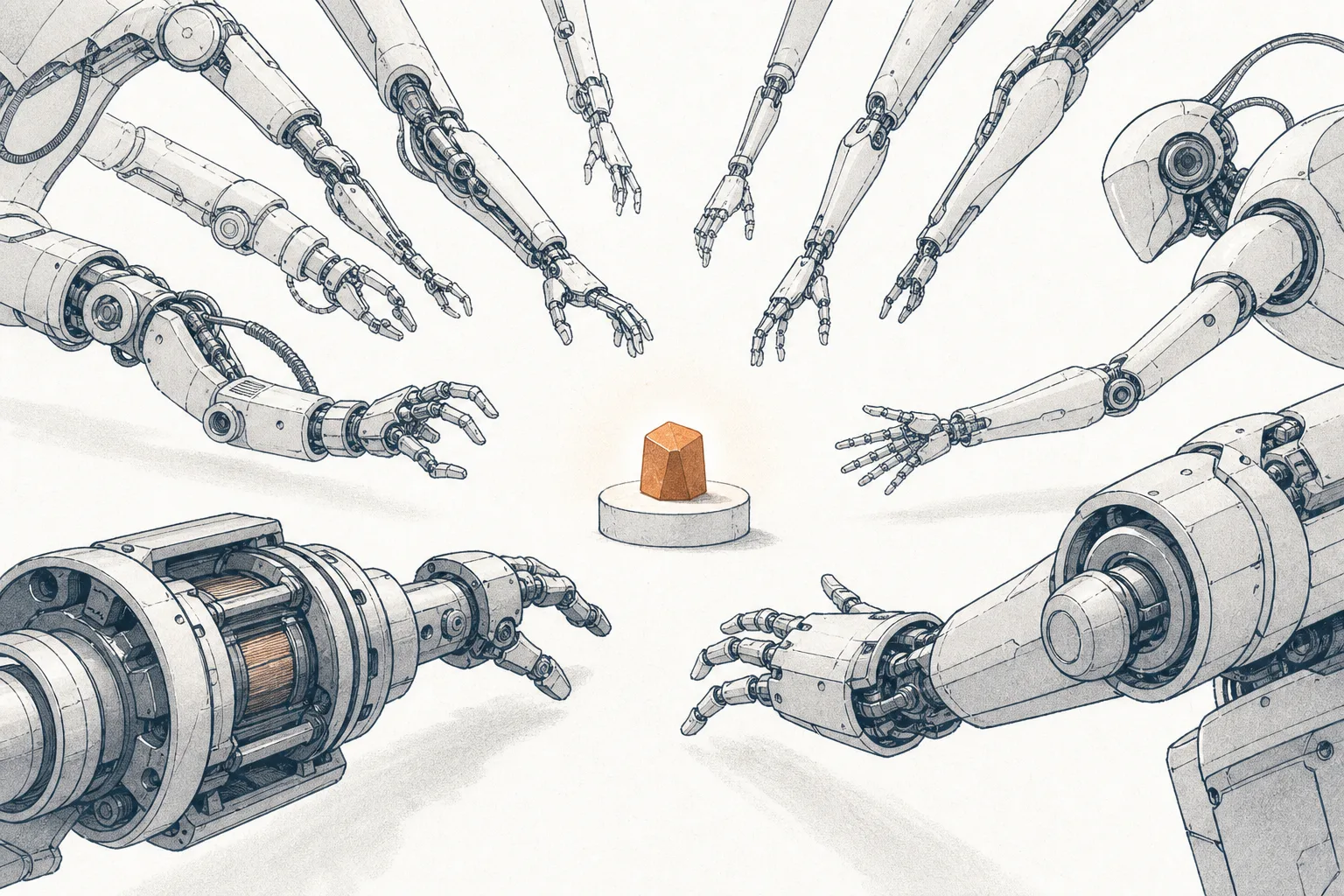
Every time a robot lifts an arm, twists a wrist, or takes a step, it uses the same group of "muscles" — servo motors that turn with fraction-of-a-degree precision, and the heart that makes them strong enough at a tiny size: a block of NdFeB permanent magnet made from rare earths. The catch is that almost all of these magnets are refined and made in China. This is the story of the "robot's muscle" — and the geopolitical weak point buried in every single joint.
01What it is (the robot's muscle)
We like to say modern robots got "smarter" thanks to AI — but no matter how smart the AI is, all it can do is command "I want the arm to move." The part that actually moves is a completely different story. If the brain is AI, the robot's muscle is the servo motor — a motor that doesn't just spin, but spins and "stops exactly at the commanded position" to within a fraction of a degree, and holds there even under load.
This node is about two things you can't separate: the servo motor that creates the motion, and the NdFeB permanent magnet (neodymium-iron-boron) buried inside it — because it's this magnet that lets a tiny motor produce enormous torque. On the megatrend map, it's the deepest sub-category of Robotics Components & Actuation under Robotics & Physical AI, sitting in the deepest "upstream layer" — the one that makes the parts every robot has to assemble.
Picture a single robot joint. It's a unit called an actuator, made of three main parts: a motor (creates rotation) + a reducer, or gear set (slows it down but makes it stronger) + an encoder (a sensor that measures position). This lesson focuses on the motor and the magnet — the reducer is the business of the neighbor, Precision Drives & Reducers. One humanoid robot needs more than 40 of these motors — a single hand alone uses at least 10 tiny ones.
Servo motor = a "closed-loop" motor with a sensor constantly measuring the real position and correcting so it stops exactly where commanded, unlike an ordinary motor that just "spins along" · NdFeB permanent magnet = a magnet made from the rare earth neodymium (often mixed with dysprosium/terbium for heat resistance), the strongest permanent magnet in commercial use — strong enough to pack a powerful motor into something the size of a fist.
02Why magnets matter more than you'd think
Here's a question that sounds technical but decides everything: why use expensive, scarce rare-earth magnets when ordinary magnets (ferrite) exist? The answer is one number — the magnet's energy product. The higher it is, the stronger the magnet per size. NdFeB magnets run around 30–52 MGOe, while cheap ferrite magnets are only 0.8–5.2 MGOe — a tenfold gap.
In plain terms: with NdFeB you get the same torque in a much smaller, lighter motor — and in a robot, every gram counts at every important joint. The shoulder motor has to carry the weight of all the elbow and wrist motors too, so weight at the end of the arm multiplies back toward the base. "Torque-to-weight" isn't a luxury, then — it's the line between a robot that can walk and one that can't.
This is why demand is about to explode. One humanoid robot needs about 1 kilogram of NdFeB magnet (Morgan Stanley estimates ~1.3 kg of NdPr across all motors and actuators). In 2025 the world shipped about 13,000 humanoids, expected to reach ~28,000 in 2026 — still small numbers. But if shipments ever hit a million a year, as many forecasters expect, that's 3,400–34,000 tons of new high-grade rare-earth magnet demand from zero. IDTechEx estimates the weight of rare-earth magnets used in robots will grow 7x by 2036.
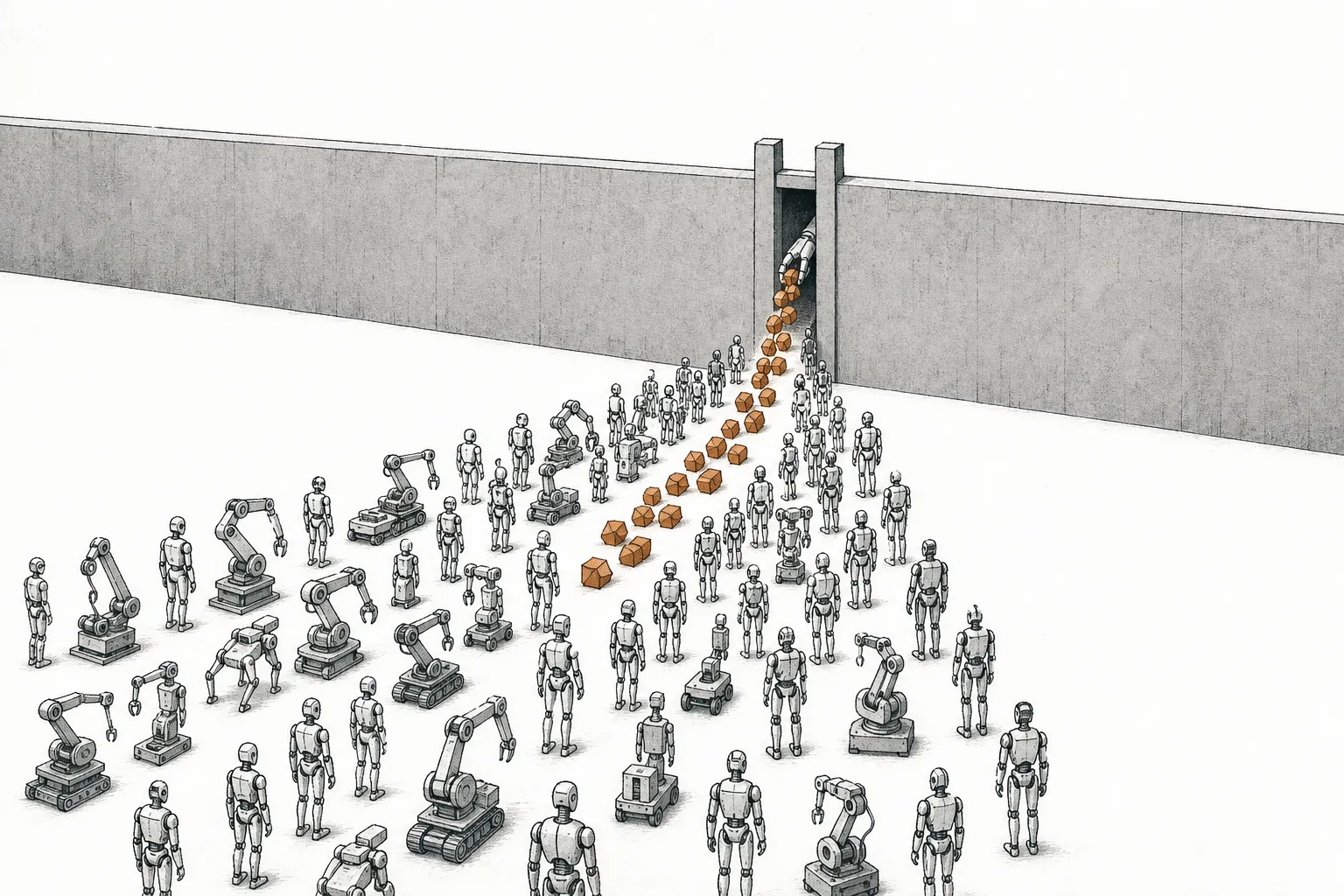
More important than size is who controls the raw material — and this is where the story turns geopolitical. China refines over 70% of the world's rare earths, and for dysprosium and terbium specifically (the two elements that make a motor's magnet heat-resistant), China holds nearly 100% of commercial production. So every motor in every brand of robot has the same single weak point buried inside — and that point is in one country's hands.
03How a servo motor works inside
The heart of the word "servo" isn't the motor itself, it's the closed loop — an ordinary motor takes the command "spin" and just spins along, not knowing where it is. A servo motor has a helper that changes everything: an encoder, a sensor that constantly measures the shaft's "real position" and feeds it back to the controller to compare against the "commanded position." If it's still off, it orders a correction — thousands of times a second.
The NdFeB magnet plays its role right in the motor itself. It's the "permanent pole" embedded on the rotor (the spinning part). When the coils create an electromagnetic field to pull and push this permanent pole, the shaft turns. The stronger the magnet, the higher the torque — without making it bigger or drawing more power. That's why the popular design for modern robot joints is the frameless torque motor — a motor sold as "just a rotor and stator" for robot makers to pack directly into the joint themselves, giving the most torque in the least space.
Frameless torque motor = a motor with no housing of its own, delivered as just the magnetic parts to embed in a joint — the highest torque per size, ideal for robots where every millimeter counts · Dual encoder = putting in two encoders (motor side + joint-output side) to compensate for the gear's "play," reaching precision down to ±10 arc-seconds (a fraction of a degree) · Backlash = the play in a gear, the arch-enemy of precision.
04What it connects to — from gears to rare earths
A motor never works alone. It's the middle link of a chain that stretches from underground (the mines) all the way to a robot's joint. Let's trace who it meshes with.
- Always paired with Precision Drives & Reducers (gears): a motor spins fast but weak; the reducer's job is to "slow it down but make it ~100x stronger." Only together do they make a usable joint — motor and gear are inseparable partners
- Depends directly on Critical Materials & Supply Chain: this is the biggest artery. NdFeB magnets need neodymium, dysprosium, and terbium — all rare earths whose refining is concentrated in China. If the upstream stumbles, robot joints worldwide stumble with it
- Driven by AI: AI is the brain that gives the orders, but it can only give them if there's a "muscle" precise enough to follow. The smarter AI gets, the more servo-motor demand surges — the two grow together
- Uses the same technology as Electrification & Mobility: EVs use the same NdFeB permanent-magnet motors — so robots and EVs fight over the same magnet material, tightening demand even more
- Works alongside Machine Vision & Force/Tactile Sensing: if the motor is the muscle, vision and force sensors are the "eyes and sense of touch" — a robot needs both to pick things up smoothly and precisely
- Feeds into Humanoid Robots and automated factories: this is the end customer — one humanoid uses 40+ servo motors, making the humanoid wave the most powerful demand accelerator for this layer
05Where it stands now
This industry has two overlapping arenas — the motor arena and the magnet arena — and what's interesting is that Japan leads both, while China is a shadow growing larger by the day.
In the servo-motor arena, the market is worth about $15 billion (2026) and is expected to grow toward ~$20 billion by 2031. The leaders are Japan's Yaskawa and Mitsubishi Electric, trading the top spot, each with about 15–20% share. Add Fanuc and Siemens and these four take over 60% of the servo market. In 2024 Yaskawa sold over 16.3 million servo motors, while Nidec, the world's largest motor maker, is pushing hard into the actuator market specifically for robot joints.
But the hottest and most dangerous arena is the magnet arena — and here China isn't just a challenger, it's the owner of the supply chain. China refines over 70% of rare earths and makes most of the world's high-grade NdFeB magnets. Leaders like JL MAG and Zhongke Sanhuan are world-scale magnet makers. On the Japanese side, Shin-Etsu Chemical, TDK, and Proterial (formerly Hitachi Metals) are high-quality rivals — but they still have to rely on Chinese raw material anyway.
The game changed on April 4, 2025, when China announced export controls on seven heavy rare earths (including the dysprosium and terbium essential to motors) under a licensing regime. The effect was immediate: China's magnet exports fell about 75% in two months, forcing some carmakers in the U.S. and Europe to cut output or pause lines temporarily. In October 2025 China widened the measures further (a "50% rule" reaching products containing Chinese rare earths), before easing some after negotiations — but the April measures remain in place. It's a live lesson that the "robot's muscle" has a tap Beijing can open and close.
06The future — a million robots, and motors without rare earths
The first direction is the clearest: the humanoid wave will turn this layer from a niche market into a mass market. Traditional industrial robots use only a few motors per arm, but one humanoid uses 40+. If shipments grow from tens of thousands to a million a year, demand for servo motors and magnets will multiply. Hyundai alone has announced plans to make 30,000 robots a year by 2028 — and that's just the start.
The second direction — and the biggest bet — is the hunt for a "rare-earth-free motor". As the risk of relying on China became clearer, engineers worldwide rushed for a way out. Tesla announced back in 2023 that its next-generation motor would use "no rare earths at all." Startups like Niron Magnetics are developing "iron nitride" magnets that use no rare earths, and have teamed up with Stellantis (Oct 2025) to develop a rare-earth-free EV motor. But the reality to accept is that, as of 2026, no alternative matches NdFeB on torque-to-size in commercial use — it's a race whose result isn't in yet.
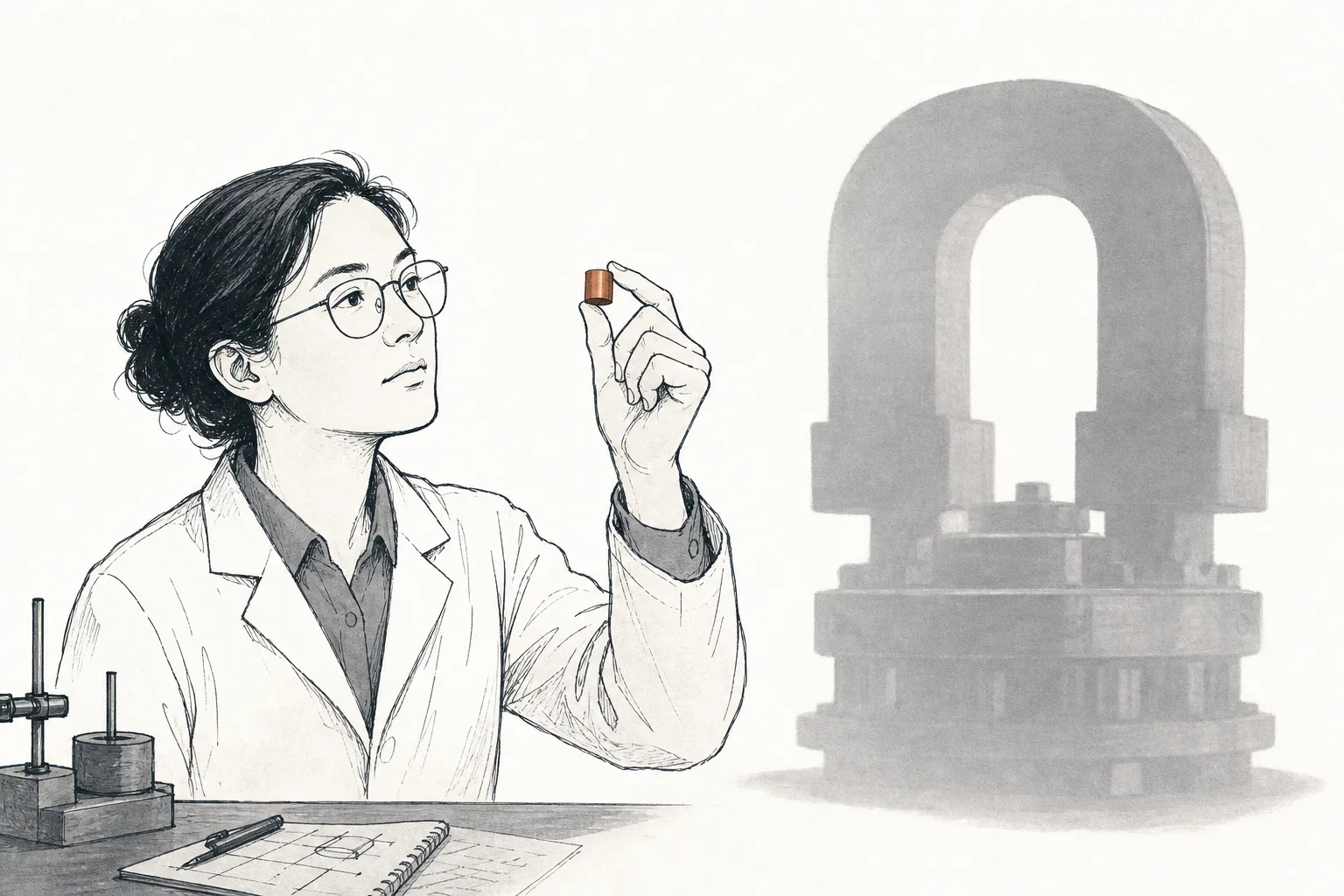
The third direction is building a magnet supply chain outside China. The U.S. is playing this hand the hardest through MP Materials, which has started commercial NdFeB magnet production in Texas, with the U.S. Department of Defense taking a major stake ($400 million) plus a guaranteed price floor of $110/kg for 10 years, and a $500 million Apple deal. The goal is to produce 10,000 tons of magnets a year by 2028 — pricier than China, but the price of "supply security" that many countries are willing to pay.
07Challenges & risks
The "robot's muscle" story sounds like investing in a sure trend. But it has its own particular risks you need to grasp clearly.
The first and biggest risk is China using rare earths as a weapon. As seen with the 2025 measures — magnet exports falling 75% in two months proved this isn't a theoretical risk, it actually happens. As long as nearly all the world's dysprosium and terbium comes from China, every motor of every brand has the same single tap that Beijing can control.
The second risk is the double-edged sword of substitute technology. If rare-earth-free motors (iron-nitride, new ferrites, induction motors) succeed commercially, they will reduce upstream risk — true — but they'll also crush the value of whoever invested in the NdFeB chain at the same time. Anyone who bets on the wrong side of this transition could get badly hurt.
The third risk is China catching up in the motor arena itself. Not just magnets. Chinese makers like Inovance and Estun are climbing servo-motor share fast, especially in China's own market — the world's largest robot market. What used to be a high-margin premium product for Japan and Germany could be pushed down into a price-competitive commodity.
In short: in an era when everyone is excited about a robot's AI brain, the overlooked story is the "muscle" — the servo motors that move precisely, and the rare-earth magnets that make them strong at a tiny size. To understand this layer fully is to understand why the robot battle may, in the end, be decided not by software but by "who has the magnets."