Megatrend · Cloud & Digital Infrastructure
The boring data closet that suddenly became AI's stomach
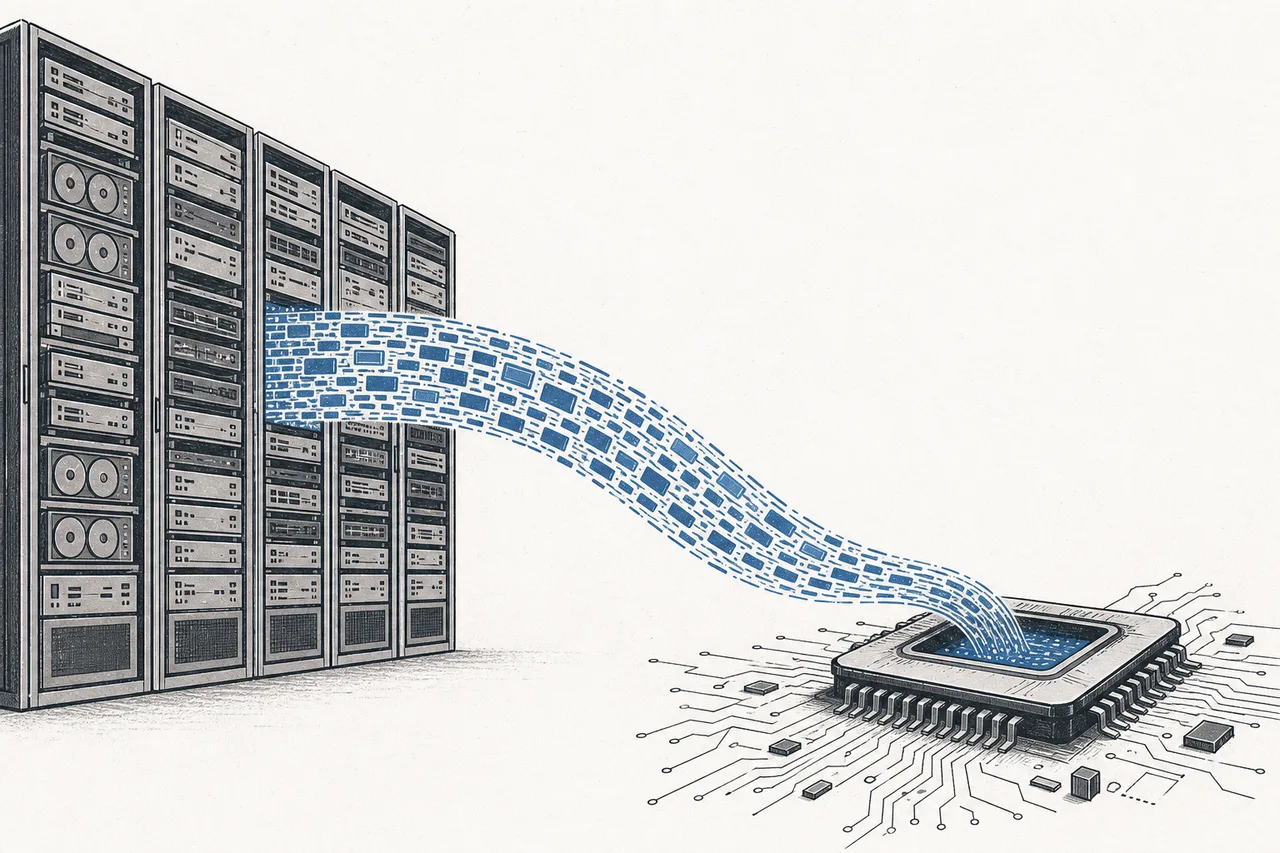
Every file, every photo, every AI model in the world has to "sleep" somewhere — on giant storage systems inside a data center. This business was once seen as the most boring corner of IT, until AI changed everything: a pricey GPU chip just sits there idle if storage can't feed it data fast enough. So storage went from "backup closet" to the "feed conveyor" of the AI era — and pushed both old hard drives and new flash into shortage at the same time.
01What it is (fast vs cheap)
Picture opening a photo on your phone — that photo isn't floating in some misty "cloud" in the sky. It's lying on a real machine, in a data-center building somewhere, on something called an enterprise storage array. This node is about those machines — the gear that big companies, banks, hospitals, and AI data centers use to keep an entire organization's data in one place, ready for every machine to pull from.
The heart of this story is a trade-off between two things that are always at odds: "fast" vs "cheap." The storage world splits into two big camps, based on the medium that actually records the data:
- Hard drives (HDD): spinning magnetic platters with a read head darting back and forth — old, slower, but very cheap per unit of capacity. Great for holding lots of data you don't grab often
- Flash / SSD: memory chips with no moving parts at all — many times faster than HDD and lower power, but much more expensive per unit of capacity
A storage system built entirely from flash is called an all-flash array (AFA) — the star of this era, because when data has to move fast, AFA is the answer. And HDD hasn't died off either — it just shifted roles, becoming the "giant cheap warehouse" for the mountains of data AI generates.
Don't confuse "storage" with "memory (RAM)" — memory is a chip's temporary workspace: blazing fast, but the data vanishes when you power off (see Memory — DRAM, NAND & HBM). A storage array is "permanent storage" where data survives a power-off, with far more capacity. This node is about the systems that assemble recording chips (NAND, magnetic platters) into a big box with management software — not the bare chips themselves.
On the megatrend map, this node is a sub-theme under Cloud & Digital Infrastructure — the "ground floor" everything in the digital era has to sit on. No storage, no cloud, no AI, nothing.
02Why it matters — storage reborn
For decades, storage was a "slow and boring" business — companies bought a bit more capacity each year as data crept up, nothing exciting. Then AI flipped the equation in two ways at once.
The first is the data explosion. The world created roughly 175 zettabytes (a zettabyte = a billion terabytes) of data in 2025, and that's expected to hit ~230–240 zettabytes in 2026. Every time you train one AI model, it eats a vast amount of training data and spits out another huge pile of new data (logs, results, checkpoints) — and all of it needs a home.
The second one matters more: storage became a direct part of the AI assembly line. A GPU chip that costs hundreds of thousands of dollars, forced to "sit and wait" because storage can't feed it data in time, is burning money every second. The industry calls this "GPU starvation." The upshot: old storage designed to "store and forget" no longer works — you need storage that can feed data at several TB per second.
The impact shows up clearly in the market numbers. The global external enterprise storage market posted about $9.7 billion in Q4 2025 (up 5.5% year over year). But here's the interesting part — inside that market, the fates split sharply: all-flash array sales grew +17.6%, while HDD and hybrid systems shrank ~6–10% — money is leaving the old stuff and flowing fast into flash.
03How it works (hot tier vs cold tier)
The key that lets both HDD and flash grow at once (even though they look like rivals) is an idea called "tiering." Data centers don't pick one or the other — they use both, placing each piece of data in the tier that fits it.
Picture a restaurant kitchen: the ingredients you use every minute sit on the counter right in front of you (grab them fast), while the whole restaurant's backup stock lives in the cold room out back (holds a lot, cheap, but slow to walk over and fetch). Storage works exactly the same way:
Here's the part that sounds contradictory but is true: AI put flash and HDD into shortage at the same time. Flash is short because everyone wants a "hot tier" fast enough to feed GPUs. HDD is booming because the data AI spits out (data lakes) is too big to keep on pricey flash, so it gets poured into cheap HDD warehouses.
And once storage has to feed GPUs directly, a new technique appeared called GPUDirect Storage — it opens a "shortcut" for data to run straight from the storage system into the GPU's memory, without the CPU acting as middleman, lifting feed speed by about 30–50%. New-generation systems like Pure Storage's FlashBlade//EXA even advertise read speeds topping 10 TB per second in a single namespace.
Nearline HDD = high-capacity hard drives for data centers, built to hold massive blocks of data while still being reasonably quick to reach (sitting between "online and fast" and "very slow tape backup"). Data lake = a giant pool of raw data an organization dumps everything into first, then lets AI dig through later — these two are the heart of the AI-era "HDD boom."
04How it connects in the ecosystem
Storage systems don't stand alone. They're the ground-floor layer that takes in from upstream and hands out to nearly every downstream tech trend:
- Sits under Cloud & Digital Infrastructure: storage is one of the data center's three legs — alongside compute (chips) and network — every cloud service rests on this layer
- Feeds AI Data Center directly: this is the hottest relationship. One AI data center needs storage fast enough to feed hundreds of thousands of GPUs — making storage an indispensable part of AI infrastructure
- Sibling of Memory — DRAM/NAND/HBM: flash systems are built from NAND chips, so when AI soaks up NAND for storage, chip prices spike — the two trends are tied directly at the "recording chip" (but this node is about whole systems, while Memory is about the chips themselves)
- A base for Data Platforms & Analytics: data analytics software and data lakes all have to live on real storage, somewhere
- Partly cannibalized by Hyperscale Cloud: the cloud giants (AWS, Azure, Google) increasingly design their own storage — both a huge customer of and a rival to traditional storage-system makers (see the risks chapter)
05Where it stands now
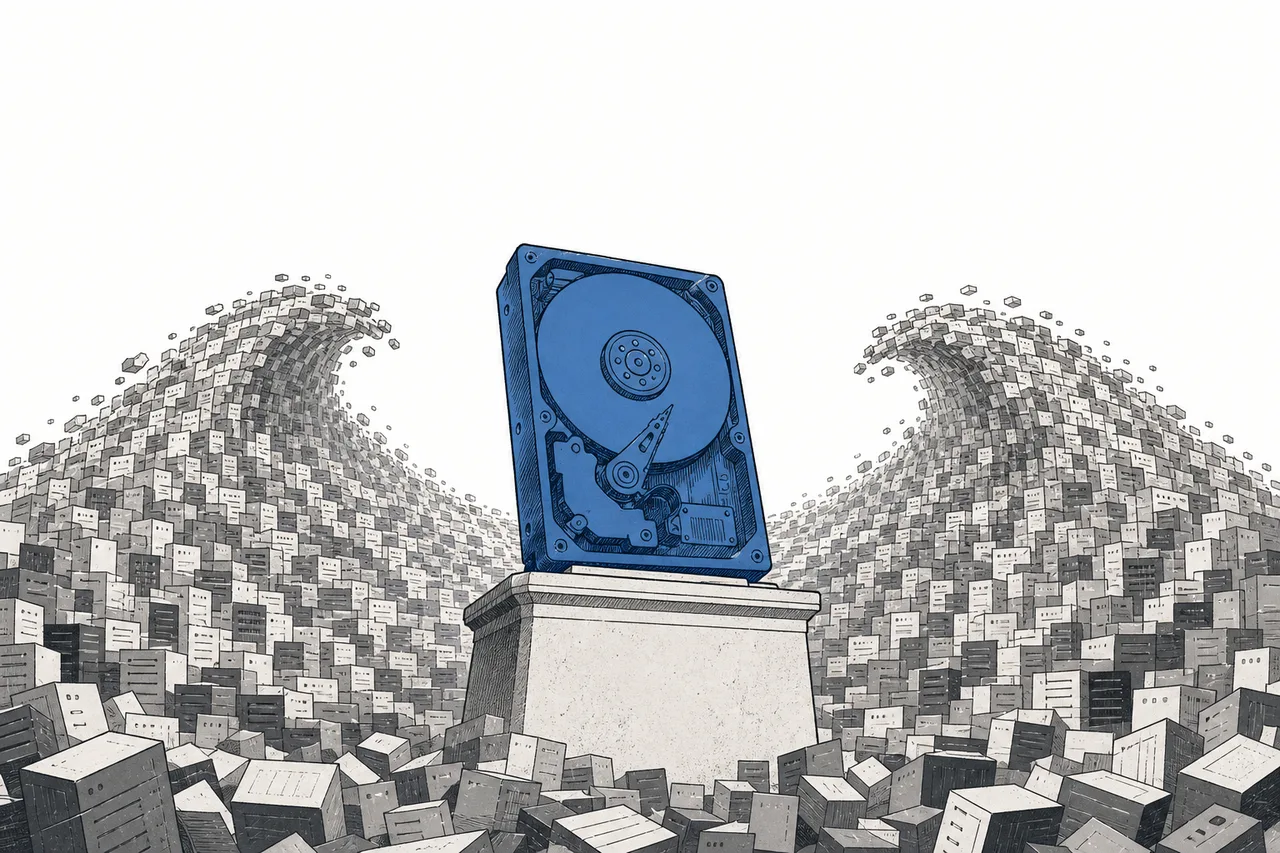
2025–2026 is the "rebirth" period for storage after a long stretch of slow growth. Both the flash and HDD sides are setting records at the same time, and a rare thing has happened: SSD got so scarce that the "cheap stuff" — HDD — came back as the hero.
The numbers tell it clearly. The price per unit of capacity of enterprise SSD versus HDD used to be about 5–6x apart in mid-2025. But once AI soaked up all the NAND chips, that gap widened to more than 20x by early 2026. The result: data centers swung back to using HDD for big blocks of data, saving pricey flash only for the jobs that truly need speed.
On the HDD side, it's a real boom — shipments of high-capacity (nearline) hard drives for data centers nearly doubled year over year, and are expected to compound at roughly 23% a year through 2028. Both Seagate and Western Digital saw revenue jump ~31–41%, with over 85–90% of the business coming from cloud and AI customers. Production capacity is booked out through the end of 2026.
The flash and whole-system side is buzzing too. Each market leader has a different strength: some are pure-play flash players chasing down HDD in the data center, some are giants selling "the whole data center," and the hottest of all are new private companies born specifically for AI.
06The road ahead
The first direction is storage getting "smart" and binding tighter to AI. Instead of just a storage box, new-generation systems are designed with feeding the GPU as the main mission — fast at several TB/s, supporting GPUDirect, and handling the terabyte-scale "checkpoints" of giant models each time. Companies that do this well (like VAST and Pure) become an infrastructure layer AI customers can't do without.
The second direction is tiering getting even sharper. Flash takes on more and more of the "hot" work (and starts nibbling at the high end of the HDD market, as the Pure–Meta deal signals), while high-capacity HDD locks in the role of the cheap "cold warehouse" for the data lakes AI keeps generating — both have a place, just with clearer, more distinct jobs.
The third direction is the business model shifting to a service (subscription). Customers would rather "rent capacity" than buy a big system all at once, so makers increasingly sell it as an ongoing service — you can see it in Pure's ARR hitting ~$1.7B and NetApp's cloud revenue growing 43%. That kind of steady revenue makes a "boring" business attractive to investors again.
07Challenges & risks
The appeal of AI-era storage comes with risks baked deep into the nature of this business.
The first risk is commoditization. Strip out the software, and a storage system is just a "box of chips" anyone can build. So the competition drops to price, and margins get squeezed easily. The survivors need superior software (managing data, compressing it, feeding GPUs well), not just hardware — sell an empty box and a price war grinds your margins thin.
The second risk is cloud cannibalization. AWS, Azure, Google, and other hyperscale cloud players increasingly design their own storage and pull enterprise data-storage work into the cloud — becoming both a huge customer of and a rival to traditional system makers. The more organizations move data to the cloud, the more the "buy-and-install-your-own-system" market shrinks.
The third risk is the flash-and-HDD price cycle. This business is tied to NAND chip and magnetic-platter prices, which rise and fall in cycles. Right now shortages are pushing prices up (good for makers, pricey for customers) — but if capacity ever catches up or AI demand cools, prices can dive fast, and the glut cycles the memory industry hits periodically come back around.
In short: enterprise storage is the story of the most boring part of the data center suddenly becoming the "stomach" that decides whether hundred-thousand-dollar AI chips work at full tilt or sit there starving. Both old hard drives and new flash going into shortage at the same time is the signal that, in the AI era, "where you keep data" is no longer back-room gear — it's part of the machine that drives everything.