Megatrend · Semiconductors
From a boring commodity chip to a battlefield AI can't do without
Memory used to be the most 'boring and brutal' business in chips — sold as a commodity, with prices swinging so hard the industry lost money in cycles. Then AI changed everything, especially a special kind of memory called HBM that let a smaller company, SK Hynix, topple the old champion and pushed the whole industry into a 'supercycle' that could run through 2028.
01What it is (3 types of memory)
Every computer — from a phone to an AI server — needs two different kinds of 'place to keep data.' Picture working at a desk: you need a 'work desk' to grab things and work fast, and a 'filing cabinet' that holds a lot but is slower to reach. This node is about both — plus a 'special desk' for AI.
- DRAM (the work desk): very fast, used as the chip's temporary workspace, but the data vanishes when you power off — every time you open an app it loads onto DRAM
- NAND (the filing cabinet): permanent storage (SSDs, your phone's storage), high capacity and cheaper per unit, but slower than DRAM and it keeps data when powered off
- HBM (the special desk for AI): really just DRAM 'stacked' vertically and placed right beside the AI chip to feed it data at extreme speed — the star of this lesson
DRAM (including HBM) is 'volatile' — fast, but the data is lost without power · NAND is 'non-volatile' — slower, but it keeps data even when powered off. That's why every device needs both: DRAM to work fast, NAND to store the real thing.
On the megatrend map, this node sits under Semiconductors. Its definition is clear — 'commodity-plus memory, with HBM as the premium layer that's in shortage because of AI' — and that's the heart of the whole story.
02Why the boring stuff turned to gold
For decades memory was seen as the 'rice' of the chip world — same standard, anyone can make it, so they competed purely on price. The result was a brutal boom-bust cycle: floods of profit in good times, selling below cost and billions in losses in bad ones (as happened in 2022–2023).
But AI changed the equation, because large AI models are 'hungry for memory' like never before — in both volume and speed. HBM demand grew wildly: +150% in 2023, over +200% in 2024, and another ~70% in 2025. The HBM market is growing from $38 billion in 2025 to $58 billion in 2026.
The result shocked the industry: in Q4 2025 the leading memory makers' gross margins were higher than TSMC's — something that almost never happens. The 'boring stuff' became the most profitable business in chips overnight.
03What is HBM — a deep dive
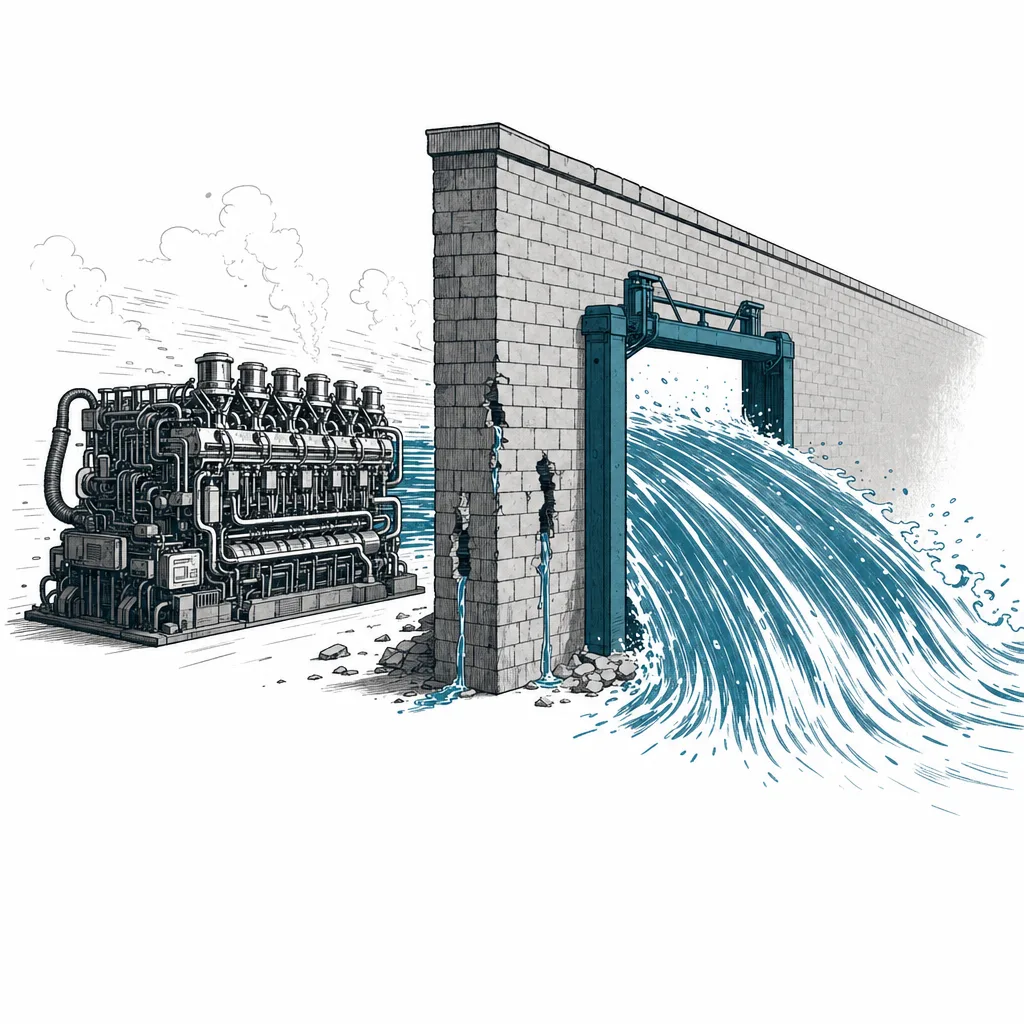
To understand why HBM matters so much, you first have to understand the problem it solves: the 'memory wall'.
A modern AI chip can compute on the order of a trillion times a second. But the problem is — it spends more time 'waiting for data' than waiting to compute, because conventional memory (DDR) can't feed it fast enough. It's like having an F1 engine but feeding the fuel through a coffee straw. The real power is bottlenecked at 'how fast you can feed the data.'
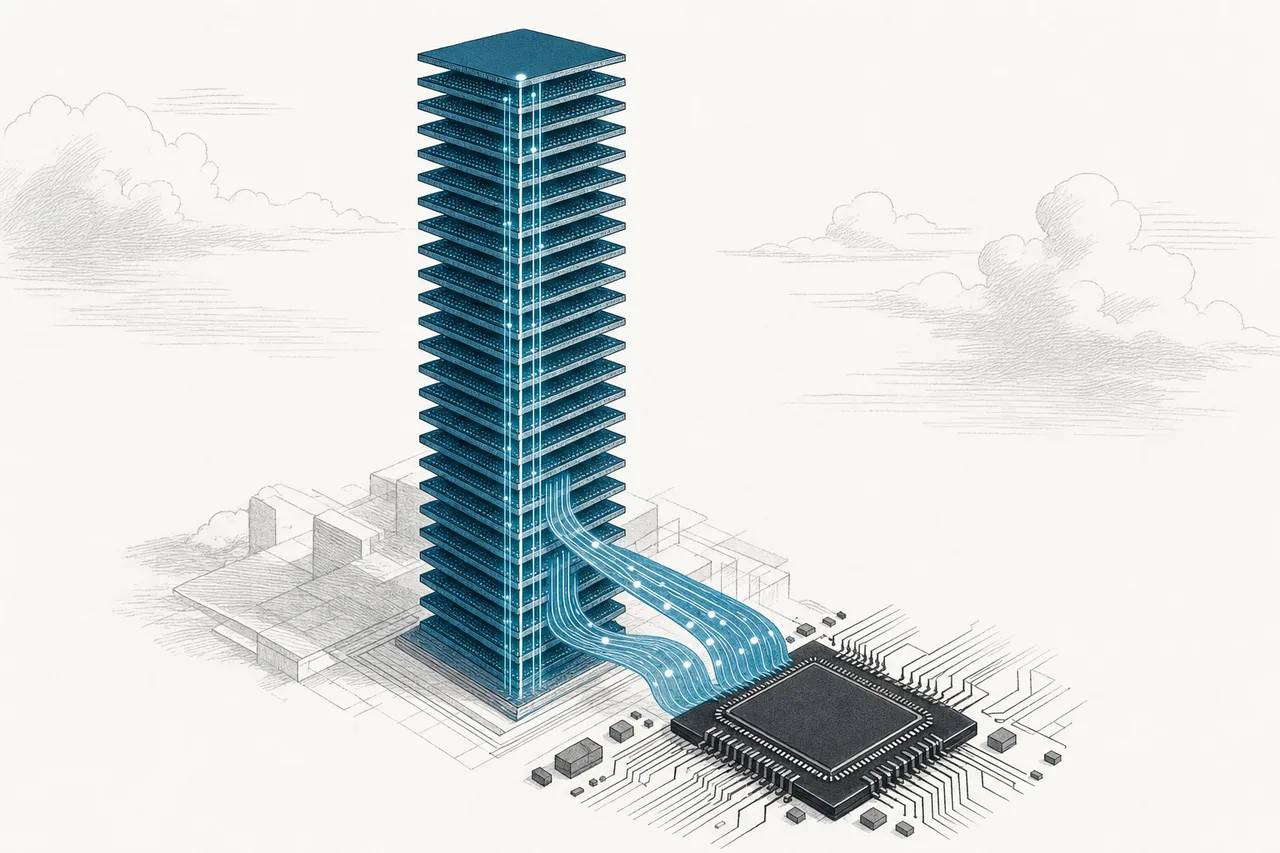
HBM solves this with an idea that's simple but very hard to build: instead of laying memory chips out on a board and running long wires, you 'stack' DRAM vertically (8–12 layers, or more), drill connections through every layer with a technique called TSV, then place that stack right beside the AI chip on a connecting sheet (interposer) — making the data path short and enormously wide.
The result is a leap in speed. Ordinary DDR5 memory moves about 50 GB/s per channel, but HBM3E does over 1,000 GB/s (1 TB/s) — roughly 20× faster, while using less power per bit.
TSV (Through-Silicon Via) = drilling tiny holes through silicon and filling them with conductive metal to connect stacked DRAM layers vertically · Interposer = a silicon sheet that acts as a 'bridge,' placing the GPU and HBM side by side — this is where the world of memory meets chip packaging (the CoWoS of a Foundry).
04The most brutal cycle in the industry
Before getting excited about HBM, you have to understand this business's 'raw nature.' Memory is an oligopoly (a market with few players) — global DRAM is held by just 3 companies (Samsung, SK Hynix, Micron), together over 95%. But even with few players, prices swing violently, because the product is a single standard and everyone tends to expand capacity together in the upturn, then face a glut together in the downturn.
This cycle is so brutal that in the latest round (2022–2023) makers had to sell chips below cost, taking huge losses, before recovering in 2024–2025. The biggest question for investors now is: 'Is this time really different?'
The reason many believe 'this time is different' is that AI is creating structural demand like never before — not just a normal cycle. Add that makers, burned by the last round, are cautious about expanding capacity, so the tightness lasts longer. Some even see this supercycle running through 2028 — but the cautious warn that 'every time in history someone said this time is different, the cycle always came back.'
05What it connects to, and why things get pricier
This node connects deeply to other trends:
- Powers the heart of AI: no HBM, no modern AI chip — HBM is the indispensable partner of every GPU
- Meets Foundry at packaging: HBM has to be assembled with the GPU using CoWoS, so the HBM bottleneck and the chip-packaging bottleneck are intertwined
- Sits on Interconnect & substrate: it all rests on an interposer and an advanced substrate
- Depends on key raw materials: high-quality silicon wafers and specialty chemicals
But the impact ordinary consumers actually feel comes from a phenomenon called the 'DDR5 squeeze'. Making HBM eats about 4× the capacity (wafers) of ordinary DRAM per unit of capacity. So when makers pour into the higher-margin HBM, the DRAM capacity for phones and PCs shrinks.
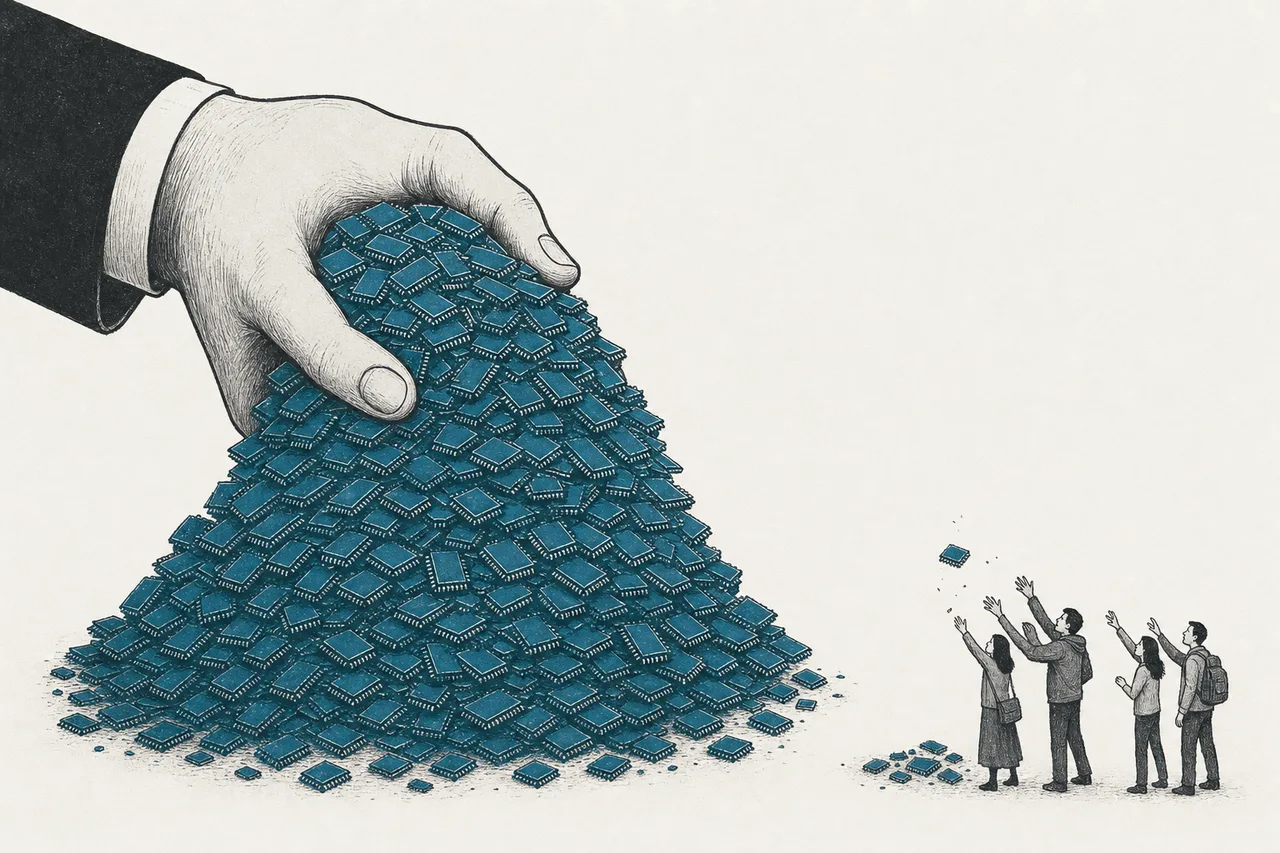
As a result, ordinary DRAM prices have surged and are expected to push up consumer-product prices — one estimate says 2026 phone prices could rise about 14%, partly because of memory costs. This is a rare example of a deep B2B trend (AI buying HBM) reaching ordinary people's wallets directly.
06The battle for the throne (2025–2026)
This is the most dramatic part. For decades Samsung held the memory throne unchallenged. But HBM upended everything — Samsung's HBM failed NVIDIA's quality tests, while the smaller SK Hynix partnered with NVIDIA first and became the runaway HBM leader.

The numbers tell the story — in Q2 2025 SK Hynix held 62% of the HBM market, while Samsung fell from 41% (mid-2024) to just 17%. And America's Micron, which had almost no HBM share a few years ago, surged to 21%, passing Samsung.
The HBM win shook the whole board — SK Hynix rose to lead the overall DRAM market for the first time, and most importantly out-earned Samsung in annual profit for the first time in history in 2025.
Prices exploded at the same time. The standard DDR5 chip price jumped from $6.84 (Sep 2025) to $27.20 (Dec 2025) — nearly 4× in three months.
Another player to watch is China — CXMT (DRAM) and YMTC (NAND) are catching up hard, even under sanctions. YMTC pushed its NAND share to 13% and targets 15% by 2026. CXMT, though about 3 years behind on technology, is racing to make DDR5 and will drop the older DDR4 by mid-2026 on Beijing's orders — which will roil the low-end market further.
07The road ahead
The first direction is HBM4 and 'custom HBM'. The HBM4 standard (out in 2025) doubles the bus width (2,048 bits), and NVIDIA plans to use up to 8–16 HBM stacks per new chip. Beyond that, next-gen HBM will start being 'custom-designed' for each customer's chip — shifting from a standard product to one tied more to the customer, which may make it less of a commodity.
The second direction is the cycle question. If AI demand stays strong and makers keep capacity in check, the supercycle could run to 2028. But if everyone rushes to expand at once (as always in the past), supply could glut and prices fall fast — the variable that decides the whole group's profits.
The third direction is China's push into the low end. While the big 3 pour into high-end HBM, China (CXMT/YMTC) is taking the low end (DDR4, commodity-grade NAND), which could pressure commodity prices and profits long term — both an opportunity (pricier at the high end) and a risk (cheaper at the low end) at once.
08Challenges & risks
Memory's appeal comes with risks baked into its DNA.
The first and eternal risk is the 'cycle'. This is a business where profit can swing from hugely positive to hugely negative in a few quarters. Every time the market believes 'this time is different,' history warns the cycle never goes away — the question is just 'when,' not 'whether.' So investing here is about reading the cycle, not buying at peak good news.
The second risk is dependence on HBM and a few customers. The leaders' big profits today are tied to AI demand and a few main customers (especially NVIDIA). If AI investment slows, or chip architectures change how memory is used, this concentration risk grows clearer. And Samsung's lesson warns: 'today's leader can fall by missing a single technology generation.'
The third risk is China and the low end. As CXMT/YMTC catch up on commodity grades, the low-end price war will intensify, pressuring commodity profits and possibly creating a glut in some segments even while the high end stays tight.
In short: Memory is the story of the component once seen as the most boring, that suddenly became one of the most important battlefields of the AI era. That a smaller company toppled the old champion with a single technology (HBM) is a lesson that in tech, size doesn't guarantee victory — and understanding how 'memory' became a scarce good that sets the price of the phone in your pocket is understanding why this once-boring node became one of the most closely watched of the era.