Megatrend · Biotech & Genomic Medicine
Fixing a disease at its “source” — rewriting the letters in your DNA, one at a time
Almost every drug we've ever swallowed or injected just “manages” a disease. Gene & Cell Editing takes a different road — it goes in and fixes the error in the genetic code that causes the disease in the first place. Do it once, and you're aiming for a cure. This is the very top of the “ladder of treatments,” and in 2023 it crossed the line from dream to a real, first-of-its-kind drug: Casgevy.
01What is gene editing?
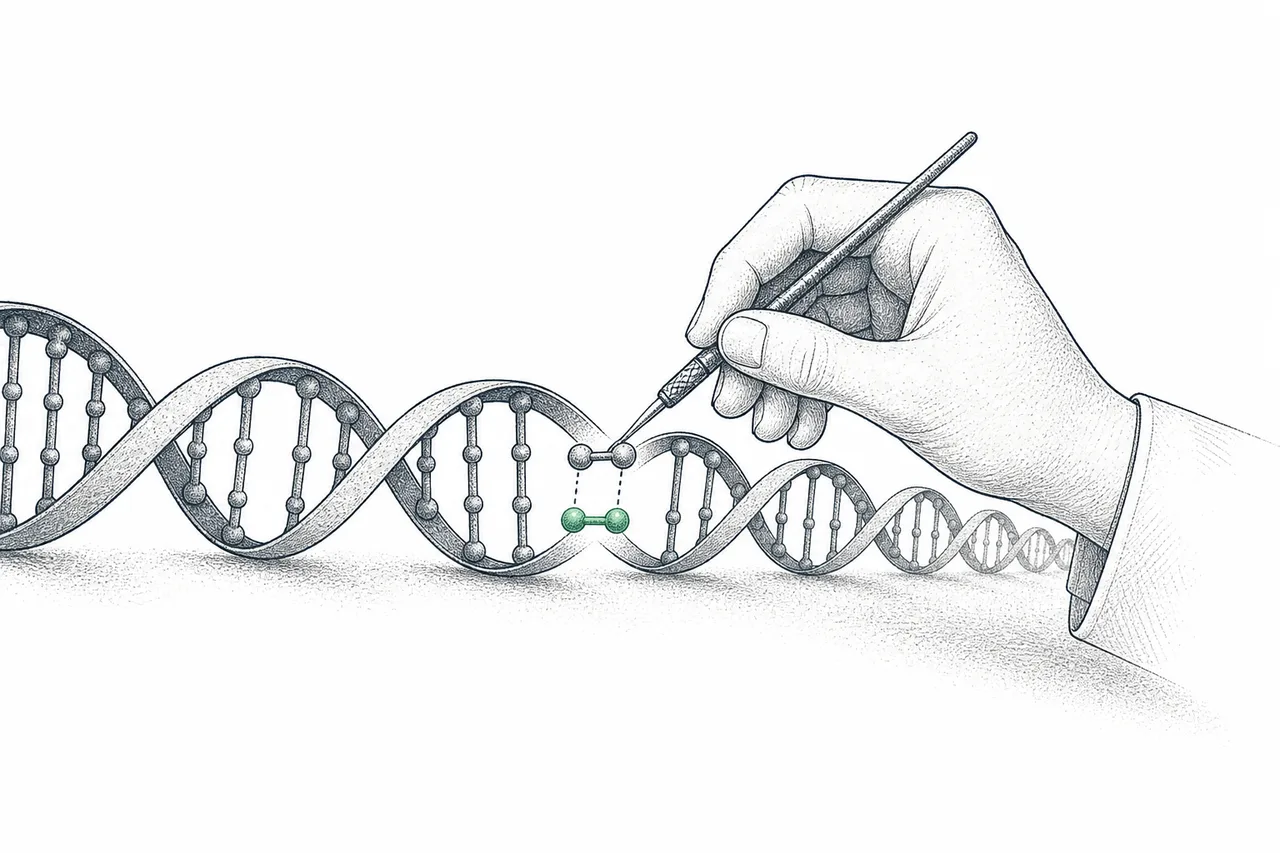
Picture your body as one enormous book, written in just four letters (A, T, C, G) strung together about 3 billion times — that's your DNA, the blueprint of life. Many genetic diseases, like sickle cell anemia, come from a single one-letter “typo” in the whole book — and that one letter is enough to make someone suffer for life.
An ordinary drug can only “manage the symptoms” of that error — like slapping a piece of tape over the misspelled word, day after day. Gene & Cell Editing does something completely different — it goes in and deletes and corrects the wrong letter in the original book directly. Do it once, and the cell passes on the corrected version from then on. The principle is simple: “treat the cause, not the symptom.”
Old-school gene therapy “adds” good genes to a cell — like sticking a new sticky note over the old text. The newer gene editing (CRISPR and friends) goes in and fixes the original letters at the exact spot, far more precisely. In this lesson we treat both as “treatment at the genetic-code level,” but the heart of this era is to fix, not just add.
On our megatrend map, Gene & Cell Editing is a sub-theme under Biotech & Genomic Medicine, and it sits at the very top of the “modality ladder” — the goal isn't to take a pill every day for the rest of your life, but “one shot, then cured.”
02Why it matters — treating diseases we never could before
The reason the whole field is buzzing comes down to one word: “curative.” There are more than 7,000 genetic diseases with a clearly known cause, and most still have no treatment that addresses the root. The old drugs only prop up symptoms, and patients live with it for life. Gene editing offers an option that used to be pure science fiction — fix it once, done.
And it's no longer just theory. In December 2023, the US FDA approved Casgevy — the world's first drug that uses CRISPR to edit genes, treating sickle cell disease. In the trial, 29 of 31 patients had zero severe pain crises (vaso-occlusive crisis) for 12 straight months — for a disease that used to land people in the hospital again and again their whole lives, that's life-changing.
The second reason is money. The whole cell & gene therapy market sits at roughly $14B in 2024, and most analysts expect it to leap to $80–105B by the early 2030s, at a very high compound growth rate (about 20–30% a year, depending on the firm). This is one of the few corners of the drug industry still growing at high double digits.
But what really changes the “world” isn't the market number. It's a new definition of the word “cured” — if a genetic disease that has haunted a family for generations can be cut off in a single generation, its human value is beyond any number.
03How it works — “scissors” that find their own cut site
The heart of this technology is CRISPR-Cas9, which is actually borrowed from a bacterium's immune system. It's made of two parts that work together cleverly: a “guide” (guide RNA) and the “scissors” (the Cas9 protein).
Think of the guide RNA as the “address” — a short strand of RNA designed to pair with one specific stretch of DNA letters, carrying everything to the exact wrong spot in that 3-billion-letter book. Then Cas9 acts as the scissors, cutting both strands of the DNA at that point. When the DNA breaks, the cell rushes to “repair” it — and scientists use exactly this repair moment to delete the broken gene, or slot in the correct one.
But “cutting” has a weakness — sometimes the cell repairs it wrong, causing unintended damage. That's where the new generation that doesn't cut at all comes in: base editing (fixing one letter at a time, e.g. changing a C to a T — like using an eraser and pencil instead of scissors) and prime editing (writing a short new code into almost any spot). Both were invented by the team of David Liu at the Broad Institute, who won the 2025 Breakthrough Prize for this work — and the field sees it as the “safer and more precise” direction.
The original CRISPR-Cas9 “cuts” both DNA strands and lets the cell repair them · Base editing uses a Cas9 made “unable to cut” to dock at the spot, then a chemical enzyme converts a letter one at a time without cutting · Prime editing uses a special guide (pegRNA) that “carries the correct copy” and writes it in at the spot without a double-strand cut — the most flexible of all the techniques.
04Two ways to get the “scissors” into the body: outside the body vs inside the body
You've got precise scissors. The next problem is — how do you get them all the way to the cells you need to fix? This is where the industry splits into two big camps, and it's the key to understanding this whole category.
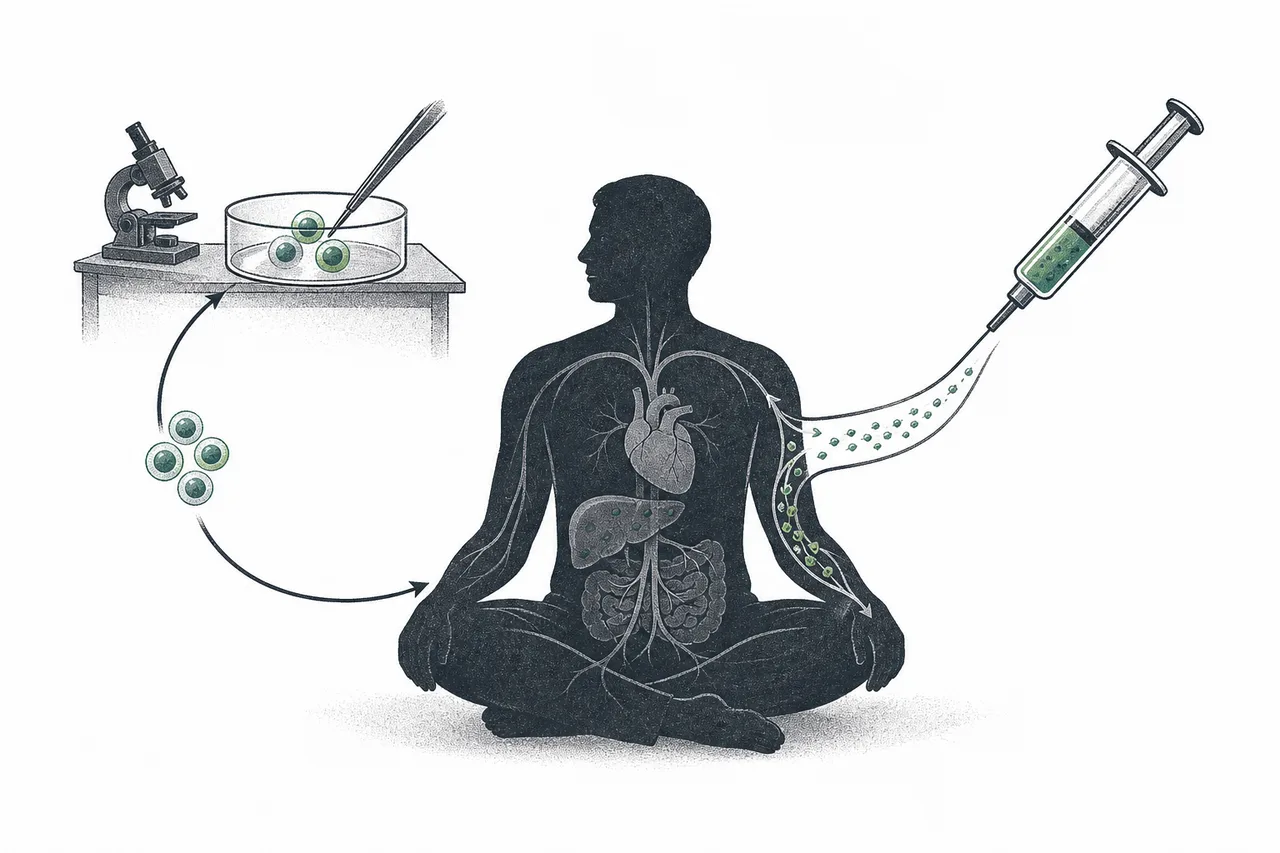
Method one — editing outside the body (ex-vivo): doctors draw out the patient's cells (e.g. blood stem cells), edit the genes in a fully controlled lab, then put them back. Casgevy uses this approach — it's more precise and safe because the editing happens in a “dish,” not inside the person. CAR-T, which treats blood cancers (like Novartis's Kymriah and Gilead's Yescarta), is a cousin of this method — take immune T-cells out, “re-engineer” them to hunt cancer, then put them back.
Method two — editing inside the body (in-vivo): inject the gene editor straight into the bloodstream and let it travel to the target cells on its own (often the liver). This is the “holy grail” — if you can pull it off, it becomes just a “shot,” much cheaper, with no surgery and no complex lab. Intellia is the pioneer here, the first to show the world that injecting CRISPR into the body really can edit genes in the human liver.
05Where it sits in the ecosystem
Gene & Cell Editing is a “platform” — not a drug for one disease, but a tool you can point at any disease where you know which gene is broken. That's what lets it branch out and overlap with other corners of Biotech in interesting ways:
- The core tool for Rare Disease: most rare diseases come from a single broken gene — a “dream target” for gene editing, since fixing one spot might treat the whole disease. So these two fields grow together
- Reshaping Oncology (cancer): CAR-T, which re-engineers immune cells to hunt cancer, is the most advanced branch of cell editing, and it's now moving from blood cancers toward solid tumors
- A cousin of RNA Therapeutics: both work at the genetic-code level, but RNA edits “temporarily” (you have to re-dose) while DNA gene editing aims for a “permanent,” one-time effect — two sides of the same coin
- Overlaps with Regenerative Medicine: gene-edited cells often rely on the same cell-culturing and transplant technology as regenerative medicine
And on a broader view, it also leans deeply on AI — designing guide RNA precisely, so it doesn't cut the wrong spot (off-target), takes massive genome analysis, and AI is now coming in to speed that up and cut the risk.
06Where it stands now
The 2025 picture is “proven it can be done, but still hard to scale.” Across cell & gene therapy overall, the FDA has already approved about 45, and the FDA itself is targeting 10–20 more a year — a sign the whole category is entering its “actually on the market” phase, not just research.
But the honest truth is access is still very slow. Casgevy, the flagship, takes about 6 months per person just to edit the cells, and it has to be done at specialized centers. The result: by mid-2025, only about 90 patients worldwide had started treatment — showing that even when a “cure” is genuinely possible, the road to the patient is still long and expensive.
On the technology side, 2025 was the year in-vivo met both hope and a hard lesson. Intellia was running a Phase 3 trial of a liver gene-editing drug (nex-z) to treat ATTR amyloidosis — one of the world's first in-body gene-editing trials to reach Phase 3. But in October 2025, the FDA ordered a “clinical hold” after one patient had a severe spike in liver enzymes — a clear warning that injecting the editor straight into the body still has things to watch for.
Meanwhile, the newer techniques have also reached human trials: Beam Therapeutics is testing base editing in both sickle cell disease (BEAM-101) and a genetic liver disease (BEAM-302), while Prime Medicine is pushing prime editing into the clinic — meaning the “fix without cutting” techniques that used to live only in the lab are now being tested in real people.
07The road ahead
The first and most important direction is solving the “delivery” puzzle. Today the editor reaches the liver fairly well (because the lipid nanoparticles, LNP, that carry it tend to pile up in the liver on their own). But delivering it to other organs — brain, muscle, lungs — is still a brutal problem no one has cracked. Whoever finds a way to “aim” the editor at the organ they want opens the door to thousands more diseases.
The second direction is moving from ex-vivo to in-vivo. If in-body gene editing gets safe enough, it turns a treatment that needs surgery-lab-and-a-6-month-wait into “one shot at a clinic” — cutting both the price and the complexity. This is the road Intellia and Beam (through new in-vivo platforms) are walking.
The third direction is the “second generation” replacing the “first”. Base editing and prime editing, which don't cut DNA, look set to gradually replace the original cut-style CRISPR, because they're safer and more precise — like upgrading from “scissors” to a “correction pen.”
08Challenges & risks
The picture of “curing for good” is beautiful. But there are four walls we have to be straight about.
The first is the harshest: price. Gene-editing drugs are priced at $1–3M per dose (Casgevy sits at ~$2.2M). Even though it's “one and done,” that's a huge sum insurers and governments have to pay up front, while it's still unclear whether the effect truly lasts forever — which creates a “how do we pay for this” problem with no settled answer.
The second is delivery — the hardest problem. As we said, getting the editor to target cells outside the liver still doesn't work well. As long as delivery is the bottleneck, most diseases stay out of reach.
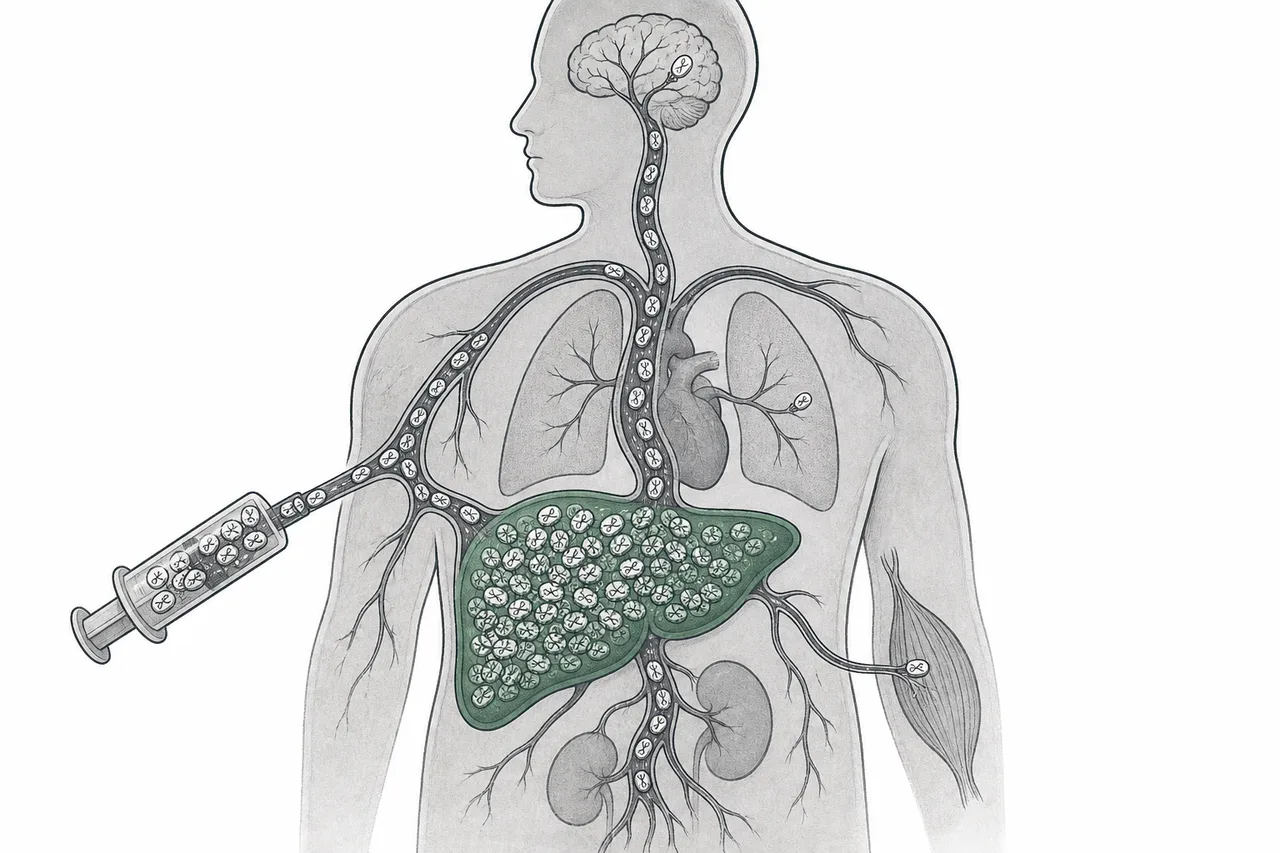
The third is safety and permanence. Cutting the DNA at the wrong spot (off-target) could cause long-term problems we don't yet understand, and the 2025 Intellia case — where the FDA halted the trial over high liver enzymes — is a reminder that injecting the editor straight into the body “can't afford to miss,” because once it's edited, it's edited, with no going back.
The fourth is business risk. Most of the real players in this arena are clinical-stage companies that aren't profitable yet. Their stock swings hard on every trial result — good news can double it, an FDA hold can cut it in half in a single day. This is an arena where “world-changing technology” and “very high risk” live in the same place.
In short: Gene & Cell Editing is the story of humans, for the first time, actually being able to “edit the original book of life.” Casgevy proved it can be done. But the road from “can be done” to “done cheaply, safely, and for everyone” is still long — and that's exactly the biggest risk and the biggest opportunity of this trend.