Megatrend · Biotech & Genomic Medicine
What if you could repair a broken organ — instead of taking pills to manage it for life
Almost every drug we know is about "managing symptoms." But one field asks a much bigger question — what if we could grow new cartilage, skin, blood vessels, even whole new organs to replace the ones that fail? This is the story of a dream that ran decades ahead of itself, and the real wins that are only now starting to take shape this year.
01What is Regenerative Medicine?
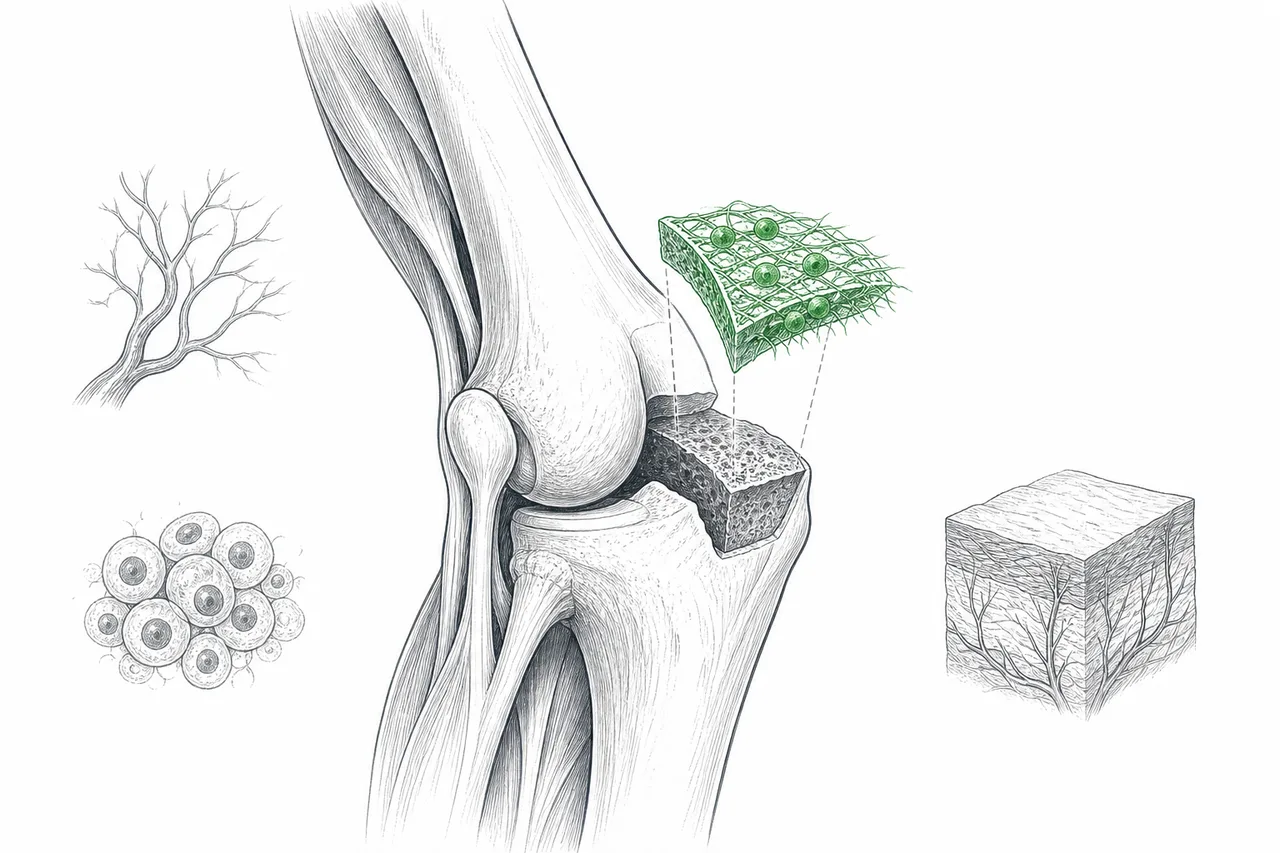
Picture an athlete whose knee cartilage has worn through — walking hurts, running is out. The old options were just two: take painkillers and manage it, or wait until it's fully gone and replace the joint with an implant. But there's a third path: take a tiny piece of his own cartilage cells, grow them in the lab to multiply, then put them back so they build new cartilage on their own. This isn't science fiction — it's a drug called MACI that doctors use to treat real people today.
That's the heart of Regenerative Medicine and Tissue Engineering: instead of giving a drug to "suppress" the symptoms of a damaged organ, the goal is to actually repair or rebuild that tissue — skin for burn victims, cartilage for knees, blood vessels for torn wounds, all the way up to the ultimate dream of growing a whole liver or kidney in the lab.
Almost every drug we're familiar with is to medicate — add a substance to suppress symptoms, reduce inflammation, control blood sugar. But the failing organ is still failing. To regenerate is to make that tissue "grow back," or be replaced by something genuinely alive. The goal isn't to live with the disease — it's to make the disease disappear because the organ works again.
On the megatrend map, Regenerative Medicine is a sub-theme under Biotech & Genomic Medicine. It differs from siblings like Gene & Cell Editing in that the latter focuses on "rewriting the genetic code" of cells (cutting and splicing DNA), while this field focuses on "repairing and building tangible tissue" — sometimes the two meet, but their starting questions differ. One fixes the blueprint; the other builds the building.
02Why it's such a huge bet
The reason so much money and hope pour into this field comes down to a single picture: hundreds of thousands of people are dying because there aren't enough organs. In the US alone, around 103,000–107,000 people are stuck on the organ transplant waiting list. Nearly 94,000 of them are waiting for a kidney, and every day about 17 people die while waiting — because donated organs are never enough.

Even though 2024 set a record with 48,149 transplant surgeries, demand still runs several lengths ahead of supply. This problem can't be solved by more donations — fewer than 1% of people die in a condition where their organs can be donated. As long as we depend on organs from other people, there will always be a shortage. The only way to truly lift this ceiling is to "manufacture organs ourselves."
The second reason is money. The global Regenerative Medicine market in 2024 was around $42–44 billion, and nearly every research firm expects it to grow at an unusually high rate — about 20–25% a year, breaking $95–150 billion by the early 2030s. Few areas of medicine grow this fast (ordinary drugs grow in single digits) — because it doesn't just take share from existing drug markets, it reaches a problem no one has been able to solve.
But let's be honest up front: most of these pretty numbers lump together a large, fragmented market (cell therapy, gene therapy, wound-care products). What's actually "selling" today is far narrower than the promise — and that's the full story we're going to tell.
03How it works: cells + scaffold + signals
The basic recipe of tissue engineering always has three ingredients, whether you're growing skin, cartilage, or an organ. Think of it like growing a plant — you need a seed (the cells), soil and something to climb (the scaffold), and water and fertilizer (the growth signals).
- 1. Cells: these can be the patient's own cells (like MACI taking his cartilage to grow) or stem cells — starting cells that haven't decided what to become, which we then prompt to turn into the cells we want
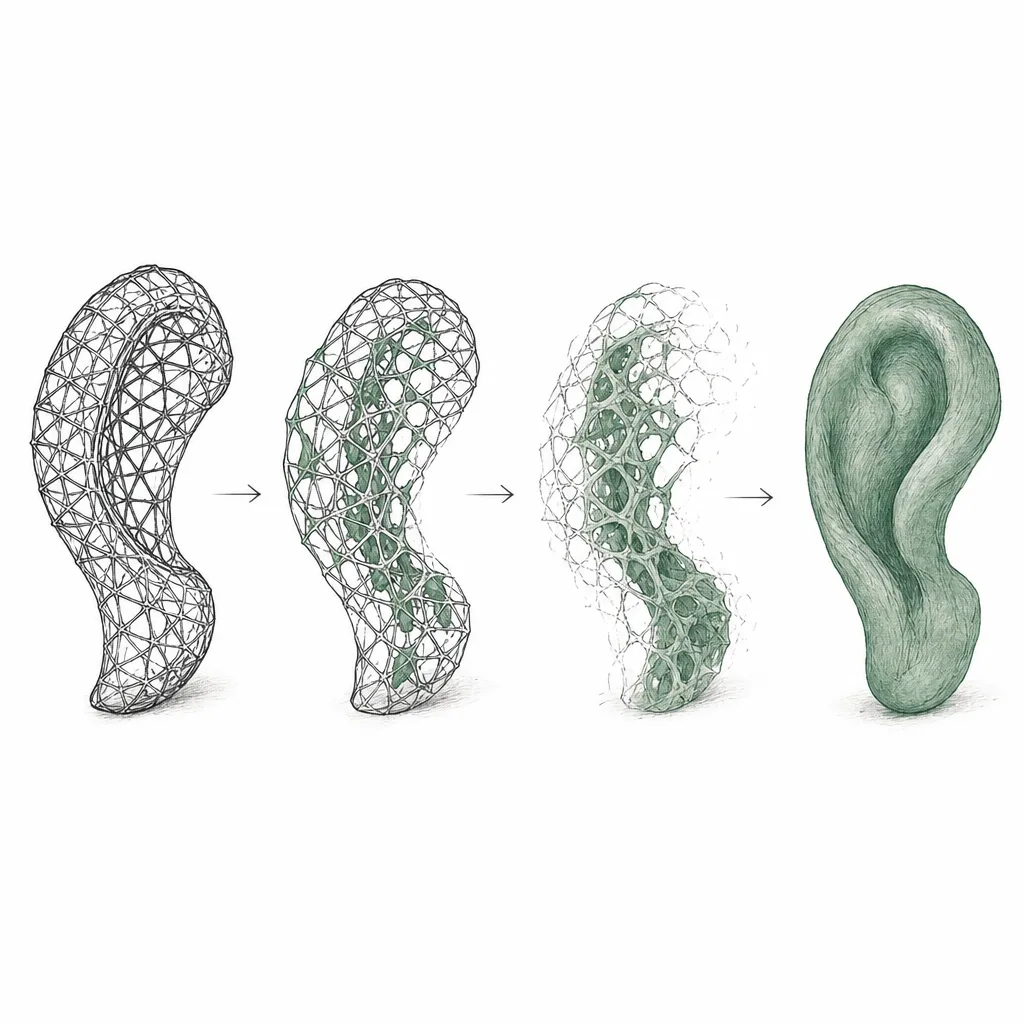
- 2. Scaffold: a three-dimensional structure, often made of collagen or biodegradable material, that acts as the "scaffolding" for cells to attach to and arrange into the correct shape
- 3. Growth signals: proteins and stimulants that tell the cells to divide, to build tissue, and how to line up
Put the three together in the right environment, and the cells gradually build new tissue. The key trick: most scaffolds are designed to dissolve away on their own, leaving behind nothing but living tissue:
The game-changing trick of the past decade or so is iPSC — the field's most powerful "toolbox":
An Induced Pluripotent Stem Cell is an ordinary adult cell (like a skin or blood cell) that scientists "reprogram" back into a starting stem cell — like pressing a reset button so the cell returns to a child that hasn't decided what to become. From there we can prompt it to become a heart cell, a brain cell, or a liver cell. The advantages: you can make them from the patient's own cells (reducing immune rejection) and grow them without limit. This discovery won the 2012 Nobel Prize, and today it's the heart of almost every dream of "growing an organ."
04Where it sits in the Biotech ecosystem
Regenerative Medicine is one of the sub-themes of Biotech & Genomic Medicine, and there's a confusing overlap with its neighboring siblings — especially Gene & Cell Editing. The simple dividing line: if the main job is "rewriting a cell's DNA code" (editing genes to treat genetic disease or to build cancer-hunting immune cells), that's the gene-editing side. But if the main job is "building or repairing tangible tissue" — skin, cartilage, blood vessels, organs — that's this side. Sometimes the two work together (using gene editing on stem cells before implanting them), but their starting questions are clearly different.
Seen through a wider megatrend lens, it tangles with other trends in logical ways:
- Powers the dream of Longevity and connects to aging societies: the older you get, the more your knees wear out, your heart weakens, your organs decline. "Replacing the parts" of the body is one of the most important tools for extending its working life — if you can swap out worn cartilage or damaged heart muscle, aging changes meaning
- Depends on AI: designing three-dimensional scaffolds, simulating how cells will arrange, and controlling the quality of each batch of "grown tissue" all require enormous computation. AI is stepping in to shorten research time and make manufacturing more consistent
- Shares a manufacturing base with other Biotech fields: companies good at culturing living cells in bioreactors (the same skill used to make biologics and Biosimilars) can often extend into the tissue arena, because keeping cells alive and pure is the shared core
05Where it stands now
This is the most important chapter, because to truly understand this field you have to separate two things: "the real thing that's already selling" versus "the promise that's still research."
Today's real thing is still very narrow. The commercial wins that actually make money cluster around "easy" tissue — thin, flat tissue that doesn't need a complex blood supply, like knee cartilage and skin for burn victims. The most concrete player is Vericel, a "pure-play" that's genuinely profitable — MACI (growing knee cartilage from the patient's own cells) brought in about $197 million, and the burn-wound-care business (Epicel cultured skin + NexoBrid) about another $40 million, for a total of around $237 million in 2024, up ~20%.
On the other side is chronic wound-care products, the largest and most reliably profitable market in this group. Organogenesis has skin substitutes like Apligraf and Dermagraft (for diabetic foot ulcers and chronic wounds), bringing total revenue to around $482 million in 2024. MiMedx plays in the dried placental tissue market, also for wound healing — this group is the "real money" that sustains the field, even if it's less flashy than the words "growing organs."
But 2024–2025 brought a genuine game-changing milestone — within a few months, the FDA approved three "world-first" products, a sign the field is moving past just skin and cartilage:
Mesoblast (listed in Australia) got FDA approval for Ryoncil in December 2024 — the first stem-cell therapy (MSC) approved in the US, to treat graft-versus-host disease in children. Getting here took two prior FDA rejections — a clear picture of just how rough this field's road is, even when it eventually succeeds.
Meanwhile Humacyte got approval for Symvess — a blood vessel engineered from human tissue, used to repair severely torn vessels (with real-world evidence from the battlefield in Ukraine). And Axogen received BLA approval for Avance, nerve tissue for reconnecting severed nerves — Axogen's Q3 2025 revenue was around $60 million, up ~24%.
On the toolbox side, iPSC is making real progress too: as of late 2024 there were about 115 clinical trials of stem-cell-derived products, covering 83 products, with more than 1,200 patients having received cells and no serious safety problems found. And by the end of 2025, the FDA is expected to grant fast-track status (RMAT) to nearly 200 such therapies in total.
We rank players by role and competitive standing rather than raw market cap — because many companies in this field are still small and early-stage, so their valuations reflect expectations more than current revenue.
Notice that the real listed players are still mostly small-cap companies, and much of the most cutting-edge "organ-growing" research is still in universities and private companies that haven't gone public — this is the look of an industry still in its early stage, not a saturated market.
06The road ahead
The road ahead for this field reads like a "staircase" climbing from easy tissue to hard — and each step is an engineering wall to clear.
The step happening now is moving from flat tissue (skin, cartilage) to tubular, three-dimensional, more complex tissue — blood vessels (Symvess) and nerves (Avance) are signs this step is becoming real. Next comes thick tissue that needs blood to nourish it, like sheets of heart muscle, a small piece of pancreas, or part of liver tissue.
The top step is a whole organ grown in the lab — and here we have to be honest that it's still "research," not a "product." The technology most talked about is 3D bioprinting (printing three-dimensional tissue with an ink made of living cells), which has genuinely advanced to the level of building "mini-organs on a chip" to test drugs, but is still far from an organ you can transplant into a person.
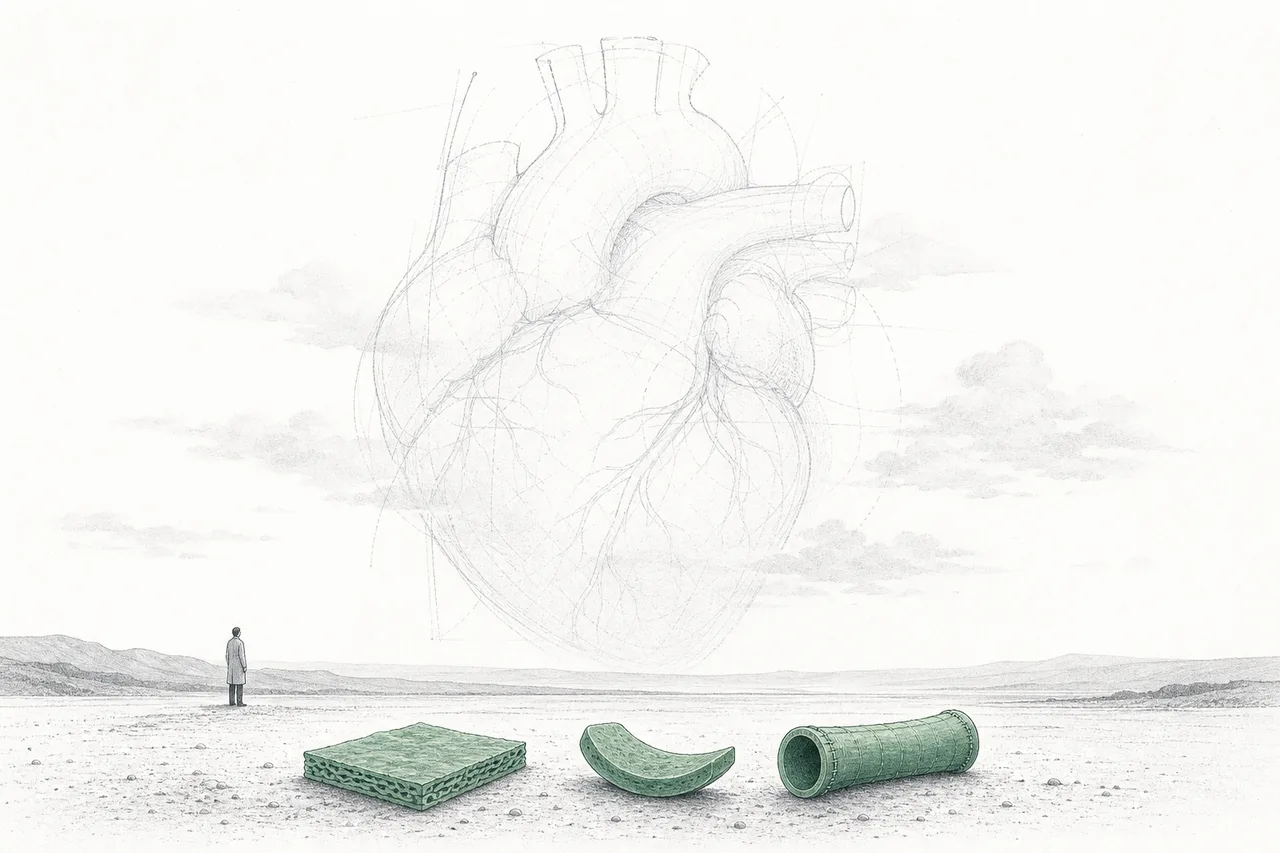
The key that unlocks the top step is one thing: vascularization — building a network of capillaries into thick tissue to deliver oxygen and nutrients so every cell survives. Without blood vessels, tissue thicker than a few millimeters dies in the middle. This is the biggest engineering wall standing between "a sheet of tissue" and "a real organ" right now.
What lets you be optimistic is that the rules are opening up. The FDA's RMAT status speeds the path to approval, and the run of first-in-class approvals in 2024 is also a sign that regulators are starting to have a clearer framework for judging these "living" products.
07Challenges & risks
This field has scars in its past worth telling honestly, and they're the most important lesson for anyone who wants to understand it.
The first risk is a history of "overpromising." This field has sold the dream of "growing organs" for decades. The most notorious case is the tissue-engineered trachea of surgeon Paolo Macchiarini, hyped in 2008 as the "world's first engineered-organ transplant," with claims that "in another 20 years, almost every organ could be made this way" — but the reality was that nearly all the patients who received this kind of trachea died, and it was eventually ruled scientific misconduct, with the Lancet paper flagged for a fabricated key result.
The lesson: when you see a headline that "scientists grew a heart/kidney/liver in the lab," always ask — is it in a petri dish, in a mouse, or in a real human? And how long does it keep working? Most of it is still very early-stage.
The second risk is manufacturing. These products are "alive" — many require each individual patient's cells, cultured one person at a time, stored at controlled temperature, and with a short shelf life. That makes them far more expensive and harder to scale than a pill. Making each batch "identical and safe" is a brutal challenge, and it's why many products, even after being proven to work, still struggle to turn a profit.
The third risk is durability and proving long-term results. How long does the grown tissue last? Will the body reject it (especially cells that aren't the patient's own)? These questions take years to answer — and the approval path reflects that difficulty, as with Mesoblast, which the FDA rejected twice before clearing it.
In short: Regenerative Medicine is one of medicine's greatest dreams — repairing the body instead of managing it. Today it's starting to have "real things" that change people's lives, from knee cartilage to blood vessels on the battlefield. But the distance from "a sheet of tissue" to "a whole organ" is still long, and full of overpromising lessons. Cleanly understanding the gap between the dream and the reality is the key to seeing through this trend.