Megatrend · Biotech & Genomic Medicine
The 70-year war on cancer — from carpet-bombing to guided missiles
Cancer drugs are the single biggest battlefield in pharma — a market worth over $220 billion a year, and the best-selling drug on Earth is a cancer drug. The way we attack tumors has evolved through four eras: from "poison the whole body" to "hit one precise target," then "take the brakes off the immune system and let it fight," and most recently the "guided missile" that delivers a toxin straight into the cancer cell. This is the story of a hunt that isn't over yet.
01What is Oncology?
Guess which drug sells the most in the world — earning more than entire large companies. Not a blood-pressure pill, not a diabetes drug, but a cancer drug called Keytruda, which earned Merck roughly $31.7 billion in 2025 — almost half the company's entire revenue, from a single drug. That's the clearest sign that cancer isn't just a disease; it's one of the biggest businesses in all of pharma.
Oncology Therapeutics is the group of cancer drugs — and it's the biggest field within Biotech & Genomic Medicine. What makes this node special is that it isn't "one drug" but several completely different ways of attacking that can't replace one another. A single patient might get chemotherapy, a targeted drug, and an immune drug all at once. So this isn't a winner-take-all market — it's an arsenal where many kinds of weapons live side by side.
"How a drug attacks cancer" — a completely different dimension from "which drug." Chemotherapy, targeted drugs, immune drugs, cell therapy, and ADCs are different modalities, each with its own mechanism, price, and risk. Because they can't substitute for each other, the cancer-drug market grows by "adding a new kind of weapon," not by discounting the old ones.
On the megatrend map, Oncology has three sub-fields that will star in this lesson — Immuno-Oncology, Cell Therapy (CAR-T), and ADC (Antibody-Drug Conjugates) — the three "new-era weapons" now replacing old-style chemotherapy. We'll tell it through a single thread: the story of how humans learned to "shoot more accurately," one step at a time.
02Why it's the biggest battlefield
The most straightforward reason: cancer still isn't beaten, and it's expensive. Tens of millions of people are newly diagnosed with cancer every year worldwide, and a course of a new-generation cancer drug often runs into the hundreds of thousands of dollars. The result: the global cancer-drug market is worth around $220 billion in 2024 and is expected to grow to roughly $470 billion in the early 2030s, at about 10–11% a year — making it one of the largest and fastest-growing drug categories in the world.
But the headline number doesn't tell the most exciting story. That story is value shifting from the old weapons to the new ones. Today the main engine is "immunotherapy" — the drug class called checkpoint inhibitors alone takes over 42% of the entire immunotherapy market, and immunotherapy in the broad sense is expected to reach ~$196 billion by 2030 (the core checkpoint-inhibitor group alone is about $154 billion), while ADCs — the "newest" weapon — are growing the fastest.
Put simply, Oncology is a field where "whoever invents the next-generation weapon first gets the treasure" — and because each generation of weapons is more expensive and more precise, the market's value doesn't fall over time, it keeps climbing. That's the opposite of ordinary drugs, whose prices collapse once the patent expires.
03How the attack on cancer evolved (4 eras)
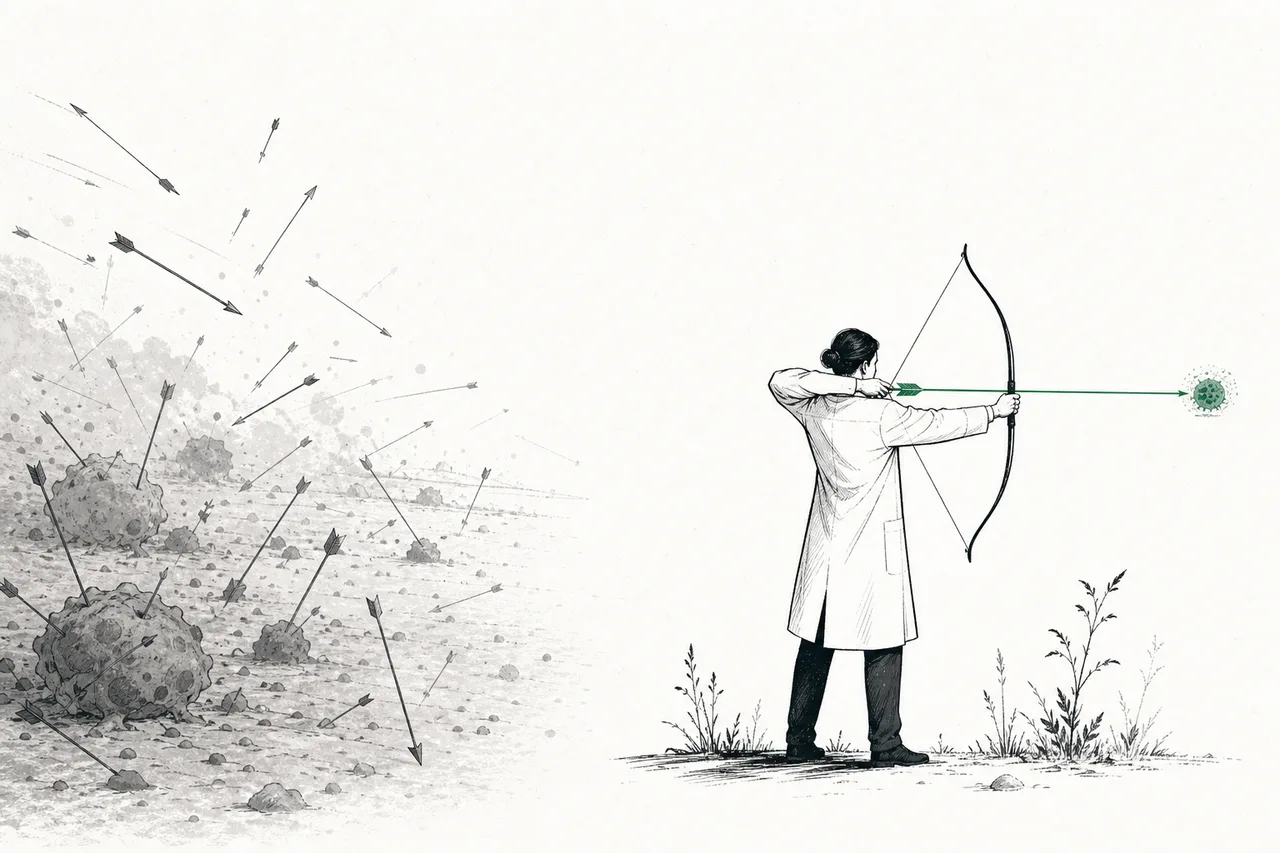
The best way to understand Oncology is to see it as a history of learning to "shoot more accurately". The trouble with cancer is that it's our own cells, mutated — not a foreign invader. Killing it without killing ourselves is extremely hard, and every "era" of cancer drugs is an attempt to solve that problem more precisely.
Era 1 — chemotherapy: the first weapon, from about 70 years ago. The principle is very simple — "kill everything that grows fast." Because cancer cells divide quickly, chemo can kill them, but it also kills fast-growing healthy cells (hair, gut lining, bone marrow) — which is where hair loss, nausea, and a weakened immune system come from. It's "carpet-bombing": effective, but brutal on the body.
Era 2 — targeted therapy: once we learned that each cancer has a "weak spot" from its own specific mutation, we could design drugs to grab just that spot — for example, a drug that targets the HER2 protein in breast cancer. It's far more precise, with fewer side effects, but it only works in patients who "actually have that weak spot" — opening the era of testing genes before choosing a drug.
Era 3 — Immuno-Oncology: this was the biggest game-changer of all. Instead of using a drug to kill the cancer, you wake up the patient's own immune system to kill it. The catch is that cancer cells are very clever — they slap on a "fake ID" that tells T-cells (the soldiers of the immune system) "I'm one of you, don't shoot." Checkpoint inhibitor drugs like Keytruda do the job of "ripping off that fake ID" — like taking the brakes off the soldiers so they see the enemy again and charge in.
The body has "checkpoints" that stop the immune system from attacking its own cells. Cancer cells hijack these checkpoints to hold T-cells back. A checkpoint inhibitor (e.g. Keytruda, Opdivo) blocks that checkpoint = takes the brakes off the T-cells. The first checkpoint drug was Yervoy (2011), and the basic research behind it won the Nobel Prize in 2018.
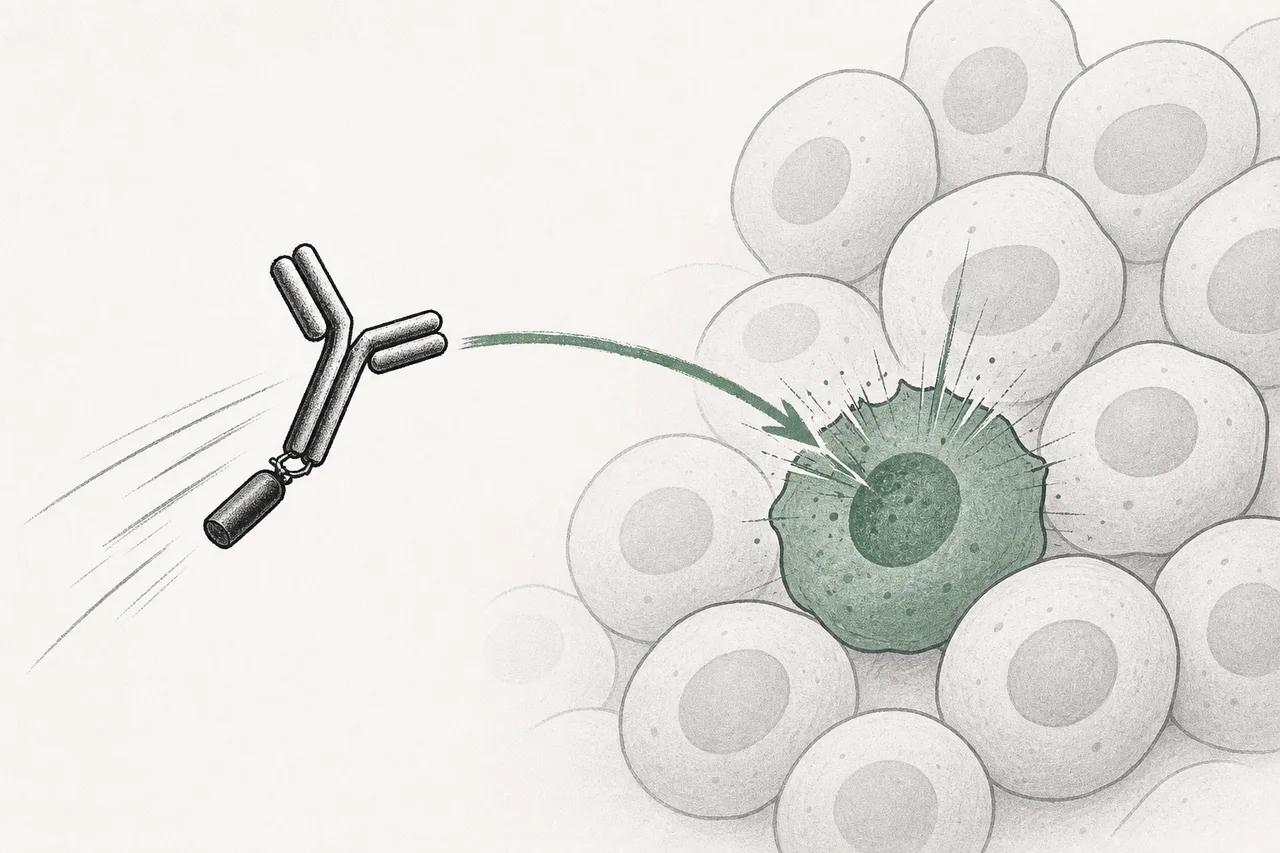
Era 4 — ADC (Antibody-Drug Conjugates): the newest and hottest weapon right now. It's a "marriage" of Era 2 and Era 1 — take an antibody that grabs cancer cells precisely (like a targeted drug) and link it to a toxin strong enough to kill the cell (like chemo, but many times stronger). The result is a "guided missile" — the antibody flies the toxin straight onto the cancer cell and releases it inside, barely touching the healthy cells around it.
These four eras didn't replace each other cleanly — they pile up in layers in the arsenal. Patients today often get several weapons at once, and this is exactly why the cancer-drug market keeps growing rather than shrinking — because we "add" weapons, we don't "swap" them.
04How it connects in the ecosystem
Oncology is the biggest field in — and the "locomotive" of — Biotech & Genomic Medicine. Research money, M&A deals, and new capabilities in pharma tend to show up here first, then spread to other fields. And within this field are three sub-fields driving everything:
- Immuno-Oncology / Checkpoint: Era 3 in our story — the main money engine today, led by Keytruda and Opdivo. It's the biggest base of all cancer-drug revenue
- Cell Therapy (CAR-T & beyond): the most extreme treatment — pull out the patient's T-cells, genetically engineer them in a lab to hunt cancer, then inject them back. It can treat some blood cancers to the point of a "cure," but a course costs hundreds of thousands of dollars and is made one patient at a time, so it's still a small market (~$7 billion in 2024) — but growing fast
- ADC (Antibody-Drug Conjugates): Era 4 — growing the fastest and at the center of the biggest deals in the industry right now
Because they're the same field, the three don't compete head-on — instead they increasingly "combine." Giving an ADC alongside a checkpoint inhibitor, for instance, is one of the hottest research battlegrounds right now. So the company that controls all three weapons has the most bargaining power.
Look beyond Oncology and it's tightly tangled with other trends too:
- Relies on AI and AI Drug Discovery: finding new "targets" in cancer cells and designing antibodies to grab them precisely is work that AI is accelerating dramatically
- Borrows tech from Gene & Cell Editing: CAR-T is editing the genes of immune cells directly; new-generation gene-editing techniques are making cell therapy cheaper and safer
- A sibling of RNA Therapeutics: the mRNA technology made famous by the COVID vaccine is now being used to make "personalized cancer vaccines" — another weapon taking shape
- Shadowed by Biosimilars: when an expensive cancer drug goes off-patent, it instantly becomes a target for biosimilar makers — Keytruda is the biggest biosimilar treasure chest, set to open at the end of this decade
05Where it stands now
If you had to sum up the mood of Oncology in 2025–2026 in one sentence: "everyone is rushing into ADCs." It's a new-generation weapon that genuinely works, with a market still wide open, so the big players are paying enormous sums to get into this arena.
The two deals that shook the industry most: in 2023, Pfizer spent $43 billion to buy Seagen, an ADC pioneer, outright; the same year, Merck partnered with Daiichi Sankyo in a deal worth up to $22 billion ($4 billion upfront) to develop three ADCs — clearly preparing for "life after Keytruda." At the peak of this frenzy, ADC deal money from acquisitions alone reached around $54 billion.
The star on the ADC side is Enhertu from AstraZeneca + Daiichi Sankyo — the best-selling ADC in the world (around $3.75 billion in 2024), rapidly expanding into more cancer types. Meanwhile Keytruda is still the king on the throne — but a king who knows the clock is ticking, because its main US patent expires in 2028.
06The road ahead
The first trend is combining weapons. The future of cancer drugs isn't "the single best weapon" but "combining weapons to fit each patient" — especially giving an ADC alongside a checkpoint inhibitor, which early research suggests works better than either alone. That's why companies controlling both weapons (like Merck and AstraZeneca) are in an advantaged position.
The second trend is "from treatment to prevention" — personalized cancer vaccines (using the same mRNA technology as the COVID vaccine) are entering late-stage trials. The idea is to teach the immune system to recognize that specific patient's cancer before it comes back. If it works, it would redefine what "treating cancer" even means.
The third trend is cheaper, faster cell therapy. Right now CAR-T has to be made one patient at a time, takes weeks, and is very expensive. But advances in gene editing are trying to create "off-the-shelf cell therapy" that can be made in advance. If it succeeds, it would unlock cell therapy's move from blood cancers to solid tumors — a far larger market.
07Challenges & risks
This beautiful growth picture has shadows worth naming bluntly — and the first one is huge.
The heaviest risk is the "Keytruda cliff." Keytruda's main US patent expires in 2028, and the peak sales expected that year — around $35 billion — sit right in the path of biosimilar rivals. No cancer-drug patent in history has dropped a revenue block this big off a cliff. For Merck it's a life-or-death matter, and it's exactly why the company is racing to buy ADCs and new drugs to fill the gap before that day arrives.
The second risk is prices so high that health systems are starting to buckle. A course of CAR-T runs into the hundreds of thousands of dollars; ADCs and immunotherapy run into the hundreds of thousands a year. The better and more expensive the drugs get, the harder governments and insurers push to cut prices — especially in the US, where a law now lets the government negotiate the price of some drugs. That could squeeze the margins of flagship drugs over the long run.
The third risk is clinical-trial failure — something new investors often underestimate. Developing a single cancer drug costs billions of dollars, and most "flunk" in late-stage trials. Even a tens-of-billions ADC deal can go to zero if the drug it bought doesn't pass. So investing in this trend is a game of "high reward, but very high risk too."
In short: the history of cancer drugs is a story of "shooting more accurately," era by era — and we've just reached the most accurate era yet (ADCs and combining weapons). But as a business, it's the field with the highest stakes, the most frequent change of champions, and the easiest failures in all of pharma. Understanding the "evolution of the weapons" cold is the key to seeing this trend clearly.