Megatrend · Cloud & Digital Infrastructure
Own the software a whole industry runs on — then take a toll on every dollar that flows through it
Restaurants, construction sites, drug companies, local governments, insurers — each industry has its own way of working that generic software just doesn't get. Vertical SaaS is software built for one industry specifically. The market is smaller, but the customers are far stickier. And here's the knockout move: once you own the software a whole industry uses, you can start handling its payments too, and charge a percentage on every transaction — turning a software company into a tollbooth on all the money flowing through that industry.
01What it is — software for a single industry
Picture a restaurant owner. He doesn't want a generic accounting system or a one-size-fits-all CRM that's sold to banks and factories too. He wants something that understands the restaurant world specifically — taking orders at the table, sending tickets to the kitchen, splitting tips among staff, scheduling shifts, costing ingredients, and running customers' cards, all in one machine. This work is so detailed and specialized that software sold to 'every industry' can't do it well enough.
Vertical SaaS is software built for one industry specifically. 'Vertical' means going deep into a single field — restaurants, construction, pharma, insurance, local government — instead of broad across all of them. It's the opposite of Horizontal SaaS, which sells the same shared functions (CRM, HR, accounting) to every industry alike.
Horizontal = broad, doing 'one function' for every industry (e.g. Salesforce sells CRM to restaurants and banks alike) · Vertical = deep, doing 'every function' for one industry (e.g. Toast does everything for restaurants — POS, kitchen, payroll, payments). Both sell on a subscription (monthly rental) the same way. The difference is 'broad' versus 'deep.'
Because it goes deep, Vertical SaaS often becomes what's called the industry's 'system of record' — the place all of the business's work flows through, from the first order to closing the books at end of day. Once one piece of software becomes the lifeblood of operations, it's hard to rip out. And that's where the whole story begins.
On the megatrend map, this node sits under Cloud & Digital Infrastructure at the 'application layer' — the top layer that the people doing the actual work touch every day. Its definition is clear: 'industry-specific software locked in by that field's expertise and regulations.' And that word 'locked' is the heart of it.
02Why it matters — a smaller market, but far stickier customers
On the surface, Vertical SaaS looks disadvantaged — software sold only to restaurants has a smaller market than software sold to every company on earth. But that 'smallness' is exactly the strength, because it buys three things investors love: fewer competitors, customers who rarely leave, and plenty of room to sell more.
This market is growing fast. The global Vertical SaaS market is worth around $130 billion in 2025 and is expected to reach ~$143 billion in 2026, growing roughly 16–18% a year — faster than the horizontal side at 12–15%. And right now, Vertical SaaS makes up about 35% of all SaaS revenue.
But the number that best tells the 'stickiness' story is revenue retention. Because customers tie the software to their industry's regulations and ways of working, leaving is especially painful — Vertical SaaS keeps about 91% of gross revenue on average, and the ones tied to fintech reach 96%, versus SMB horizontal SaaS that often drops to just 78–85%.
Customers are hard to lose because Vertical SaaS understands the regulations and procedures specific to that industry — things generic competitors can't easily match. Pharma software, for example, has to pass validation under FDA rules; government software has to handle public procurement rules. Switching isn't just 'changing programs' — it's rebuilding an entire process that already cleared certification.
03How it works — capture the work first, then capture the money
This is the mechanism that makes modern Vertical SaaS far more profitable than ordinary software businesses. It's a two-move game: the first move 'captures the work' with a subscription, then the second move 'captures the money' by handling payments on the customer's behalf.
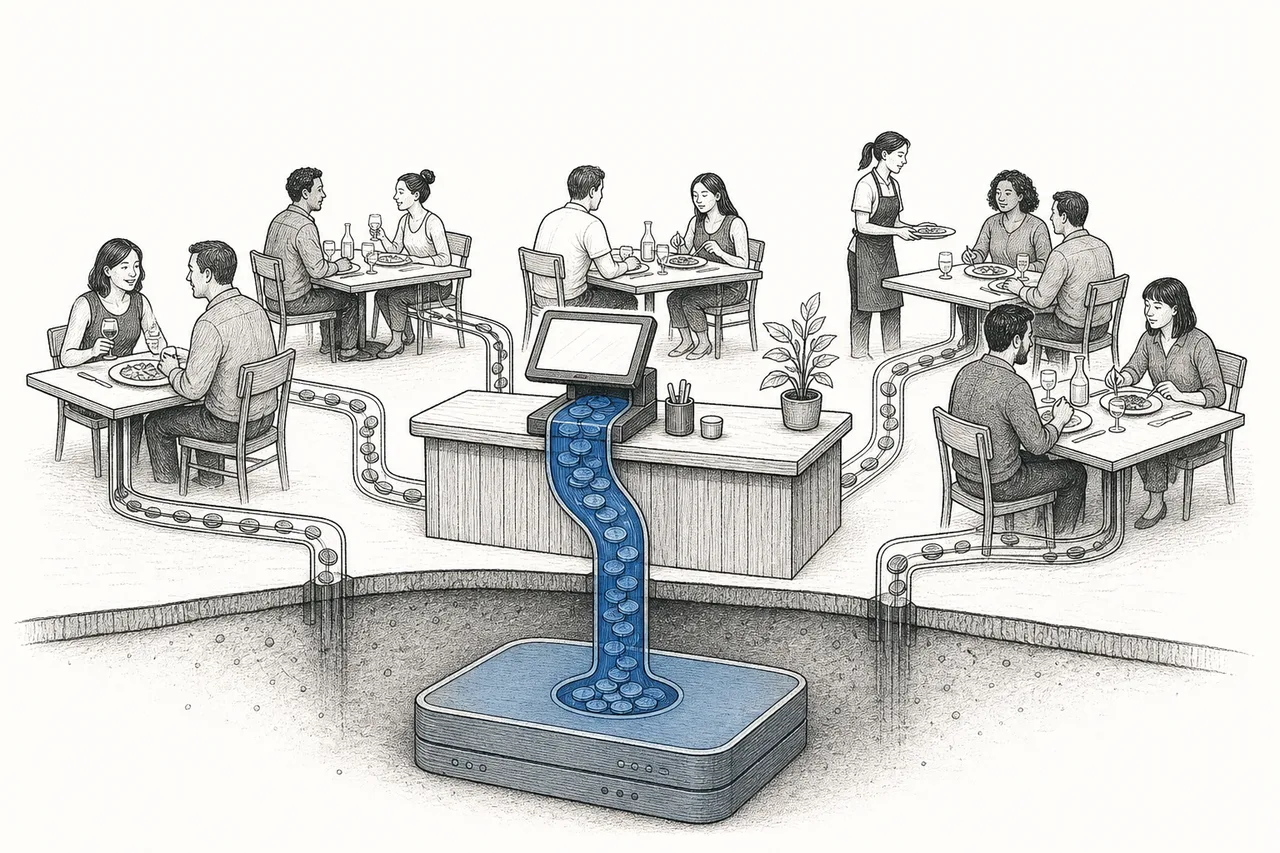
In the first move, the software gradually becomes the place all of the business's work flows through — orders, schedules, documents, customers. Once it's the whole industry's 'system of record,' it knows everything: who's paying whom, how much, and when. And that opens the door to the second move — instead of letting the money flow through an outside payments company (like a bank's card terminal), the software 'handles the payment itself' and takes a cut of every transaction.
Why is it the real 'profit machine'? Because adding fintech grows revenue per customer by 2–5x over the subscription alone, and it makes customers even harder to lose (their work and their money are tied to one place) — companies using embedded payments retain customers about 2.5x better than generic payment providers.
Take rate = the percentage a platform keeps from the transaction value flowing through it. Toast, for example, takes a payments take rate of about 0.48% (48 basis points) of every card swipe. It sounds tiny, but when the whole system's annual card volume reaches the hundreds of billions of dollars, that small percentage becomes bigger revenue than the software subscription itself.
04The ecosystem — what it connects to
Vertical SaaS sits at the application layer, the very top of digital infrastructure, and it's tightly woven into other trends:
- Twin to Horizontal SaaS: same business model (subscription), but horizontal goes broad across every industry while vertical goes deep into one — two sides of the same coin. Vertical SaaS often chooses to 'embed' shared functions (like CRM) inside itself rather than have customers buy a separate horizontal tool
- Morphs into Digital Finance: this is the most important connection. When Vertical SaaS starts handling payments, lending, and selling insurance to customers, it becomes the main distribution channel for modern financial services (embedded finance)
- Armed with AI Applications: because Vertical SaaS owns deep, clean industry-specific data, it's where AI works sharpest — an AI assistant that understands 'the language of the industry' is worth far more than a generic one
- Sits on Hyperscale Cloud: like every SaaS, it runs on the giant clouds (AWS, Azure, Google Cloud) and then collects subscriptions plus fees from its own customers on top
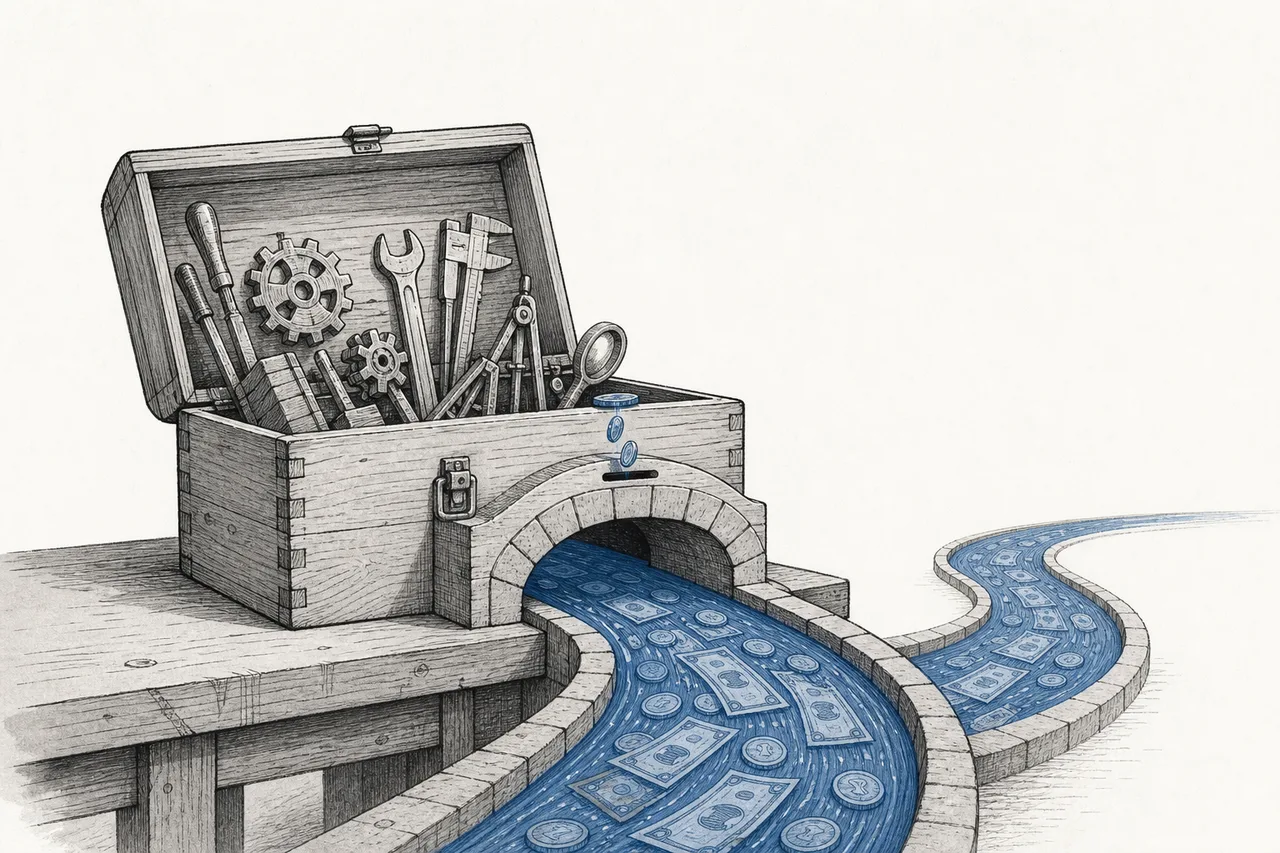
An easy way to remember it: if Horizontal SaaS is the 'standard toolbox' any industry can pick up, Vertical SaaS is 'a tool kit made for one specialist craftsman' — and once that craftsman can't work without it, the toolmaker steps in to 'hold his wallet' too. In one machine, it becomes both the industry's software and its little in-house bank.
05Where it stands now + the players
2025–2026 is when the 'capture the work, then capture the money' theory proved itself with real numbers. The clearest example is Toast — restaurant software that now serves about 164,000 locations and, in 2025, saw total revenue jump to $6.15 billion (from $4.96 billion in 2024), with the money flowing through its system (GPV) reaching $195.1 billion. And crucially, most of Toast's revenue comes from fintech, not software fees: fintech revenue was about $5.04 billion. This is the clearest picture of a software company turned into a tollbooth on a whole industry's money.
But Vertical SaaS doesn't always win with payments — some industries win with 'regulations so deep competitors can't keep up.' The classic example is Veeva, which makes software specifically for the pharma industry. 19 of the world's top 20 drug companies already use Veeva, and it holds over 80% of pharma's CRM share, because its software comes 'already validated under FDA rules' — so customers won't risk switching. Veeva's fiscal 2025 revenue was $2.75 billion (+16%).
Another good 'capture the money' story is the payments take rate — Toast takes about 0.48% on every bill swiped, while Shopify (online-store software) takes a card fee of about 2.5–2.9% per transaction. The gap comes from business type and negotiation, but the principle is the same: every dollar of a customer's sales becomes the platform's revenue base.
06The road ahead — payments is just the first door
Once you understand the 'capture the work, then capture the money' mechanism, the next question is — how much can it capture? The answer: payments is just the first financial service. Once a platform stands over an industry's money, it can sell other financial services on top, layer by layer — lending (to customers whose real sales it can see), insurance, deposit accounts, cards.
This opportunity is huge. The TAM for embedded finance (financial services embedded in other software) in North America and Europe is estimated at around $185 billion, covering four main services (payments, lending, accounts, card issuing). But only about $32 billion of it is actually used today — leaving enormous room to grow, and Vertical SaaS is the main distribution channel for this wave.
The second direction is AI that understands the industry. Because Vertical SaaS owns the deepest industry-specific data (every restaurant order, every insurance claim, every tradesperson's work ticket), an AI assistant trained on it is far sharper than a generic one — and can be upsold to existing customers at a higher price. This is where Vertical SaaS connects naturally with AI Applications.
The third direction is expanding into new industries. Every field still run on paper or Excel — vet clinics, auto shops, gyms, daycares, farms — is 'the next restaurant,' waiting for someone to build specialized software and run the same playbook: capture the work, then capture the money.
07Challenges & risks
The 'capture the work, then capture the money' formula sounds elegant, but it carries its own risks you need to understand.
The first risk is the ceiling of each industry (small TAM per vertical). Because it goes deep into just one field, growth hits a ceiling once it has captured nearly all of that industry's customers. The way out is 'selling more per customer' (adding payments/fintech) or 'crossing into a new industry' — both hard and risky. This is why many players lean on fintech to lift their revenue ceiling.
The second risk is leaning too hard on payments. When most revenue comes from a cut of transactions (like Toast, where over 80% is fintech), revenue is tied to the customer's 'spending volume.' If the economy slows, fewer people dine out, card swipes shrink, and the platform's revenue shrinks too — unlike subscriptions, which are steadier. On top of that, take rates can be pressured anytime by competition and card-fee regulation.
The third risk is AI that may lower the wall. Vertical SaaS's edge is that 'industry-specific software is hard to build.' But if AI makes building specialized software much easier and cheaper, new rivals 'built with AI from day one' could appear in every industry, pressuring both price and share — the wall that was once high may get lower.
In short: Vertical SaaS is the story of choosing to go 'deep' instead of 'broad,' then using that depth to hold both the way an industry works and its cash flow in hand. Companies like Toast have proven that software that looks like just a restaurant cash register is really a tollbooth on hundreds of billions of dollars. Understanding how 'owning an industry's software' becomes 'owning an industry's money' is understanding why this niche-sounding node is one of the most powerful business models in the digital economy.