Megatrend · Space Economy
The loudest part of the space economy — and the one that makes the least money
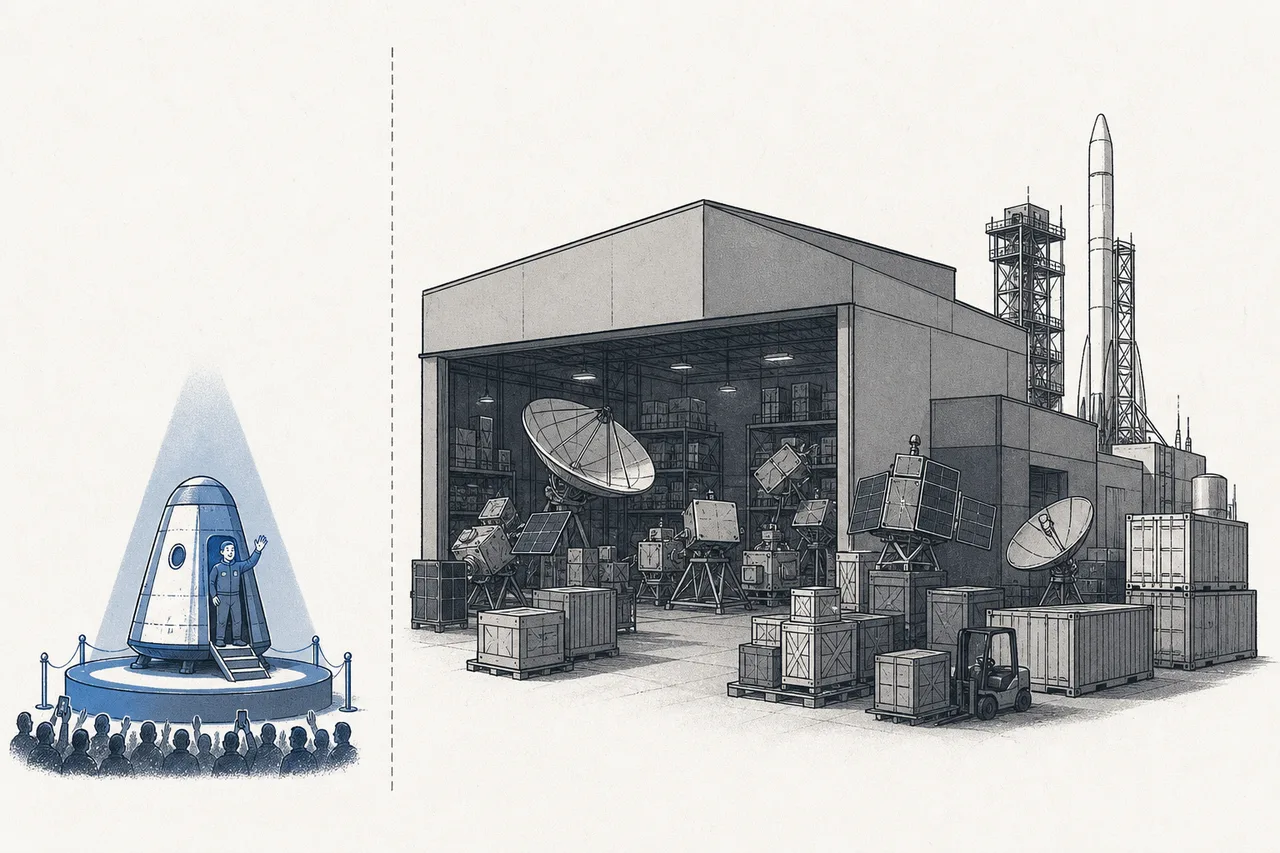
Sending "people" to space commercially is the sexiest headline in the space business — billionaires floating weightless, a round Earth out the window. But look at the real numbers and this is the smallest, most speculative, lowest-margin, and most safety-fragile slice of the whole space economy. The real money is in satellites and rockets — this part is still a "story" that has to prove itself.
01What it is
In July 2021, two billionaires — Richard Branson and Jeff Bezos — flew to the edge of space just 9 days apart, floated weightless for a few minutes, and came back down as front-page news around the world. That was the moment "space tourism" entered everyday vocabulary. But years later, the real question isn't "is it cool" — it obviously is — it's "is it a real business yet?"
This node is about sending "people" to space commercially — not satellites or cargo. It's a sub-theme under the megatrend Space Economy, and it splits into two worlds as different as sky and earth:
- Suborbital (a hop to the edge of space): a rocket takes people up to the edge of space (~85–100 km), floating weightless for a few minutes, seeing the curve of the Earth, then falling back down — never entering orbit. This is the real "tourism": expensive, few seats. The players are Virgin Galactic and Blue Origin
- Orbital (actually entering orbit): a spacecraft carries people into an orbit around the Earth, staying for days to weeks, able to dock at a space station. It costs tens of times more. This is where the real money and real missions are — and the real leader is SpaceX with its Crew Dragon
Suborbital = going up to the edge of space and falling right back (like throwing a ball hard into the sky); the whole trip takes just ~10–90 minutes · Orbital = going up fast enough to keep "falling around the Earth" without hitting the ground (you need ~28,000 km/h), staying in space for days to months. The difference in energy required is exactly why orbital is vastly more expensive.
A common confusion is lumping both together as "space tourism." But a tourist's 4-minute suborbital flight and SpaceX sending a NASA astronaut to a space station for 6 months are completely different businesses using completely different technology.
02Why it matters (and why it's small)
Start with the blunt truth: of all the slices of the space economy, carrying people to space is the smallest chunk of money. The entire world space economy in 2024 was worth about $613 billion — almost all of it from satellites, communications, and ground services. "Space tourism," the whole market, was just about $1.3 billion in 2024 — less than 0.3% of the entire industry.
So why does it still matter? Because it's the end point of a falling-cost curve. Over the past 20 years, the cost of sending things to space has dropped tenfold (thanks to reusable rockets). As getting to space keeps getting cheaper, one day it might get cheap enough for ordinary people — not just billionaires — to go up. So carrying people to space becomes the "face" of the industry, the thing that lights up interest and investment money, even though it doesn't turn a profit itself yet.
This market is indeed growing fast — many research houses expect it to grow from ~$1.3B (2024) to about $6.7 billion by 2030 (CAGR ~30%, with estimates ranging from $6.7B to $10B depending on the house). But read this number with caution: the base is tiny, so going from small to slightly-less-small makes the percentage look flashy. And importantly, some houses estimate the market may plateau around $4–6B through 2035, because the number of people who can afford this is limited.
03The ladder to space — how it works
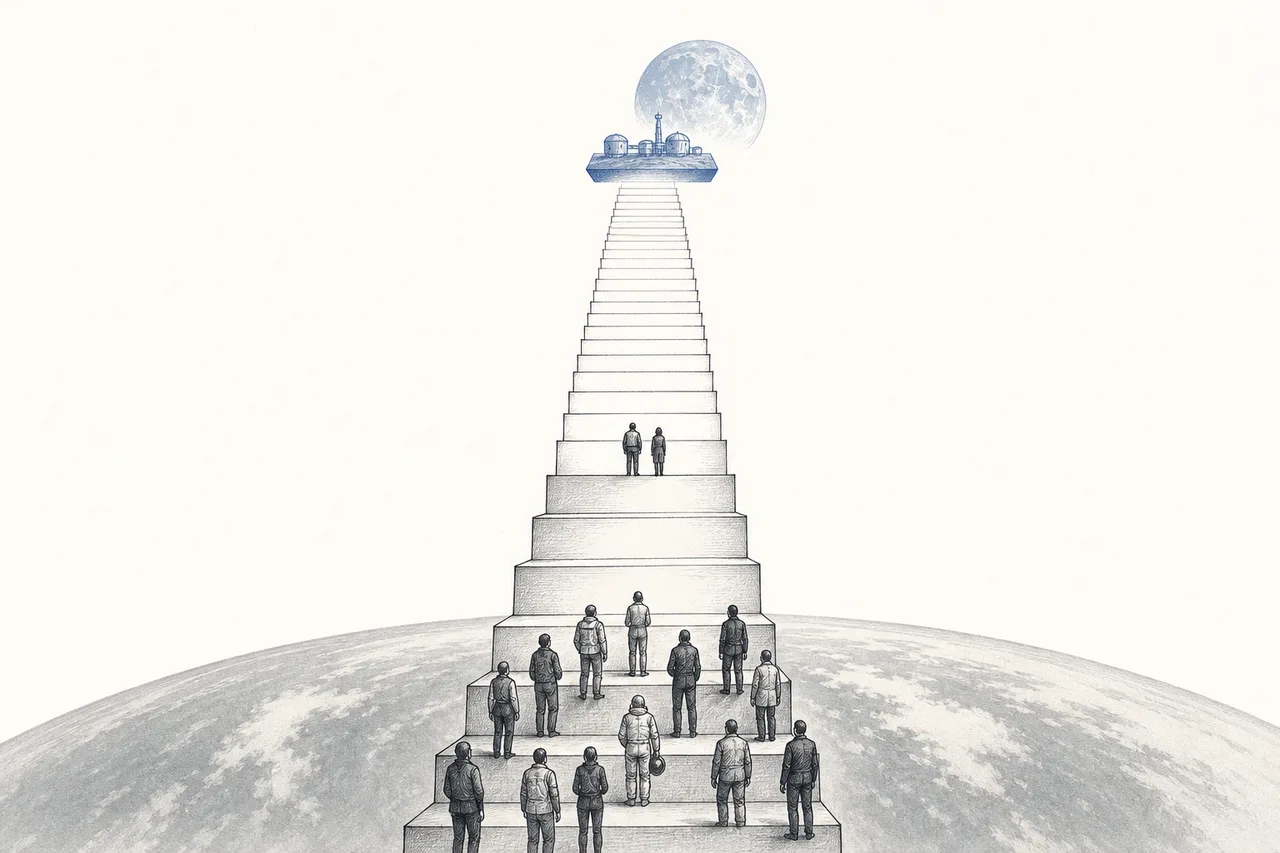
The best way to understand this node is to see it as a "ladder" you climb one rung at a time. Each rung is harder, more expensive, and exponentially riskier — and the higher the rung, the fewer the people.
The bottom rung is suborbital — a hop to the edge of space. Virgin Galactic uses a mothership plane to carry its spaceplane up and release it mid-air; Blue Origin fires a rocket straight up and the capsule parachutes down. Both give customers ~4 minutes of weightlessness, a view of the curved Earth, and then the trip down. The whole thing takes under an hour.
The next rung is orbital — you have to accelerate to ~28,000 km/h to keep "falling around the Earth," which takes vastly more energy. This rung is almost entirely SpaceX's, sending people to actual space stations. And the top rung — private space stations and moon tourism — is still the future; no one has climbed there yet.
The key thing to grasp is that safety is the gate at every rung. This isn't a business where you can "sell a lot and cut costs," because a single accident with a fatality could shatter the entire market's confidence overnight (Virgin Galactic had a test vehicle crash in 2014 that killed a pilot and delayed the program by years). So each rung of the ladder climbs slowly, is tightly regulated, and is far harder to scale up than a normal business.
04Where it sits in the space economy
This node doesn't stand alone. It sits at the very end of the Space Economy supply chain and leans heavily on its siblings in the same family:
- Depends on Launch Services & Propulsion as the foundation: without cheap, reliable rockets, there's no carrying people to space. In fact the orbital leader SpaceX is a rocket company that happens to carry people too — the people business is an "add-on" built on top of the rocket business that actually makes money
- Extends toward In-Space Manufacturing & Commercial Stations: the top rung of the ladder — private space stations to replace the ISS — is the "destination" that gives long stays in space somewhere to go. Future orbital tourists will stay there
- A distant cousin of Advanced Air Mobility (eVTOL): both are "human travel by a new kind of vehicle where safety is the main gate" — they differ in altitude and how speculative they are, but face the same homework of safety certification and building trust
It also connects outside the family — advances in life-support systems, automated training, and health screening pull in AI to help, and demand from government/defense (like training astronauts) is a big customer that keeps players alive while the pure tourism market is still small.
05Where things stand now + the players
The 2025–2026 picture tells a clear story: the orbital rung is really moving forward and making money, while the suborbital rung is stumbling.
On the orbital side — SpaceX has sent people to orbit roughly 18–19 times on Crew Dragon, carrying over 68 people in total, split into about 11 NASA missions and 7 more private/Axiom flights. This is a business that "actually works, consistently, with a paying customer (NASA) that's rock-solid" — which is why orbital is the most tangible slice of carrying people to space.
On the suborbital side — Blue Origin has flown New Shepard 37 times (16 crewed), carrying about 86 people above the Kármán line, running steadily. Meanwhile Virgin Galactic is hurting badly: the company halted all commercial flights in 2025 to pour everything into building a new vehicle (Delta), bringing in just $2 million in revenue for the whole year (down from $7 million in 2024), while posting a $279 million net loss and negative $438 million in free cash flow — burning enormous amounts of money with no revenue-generating flights at all.
On price — Virgin Galactic's old ticket was ~$450,000 per seat, and the new (Delta) ticket is set at $750,000. Blue Origin doesn't publish a fixed price, but seats have changed hands at $1 million and up. Orbital from Axiom/SpaceX is a different league entirely — about $55 million per seat. These numbers tell their own story about why the market is small: customers at this level are limited.
The most important story in this category is that the lineup of players just changed: SpaceX (the true orbital leader) has gone public (SPCX, June 2026), but the players focused on human spaceflight — Blue Origin and Axiom — are still private companies. And the public companies focused purely on this are basically down to one, Virgin Galactic — which is struggling. This is the look of a young, highly speculative industry.
06The road ahead
The first direction is climbing the upper rungs of the ladder. As the ISS nears retirement (around the end of this decade), private space stations — which Axiom and others are building — will become the "destination," giving orbital trips somewhere to stay for longer. If this really happens, orbital tourism (more expensive but creating far more value per head) could become the core of the market instead of suborbital.
The second direction is the cost-cutting game. As long as the cost of sending things to space keeps falling (from newer reusable rockets), ticket prices could gradually come down, widening the customer base from "billionaires" to "ordinary rich people." But this is a decade-scale change, not a year or two — and still far from the point where "ordinary people" can go.
The third direction is proving it's a business, not just a show. 2026–2027 is the moment of truth for Virgin Galactic: can the Delta vehicle come back and actually fly revenue flights? If it can, and can repeat it often enough, suborbital might start to make economic sense. If it can't, it reinforces that suborbital is just a "narrative" that burns money more than a business.
07Challenges & risks
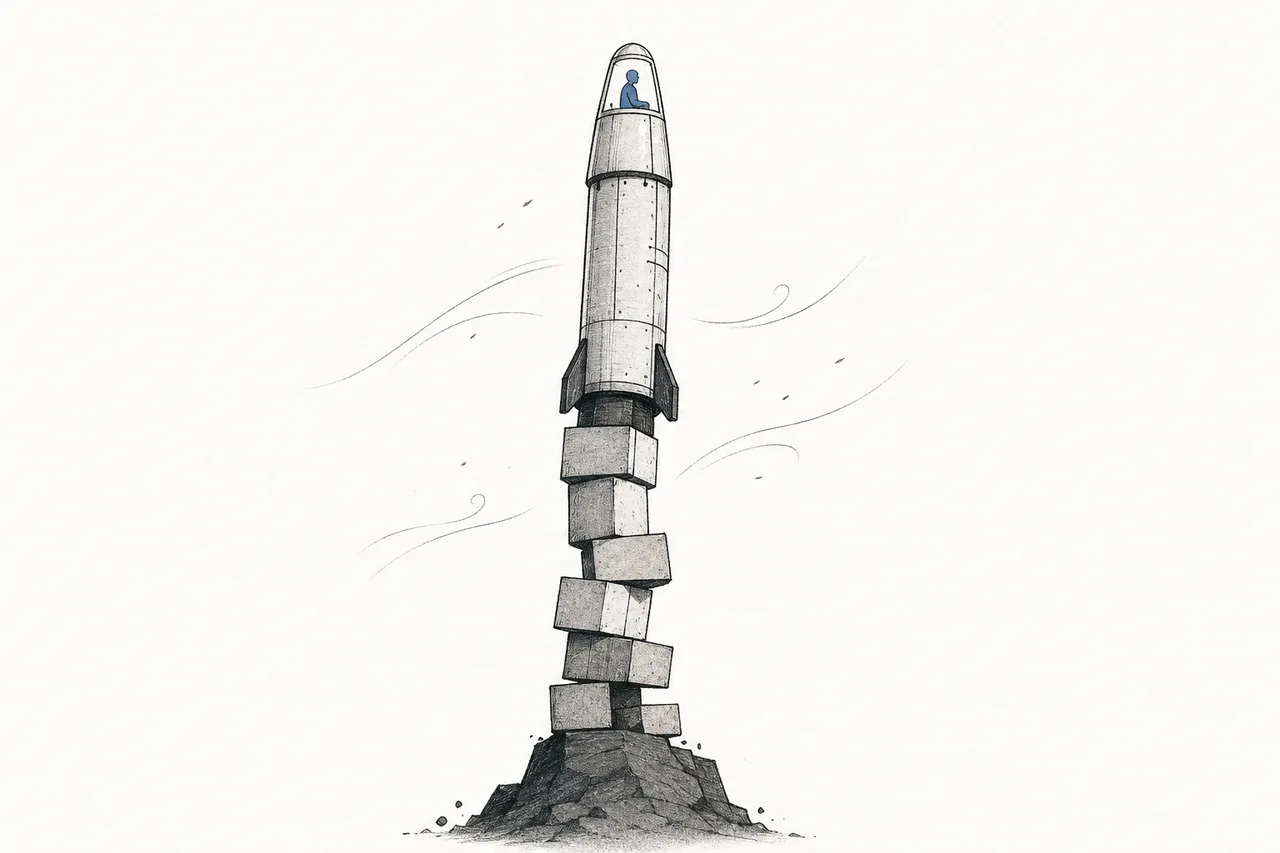
The first and most serious risk is safety. This is a business where a single accident — a passenger fatality — could shatter the whole market's confidence and stall it for years (Virgin Galactic experienced this firsthand in 2014). Unlike airlines that fly tens of thousands of flights a day until their safety record proves itself, spaceflight has very few flights, so every flight carries high stakes, and scaling up to "lower the cost per unit" is harder than in a normal business.
The second risk is economics that aren't settled yet (low/negative margins). Virgin Galactic's numbers say it clearly: burning hundreds of millions of dollars with almost no revenue. A pure suborbital business hasn't proven it can turn a profit at a sustainable level. The companies that survive tend to be those with deep pockets (Blue Origin/Bezos) or a money-making rocket business behind them (SpaceX), not companies relying on tourist tickets as their main revenue.
The third risk is a small and speculative TAM. The number of people willing to pay $450,000–$55,000,000 to go to space is very limited. Many estimates see the market plateauing around $4–6B through 2035. This is not a mass market like commercial aviation, and the flashiness of a "high CAGR" comes from a very small base — so be careful not to be dazzled by the percentage.
In short: carrying people to space is a story that fires up the world's imagination — but as a business, it's still on the bottom rung of the ladder, small, speculative, and betting on safety every single flight. Understanding this node correctly means understanding that "loudest" and "most profitable" are usually not the same thing.