Megatrend · Space Economy
Factories in orbit, and a new home in space after the ISS retires
By 2030, the International Space Station (ISS) — in use for over 30 years — will be retired and allowed to fall into the ocean. The question is: who replaces it? The answer isn't a government, it's private companies — and alongside that comes an idea that sounds like science fiction but is actually starting to happen: "manufacturing" things in weightlessness, where some products come out better than anything you can make on Earth.
01What it is (two stories tangled together)
This node bundles two stories that sound completely separate — but really, they depend on each other. It's a sub-theme of the megatrend Space Economy and the "newest" slot in the group — its very definition states plainly that it's still pre-profit, meaning it isn't making money yet.
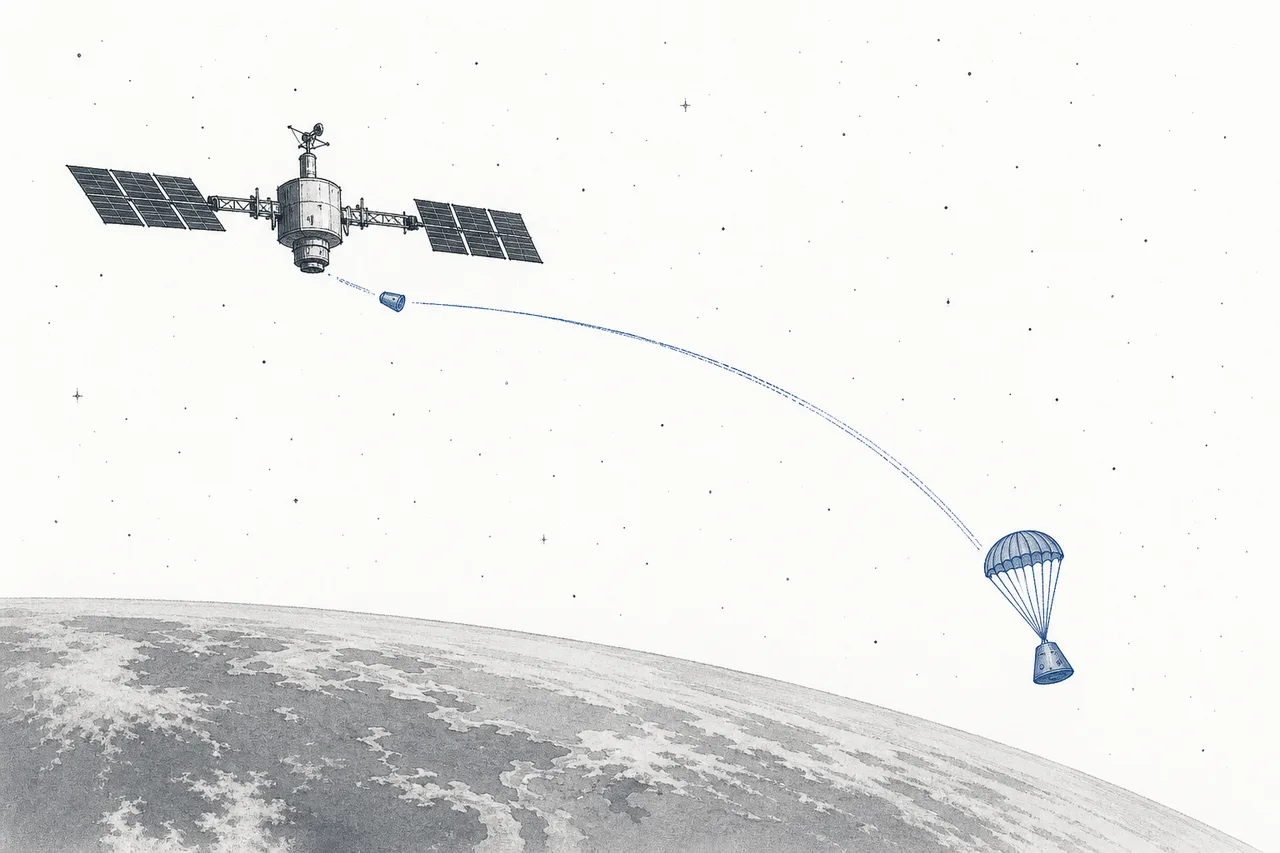
The first story is commercial stations — the "homes" and "labs" in orbit that private companies build themselves, to take over from the retiring ISS. Put simply: the government used to own the one piece of real estate in space that everyone leased. From now on, it becomes multiple private players building their own buildings and renting them out.
The second story is in-space manufacturing — using "weightlessness" (microgravity) as a tool to make certain things that Earth just can't make well, because gravity gets in the way. Think special-grade optical fiber, protein crystals for making drugs, even semiconductor crystals.
Why are the two tangled? Because a factory needs a location — if you're going to make things in space over and over, you need a station where people or machines can work, or at least a capsule that goes up, does the job, and comes back. The station is the "industrial park," and the manufacturing is the "factory" that leases that space.
In orbit, things don't really "have no gravity" — but because the station is constantly in free fall around Earth, everything inside floats as if weightless. The result: there's no pull to make heavy things sink and light things rise, and no convection the way there is on the ground. So liquids and molten materials go "still" and become as uniform as Earth never lets them be.
02Why it matters — the gap after the ISS
At the heart of this is a "deadline" — NASA has said clearly it will retire the ISS and bring it down into the ocean in a controlled way by 2030. The floating lab that scientists worldwide have run experiments in for 30 years is about to disappear — and NASA does not intend to build a replacement itself.
Instead of building its own, NASA chose a new approach: pay private companies to build their own stations, and NASA becomes the "customer" buying the service rather than the owner. The program is called Commercial LEO Destinations (CLD); its 2026 budget is set at about $272 million, with a plan to put in roughly $2.1 billion over five years to help private companies get a station up before the ISS goes dark.
On the "in-space manufacturing" side, it's a market that's still very small but growing fast. Estimates put the market at about $1.5 billion in 2026, possibly reaching ~$3.5 billion by 2030 — roughly 24% growth a year. But this figure is a research-firm projection, and you have to read it with caution, because in revenue terms this market "barely exists yet."
Why does this matter to the world economy? Because it's a test of a big hypothesis: can space really become a "place to do business" — not just somewhere to launch satellites or explore. If orbital factories and private stations work, they open a whole new industry — but if they don't, it's a huge amount of tax money and risk capital sunk. This is a bet no one knows the answer to yet.
03Why manufacture in space (the mechanism)
The question everyone asks: "why go to the trouble of hauling stuff up there, when Earth can make it?" The answer is — some things genuinely can't be made on Earth, and the culprit is the thing we're most familiar with: gravity.
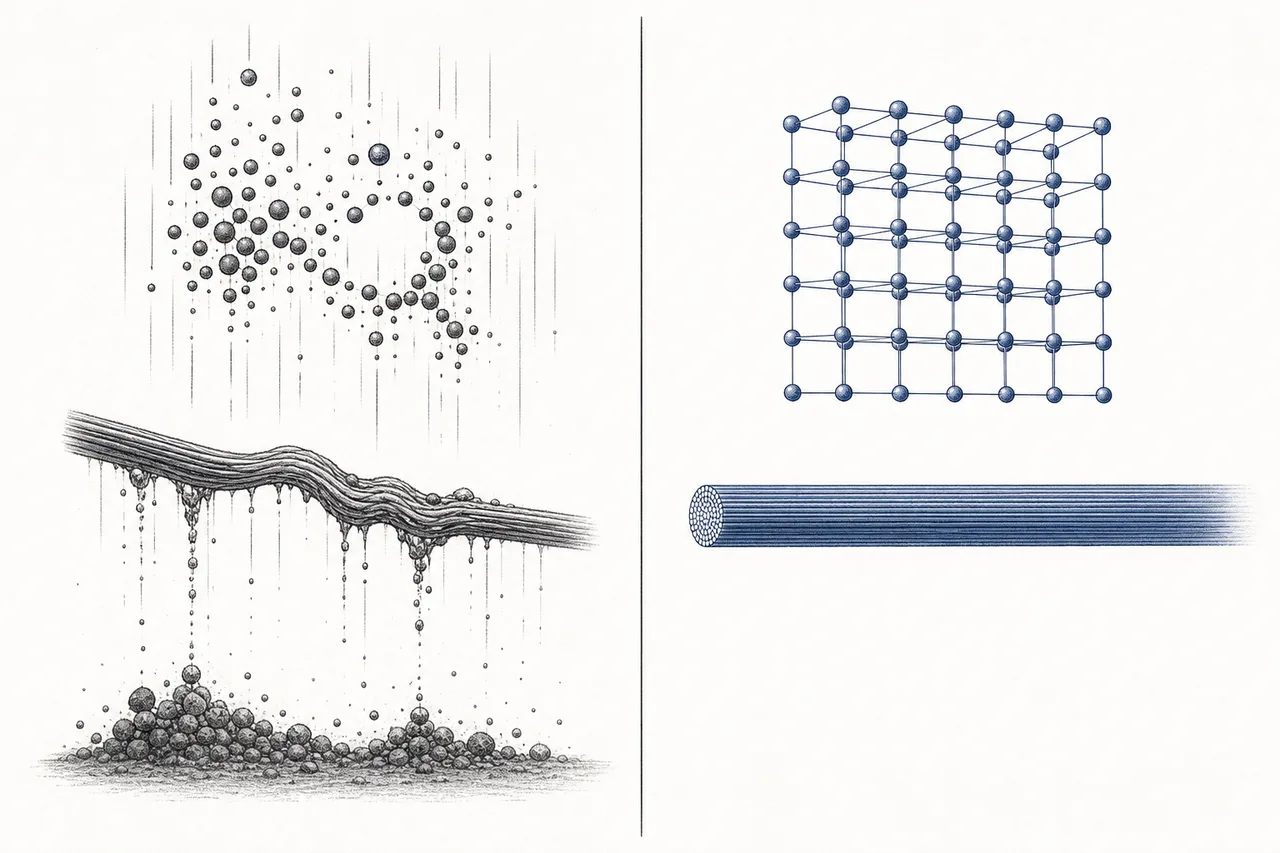
On the ground, when you melt or mix materials, gravity is always interfering — heavy things sink, light things rise, heat creates flow (convection), and bubbles move. All of this makes the material "uneven," creating tiny defects you can't see but that wreck quality. In orbit, these forces nearly vanish, so things form "still" and far more perfectly.
Now, the catch is the station is up in the sky but the customers are on Earth. So the whole chain has to line up three moves: (1) make it in orbit (2) bring it back down (3) sell it on Earth. The hardest and most expensive step is usually the second — bringing the capsule back through the atmosphere at Mach 25 (25 times the speed of sound) without the contents breaking.
So where is it "worth it"? Only for things with very high value per gram — cheap stuff will never justify the transport. The classic examples are:
- ZBLAN optical fiber: a special optical fiber that, made in orbit, has far lower "signal loss" than ordinary silica fiber, because there are no crystal defects caused by gravity. This grade has high enough value per meter to make the transport worth it
- Drugs and protein crystals: in weightlessness, protein crystals grow bigger and more perfectly, helping researchers understand a drug's structure better — and potentially turning an IV drug into a more convenient subcutaneous injection
- Semiconductors: silicon crystals grown in weightlessness have fewer defects and more uniform material — still pure research at this stage
04Where it sits in the Space Economy
This node is like the "end point" of the space economy — the point where space stops being just "somewhere to launch satellites" and becomes "somewhere to live and work." That's why it leans hard on the other slots in the megatrend Space Economy:
- It depends on Launch Services & Propulsion first: without cheap rockets that can carry things to orbit frequently, neither stations nor factories can exist — Starship and a new generation of rockets are the precondition that makes this possible
- A close cousin of Human Spaceflight & Space Tourism: many private stations will earn money from researchers, tourists, and other governments' astronauts all at once — one "home" sells to multiple markets
- It uses parts from Satellite & Spacecraft Manufacturing: the station and capsule are themselves spacecraft, needing structures, solar panels, and control systems from spacecraft makers
- It connects to Lunar & Cislunar Logistics: the skills to build habitats and manufacture in orbit around Earth are the first step before doing the same thing on the Moon
Looking beyond space, it also tangles with other trends — it feeds materials and drugs to the whole world of biotechnology and connects with AI used to design drugs. And the demand to "be self-sufficient in space" is driven in part by the geopolitical competition in Defense & Geopolitical Fragmentation.
05Where things stand now + who the players are
First, to be honest about it: most of the real players are still private companies not on the stock market, and nearly all of them still rely mainly on NASA funding. This is a field where "the real thing has only just started flying" — not a business that's already profitable.
On the private station side, there are about four main contenders right now: Axiom Space (private), which will attach a module to the ISS first, then break off into a standalone station — its first module is planned for 2026 and it just raised several hundred million dollars; Vast (private), with its tiny Haven-1 station; Orbital Reef from Blue Origin teaming up with Sierra Space; and Starlab, led by Voyager.
On the in-space manufacturing side, the star is Varda Space (private), which flies factory capsules up to make drugs in orbit and brings them back — six successful flights so far (the latest landing in Australia), and it just signed a contract with the drugmaker United Therapeutics, the first major publicly disclosed drug contract. But its own executives say real patients likely won't get the drug before 2030.

A few numbers capture the size of the bet well: NASA signed a Space Act Agreement with Voyager for Starlab worth about $217 million, while Starlab itself is expected to cost $2.8–3.3 billion to build — making it clear that government money is just the starting piece, and private players have to raise vast sums on their own.
On the stock market, the main accessible players are Redwire and Voyager Technologies — these two are the "picks-and-shovels sellers," selling equipment and infrastructure to others chasing the gold rush, rather than making and selling drugs themselves.
06The road ahead
The first direction is making the "handoff" go smoothly. 2026–2030 will be the decisive window — Axiom's first module goes up in 2026, Vast is rushing to fly Haven, and Starlab is aiming to launch in 2029 on a single Starship flight. If at least one of them is genuinely operational before the ISS goes dark in 2030, humans will have a continuous "home" in orbit with no break.
The second direction is making "coming back to Earth" boring. Varda's own executives say the goal is to make capsule re-entry reliable enough to be routine — if it can be done often and cheaply, the cost of in-space manufacturing drops sharply, and things that "weren't worth it" before may start to be worth it.
The third direction is drugs as the first "spark". Because drugs have such high value per gram, they're the first product group where the economics might make sense — but the timeline is still long. Varda itself expects to "fly its first drug" around next year, make it for real the year after, and have patients use it no sooner than around 2030. This is a long game, not a payoff next year.
07Challenges & risks
Let me say this as plainly as possible in this lesson: this is a node that's "just getting started" and "can't prove its economics yet." Every number above has to be read with a careful eye.
The first risk is unproven economics. The in-space manufacturing market "barely exists yet" in revenue terms — there are only samples and pilot contracts. No one has yet proven you can make things in space and sell them profitably at industrial scale. If transport costs don't fall fast enough, most things will stay "not worth it" forever.
The second risk is dependence on government money. Almost every player still breathes on NASA's budget (the CLD program at ~$2.1 billion over five years, plus per-company contracts). If U.S. politics or budgets shift, or NASA changes plans midway (which it just did in 2025), the whole industry can shake instantly. This isn't pure free-market demand — it's demand the government props up.
The third risk is a deadline it may not make. If private stations aren't finished before the ISS retires in 2030, there'll be a "gap" where the U.S. has nowhere to live in orbit — losing both research continuity and leadership in space. Delays and slipped plans are very common in this field.
The fourth risk is the pure tech that's still brutal. Bringing things back through the atmosphere at Mach 25 without breaking them, controlling manufacturing quality somewhere with no one watching, and scaling from "can make a little" to "can make at industrial scale" — these are all problems no one has fully solved yet.
In short: In-Space Manufacturing & Commercial Stations is the node sitting right at the seam between "science fiction" and "real industry" — it has solid physical reasons (some things really are better made in space) and a clear deadline (the ISS goes dark in 2030). But today it's still "only just able to fly," not "already profitable." The people who understand this slot best are the ones excited by its potential, but who never forget it's still a bet whose answer is years away.