Megatrend · whole-trend overview
Electric aircraft are about to actually fly — but the aircraft alone isn't enough
For a decade, "flying taxis" were always a story about the future. But 2025–2026 is when they started getting their first real flight approvals — EHang is already selling tickets in China, and Joby and Archer are flight-testing with the FAA. Yet for an "electric air network" to actually work, four things have to come together at once — the aircraft, the parts supply chain, and landing pads + airspace management. This lesson is the map that strings the 5 categories together: why you can't skip any one of them, and where the money (and the risk) sits — being honest that the whole field is still "burning cash" and almost nobody has revenue yet.
01The big picture: electric flight is about to become real
"Flying cars" were talked about for so long they became a punchline. But the status has changed — in the Chinese cities of Guangzhou and Hefei, EHang has started selling sightseeing flight tickets on uncrewed electric aircraft — the first in the world to hold every approval from China's regulators. In the US, Joby and Archer are flight-testing with the FAA, aiming to launch commercial service in late 2026. This isn't a distant future anymore — it's a deadline that's already counting down.
The core of this technology is called eVTOL — electric aircraft that take off and land vertically like a helicopter (no runway needed), but quieter, cheaper, and zero-emission because they run purely on batteries. The picture in your head is a "flying taxi across the city," but the market is actually much wider — it includes regional electric aircraft and delivery drones too.
The number exciting investors comes from Morgan Stanley, which has seen the global AAM (Advanced Air Mobility) market reaching ~$1 trillion by 2040 and possibly growing to ~$9 trillion by 2050 in its base case — with more than half of that being "cargo/logistics," not just moving people.
But let's be honest from the start — the market today is still very small, and almost every company is losing money. That trillion-dollar figure is the "destination," not the present. Morgan Stanley itself has pushed its "tipping point" closer to 2040 than 2030, and famous names like Lilium and Volocopter have already gone bankrupt along the way. What makes this different from "fusion" or other far-off dream technologies is that it's much closer to reality — there are real aircraft flying, real companies getting approvals, real people buying tickets. And to understand whether it will succeed, you first have to understand what this "system" is made of.
02The map: what are the 5 subcategories?
This trend splits into 5 categories, grouped into 3 "layers" by their role in the system — the categories that build the aircraft, the ones that feed in the parts, and the ones that create the space for it to fly. Each has its own deep-dive lesson (tap to read):
End layer — the aircraft itself (application)
- Passenger eVTOL OEMs: makers of vertical-takeoff "flying taxis" for carrying people — Joby, Archer, and EHang are here. This is the most famous and hottest category
- Hybrid-Electric & Regional Electric Aircraft: electric (or hybrid) aircraft for short regional routes — bigger than eVTOL and using normal runways. A shortcut for electric flight to start earning revenue sooner
- Cargo & Delivery Drone Systems: autonomous drones delivering goods/medical supplies — the category that's most "already making real money," because not carrying people means lighter regulation (Zipline has passed 2 million deliveries)
Middle layer — the parts (supply_chain)
- AAM Propulsion, Avionics & Supply Chain: electric motors, batteries, propellers, flight control, and electronics — the "guts" every aircraft needs. You get paid no matter who wins at the end layer (Honeywell, Albany are here)
Base layer — infrastructure (infrastructure)
- Vertiport Infrastructure & Airspace Integration: landing pads (vertiports), charging systems, and most importantly the airspace management system (UTM) that lets many aircraft fly over a city safely at the same time — without this layer, even if you have aircraft, there's nowhere to fly them
03How it connects (the whole system has to be complete)
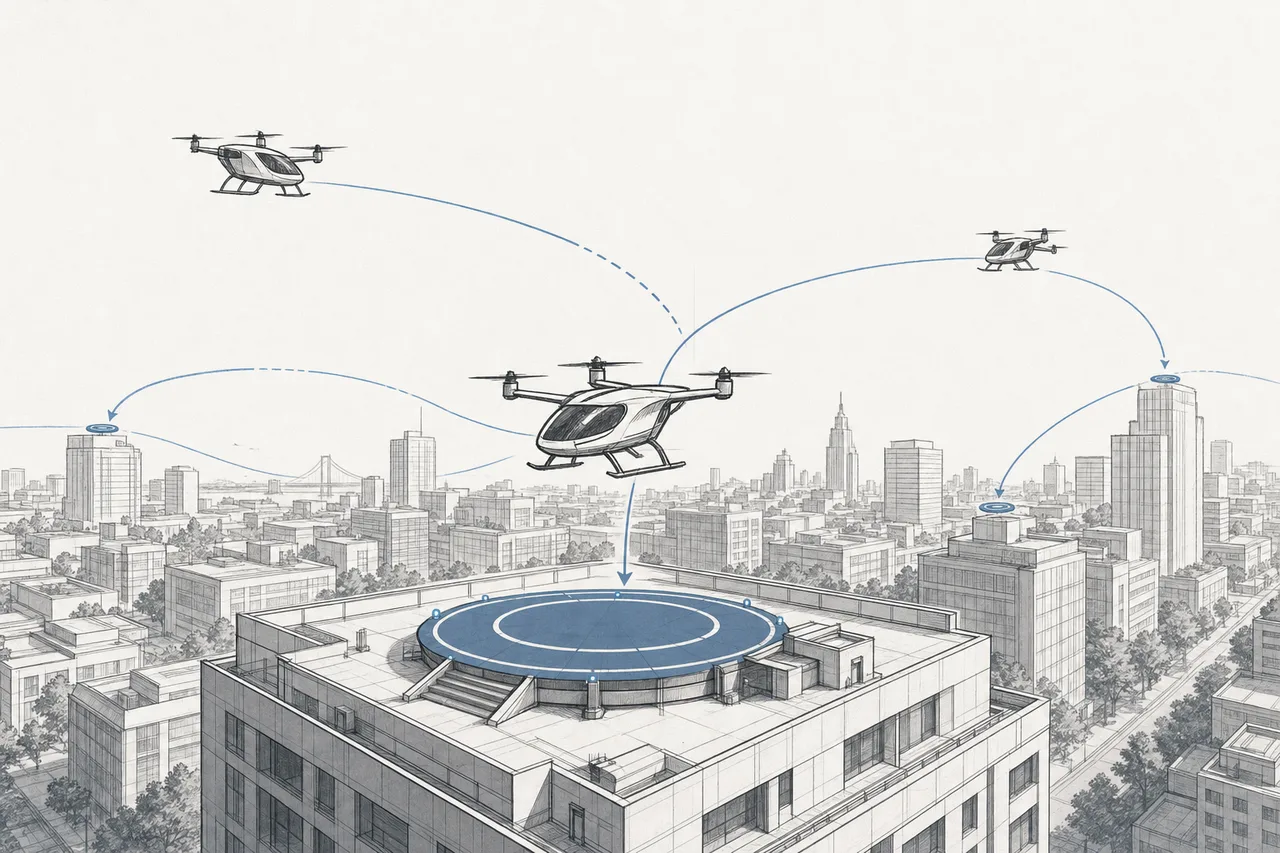
Here's the core that's different from other trends — AAM isn't a "chain" where goods flow from upstream to downstream; it's a "system" where every piece has to be ready at the same time to work. Picture it: even if you have a certified flying taxi, if the city has no landing pads and no system telling who's flying where and when, it can't fly. And even if landing pads fill the city, if batteries still aren't light enough to fly far enough to pay off, there's no business. So all three layers are "conditions that have to be true simultaneously."
And this is why the "bottleneck" of this trend isn't the aircraft — the aircraft technology is more ready than anything else. What's holding the whole field back is certification, which takes a very long time, and the airspace management system (UTM), which isn't built yet. Worldwide there are plans for over 1,500 landing pads, but in the early period (2025–2028), nearly 90% will reuse existing airports/heliports for now — because dedicated landing pads barely exist yet, and the FAA's design standards are still only a "draft."
04Where the value and power sit
The key rule for looking at a trend that's "just getting started" like this — don't just look at who has the prettiest aircraft, but at who's already certified, who has real orders, and who can make money right now. The value isn't spread evenly across the 5 categories.
It's clear that delivery drones lead every category — because not carrying people means much lighter rules. Zipline has passed 2 million deliveries and over 125 million miles of commercial autonomous flight. This is a business that's truly "already born." On the people-carrying side, even though EHang holds full approvals and has started selling tickets, revenue is still very small (estimated at ~600 million yuan ≈ $84M for all of 2026). And Joby/Archer in the US have no flight revenue at all yet — both are burning cash while waiting on certification.
The side that may get overlooked but matters is the parts layer (supply chain) — the "picks and shovels" of this trend. Companies selling electric motors, avionics, or carbon-fiber propellers get paid no matter which brand of flying taxi wins. And in the long run, the infrastructure layer (landing pads + airspace) is the one that "collects the toll" for the whole network — but right now it's still in its infancy.
The lesson for looking at this trend: don't just ask "does this company do eVTOL," but "is it certified yet, does it have real orders, and will its cash last until revenue arrives".
05The forces moving the whole trend
Even though each category differs, four big forces shape the whole field's fate at once:
1. Battery energy density — this is the most real physical wall. Vertical takeoff burns 10–15 times more energy than a car on the road. Today's lithium batteries deliver about 250–300 Wh/kg, but for electric aircraft to truly pay off commercially you need over ~400 Wh/kg — this gap is why today's eVTOLs can't fly far and can't carry much.
2. Certification progress — this is the clock everyone is watching. In the US the FAA process is split into several stages, and both Joby (in stage 4 of 5) and Archer (first to close phase 3 of 4) are entering the final corner — whoever gets certified first can open service and charge first. China runs its own path, and EHang has already reached the finish line.

3. Demand to solve crowded cities — the demand-side pull comes from big cities with heavy traffic. A 90-minute route by road could take 10–15 minutes by air. So the first markets emerge where there's both money and congestion — like Dubai/Abu Dhabi (Joby is preparing to carry its first passengers in the UAE this year, and Archer is basing itself in Abu Dhabi). The UAE is becoming the world's real testing ground.
4. Defense and cargo = the first chunk of revenue — before "people-carrying flying taxis" make money, the markets actually paying right now are delivery drones (medical supplies, parcels) and military uses, where defense is interested in eVTOLs/drones for transport and reconnaissance — a revenue bridge that keeps companies alive while waiting for the people-carrying market to grow.
06Where things stand now + each category's champion
2025–2026 is the whole field's "year of proof" — China has started commercial flights, the US is entering certification's final corner, delivery drones are expanding cities — but at the same time, some companies have vanished. Below are each category's "champions," reflecting how power is split across regions (US/China) and across "readiness" (some are already selling tickets, some are still burning cash):
07The future and the risks worth being honest about
Looking ahead, this trend has both real tailwinds and risks you need to keep in view, eyes wide open.
On the opportunity side: for the first time we have the "real thing" — certified aircraft, people actually buying tickets, drones actually delivering goods. If the US side (Joby/Archer) gets certified in 2026–2027 as planned, and the UAE/China prove the business model works, the market starts expanding from "sightseeing/tourism" to "real travel" — with cargo drones and defense work holding up revenue along the way.
On the risk side — this lesson wouldn't be honest if it didn't say this plainly. There are three layers to watch:
- No revenue yet + burning cash hard: almost all the people-carrying players (especially in the US) have no flight revenue at all yet. Joby itself expects to spend ~$370M in just the first half of 2026. Developing a certified aircraft takes $0.5–5B, and Lilium and Volocopter went bankrupt because their cash ran out before the finish line — cash in the bank vs. time remaining is the most important number
- Certification may be slower than expected: timelines can always slip. Morgan Stanley itself has pushed the market's "tipping point" closer to 2040 than 2030 — every slip is another month of burning cash
- Infrastructure isn't ready: even if aircraft get certified, if landing pads and the airspace management system (UTM) aren't finished, flight can't truly scale — FAA standards are still a draft, and the full Advisory Circular only arrives in 2026
And that's why this chapter is a "map," not a "deep-dive manual" — the real value of viewing the whole trend is seeing all 5 pieces assemble into one system before you walk in to explore each room. Tap into the deep-dive chapter of whichever category interests you.