Megatrend · Space Economy
When rockets stopped being throwaways, the price of getting to space collapsed
Throughout history, a rocket was used once and the whole thing thrown away, which made putting something in orbit cost a fortune — "gold per kilogram." But the day a rocket could fly up and then "land itself back" to fly again, the cost per kilogram fell from about $54,500 to under $3,000 — and that is the key that unlocks every other space business, from satellite constellations to space tourism.
01What it is
Everything in space — the Starlink internet dish on your roof, the satellite imagery behind the weather forecast, the GPS in your phone — starts from the same place: "something first has to lift the heavy payload up and place it in orbit." That job is Launch Services & Propulsion: the business of "shipping things to space" plus the "engines and rocket hardware" that make it possible.
Think of it simply as a "delivery company for the space age." Customers (satellite owners, government agencies, researchers) have something they want in orbit but don't own a rocket, so they pay for a "seat" on a launch provider's rocket — like booking space in a shipping container, except the destination is 28,000 kilometers per hour around the Earth.
On the megatrend map, this node is a sub-theme under Space Economy, sitting in the deepest "infrastructure layer" — because it's the first gateway every space venture has to pass through. Its own definition calls it "the cost-curve gateway" — a door that opens wider and wider as costs fall, and this whole lesson is the story of that door.
LEO (Low Earth Orbit) = a low orbit roughly 200–2,000 km up, where most communications and imaging satellites live — the nearest and cheapest "shelf." The industry's standard yardstick is "dollars per kilogram to orbit ($/kg to LEO)" — the cost to lift 1 kilogram up to LEO. This number is the "ticket price" that decides what businesses you can run in space.
02Why it matters — the cost collapse
The importance of this node boils down to a single number: the price per kilogram of getting to space, and that number just fell more sharply than at any point in history.
In NASA's Space Shuttle era, lifting payload to LEO cost about $54,500 per kilogram — so expensive that everything sent up had to be worth a fortune, because each flight mostly threw away the entire rocket. Like buying a Boeing jet, flying it once, dumping it in the ocean, and buying a new one for the next trip.
Then SpaceX did what many had said was impossible: it made the most expensive part, the lower stage (booster), land itself, get recovered, and fly again. The result: the cost of Falcon 9 dropped to about $2,720 per kilogram — nearly 95% cheaper. And that's not the end. The next-generation rocket, Starship, is aiming for the "low hundreds of dollars per kilo" (SpaceX's target is ~$100–200/kg, though independent analysts reckon the real early figure is more like $100–500).
Why does this matter to the whole economy? Because a cheaper ticket changes every question. It used to be so expensive to put things in space that it only made sense for the billion-dollar satellites of governments or big firms. Once the price collapsed, ideas that were once "too expensive to be real" instantly became businesses — constellations of thousands of internet satellites, pharmaceutical factories in space, space tourism. All of it is possible because the "price floor" was removed first. That's why launch isn't just "one branch" of space, but the foundation every other branch stands on.
03How it works (the reusability mechanism)
The heart of this cost collapse is one word: reusability. To understand why it changed the game, you have to see where the "money" in a rocket actually is.
Almost all of a rocket's cost is in the hardware itself — the structure, the engines, the fuel tanks, especially the "first stage (booster)" with its many engines, the most expensive part. The actual fuel is very cheap (just a few percent of the cost of a whole flight). So in an old rocket that throws away every part after one flight, you're essentially burning tens of millions of dollars of hardware every trip.
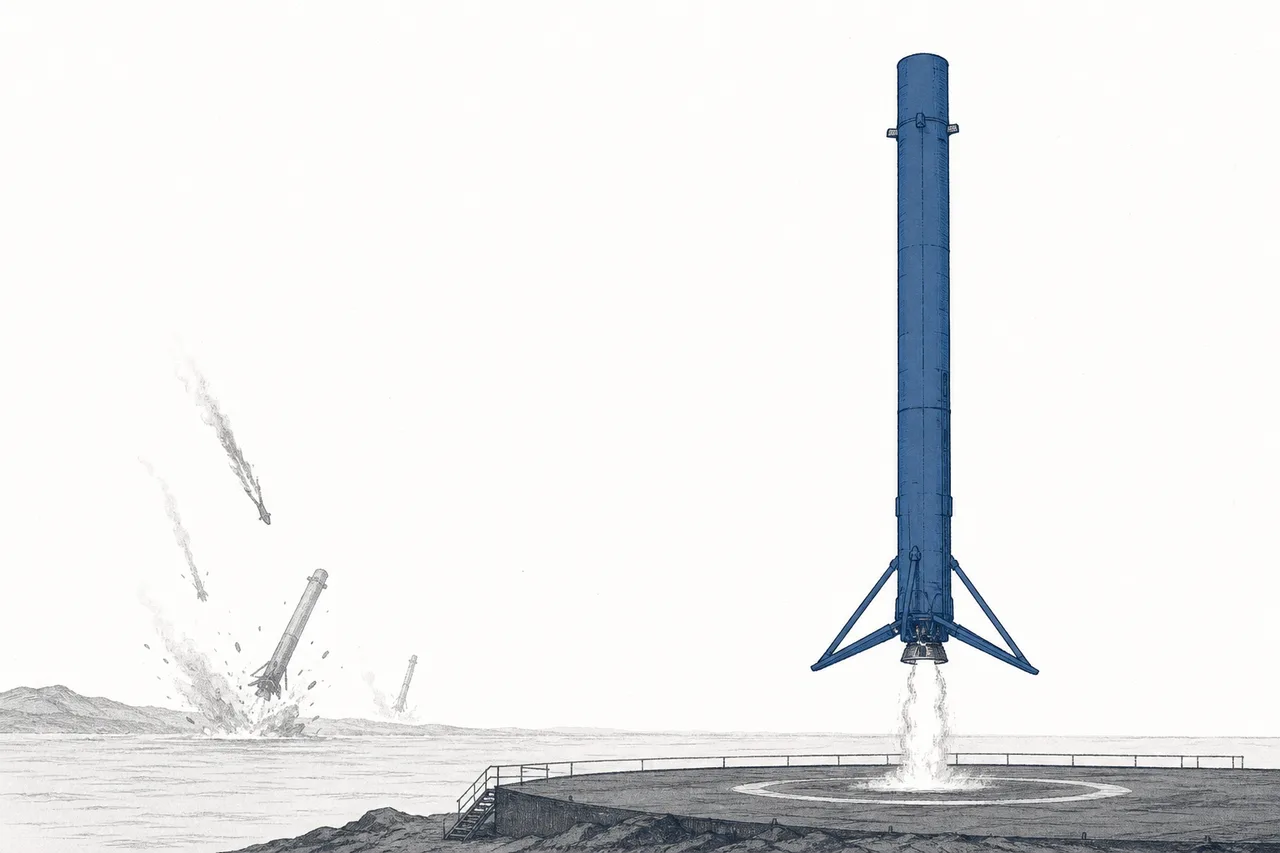
Reusability flips this equation with an idea that sounds simple but is enormously hard to do: after the first stage sends the upper part up, it fires its engines to slow down and lands itself upright — on a pad on the ground or a ship out at sea. From there it's inspected, refueled, and flown again. Spread the same hardware cost across many flights, and the cost per trip plunges.
But reusability alone isn't enough. It has to come paired with "flight frequency (cadence)." Like an airline: a plane only pays off if it flies often, not if it sits parked. The more often the same rocket flies, the more the fixed costs get divided across trips — in 2025, SpaceX's boosters landed successfully more than 620 times out of 633 attempts, and one booster has flown 35 times. That's proof that "a rocket that re-flies often" is no longer theory, but a real routine.
04Where it sits in the Space Economy
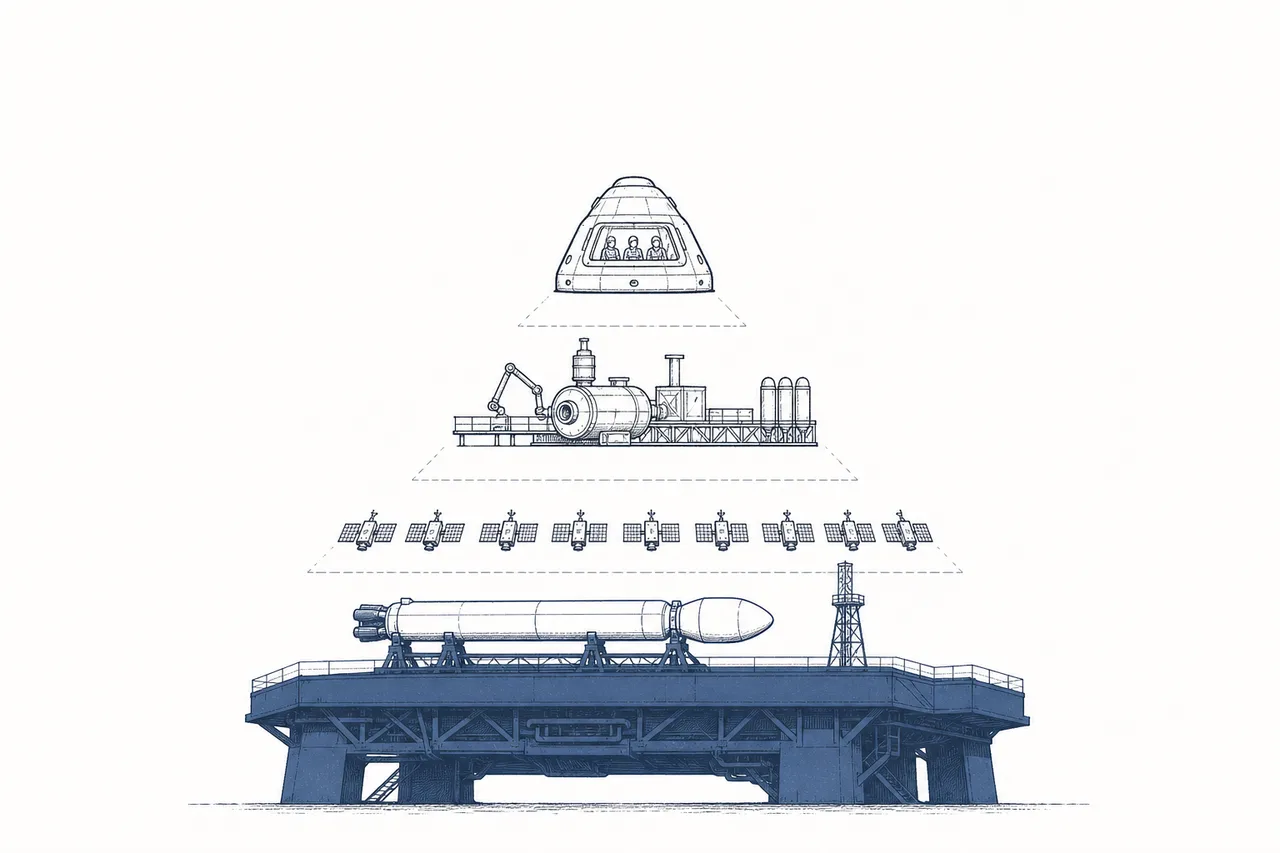
If Space Economy is a whole city, launch is the roads and ports that everything has to pass through. No roads, no shops, no factories, nothing — it's the branch furthest "upstream," propping up all the others.
- Feeds Satellite Connectivity directly: internet constellations like Starlink, with thousands of satellites, would be impossible if the cost to orbit were still as high as before — in 2025, 123 of Falcon 9's 165 flights were its own Starlink missions, showing that launch and constellations are engines that drive each other
- Lifts Satellite & Spacecraft Manufacturing into the sky: a finished satellite only reaches orbit if there's a rocket to carry it — as launch gets cheaper, makers can design satellites to be "cheaper and more numerous," changing how satellites are built
- The boundary with Space Defense: civilian and military rockets use the same basic technology (a rocket = a missile carrying cargo instead of a warhead), so major launch providers have customers on both the commercial and Defense Department sides — security demand is a big, steady revenue source for this industry
- Depends on raw materials and the supply chain: rocket engines need special heat-resistant alloys, which makes propulsion sensitive to strains in the global supply chain
05Where it stands now
2025 was the "busiest year in history" for space. The world attempted 329 orbital launches (about 321 reached orbit), up about 25% from the year before, with the U.S. at 193 and China at 92 — those two countries together making up 88% of all launches worldwide.
But the most shocking number is this — almost all of the U.S. side came from a single company. SpaceX launched 165 Falcon flights in 2025 (a new record), more than the rest of the world combined and nearly twice all of China. Put simply, one company launched more than once every two days, while about 85% of all U.S. launches were SpaceX missions.
And the biggest event for the industry in 2026 didn't happen on a launch pad — it happened on the stock market. In June 2026, SpaceX listed on Nasdaq under the ticker SPCX, becoming one of the largest IPOs in capital-market history, priced at $135 a share, valuing the company at about $1.75 trillion, and closing day one around $161 (up about 19%). Crucially, Starlink — the company's most profitable internet-satellite business — trades inside SpaceX and was not spun off in a separate IPO, meaning this is the first time ordinary investors can directly buy the "real market leader" of space, after previously only being able to through smaller challengers.
Another interesting business model is "ride-share." Instead of a small customer chartering an entire rocket (too expensive), SpaceX runs Transporter flights where dozens of small satellites from many operators "share the ride," starting at about $350,000 per 50 kilograms (~$7,000/kg) — like switching from "chartering a whole tour bus" to "buying a city-bus ticket." The price is so cheap that a rival executive admitted it "is the price that created the entire small-satellite market."
What about everyone else? Rocket Lab is the clearest challenger, with its small Electron rocket focused on small, "express delivery for one specific spot" missions — in 2025 it posted record revenue of $602 million (up 38%) with a backlog surging to $1.85 billion (rising to $2.2 billion in early 2026). Its single most important next step is the larger rocket, Neutron, designed to be reusable to take on Falcon 9 head-on — though its first flight has slipped to late 2026.
06The road ahead — the bet called Starship
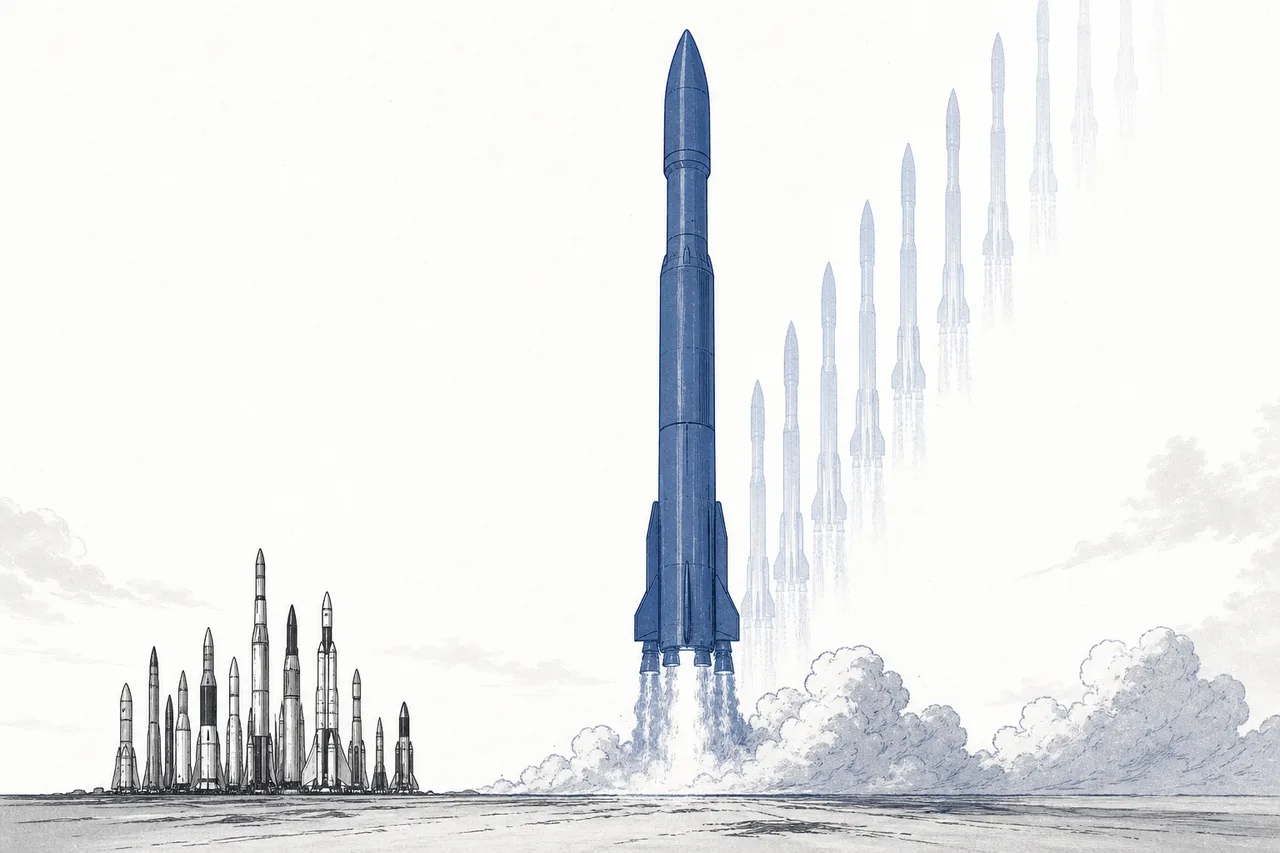
If Falcon 9 cut costs by 95%, Starship intends to cut them another big step — the goal is a rocket that's fully reusable (both lower and upper stages, throwing nothing away), carrying more than 100 tons to orbit at a time. If it works as targeted, it will push the price per kilo down into the "low hundreds of dollars" — once again changing every equation in space.
But Starship is still proving itself through real testing. By mid-2026 it had flown 12 test flights — 7 successes, 5 failures. Flight 12 (May 2026) was the first flight of the more powerful new "Version 3" Starship, and achieved its target splashdown in the Indian Ocean — a major step, but it still has a lot to prove on "routine commercial reflight."
The second direction is competition that's about to tighten. Today SpaceX is nearly a monopoly, but several reusable heavy rockets are coming — Rocket Lab's Neutron, Blue Origin's New Glenn. If any one of them succeeds commercially, the market gets a second option — good for customers and for the stability of the whole space supply chain.
The third direction is "a cheaper price will awaken new demand we can't yet imagine." Every time shipping costs drop tenfold, things that were "too expensive before" become businesses — orbital factories for special materials, private space stations, space tourism. All of them are waiting for launch's "price floor" to fall low enough. That's why this node is the "accelerator" of the whole Space Economy.
07Challenges & risks
The appeal of launch comes with its own heavy risks.
The first risk is concentration in SpaceX. When one company launches more than the rest of the world combined, the whole space system hangs on a single player. If SpaceX stumbles (for any technical, legal, or business reason), nearly every satellite constellation and space mission stumbles with it — this is the "single point that, if it breaks, hits the whole system," and the reason many governments want a more diverse set of routes to space.
The second risk is that it's a hugely capital-hungry business with no room for error. Developing a new rocket takes billions of dollars and many years, and failure is plain for all to see — Starship has still failed 5 of 12 flights, Neutron has slipped again and again, New Glenn has only just started flying. Companies without deep enough pockets run out of steam before the finish line, leaving only a handful of real players in this arena.
The third risk is SpaceX's own dependence on Starship. Nearly all of the next round of cost cuts is tied to Starship, which is still "unproven." If it's delayed or falls short of its cost target, the whole industry's expectations (and the downstream businesses planned on the assumption that "space will get cheaper still") may have to slip too — the target of $100/kg is still a "target," not a price proven in the real market.
In short: Launch Services & Propulsion is the story of "the ticket price to space" falling more sharply than ever in history, thanks to a single idea — stop throwing rockets away, and bring them back to fly again. This cost collapse didn't just grow launch, it unlocked the rest of the entire space economy. To fully understand this node is to understand why "a rocket that can land itself and be recovered" is the image that changed the meaning of the words "going to space" forever.