Megatrend · Energy
When AI got hungry for power, the world turned back to gas
Solar and wind keep getting cheaper — but they show up in fits and starts. And AI data centers need power that's "on, 24 hours a day, no interruptions." The result: demand for natural gas and gas turbines has exploded all over again. The order queue for turbines now stretches past 2030, and gas is being called a "bridge fuel" that carries us across to a clean-energy world — or maybe a trap that drags us back into fossil fuels for another 30 years.
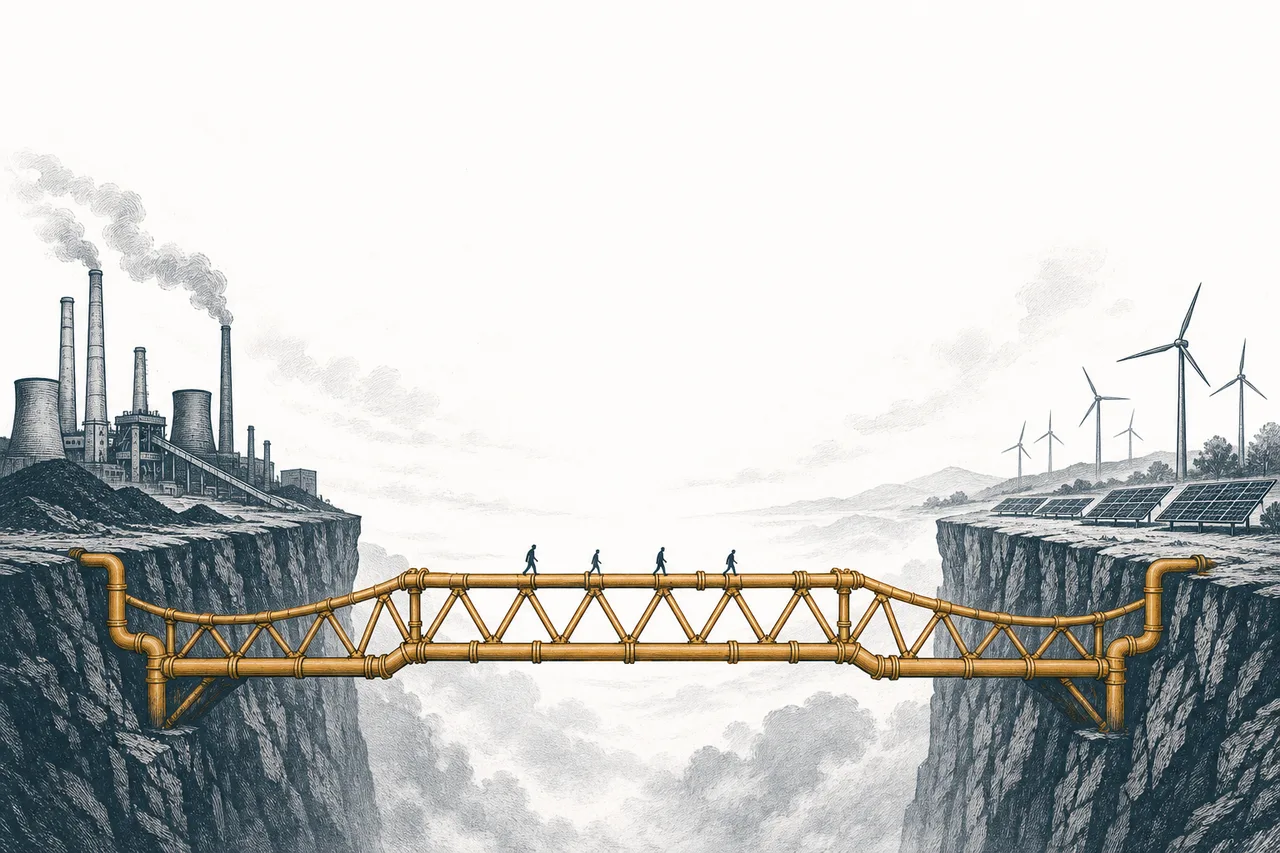
01What it is: "power you can dispatch" vs "power at the mercy of the sky"
Picture flipping on a light at 2 a.m. on a pitch-dark, windless night — it still has to come on. That's something we all demand from the power system without realizing it: electricity has to arrive when we need it, not when nature feels like providing it. And that's the heart of this node.
The energy world splits power sources into two big camps:
- Power you can dispatch (firm / dispatchable): electricity you can "turn on, off, ramp up, ramp down" at will, whatever the sky is doing — natural gas, nuclear, and hydro are in this group. It's the backbone that keeps the grid from going dark
- Power at the mercy of the sky (intermittent): sun (solar) and wind — cheaper every year and clean, but they only generate when there's sun and wind. No sun at night; no wind on a still day
This node — Firm Power & Transition Fuels — is about that first kind of power, especially natural gas in its role as the "bridge fuel" that keeps the system reliable while solar and wind slowly scale up. And lately it's caught a second wind from the enormous electricity demand of AI data centers.
Dispatchable = grid operators can tell a plant to ramp up or down within minutes, to match demand that rises and falls all day · Intermittent = generation depends on the weather, with no control over timing, so something else always has to "back it up" — and right now most of what's backing it up is gas.
On the megatrend map, this node is a sub-theme of Energy Transition & Power Demand, with two child topics that are two sides of the same coin — the natural gas value chain (from the drilled well to the turbine) and behind-the-meter power, where customers build their own power plant right next to the factory. We'll unpack both sides in this lesson.
02Why it matters: the reliability wall the grid can't get past
It starts with a number that sounds boring but flipped the whole industry: for almost 20 years, US electricity use barely grew at all — because devices kept getting more efficient and the economy shifted from factories to services. Then AI arrived — and the data centers that train AI models eat power at a scale no one had ever seen.
The EIA (the US Energy Information Administration) expects 2024–2027 to be the strongest four-year stretch of electricity-demand growth since 2000 — demand that slept for almost two decades, suddenly waking up all at once.
The catch is that the demand shows up fast and "all the time" — data centers run 24 hours, they don't pause for the sun and wind. So feeding a load like that on solar and wind alone is hard, because you need backup power when the sky is dark and the wind is still. The thing you can build fastest, scale biggest, and dispatch most reliably right now is natural gas.
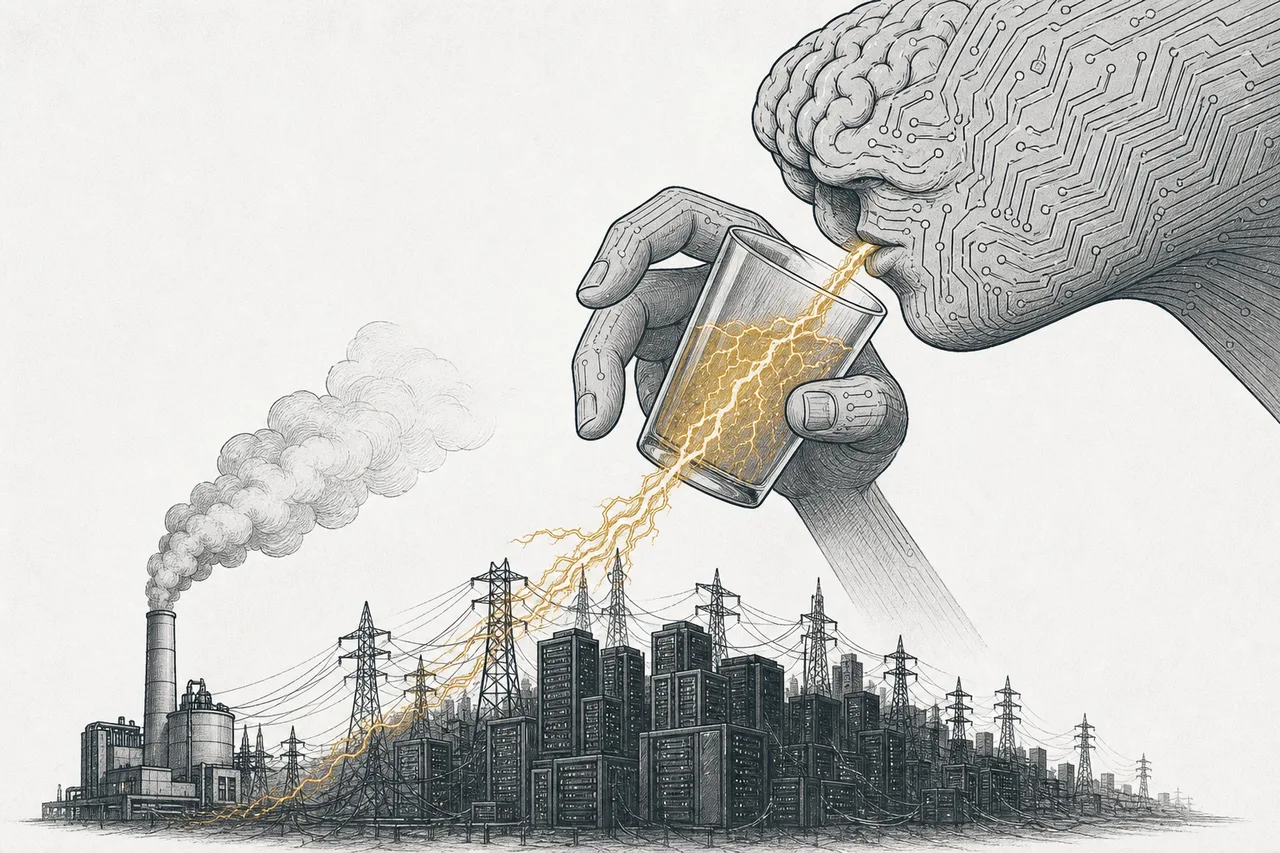
That's why a node that sounds "old-fashioned" — natural gas — became one of the hottest stories in energy in 2025–2026. It isn't about the past — it's what decides whether hundreds-of-billions-of-dollars worth of AI data-center plans are actually buildable.
03How it works: the gap a gas turbine steps in to fill
To see why gas is indispensable, you have to look at what grid engineers call "the gap." Within a single day, electricity demand rises and falls constantly, peaking in the evening (people come home, switch on the AC and the lights) — but the sun disappears right at sunset, and wind is unreliable. The result is a "gap" between the power solar and wind can produce and the power people actually need.
The gas turbine's job is to step in and fill that gap on command — ramping up within minutes when the sun fades, ramping down when it returns. It's the "balancer" that keeps a system full of solar and wind steady and unbroken. Look at the figure below.
Engineering-wise, gas turbines come in two main types: heavy-duty / combined-cycle turbines, which are big, fuel-efficient, and run as the main plant, and aeroderivative turbines, adapted from jet-aircraft engines — smaller, faster to start, easier to install, and ideal for placing right next to a data center (this point matters a lot for the "behind-the-meter" power we'll talk about next).
Combined-cycle = a gas turbine that takes its waste heat, boils water, and spins a steam turbine too, for the highest efficiency — the workhorse of base-load plants · Aeroderivative = a turbine adapted from an aircraft engine, going from zero to full power in minutes, quick to install, and movable — in hot demand for the behind-the-meter power plants of data centers.
04Two sides of this story: the gas chain + behind-the-meter power
This node is made of two child topics that tell the same story from opposite angles — one is "who produces and ships the gas," the other is "who turns gas into a new kind of power."
Side 1 — the Natural Gas Value Chain
This is the whole conveyor belt, from the drilled well (E&P) → pipeline transport (midstream) → turbines that burn gas into power → and the export endpoint in the form of LNG (liquefied natural gas). The hottest part of this chain right now is the gas turbine, which is severely short. Just three makers — GE Vernova, Siemens Energy, and Mitsubishi Power — control over 75% of the world's large-turbine market, and all three have order queues stretching to 2028–2030.
The other end of the chain is LNG — chilling gas until it turns liquid so it can be shipped across oceans and sold to Europe and Asia. In just a few years the US became one of the world's biggest LNG exporters, and it's expanding export capacity fast — which tightens domestic gas demand even further.
Side 2 — Behind-the-Meter & On-site Power
This is the new idea AI made possible: instead of waiting to plug into the public grid, data-center companies build their own gas power plant right next to the facility (aeroderivative turbines or fuel cells) and use that power directly, without going through the utility's meter — that's "behind-the-meter."
Why do this? Because connecting to the public grid takes an incredibly long time. A project aiming to deliver power in 2025 has to wait an average of more than 2,100 days (almost 6 years) in the grid-connection queue — and in the end about 80% of requests get withdrawn for taking too long. A behind-the-meter gas plant, by contrast, can be finished in just ~15 months. For companies racing to open AI centers before rivals, time is everything.
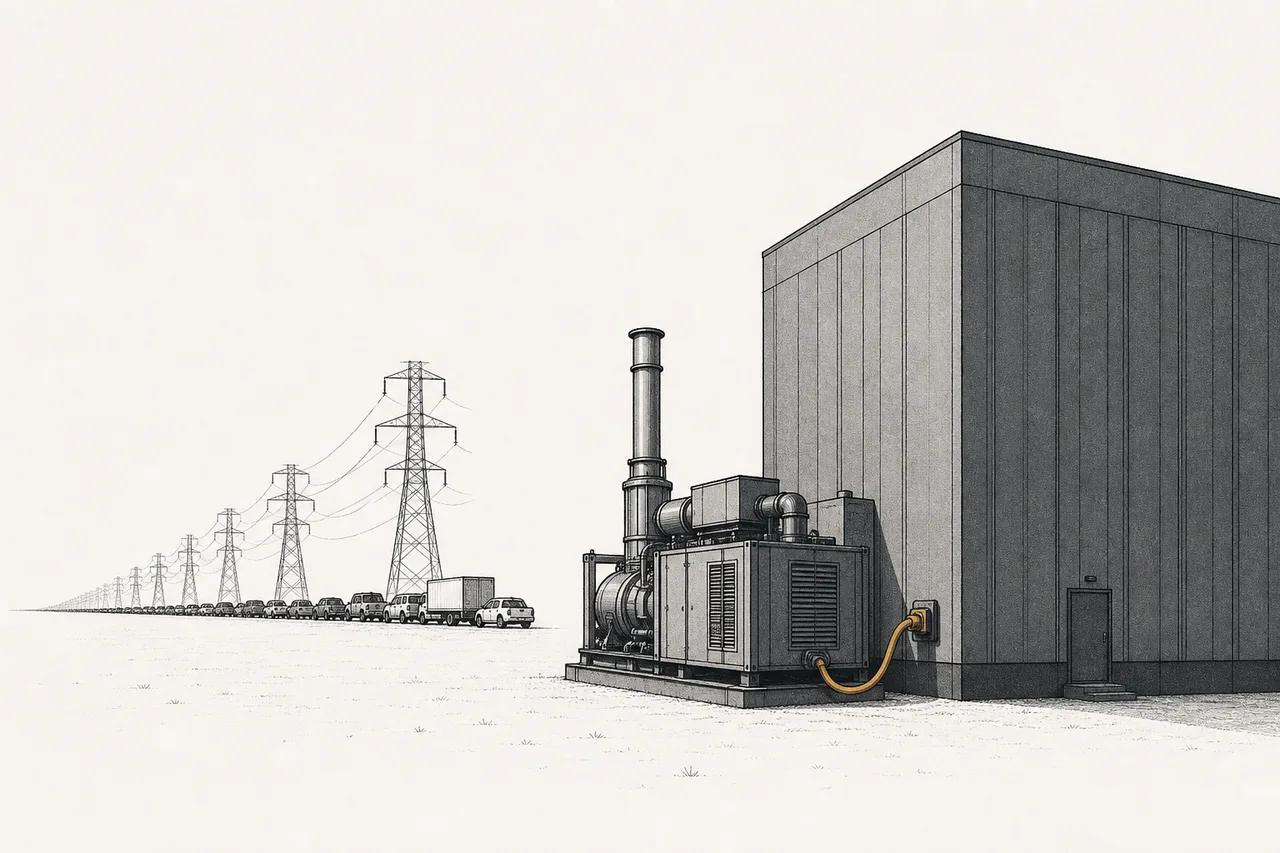
A 2026 survey of data-center developers found 56% are considering generating their own power on-site as a key strategy. And in February 2026, regulators like PJM/FERC started issuing rules that allow power plants to sit right next to data centers (colocation) — a sign that this isn't a temporary shortcut, but is becoming a permanent feature of the industry.
05Where it sits on the energy map
This node doesn't stand alone. It's the "reliability" piece in the bigger puzzle of Energy Transition & Power Demand, and it's deeply tied to its sibling nodes:
- Competes with and complements Nuclear Generation: nuclear is also clean, dispatchable power that runs 24 hours. Many data-center deals pick nuclear as their base power — but a new nuclear plant takes a decade-plus to build, while gas takes a few years. In the short run, gas wins on speed
- Depends on Grid & Transmission: power you generate needs "wires" to deliver it — and it's exactly this transmission bottleneck that pushes data centers to make their own power behind the meter
- Feeds AI Data Center: this is the real customer that lit the whole trend on fire — electricity demand from AI data centers is the main reason gas came back as a star
- A bridge to Hydrogen & Fuel Cells: many new-generation gas turbines are designed to "blend in hydrogen" in the future — the argument makers use to claim today's gas infrastructure won't become junk when the world shifts to hydrogen
The most interesting tension sits right here: gas is both a partner and a rival of solar and wind. It helps solar and wind expand (by filling their gaps) — but at the same time, every new gas plant built is a fossil source that will keep emitting carbon for another 30–50 years. That's the core of the "bridge-fuel debate" we'll go deep on in the risks chapter.
06Where it stands now + who the players are
The 2025–2026 picture sums up in one word: shortage. Gas-turbine demand is so strong that makers are sold out years in advance.
Market leader GE Vernova closed 2025 with a gas-turbine backlog of about 83 gigawatts, surging to 100 gigawatts in the first quarter of 2026 — while its actual production capacity is only around 10 gigawatts a year. That means this backlog is "a decade's worth of work." The CEO says the order queue is likely full through 2030. By the end of 2026, the price of new-order turbines had risen 10–20% per kilowatt versus late 2025.
The same thing is happening at every maker. Siemens Energy has a record order book of €154 billion, with about 60% of its 2025 gas-turbine orders tied to data-center projects. Mitsubishi Power says plainly that a turbine ordered today won't arrive until 2028–2030. Overall, the wait for a gas turbine has stretched to 5–7 years on some models.
On the other end of the chain, LNG is growing just as fast, with big exporter Cheniere Energy setting a new record in 2025 (you can go deep on the whole gas–LNG chain at Gas Value Chain).
And the other pole of this node — behind-the-meter power — is exploding too: in 2025 alone, more than 50 gigawatts of on-site generation projects were announced. The standout is fuel cells like Bloom Energy, which can deliver 100 megawatts of power in ~90 days — far faster than turbines with queues stretching to 2028 (see → Behind-the-Meter).
07The road ahead
The first direction is the cycle of "shortage." All three turbine makers have announced they'll expand capacity 25–35% a year starting in 2026 — but even if they all pull it off, total capacity rises only about 20–25%, still far behind demand. That means the backlog and high prices are likely to stay with us for years. Good news for turbine-makers' margins, but a hard problem for data-center companies fighting over the supply.
The second direction is behind-the-meter power going mainstream. As PJM/FERC's colocation rules get clearer and aeroderivative turbines and fuel cells become easier to get, "building your own plant" won't be an emergency option — it'll be the normal pattern for large data centers, significantly changing how the world builds and delivers power.
The third direction is the hydrogen bet. New-generation turbines are designed to burn gas blended with hydrogen (and maybe pure hydrogen in the future). It's the card makers play to answer the carbon question — if it actually works, today's gas plants get "cleaner" in the future without being torn down. But if cheap hydrogen doesn't arrive in time, the promise stays just a promise.
08Challenges & risks
The appeal of a "bridge fuel" comes with deep-rooted risks — and we have to talk about them honestly.
The first risk is "bridge" or "trap"? Climate critics point out that gas infrastructure — pipelines, plants, LNG terminals — has a working life of 30–50 years. Every facility built today is carbon locked in for decades. They call it "carbon lock-in" — instead of a short bridge to clean energy, gas could become the path that keeps us stuck on fossil fuels longer than we should. Gas also has a methane leak problem during drilling and transport — a potent greenhouse gas that erodes its "cleaner than coal" edge once you count the full life cycle.
Carbon lock-in = once you invest a huge sum in fossil infrastructure, the economy gets "stuck" with it for a long time, because the money already spent is too painful to walk away from · Stranded asset = the opposite — if the world shifts to clean energy faster than expected, a freshly built gas plant or pipeline could be forced to close before it pays back, leaving an enormous sum of money sunk — two exactly opposite risks facing each other.
The second risk is policy and rules. Gas depends heavily on politics and environmental regulation. Permits to build plants, pipelines, and LNG terminals can be blocked or fast-tracked as governments change — and that uncertainty makes long-term investment planning harder.
The third risk is gas prices and competition. The whole chain's profit is tied to volatile gas prices. If too much LNG is exported and domestic gas gets pricier, the cost of making power rises too. And over the long run, if batteries (Energy Storage) get cheap enough, fast enough, to "store solar and wind" for nighttime use economically, the need for gas to fill the gap shrinks — that's the real long-term rival of "dispatchable power."
In short: Firm Power & Transition Fuels is the story of a fuel the world once meant to phase out gradually, suddenly called back because AI got hungry for power like never before. Today it's an indispensable "bridge" — but whether it's a bridge that actually carries us across, or a trap that strands us mid-way, is the question that will decide both investment returns and the future of the global climate at the same time.