Megatrend · Energy
The cheapest electricity humans have ever made — yet the people making it get hurt
In just over a decade, solar panels made electricity from sunlight roughly 90% cheaper, until it's now the cheapest way to make power in history — and the fastest-growing energy source in the world. But there's another side to the story: China dominates almost the entire supply chain, overbuilt until the market is flooded, panel prices collapsed, and manufacturers are losing money across the board. The real profit isn't in the panel itself — it's hidden in the parts everyone overlooks.
01What solar is
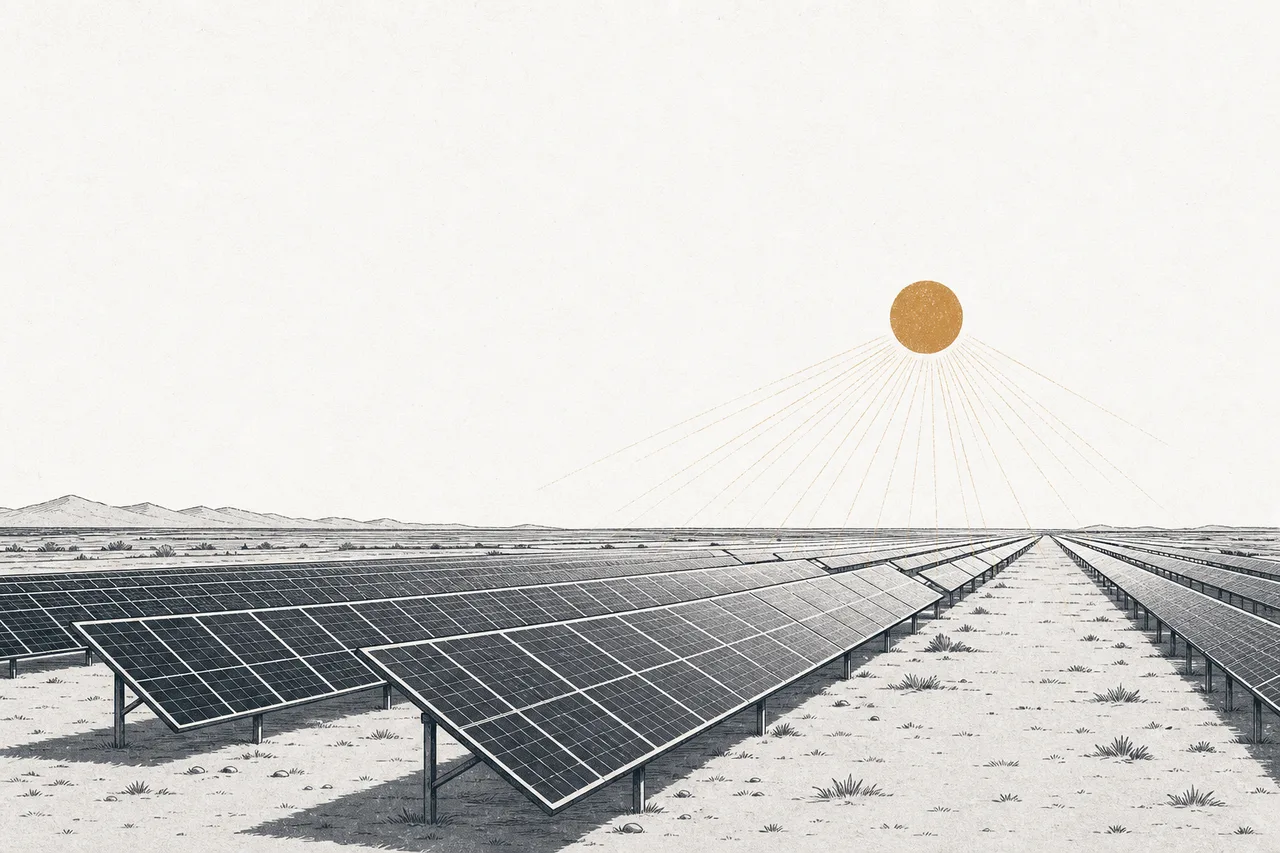
Solar PV means turning sunlight directly into electricity — no combustion, no moving parts, no smoke. You just put a sheet of silicon in the sun, and it quietly puts out a current. That's what makes it different from every power plant in history — coal, gas, even nuclear all 'boil water to spin a turbine.' Solar skips that whole step.
This node isn't just about 'the panel.' It means the whole system that makes a solar plant actually run: the panel itself (module), the device that converts the power called an inverter, the frame that rotates with the sun called a tracker, and the other parts lumped together as balance-of-system. On the megatrend map, solar is a sub-theme under Energy Transition & Power Demand — and it's the single biggest 'workhorse' of the entire energy transition.
Photovoltaic = 'light (photo) → electricity (voltaic)' — the effect where certain materials (especially silicon) put out a current when light hits them · It's different from 'solar thermal,' which uses the sun's heat to boil water — and almost all of the world's solar today is PV, turning light straight into power.
02Why it changed the world — the cheapest electricity in history
The most important thing about solar isn't that it's 'clean' — it's that it's cheap, shockingly cheap. Between 2010 and 2024, the cost of utility-scale solar power fell about 90%, to a global average of roughly $0.043 per unit (kWh), and in the best markets like China and India it dropped to ~$0.033. By 2024, solar power was 41% cheaper than the cheapest fossil-fuel option. That's why ~91% of the new generating capacity built that year was renewable power that costs less than fossil fuels.
Why does the price keep falling like this? The answer is something called the 'learning curve' — every time cumulative production doubles, the cost per unit drops by a fairly constant percentage. The more panels the world makes, the cheaper they get; the cheaper they get, the more people buy; and then the more get made. It's a loop that spins faster and faster. Unlike coal or gas, whose price is tied to the 'fuel' you dig up and burn, solar has no fuel cost — sunlight is free. Almost all the cost is 'stuff made in a factory,' which keeps getting cheaper with scale.
The result is growth almost no energy technology can match. In 2024, the world installed about 602 gigawatts (GW) of new solar, up 32% from the year before, pushing cumulative capacity past 2 terawatts (TW) for the first time. By the end of 2025, the cumulative figure climbed to around 2,800 GW — making it the largest power-generating technology in the world by installed capacity.
03How it works (from sunlight to electricity)
At the heart of everything is the 'solar cell' — a thin wafer of silicon. The principle is amazingly simple: sunlight is made of tiny energy particles called photons. When a photon hits the silicon, it 'knocks' an electron loose. And because the cell is designed with two layers that pull electrons in opposite directions, the freed electrons all flow the same way — and that 'flow of electrons' is exactly what an electric current is.
But the electricity a cell makes is direct current (DC), which you can't use in a home or feed into the grid directly. So you need a device called an inverter to convert it to alternating current (AC). And in big plants, they mount the panels on a frame called a tracker that follows the sun all day, adding another 15–25% to the power produced. Strung together, it's a chain: polysilicon → wafer → cell → module → inverter/tracker → installation — and each of these steps is a battleground that decides who makes a profit.
Inverter = the box that converts the DC from the panel into usable AC. It's the 'brain' of the system, controlling voltage and frequency and talking to the grid · Tracker = the mechanical frame that tilts the panels to follow the sun all day, capturing as much light as possible — both are 'smarter' parts than the panel, and often more profitable.
04The supply chain & why prices crashed
This is the core of the entire solar investment story. The panel supply chain has 4 major stages — polysilicon (pure silicon), wafer (thin sheets), cell, and module (assembled into a panel). And the most shocking fact is this: China dominates nearly every stage. In 2024, China made about 93% of the world's polysilicon, ~97% of wafers, ~92% of cells, and ~86% of modules — and the capacity now under construction will push some stages toward ~95%.
China doesn't just dominate the market — it overproduces. The wafer/cell/module capacity coming online in China adds up to enough to supply the entire world's demand through around 2032. The result was the most brutal price war in the industry's history. The price of polysilicon fell from $32.7/kg (Feb 2023) to $4.4/kg (May 2024) — more than 85% wiped out. Panel prices plunged to just $0.07–0.09 per watt, the lowest ever.
Cheaper prices are tremendous good news for the 'buyers' (project owners, installers, power users), but a disaster for the 'makers.' In the first half of 2024, China's four big manufacturers lost a combined $1.54 billion, and the average EBITDA margin of China's top 5 makers fell from 12.4% to just 4.7%. Some companies like Daqo had gross margins as low as -66% — meaning they couldn't even cover the cost of raw materials with what they sold.
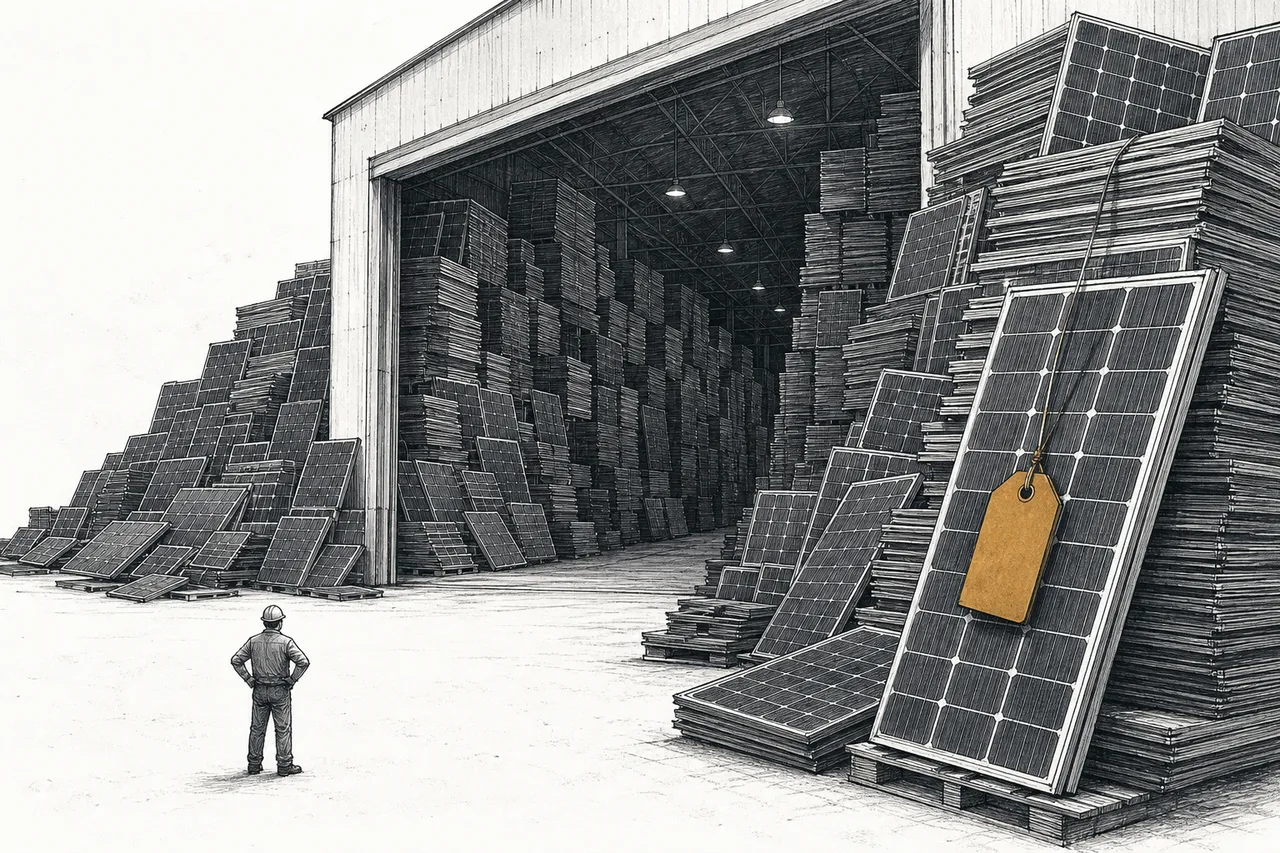
This is the core lesson of solar: the panel itself became a 'commodity' — identical product, competing purely on price, anyone can make it, so no one has pricing power. The real profit isn't in the panel but in the parts that are 'harder to copy' — inverters, trackers, and specialized technology. It's a point this lesson will come back to when we talk about the real players.
05How it connects in the energy ecosystem
Solar doesn't stand alone. It's one piece of the bigger picture, Energy Transition & Power Demand, and it's deeply connected to other trends:
- The inseparable partner of Energy Storage & Grid Flexibility: the sun is only out during the day, and unreliably — so solar on its own is 'unstable.' Batteries are the part that stores the surplus power during the day to deliver it at night. Today solar and storage almost always come as a package deal
- Relies on Grid & Power Equipment: power from a solar farm in the middle of the desert needs transmission lines and substations to carry it into the city. Solar expanding faster than the grid can absorb is the real bottleneck in many countries
- Feeds demand from AI and data centers: AI data centers are ravenous for power and want cheap, clean electricity that can be built fast — solar (+ storage) is the answer you can build quickest, which makes AI's power demand a new pull on solar
- Drives Electrification & Mobility: an EV charged with solar power takes oil out of the travel equation entirely
- Depends on Critical Materials: from special-grade silicon to the silver in the cells and the copper in the wiring — solar is sensitive to material prices and supply restrictions
- Converges with Semiconductors: a solar cell is a form of silicon processing too — a different production line from chips, but sharing the same knowledge base and raw materials
06Where it stands now + the real players
The 2025–2026 picture splits clearly into two worlds heading in opposite directions. The world of 'installation' is still booming — China alone installed nearly 370 GW of new solar in 2025. Meanwhile the world of 'manufacturing' is bleeding: makers are losing money, shutting down lines, and waiting for prices to recover. Late in 2025 the Chinese government stepped in to impose order, ordering production cuts and scrapping export tax breaks — which sent polysilicon prices up 48% in a single month (Sep 2025), with panel prices expected to rise ~9% in Q4 — the first sign the price-crash cycle may be hitting bottom.
This is where 'who sits where in the supply chain' matters more than who's bigger. China's giant panel makers like LONGi, JinkoSolar, and Trina control the world's production volume but are stuck in a price war with razor-thin profits — while the players who could 'escape the commodity battlefield,' with proprietary technology or a position in hard-to-copy parts, are making far more money.
07The road ahead
The first direction is solar getting much bigger still. Many institutions think the world could reach 1 terawatt (1,000 GW) per year of installs by around 2030 — almost double 2024. The new demand comes from every direction: electricity for EVs, electrifying industrial heat, and the hottest of all, AI data centers that urgently want cheap, clean power.
The second direction is 'solar has to pair with batteries'. Once solar starts supplying more than ~20% of the system in many areas, the 'too much at noon, not enough in the evening' problem (the duck curve) gets sharper, forcing some surplus power to be thrown away (curtailment) at times. So solar's future is inseparable from the growth of batteries and the grid — in the US in 2025, solar + batteries together made up over 80% of all new generating capacity.
The third direction is 'spreading production out of China'. The US (through the IRA and import tariffs), India, and Europe are all trying to build their own supply chains. First Solar is a prime example of a company benefiting directly from this trend. But building an entire new chain that can compete with China's costs is a job that takes years and enormous money — and the higher cost lands on power users in those countries.
08Challenges & risks
Solar's appeal — cheap and fast-growing — comes with risks baked deep into its own structure.
The first risk is the 'commodity trap and oversupply.' Because panels are all identical, competition always ends up on price, and as long as China holds enough capacity to supply the world for years, the price war could drag on. Many makers will keep losing money or disappear. So investing in the 'panel makers' is more dangerous than it looks — an industry growing doesn't mean its manufacturers will profit.
The second risk is 'the sun is fickle, you have to lean on others.' Solar can only generate when the sun is out. The higher its share of the system, the more it needs batteries and a flexible grid to back it up. If investment in storage and transmission can't keep pace, solar's growth will hit a ceiling — wasting both power and money for nothing.
The third risk is 'geopolitics and trade barriers.' With the supply chain concentrated almost entirely in China, every tariff hike, every ban, every trade tension shakes prices and supply instantly. Policy that swings back and forth (import tariffs, tax credits cut or extended) makes long-term planning hard for companies — and can make something that 'should be the cheapest in the world' actually more expensive in some countries because of tariff walls.
In short: solar is one of the greatest success stories in energy technology — humans made electricity so cheap it became the lowest-cost way to make power in history, and grew so fast it now dominates the world's new electricity. But hidden inside that success is a classic capitalism lesson: when something is cheap and anyone can make it, the real winner isn't the one who makes the most, but the one who finds a place to stand that no one else can copy.