Megatrend · Electrification & Mobility
The people who roll the “bricks” of an EV — and why only the biggest factory still makes money
The lithium-ion cell is the most expensive part of an electric car, and today only a handful of companies can build it at a scale cheap enough to compete. This lesson walks through how a single “cell” is made, why just two chemistries (LFP and NMC) decide who gets rich and who goes bust, and why — in a market so flooded with overcapacity that prices are crashing — CATL alone still earns tens of billions of dollars a year while the Korean giants bleed deep losses.
01What it is — the cell is the heart, and the costliest part
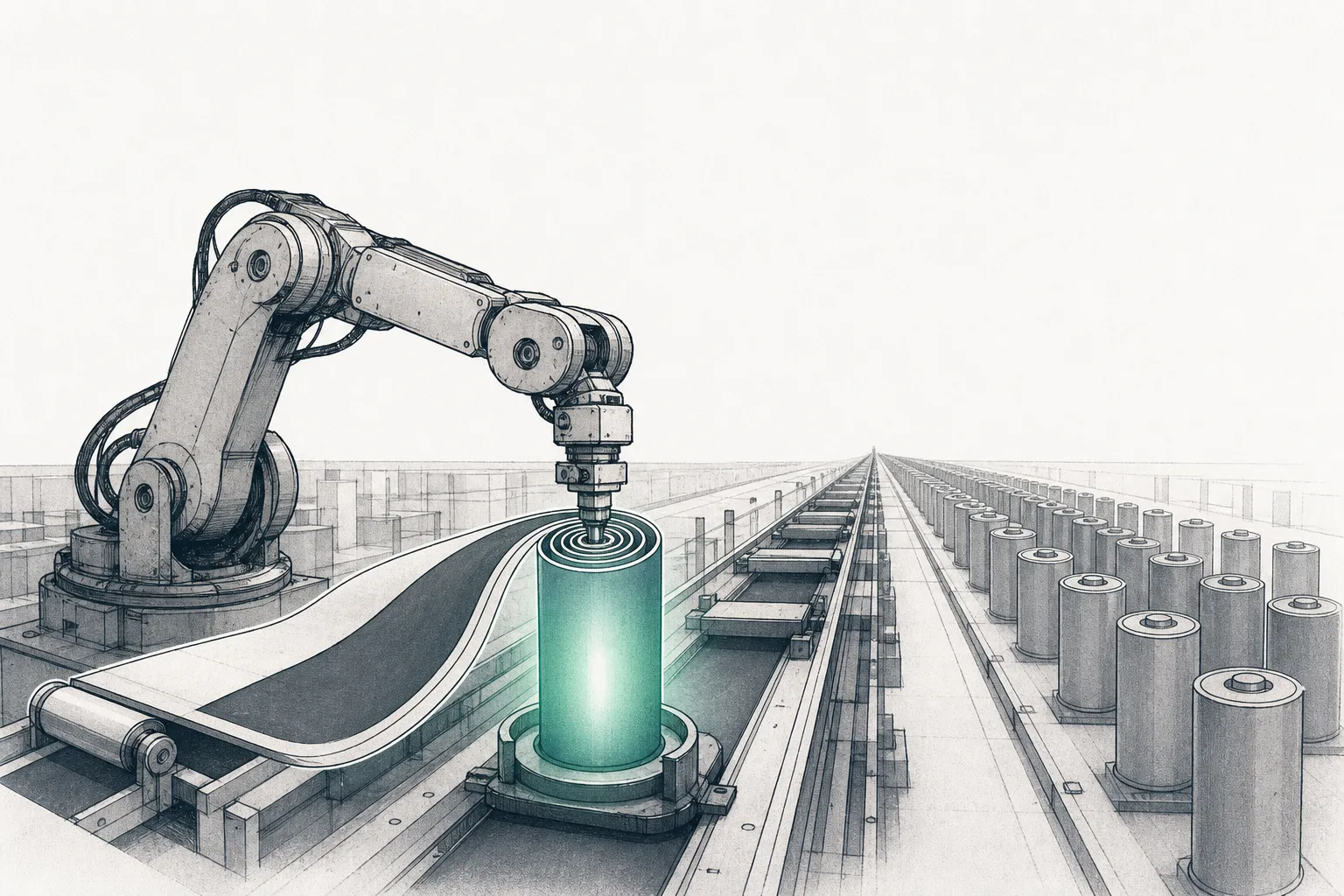
When we say “EV battery,” it sounds like one single thing. But it's really thousands of small blocks called cells assembled together. A cell is the smallest unit that can actually store and release electricity — shaped like a fat AA battery (cylindrical), a flat pouch, or a box (prismatic). This node — Incumbent Li-ion Cell Makers — is the group of companies that make the “lithium-ion cells” actually used in the market today, at giant-factory scale.
The word incumbent (the established market leader) matters here — because it points specifically to who rules the field right now with proven “liquid-electrolyte” lithium-ion technology, made by the billions, not a lab technology. Next-generation cells like solid-state or silicon-anode that might flip the game next decade are the business of the sibling node, Next-gen Cells — this lesson focuses on “who's making money right now.”
On the megatrend map, this node is a branch under Battery Cells & Pack Manufacturing, within the larger trend Electrification & Mobility. If the battery factory is “the layer that captures the most value in an EV,” this node is the people who actually build the hardest and most expensive piece of that layer — because within the whole battery pack, the “cell” alone eats about 77% of the cost. The rest is just the box, the wiring, the cooling system, and the battery management system (BMS).
One cell has four main parts: cathode = the positive electrode, where lithium is stored; it takes about half the cell's cost because it uses expensive minerals · anode = the negative electrode, mostly made of graphite · electrolyte = the liquid that carries the charge back and forth · separator = a thin sheet that keeps the two electrodes from touching. When charging, lithium ions move from the cathode and lodge in the anode; when in use, they move back — and that's all there is to storing and releasing power.
02Why it matters — 30–40% of the car, and China rules
The reason everyone fights to make cells comes down to one sentence: it's the most expensive part of an EV. The battery pack takes up about 30–40% of the whole car's price — more than the engine of a gasoline car. And within that pack, the cell is the single biggest cost. The result: whoever can control the cheapest, best cell controls the cost of the whole car, and holds enormous leverage over the automakers.
This market is huge and growing fast. EV battery volume installed worldwide jumped from 901 GWh in 2024 to 1,187 GWh in 2025 (+32%). That's demand growing about a third every year — and that's cars only, not counting the energy-storage (ESS) market, which is growing even faster.
But the most shocking thing about this node is the concentration of makers. The whole world depends on cells from just a few companies, and almost all of them are in East Asia — in order of size, China > South Korea > Japan. In 2025, Chinese companies together controlled about 69% of the global EV cell market, with CATL and BYD alone past half the world. The rest is Korea (LG, Samsung SDI, SK On) and Japan (Panasonic). This isn't just a business story — it has become a strategic pressure point for the global economy, because the entire transition to electric vehicles hinges on who can make the cells.
03How it works — how a single cell comes to be
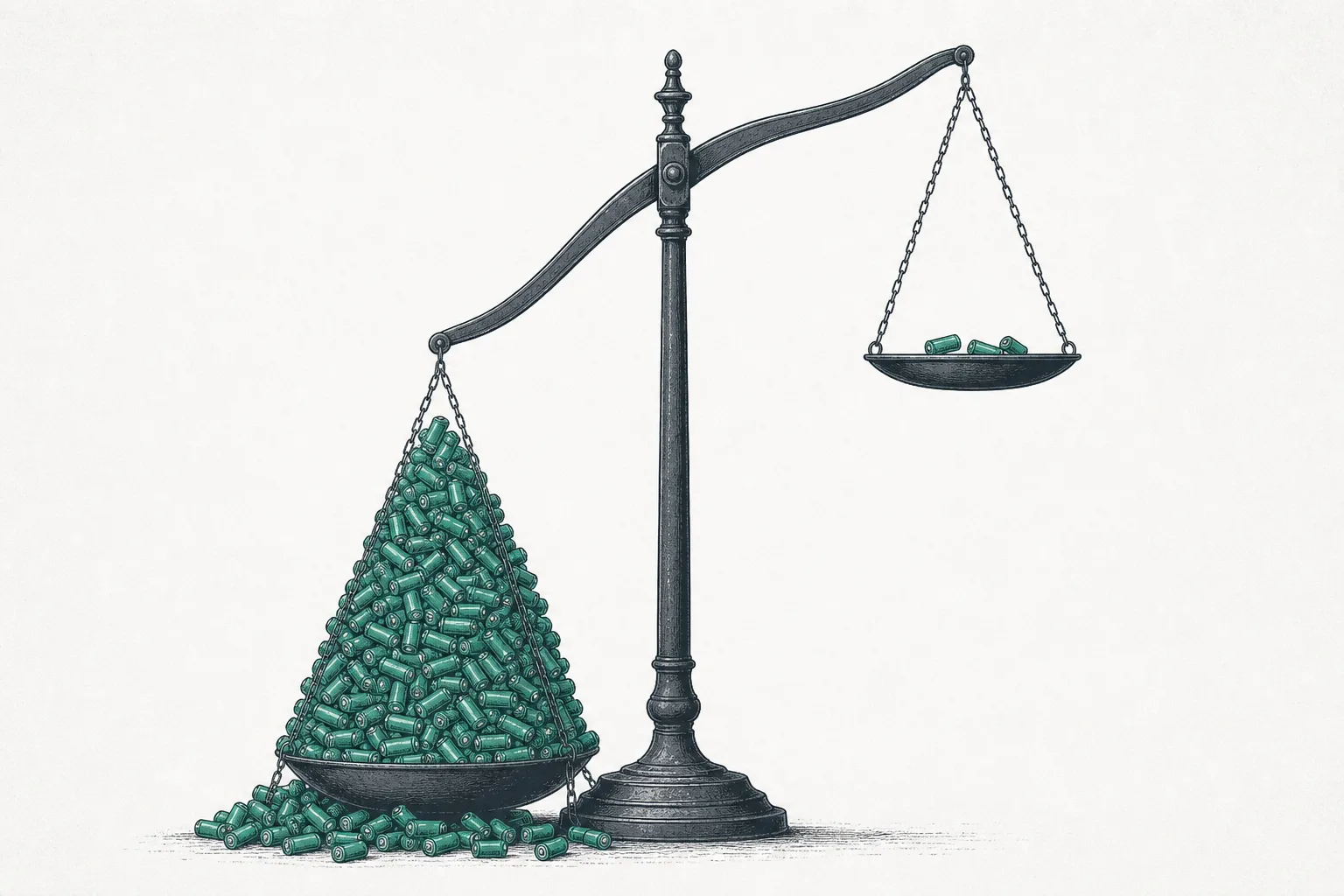
Making a cell isn't a one-shot “casting.” It's a continuous production line that has to be as clean as a chip factory. Let's trace it step by step — how chemical powder becomes a block that stores electricity.
Step 3 is the one that decides the cell's “shape”: if you wind it into a round roll like a roll of paper, you get a cylindrical cell, the kind Tesla and Panasonic use. If you wind it and then press it flat into a steel box, you get a prismatic cell, the kind CATL and BYD favor. If you stack the sheets in layers like a sandwich, you get a soft pouch cell, the kind LG likes to use. Each shape has different strengths in heat dissipation, energy density, and manufacturing cost.
The final step, formation (the first charge), is surprisingly both time- and capital-hungry — every new cell has to be carefully charged and discharged to form a thin protective film inside it (called the SEI). Get it wrong and the cell degrades fast or becomes dangerous. This step takes enormous factory space and investment, and it's one of the places makers compete to cut cost — which is why “making a cell” isn't just having a chemical recipe, but a game of high-end manufacturing engineering that newcomers find hard to copy.
04Ecosystem — it eats raw materials, feeds automakers, hands off to the next generation
Cell makers sit right in the middle of the entire EV supply chain — with clear flows coming in and going out.
- It eats materials from Battery Components & Materials: cathode, anode, electrolyte, separator are the “upstream” that sets half the cell's cost — and beyond that, the raw minerals like lithium, nickel, and cobalt in Critical Materials & Supply Chain. When mineral prices move, the cell's cost shakes immediately
- It feeds cells to automakers (OEMs): EV makers are the main customers, and because the battery is 30–40% of the car, whoever controls the cell has high leverage. Some makers (Tesla, BYD) even make their own cells so this big profit doesn't slip away
- It's a sibling to Energy Storage: the same cell (especially LFP) is also used to store power for the grid and data centers (BESS) — and this market is becoming a “second leg” that props up sales when EVs slow down
- It hands the baton to Next-gen Cells: the field this node competes in is proven “liquid-electrolyte” lithium-ion, while next-gen cells like solid-state are an evolution that may replace it in the future — many incumbent leaders invest in the next generation themselves so they don't get leapfrogged
Crucially, this node also connects two ways with the whole Electrification & Mobility trend: if cells don't get cheaper, EVs will never be cheap enough to replace gasoline cars. So the cell is the “door-opener” of the entire transition — and the price per kWh dropping every year is the engine that drives EV sales worldwide.
05Where it stands now — CATL vs LG vs Panasonic
The 2025 picture is shockingly clear: China dominates the cell game outright. CATL holds a 39.2% share of the global EV cell market, followed by BYD at 16.4% — the two Chinese makers together are already past half the world. LG Energy Solution, Korea's number one, is left with about 9% in third place. This is a concentration rarely seen in an industry this big.
CATL isn't just big — it makes enormous profits at the very moment others bleed. In 2025 it had revenue of about $61B, net profit of $10.5B (up 42%), and shipped 661 GWh of batteries, with gross margin even rising to 26.3% — all while in a price war. The secret is scale and the lowest cost in the world, which lets it stay profitable at price points where others lose money.
The flip side of the coin is the pain of the Korean players, once the leaders in NMC technology. The three big names — LG Energy Solution, Samsung SDI, SK On — lost a combined ~$2.2B in 2025 (excluding U.S. tax credits). Utilization rates dropped below 50% for the first time: LG to 47.6%, SK On to 48.7%, Samsung SDI around 50%. The cause was betting the wrong way — building a business on premium NMC batteries (longer range, but expensive) while the market poured into the cheap LFP that China does better. Japan's Panasonic, tied to Tesla and strong in cylindrical cells, faces the same pressure.
LFP (lithium iron phosphate) uses no nickel or cobalt, so it's cheaper, safer, and more durable — but stores less energy per unit of weight · NMC (nickel-manganese-cobalt) goes farther and is lighter, but is pricier and runs hotter. In 2025, LFP overtook NMC for the first time globally (over 55% of EV cells), and within China itself reached over 80% — LFP packs averaged $81/kWh while NMC was at $128/kWh. When “good enough” meets “much cheaper,” the market pours toward cheap.
The price numbers are the heart of this drama. In 2025 the average lithium-ion pack price worldwide fell to $108/kWh (down from ~$117 the year before, an 8% drop) — even as mineral prices rose. The reasons: overcapacity, price competition, and the shift to LFP. China was cheapest at $84/kWh, and EV-only packs touched $99/kWh, below the “$100/kWh” line once seen as the point where EVs get as cheap as gasoline cars.
06Future — ESS, low prices, relocating production
The first direction is a second leg named ESS (energy storage). When EV production lines sit idle, cell makers redirect supply to the market for storing power on the grid and in data centers — which grows much faster than EVs. LFP makes up over 90% of batteries in the ESS market, and cell prices for ESS fall even faster (stationary storage packs dropped to just ~$70/kWh in 2025). For the Korean players with idle EV lines, this is a new lifeline. And for CATL, it's a business it already leads worldwide (ESS share ~30%).
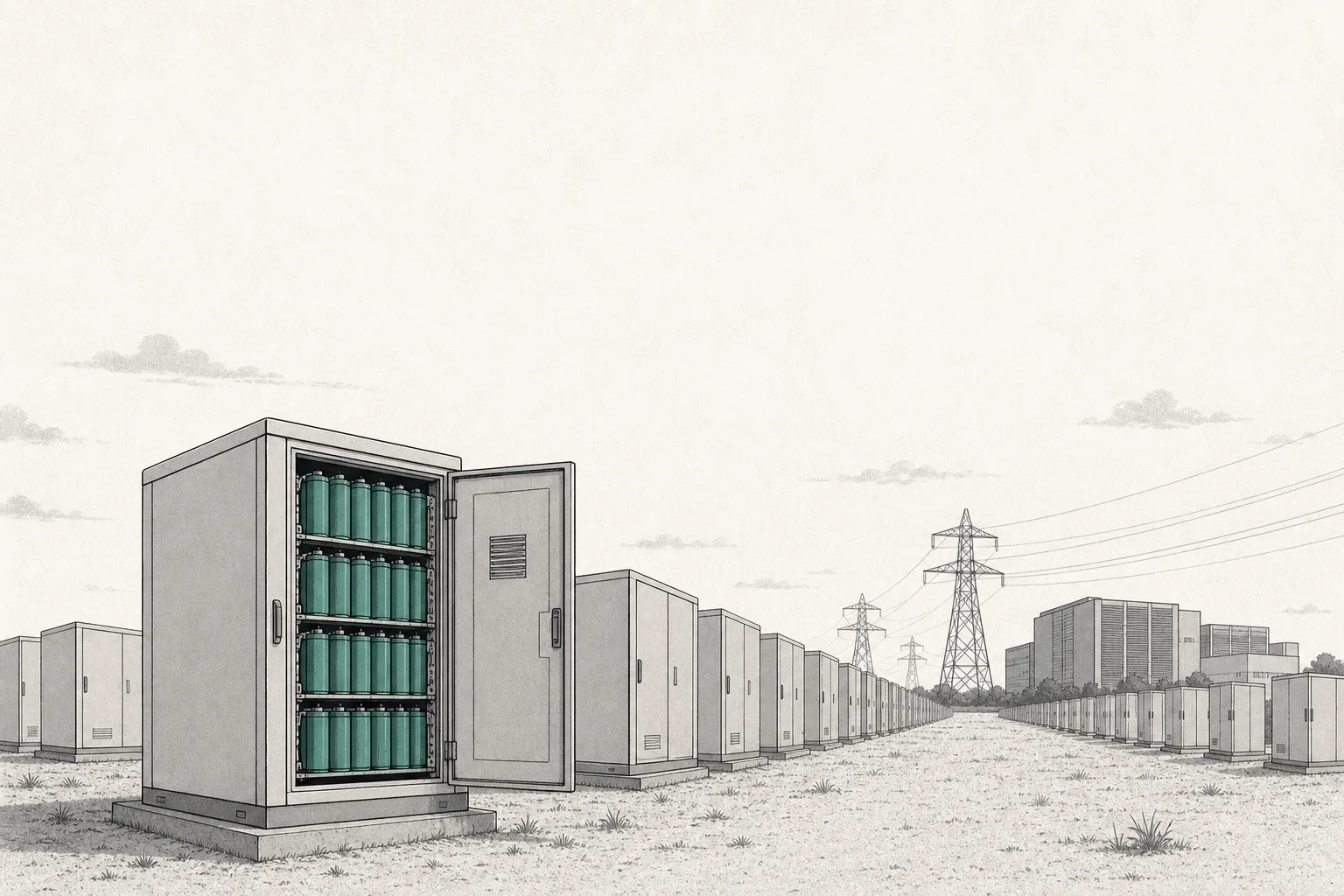
The second direction is prices keep falling and expand the market. Every time $/kWh drops, an EV moves closer to a gasoline car's price and opens up the low-cost mass-market cars that weren't possible before. This is a structural tailwind — the volume of demand keeps growing even as the price per unit falls. The winner is whoever can cut cost faster than prices fall, not whoever sells at the highest price.
The third direction is relocating production and “splitting into two worlds”. The U.S. and Europe are raising tariff and subsidy walls (like the IRA) to force cells to be built domestically, not relying on China. So Chinese and Korean makers are rushing to build factories in North America and Europe to access tax credits and dodge the walls. In the short run this is a fresh chunk of demand for building factories. But in the long run it's a parallel supply chain costing 40–56% more than China — making the “decoupling” from China both expensive and slow.
Next-generation technology like solid-state is squarely the business of Next-gen Cells. For incumbents it's both an opportunity (building on their materials expertise) and a threat (if it arrives fast, the massive lithium-ion capacity they've invested in could become obsolete) — so leaders like CATL and Samsung SDI invest in the next generation alongside, so they aren't leapfrogged by a game they aren't playing.
07Challenges & risks
Battery cells are a trend that will “grow for sure” but is “hard to profit from” — and here are the three main risks.
The first risk is overcapacity and price wars. The whole world rushed to build giant factories (gigafactories) at once, until capacity overshot real demand many times over — in China alone, nameplate capacity is several times the demand of all the world's automakers. When supply floods in, prices keep getting pushed down. Good for car buyers, brutal for makers. Even China's LFP leaders skirt losses, while Korea is actually in the red. The lesson: “growing fast” doesn't guarantee profit unless you're the lowest-cost, largest-scale player.
The second risk is concentration in China and geopolitics. When ~69% of the world's cells come from one country, the whole world depends on a single supply chain. So the U.S. and Europe are raising tariff and subsidy walls to build their own chains — but the cost, 40–56% higher than China's, makes that decoupling expensive and slow. The risk cuts both ways: if China restricts exports of technology or raw materials, the whole global EV industry shakes — but if protectionist policy shifts (say, U.S. tax credits get cut), those who invested in factories outside China are exposed too.
The third risk is choosing the wrong chemistry, at the wrong time. The Korean lesson — betting on NMC while the market poured into LFP — is a reminder that in this business, “picking the wrong chemistry” carries an enormous price. And this risk comes back around again with next-gen cells — jump to solid-state too early and you risk burning money on tech that isn't ready; too late and you risk getting leapfrogged. Survival isn't just being good at manufacturing, but “reading the chemistry-and-timing game right.”
In short: this node is the people who actually build the hardest and most expensive piece of an EV — the cells rolled and stacked one at a time in giant factories. Today China leads that game by a wide margin with cheap LFP and unmatched scale. So the big question of the next decade isn't “will EVs come” but “who will profit from their heart” — and whether a new wave like solid-state can change that answer.