Megatrend · Fusion Energy
Lighting a sun with light: the laser road to fusion energy
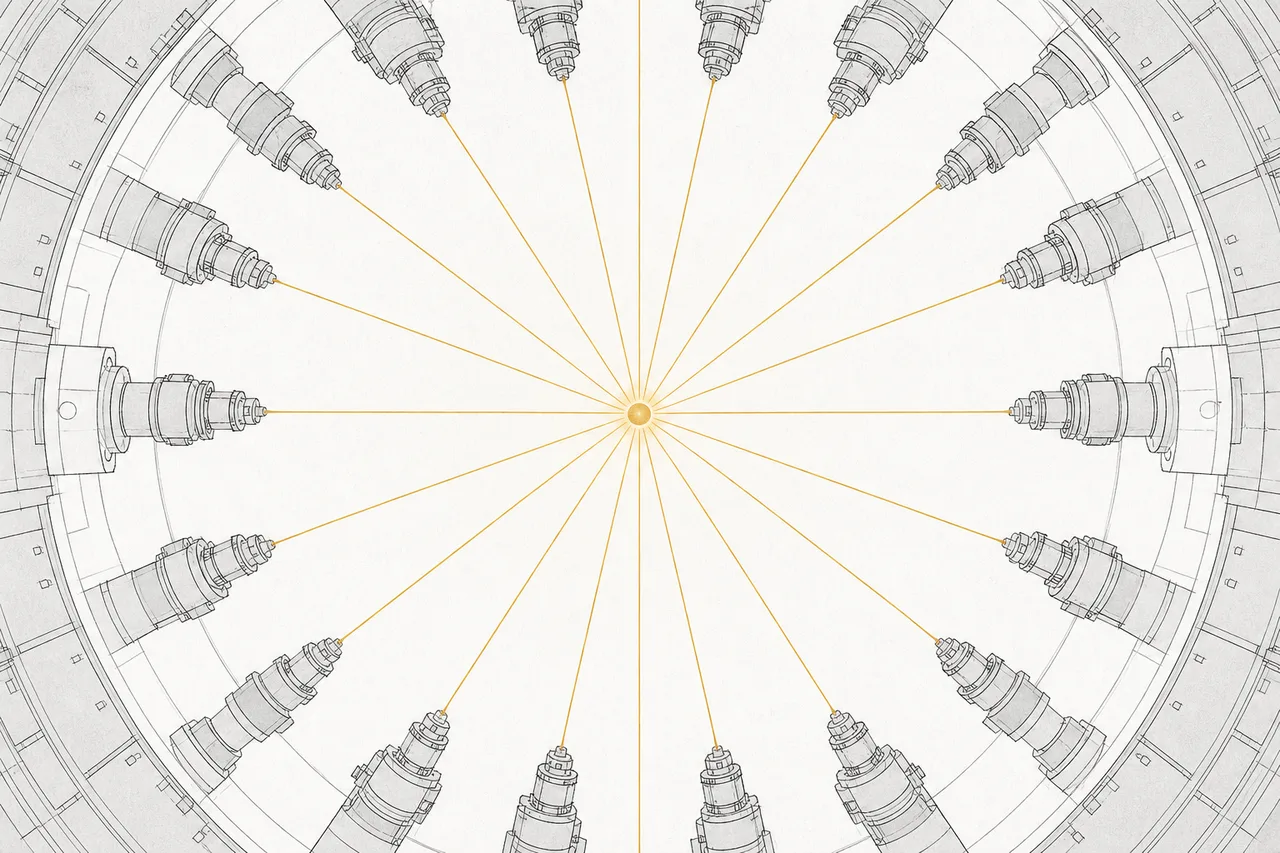
In late 2022, a lab in California fired the world's 192 most powerful lasers at a fuel pellet the size of a pinhead — and got out "more" fusion energy than it put in, for the first time in history. This is the "laser road" to limitless clean energy. But behind it isn't just a dream — it's a supply chain of lasers, lenses, and high-energy electronics that already "earns real money today" from chips, defense, and industry.
01What it is
Fusion is taking the nuclei of light atoms (like hydrogen) and fusing them into a heavier atom, releasing enormous energy — the same reaction that makes the sun shine. The problem is that it needs heat and pressure on the order of a "star's core." So there are two big ways to create those conditions here on Earth.
The first uses a magnetic field to "confine" super-hot gas (plasma) in a magnetic bottle for a long time — that's the tokamak road. This node is about the second way: Inertial Confinement Fusion (ICF) — fusion held by inertia, which confines nothing at all. Instead it fires many high-energy lasers to "crush" a tiny fuel pellet, imploding it inward fast and hard until it's hot and dense enough for fusion — all in a billionth of a second.
The name comes from the fact that the lasers crush the fuel pellet so fast that the pellet's own mass (its inertia) hasn't even flown away yet before the fusion happens and is over. Unlike the magnetic version that has to "confine" the plasma for seconds or longer, here it's "ignite and die" in an instant — repeated rhythmically.
On the megatrend map, this node isn't about "fusion companies" directly — it's about the hardware that makes the laser road possible: high-energy lasers, high-precision optical lenses and mirrors, and pulsed-power electronics that release enormous electrical energy in an instant. It's a sub-field under the megatrend Fusion Energy, in the "supply chain" layer — not the one who walks onto the stage, but the one who builds the stage.
02Why it matters — the laser road + a broad supply chain
The reason this road matters so much comes down to a single day: December 5, 2022, when the National Ignition Facility (NIF) at Lawrence Livermore National Laboratory fired 2.05 megajoules (MJ) of laser at a target and got 3.15 MJ of fusion energy out — more than the laser energy that went in. This was "ignition," the first time in history that a fusion reaction returned more energy than was put into the target. And it happened on the "laser road," not the magnetic one.
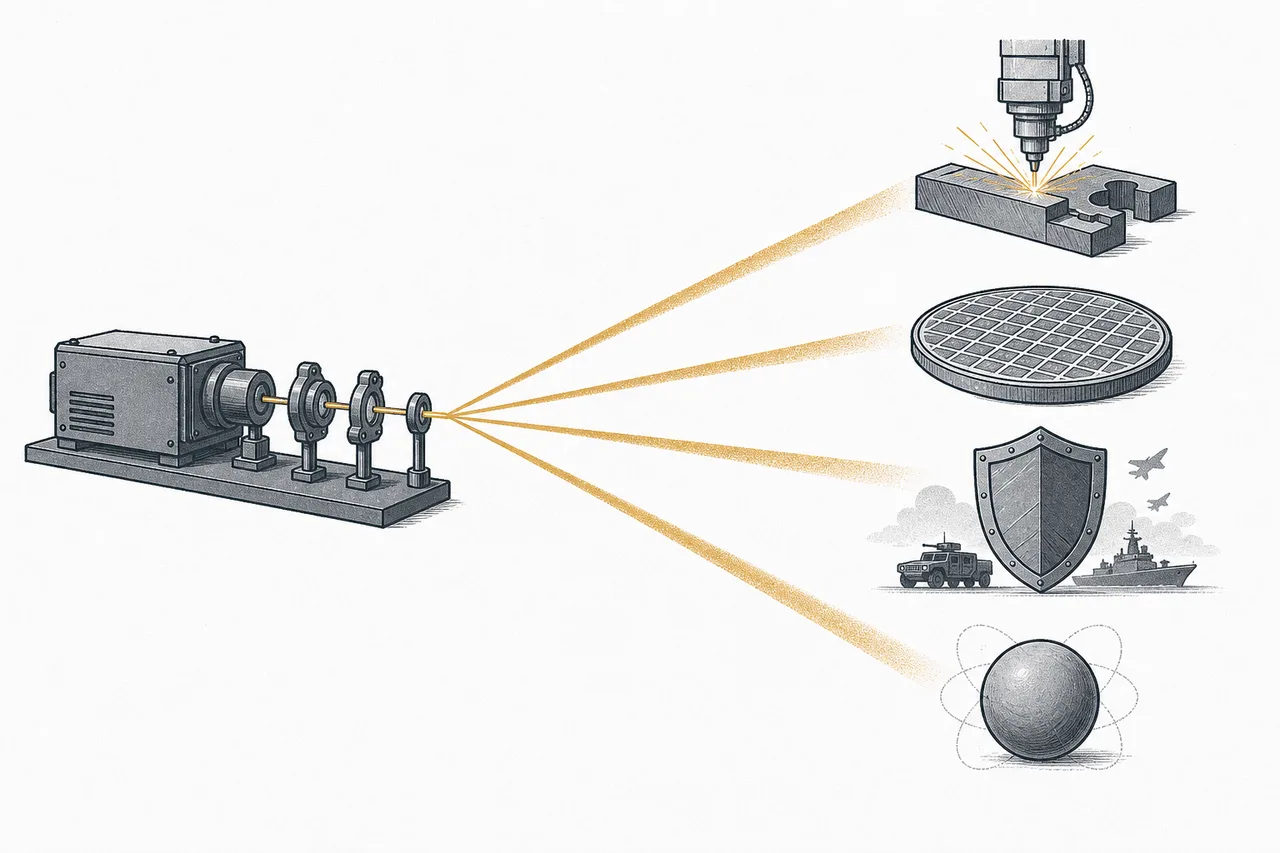
But the "economic" weight of this node isn't in fusion alone — and this is the most interesting part. The very same hardware set (high-power lasers, lenses, mirrors, optics, pulsed electronics) is what the world's industries already use today: cutting and welding metal in factories, firing beams in chip-making machines, military laser weapons, medical devices, and research. So this supply chain already "earns real money" — and it will "scale up further" if laser fusion reaches commercial scale.
And if you focus on "optics" specifically — lenses, mirrors, and coatings as precise as what fusion demands — the market grows even faster, from ~$11 billion in 2025 to ~$19 billion in 2030 (CAGR ~12%). The main tailwinds are AI, chips, and defense — trends that are already running hot.
03How it works (the mechanism)
Picture a spherical fuel pellet the size of a peppercorn (~2 millimeters), packed inside with frozen heavy hydrogen (deuterium + tritium). The way to ignite it is to fire many high-energy lasers at it from all directions at once. The pellet's outer surface violently vaporizes and blasts outward, and by the law of reaction (just like a rocket), that force "pushes" the inside inward, imploding it at tremendous speed.
When the core is crushed dense and heated to ~100 million degrees, fusion ignites and "burns" across the fuel in roughly a billionth of a second, releasing energy — and then it's done. One shot, ignite and die. Everything hinges on symmetry: if the lasers squeeze unevenly on any side, the pellet implodes lopsided and fusion won't ignite.
Here's the key point to get straight: the fusion mechanism itself is proven. But NIF was designed for "science experiments," not to generate electricity. It can only fire a few shots per day, whereas a real power plant has to fire about 10 times per second — or ~86,400 targets a day — and the lasers must run at 10–15% efficiency (NIF draws about 100 times more electricity from the wall than the laser energy that reaches the target). This is the "engineering gap" no one has solved yet.
Repetition rate = how many times per second you can fire the laser + ignite fusion — the metric for whether it can become a "power plant" (producing electricity continuously) · Wall-plug efficiency = the laser energy that comes out, divided by all the electricity drawn from the wall. NIF is at a very low level (because it uses old-generation laser technology), while a power plant needs ~10–15% — these two are the hardest problems on the laser road.
04Where it sits in Fusion
The megatrend Fusion Energy splits into several layers. This node is one of the two main "technology roads" of fusion. Lined up side by side:
- Magnetic road: confine the plasma with a strong magnetic field. The heart is magnets and high-temperature superconductor HTS — the famous bottleneck on the tokamak side
- Laser road (this node): crush the fuel with lasers, no giant magnets needed at all — but it takes extreme lasers, optics, and pulsed power instead
These two roads use different hardware sets, but they meet at the same destination — producing clean electricity. And both rely on some shared things, like vacuum, cryogenic systems, and wall materials that have to withstand heat and neutrons, as well as the real fusion companies (Developers) that assemble all the parts into a power plant.
What's interesting is that this node overlaps directly with another megatrend. High-precision lasers and optics are also the heart of Semiconductors — especially the advanced chip-making machines that use high-energy light to "draw" circuits onto a wafer. The companies that sell lasers/optics to chip factories are the same group that would feed fusion's laser road. That's why this supply chain "already has customers" — it doesn't have to wait for fusion to succeed to earn revenue.
05Where things stand now — straight talk
Let me be blunt first, because this matters: NIF is not a power plant, and was never meant to be. It was built for a nuclear-weapons research mission (simulating explosions in the lab), and the 2022 ignition was a huge scientific "bonus." But this machine costs billions of dollars, is the size of three stadiums, fires only a few times a day, and eats enormous amounts of electricity — it proved "the physics works," but it's still far from "engineering that pays off."
The second truth to tell: most of the companies chasing laser fusion to build a power plant are still private companies that aren't on the stock market, and still at a very early stage — Focused Energy, Marvel Fusion, Xcimer Energy. Retail investors can't buy these shares directly. In 2024, private fusion companies raised over $1 billion combined — but that's money flowing into companies that still "don't have a power plant."
So how do investors reach this node? The answer is through the "sellers of picks and shovels" — the listed laser/optics/photonics companies that sell to chip factories, defense, industry, and fusion research alike. We arrange the players by their role in the supply chain and their market position, not by raw market cap.
06The road ahead
The first direction is closing the repetition-rate gap. The heart of turning a "science machine" into a "power plant" is making it fire the laser + ignite fusion many times per second. LLNL itself built an experimental system called HAPLS that fires at 10 Hz to prove it's possible, and several startups are designing new-generation laser architectures (like excimer or laser diodes) that are both faster and far more efficient than NIF's old Nd:glass technology.
The second direction is public money + private money flowing in together. The U.S. Department of Energy (DOE) has started officially backing inertial fusion energy projects, while Europe (Germany) is putting public money behind Focused Energy to build a prototype power plant on the site of an old nuclear plant — a signal that the laser road is recognized as "serious enough to invest in," not just a lab experiment.
The third direction is a supply chain that grows from other markets first. This is this node's strength — no matter when fusion arrives, the laser/optics market ($20–28 billion) is already growing on AI, chips, and defense, which lets the companies in the chain "survive and grow" while they wait, and stand ready to scale the moment laser fusion reaches commercial scale.
07Challenges & risks
The appeal of the laser road comes with risks you have to look at squarely.
The first risk is an engineering gap with no answer yet. Fusion ignition is proven, but a "power plant" needs three things that can't all be done at once yet: firing ~10 times/second, lasers at 10–15% efficiency (NIF is at a tiny fraction), and producing precise, cheap "targets" — ~86,400 a day — and firing them into the burn chamber in time. Each one is a major research problem, never mind doing all three at once.
The second risk is timing. No one knows whether laser fusion will reach commercial scale in the 2030s, the 2040s, or later. The startups are still private, still burning cash, and still without a power plant that actually sells electricity. So investing in this node "as a fusion bet" is a long-term bet with very high uncertainty.
The third risk is this node is not a "pure fusion stock". The companies you can buy on the market (Coherent, MKS, nLIGHT, Lumentum) have almost zero revenue from fusion today — their value is tied mainly to AI, chips, and defense. If the chip cycle or defense budgets turn, these stocks take a hit, while the "fusion story" barely affects the near-term price — you have to understand that you're buying "a supply chain that may benefit from fusion," not fusion itself.
In short: the laser road is fusion's most tangible answer in the sense of "the physics is proven" (NIF really ignited). But it's also the road furthest from a "power plant" in engineering terms. What makes this node interesting isn't the promise of fusion alone — it's the fact that this same laser-and-optics supply chain already earns money today, and will earn more no matter when fusion arrives.