Megatrend · Fusion Energy
The race to build a "sun in a box" — the biggest prize in energy
If anyone pulls it off, it's clean energy that almost never runs out, feeding electricity around the clock with zero carbon. That's why more than 50 companies have poured in nearly $10 billion combined, racing to build a fusion reactor. But here's the honest truth up front — to this day, not a single plant is putting electricity onto the grid, and almost all the real players are private companies whose shares you can't buy.
01What it is
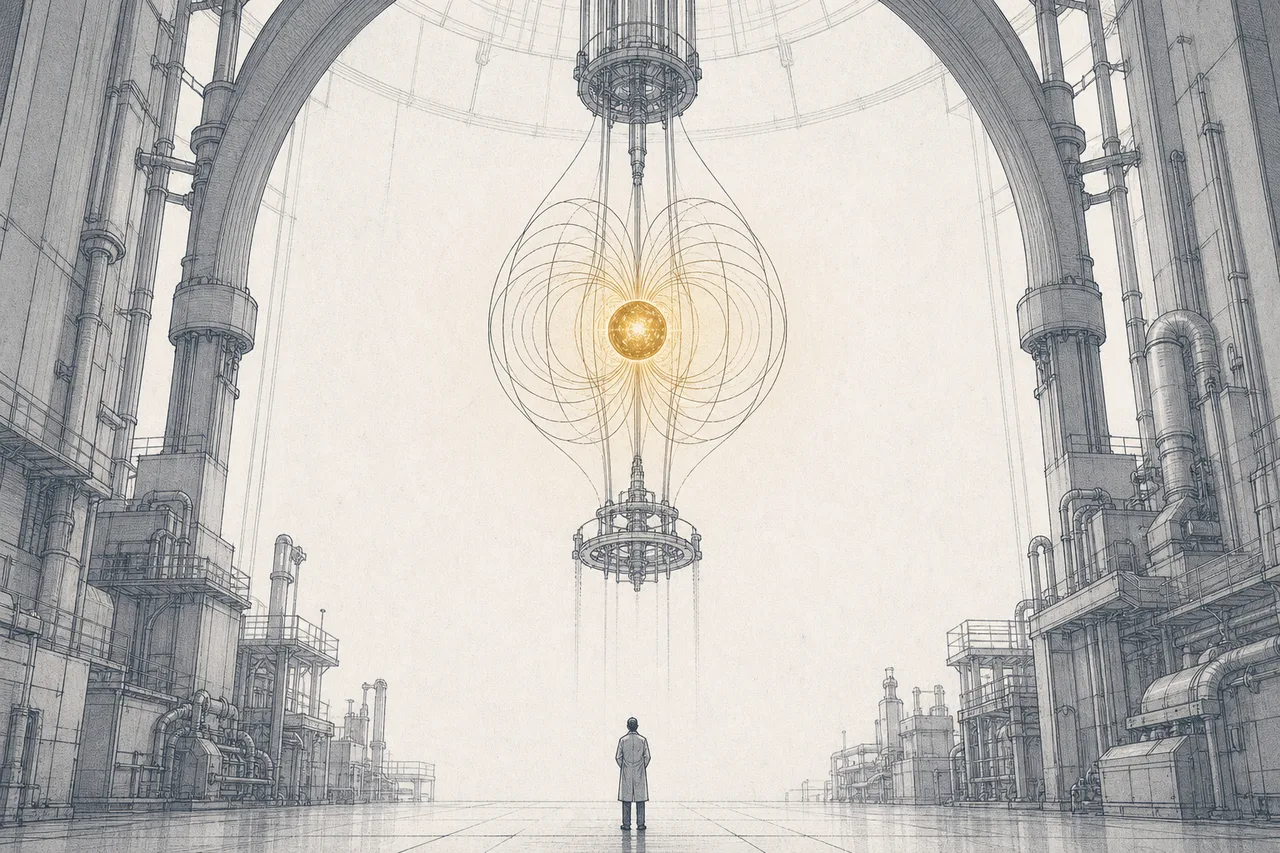
The sun produces enormous energy through a process called "fusion" — fusing two small atoms into a bigger one and releasing energy in the process. "Fusion Pure-plays" are the companies whose entire core business is bet on one thing: building the first fusion power plant that actually works — not companies that do fusion on the side, but ones "born for this."
First, an important distinction: fusion is not like the nuclear power plants we know. Today's nuclear plants use fission — splitting a heavy atom (uranium) into smaller pieces, which leaves long-lived radioactive waste and carries a meltdown risk. Fusion does the opposite: it fuses light atoms — no runaway chain reaction, and if something goes wrong, the reaction simply shuts itself off.
Fission = splitting heavy atoms apart → the technology in today's nuclear plants and SMRs (it lives in the Energy megatrend) · Fusion = fusing light atoms together → the subject of this lesson, and no one has yet made it commercially profitable.
On the megatrend map, this node sits under Fusion Energy and is the "heart" of the whole trend — because the companies developing the reactors are the customers that order everything in the supply chain: magnets, lasers, vacuum systems. If they succeed, the whole supply chain booms with them.
02Why it's the biggest prize in energy
Picture the dream energy source. It should be: clean (zero carbon), nearly inexhaustible, running 24 hours a day regardless of sun or wind, and free of the tens-of-thousands-of-years radioactive waste that fission leaves behind — fusion delivers all of it, in theory.
Its fuel is isotopes of hydrogen, one of which (deuterium) can be extracted from seawater. The deuterium in a single glass of water, if you could fuse all of it, would yield energy equivalent to a large tank of oil. That's why people call it "energy that almost never runs out."
Here's what changed in just a few years: fusion used to be the domain of government labs alone. Now it's a competitive arena of private startups raising billions. In the 12 months to mid-2025, the industry raised about $2.64 billion, and the number of companies keeps growing.
And if it truly succeeds, the market is enormous. Analysts estimate the fusion sector could reach $40–80 billion by 2035 and surpass $350 billion by 2050 — but two words matter: "could," and "if the technical targets are met."
03How it works — and why the "Q>1 barrier" is so brutal
The heart of fusion is an equation everyone has heard: E=mc². When you fuse two hydrogens — deuterium (D) and tritium (T) — you get one helium plus a neutron. The remarkable part: the total mass after fusing is just slightly "lighter" than before. That tiny missing mass is what converts into enormous energy, per E=mc².
The problem is that atoms don't want to fuse easily, because both carry a positive charge and repel each other violently. To force them to collide, you have to heat the fuel to about 100 million °C — many times hotter than the core of the sun. At that temperature, matter becomes a fourth state called "plasma."
This is where the decisive number comes in, called "Q" — the ratio of energy out ÷ energy in. If Q is below 1, you're losing energy on net (you put in more than you get back). The whole field has chased the point where Q > 1 for over 70 years, because it's the line between a "science experiment" and a "real energy source."
And a historic turning point just happened — on December 5, 2022, the NIF lab in the U.S. fired lasers at a fuel pellet with 2.05 megajoules of energy and got 3.15 megajoules of fusion energy out — the first time in history that Q > 1 (about 1.5). But there's an important caveat to be honest about: producing that 2.05 MJ laser shot took about 300 MJ of electricity from the wall. So in "whole-plant" terms, we're still losing a lot of energy — a gap that's still a long way from being crossed.
04Two paths: confine with magnets vs. squeeze with lasers
When plasma reaches 100 million °C, no material on Earth can withstand it. So the big problem is: "how do you contain something that hot without letting it touch the walls?" The world splits into two major schools.
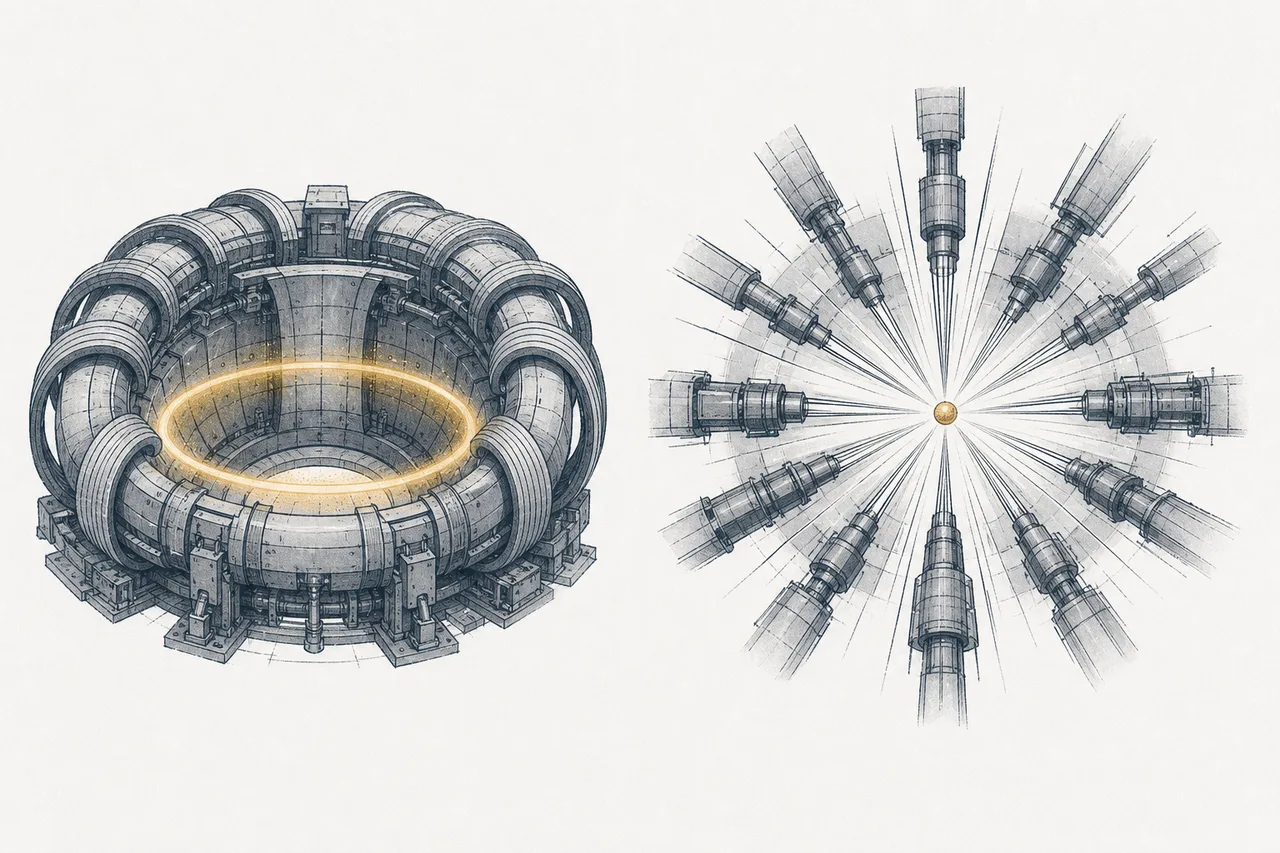
Path 1 — magnetic confinement: use powerful magnetic fields to build an "invisible bottle" that holds the plasma floating in the center, never touching the walls. The most popular shape is the tokamak, which looks like a donut. This is the path of the giant state project ITER (a 35-country collaboration in France) and of the standout startup Commonwealth Fusion Systems (CFS), which uses high-temperature superconducting (HTS) magnets to make its reactor far smaller and cheaper than ITER.
Path 2 — inertial confinement: instead of holding it for a long time, you fire hundreds of ultra-powerful lasers at a tiny fuel pellet all at once, squeezing it to implode and heat up in a fraction of a second, fusing before it flies apart — this is the method NIF used when it achieved Q > 1 in 2022.
Tokamak = a donut-shaped fusion reactor that uses magnetic fields to hold the plasma in a loop — the most heavily researched type · HTS (High-Temperature Superconductor) = a new generation of superconducting magnets that create far stronger fields, letting you shrink the reactor → the "bottleneck" and key technology of magnetic fusion (go deeper at Magnets & HTS Superconductors).
There are also smaller schools, like Helion's magnetic-pulse approach, which doesn't have to reach "ignition" like NIF but instead compresses the plasma and harvests electricity directly. This very diversity is what makes fusion exciting — no one yet knows which is the "winning recipe."
05Where it sits in the fusion ecosystem
The reactor developers (this node) are the "brain" that designs the machine. But they can't make every part themselves — they have to order ultra-advanced components from specialist suppliers, and each of those is a sibling node within the same Fusion Energy megatrend:
- The heart of the magnetic reactor → Magnets & HTS Superconductors: HTS magnets are the bottleneck and the cost driver of tokamak fusion. CFS even built its own HTS-tape factory
- The heart of the laser reactor → Lasers & Pulsed Power: the high-power laser and pulsed-power systems NIF used to squeeze the fuel pellet
- Industrial "plumbing" → Vacuum, Cryogenics & Plasma-Facing Components: high vacuum, helium-based cooling systems, and tungsten walls that have to withstand neutrons
- The future power buyers → Utility Off-takers & Grid Integration: the utilities and tech companies that sign contracts to buy fusion power in advance
And fusion also connects outside its own trend in interesting ways. It's a rival / new alternative to all of Energy Transition & Power Demand (if fusion arrives, other energy sources have to adapt). Crucially, the demand pushing it hardest right now comes, surprisingly, from AI — AI data centers crave clean 24-hour electricity on a massive scale, so much that tech companies are willing to pay to reserve fusion power that doesn't exist yet.
On top of that, fusion also depends on several critical raw materials — especially rare earths in the HTS magnets and tritium fuel, which is scarce and has to be produced in-house — another challenge we'll cover at the end.
06Where it stands now
This is the chapter that has to be the most honest, because fusion is the technology that's long been mocked as "20 years away from success — and it's been that way for 50 years." The reality as of 2026 has two sides that have to be told together.
The exciting side: capital and real progress are flowing in like never before. CFS has raised about $3 billion cumulatively (including an $863 million Series B2 round in August 2025, roughly one-third of all private fusion investment worldwide). Its experimental reactor SPARC is about 60% built, targeting proof of Q > 1 in 2027, and it plans a real 400-megawatt power plant called ARC in Virginia, with Google signed up to buy 200 megawatts and Eni signing a power-purchase deal worth over $1 billion.
Meanwhile Helion signed the "world's first fusion power-purchase agreement" with Microsoft, promising to deliver 50 megawatts by 2028 (with real penalties if it can't). And TAE Technologies, the oldest private fusion company (having raised over $1.3 billion), just announced a merger with Trump Media (DJT) in a deal worth over $6 billion in December 2025.
The side to watch — especially if you're an investor: the real frontrunners building the reactors are almost all private companies — CFS, Helion, TAE, Zap Energy, General Fusion, Tokamak Energy — whose shares you can't buy on the market. That means a "pure fusion stock" barely exists.
So the channels a retail investor can actually touch are mostly "indirect" or "selling picks and shovels": (1) through a rare merger deal like the TAE–DJT one that just happened — but you have to understand that such a share price is tied to many factors beyond fusion, so it needs extra caution; (2) through public companies in the supply chain — makers of HTS tape, special materials like beryllium, vacuum/cryogenic systems — which benefit no matter which reactor recipe wins (see Magnets and Lasers).
07The future
The big question isn't "is fusion possible" — NIF proved the science is real. The question is "when can we make it commercially profitable," and the key dividing lines over the next few years come down to three milestones.

Milestone 1 — prove Q>1 in a company's own reactor (2027): NIF did it in a state lab. But if CFS's SPARC achieves Q>1 in a tokamak reactor of a size that "leads to a power plant," it will be a signal that commercial fusion is becoming genuinely within reach.
Milestone 2 — the first power onto the grid (late 2020s to early 2030s): Helion promises to deliver power to Microsoft in 2028, and CFS plans to run its ARC plant in Virginia in the early 2030s. Many analysts see the first commercial fusion power plant possibly starting up around 2030–2035.
Milestone 3 — becoming a primary energy source for the world (second half of the century): even if everything goes to plan, fusion is not the solution to the 2030 climate crisis. It will more likely grow, gradually, into a baseload power source that complements renewables in the second half of this century. Its role is a "long-term game-changer," not a "short-term emergency fix."
08Challenges & risks
Fusion is a bet with enormous returns, but the risks are just as large — and you have to understand both sides fully.
Risk 1 — "the science passed, but the engineering hasn't": igniting fusion for a split second in a lab (like NIF) is different from building a power plant that has to run continuously, withstand neutrons gnawing at the walls for years, produce enough tritium fuel itself, and — most importantly — reach Q>1 in "whole-plant" terms, not just "at the laser target." That gap is still very wide.
Risk 2 — "always delayed": fusion's history is full of schedules that keep slipping. "20 more years" has become an industry joke. Now the promise has moved up to "the 2030s" — but it's still a promise, not something that has already happened. Investors should brace for the milestones to slip again.
Risk 3 — "no pure stock to buy": this is a market fact to state plainly. The real leaders are almost all private. Anyone who wants to invest "directly in fusion" can barely do so. The options are rare merger deals (whose prices are tied heavily to other factors) or playing it indirectly through the supply chain — neither of which is the "pure fusion investment" many people think exists.
Risk 4 — "costs a lot and takes a very long time": building a first-of-its-kind power plant costs billions of dollars per plant, and the payback is a long way off. Many startups may "run out of money before the finish line" even if their technology is on the right track — industry reports themselves cite "access to capital" as one of the top challenges.
In short: fusion is the story of the biggest prize — clean energy that almost never runs out — and the hardest road. NIF just proved in 2022 that it's scientifically possible, and now nearly $10 billion in private capital is racing to make it real in engineering terms. But honesty matters more than excitement: today no reactor can sell power, the leaders are almost all private, and the road ahead is still measured in decades — understanding both its grandeur and its distance is what it means to truly understand fusion.