Megatrend · Fusion Energy
Inside a fusion reactor there are three hells stacked together — and there are people selling hardware to all three
One fusion reactor packs three extreme states into a span of just a few meters — a vacuum emptier than space, a cold of −269°C near absolute zero, and a wall that has to face a 100-million-degree plasma without melting. The hardware that does all three isn't science fiction — it's vacuum pumps, cryo coolers, and a refractory metal called tungsten that already sells and makes real money today to chip fabs, MRI machines, and physics labs. Fusion is the "future option" that comes free on top.
01What it is
When we talk about fusion, we usually picture hot plasma and giant magnets. But the truth engineers know well is that most of a fusion reactor is not the plasma itself — it's a massive "industrial plumbing system" wrapped around that plasma. And this plumbing is what this node is about.
To put it plainly, this node bundles together three groups of hardware that work in "extreme" conditions: (1) ultra-high vacuum systems that pump the air out of the reactor chamber until almost nothing is left, (2) cryogenics systems that cool superconducting magnets down to −269°C, and (3) plasma-facing wall materials — especially the metal tungsten, which has to survive the heat and the bombardment of neutrons without melting or eroding.
Inside a fusion reactor chamber, the gas has to be pumped out until it's emptier than the space around a space station, because even a few stray gas atoms can disturb the plasma and snuff out the reaction · the machines that do this are the vacuum pump and the cryopump, which use extreme cold to trap gas molecules and stick them to a cold wall.
On the megatrend map, this node is a supply chain under Fusion Energy. Its definition is straightforward: "ultra-high vacuum, cryo-helium plants, and plasma-facing tungsten parts — the industrial plumbing of every tokamak." What makes it interesting is that this hardware wasn't invented for fusion — it already exists and already makes money in other industries. Fusion is just a new customer.
02Why it matters — hardware that sells before fusion arrives
This is where this node clearly differs from its siblings in the fusion family. Reactor-developer stocks bet everything on the question of "when will fusion succeed" — if it's late, the money burns. But the people selling vacuum pumps and cryo machines don't have to wait, because their real customer today is the chip fab.
The numbers tell this story clearly. The global vacuum-pump market is around $7.5 billion in 2025 and is expected to grow to about $11 billion in 2030–2031 (CAGR ~6–7%), with the largest group being semiconductors and electronics at ~32% of demand — because every step of chip manufacturing (etching, deposition, lithography) has to happen in a vacuum chamber. Fusion is still only a tiny sliver of this market.
It's the same story on the cryogenics side. The cryocooler market is $3.5 billion in 2025, expected to grow to $4.9 billion in 2030 (CAGR ~7%), with the main drivers being MRI machines that don't need liquid-helium refills, quantum computers, and defense — fusion is still a new customer. And the tungsten for the reactor wall is a metal that's been sold as cutting and drilling tools and heat-resistant parts for a hundred years.
Put simply, if HTS magnets are the "picks and shovels" of the fusion gold rush, this node is the "foundry that already makes and sells picks to the whole town" — fusion is just a new customer that may become a big one someday.
03How it works — three hells just a few meters apart
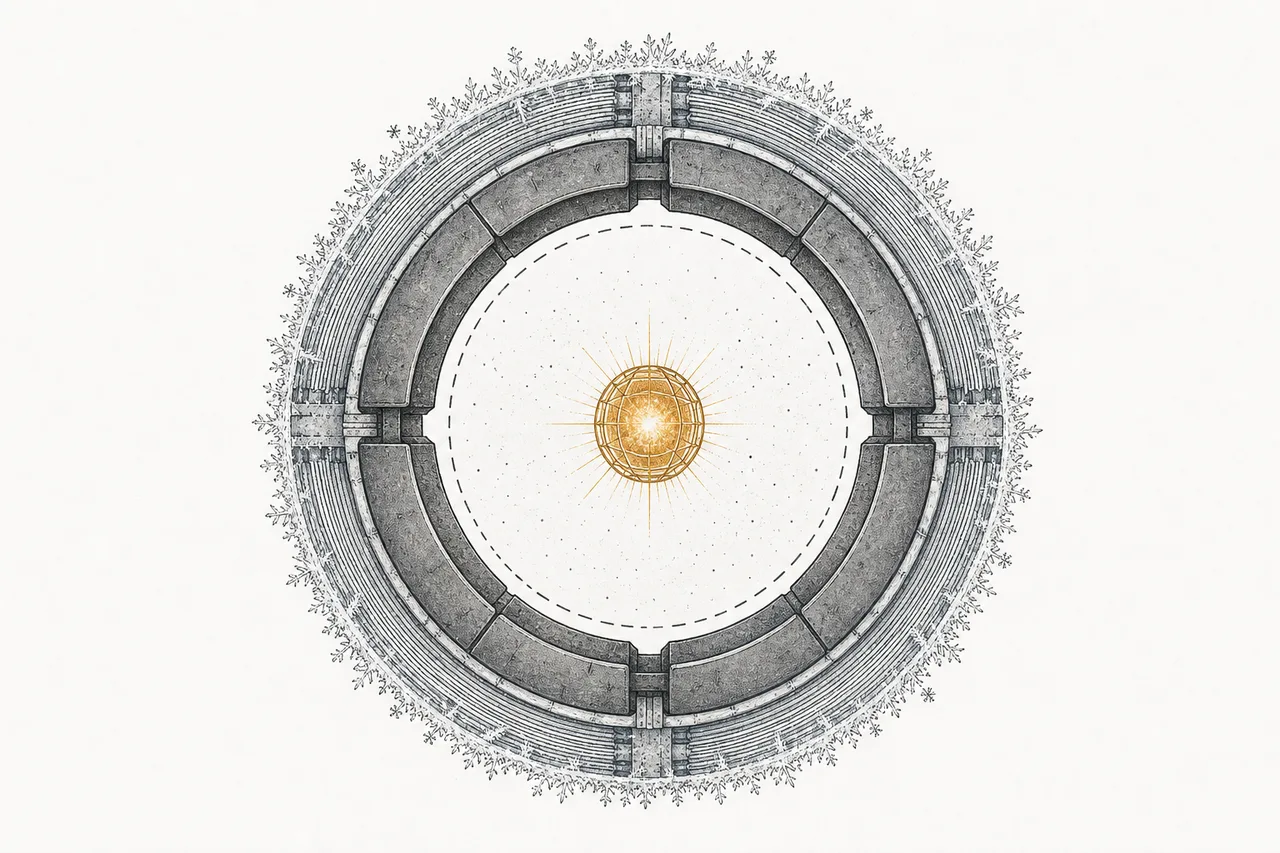
What makes a fusion reactor one of the most brutal pieces of engineering humans attempt is that it has to manage three extreme states that contradict each other, side by side within a few meters. Let's go from the inside out.
Layer 1 — at the center is the "vacuum" ITER's reactor chamber (vacuum vessel) has a volume of about 1,400 cubic meters and has to be pumped nearly empty, to keep the plasma pure with no foreign atoms to interfere. This job is done by giant cryopumps — ITER has 8 of them, each a steel cylinder 3.5 meters long and weighing 8 tons, using a 4K cold surface to trap gas molecules and hold them.
Layer 2 — just outside is the "extreme cold" The superconducting magnets that confine the plasma have to be chilled to ~4 kelvin (−269°C), nearly absolute zero, or they instantly lose their superconductivity. ITER's cryo plant has to deliver 75 kilowatts of cooling at 4.5K and produce about 12,300 liters of liquid helium per hour to keep 10,000 tons of magnets alive.
Layer 3 — the innermost wall facing the plasma is "star-level heat" The wall, and the hottest spot of all (called the divertor), have to face a 100-million-degree plasma and take the bombardment of neutrons. The material chosen is tungsten, because it has the highest melting point of any metal — 3,422°C — and conducts heat well (~160 W/m·K), shedding the heat fast.
Here's the engineering magic: the 100-million-degree hot point and the −269°C cold point are just a few meters apart. What keeps the heat from leaking out and destroying the cold magnets is the vacuum itself (a vacuum is a superb thermal insulator, because there's no air to carry heat). So these three systems don't just coexist — they depend on each other.
04Where it sits — the foundry that sells to every reactor
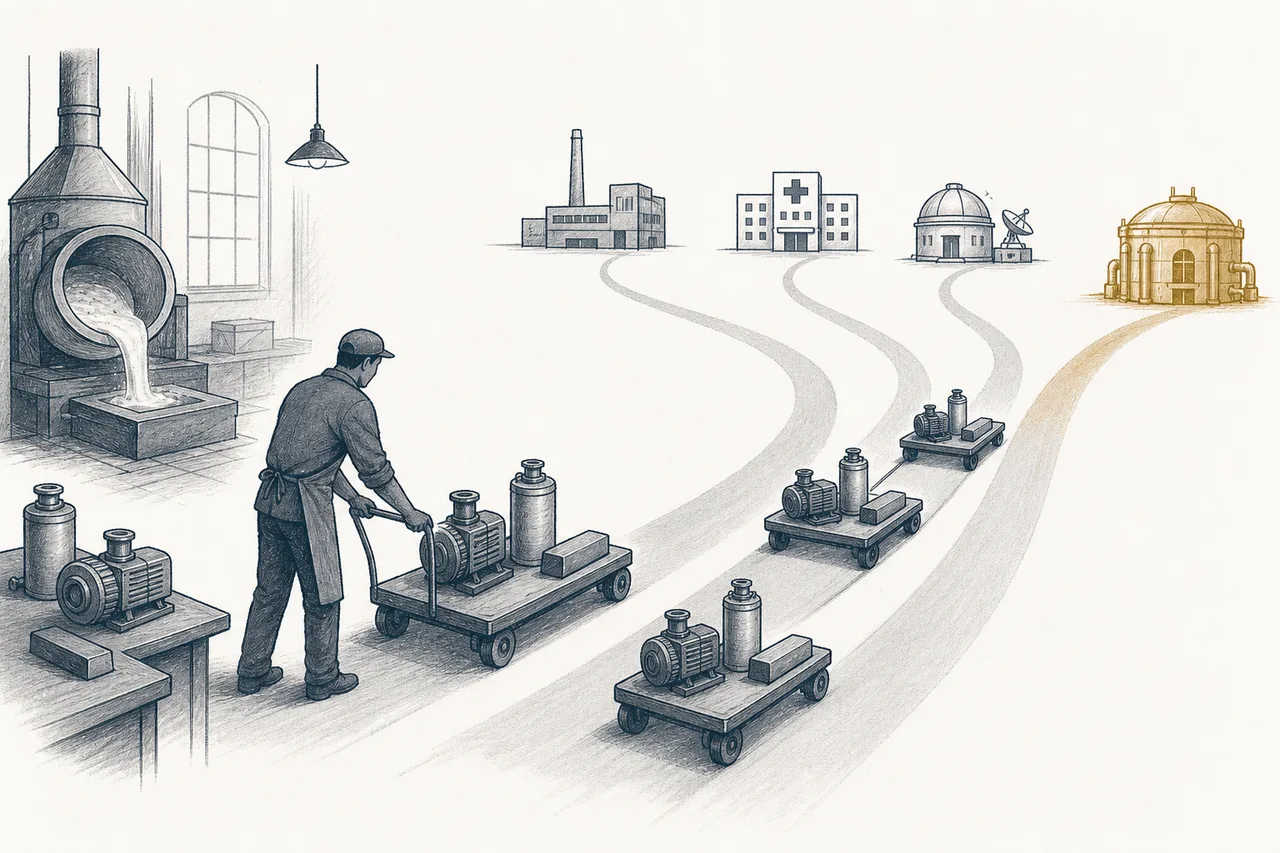
If HTS magnets are the "picks and shovels" of the fusion gold rush, this node is the factory that already makes and sells the basic tools to the whole town — pumps, coolers, refractory metals. We don't yet know who'll win the fusion race, but every reactor needs vacuum, needs cryo, needs a heat-resistant wall.
How it connects to the rest of the fusion trend:
- An inseparable partner to Magnets & HTS: superconducting magnets only work if they stay chilled to 4K at all times — the cryogenics systems in this node are what keep those magnets "alive." Neither can do without the other
- Supplies the reactor developers: every company building a reactor — CFS, Tokamak Energy, and state projects like ITER — has to order vacuum pumps, cryo plants, and tungsten walls. This is the main customer base in the fusion world
- Depends on critical raw materials: tungsten is a mineral where China holds about 80% of world production, and helium is a limited resource with volatile prices. That ties this node's supply chain directly to rare minerals and strategic materials
- Shares technology with semiconductors and is accelerated by AI: the same vacuum pump fusion needs is the heart of chip manufacturing — the surging chip demand of the AI era is the "main revenue" that holds this business up, while fusion is the "future upside"
What makes this node the strongest in the fusion family is that it carries almost no "fusion fails" risk — because most of its revenue doesn't come from fusion in the first place. That's the opposite of reactor-developer stocks, which bet the whole company on fusion.
05Where it stands now
In 2026, this node's picture splits clearly into two layers. The first is the mature core business that actually turns a profit, led by the vacuum giants. The second is fusion demand that's starting to take shape — especially at the ITER project in France, which just succeeded in cooling a 330-ton magnet down to 4K at the Magnet Cold Test Facility, a signal that this extreme hardware is "already in real use in a fusion reactor," not just theory.
On the vacuum side, the market is held by just a few players — Busch, Atlas Copco, Pfeiffer, and ULVAC together control about 45–50% of global revenue. The largest, Atlas Copco, owns the Edwards (revenue ~$2.1 billion in 2024) and Leybold brands, and Edwards just poured $300 million into building its first dry-pump plant in the U.S., backed by CHIPS Act money — a reflection of how most of the money in this business comes from the chip race, not fusion.
On the cryogenics side for fusion, the standout player is France's Air Liquide, which won the contract to build three cryo-helium plants for ITER — the largest centralized cooling system ever built. Linde and Sumitomo Heavy Industries (the market leader in cryocoolers for MRI) are also key players in extreme cold. For the reactor-wall tungsten, the Austrian company Plansee is the leading refractory-materials specialist, supplying divertor parts to fusion projects worldwide.
What's interesting is that many of the real players — especially in tungsten (Plansee is a private company) — aren't on the stock market yet, or are just a small part of large companies mainly in other businesses. So we arrange the players by their role in the supply chain and their expertise, rather than by raw market cap.
Off the stock market, the real drivers of fusion demand are the private reactor developers (CFS, Tokamak Energy) and state projects like ITER, which are progressively installing 8 cryopumps and full tungsten divertors — orders that are the "appetizer" making manufacturers start to take fusion seriously as a new market.
06The road ahead
The first direction is fusion demand starting to climb off a low base. The most tangible number is the cryo-helium market for fusion pilot plants, estimated at ~$1.2 billion in 2024 and expected to grow to ~$2.5 billion in 2033 (CAGR ~8.7%) — when several fusion pilot reactors start being built at once, demand for pumps, cryo, and tungsten will jump to large orders.
The second direction is that the "non-fusion legs" keep growing, and this is this node's best defense. Vacuum-pump demand from AI-era chips, new MRI machines that use cryocoolers instead of liquid helium, and quantum computers that need extreme cold — all grow on their own, with no need for fusion at all.
The third direction is the race to make next-generation wall materials. This is the fiercest research battlefield, because plain tungsten still isn't good enough (we'll get to that in the next chapter). Researchers are developing tungsten composites, special alloys, and materials that better withstand neutrons. Whoever solves this puzzle first will hold a key to commercial fusion.
07Challenges & risks
Let's be straight: even though this node is "tougher" than pure fusion stocks, from a fusion point of view it faces three real walls.
The first and heaviest is that neutron-resistant materials are still an "unsolved" problem — and this is no small thing. In a commercial fusion reactor, the wall gets bombarded by high-energy neutrons nonstop for years. Neutrons make tungsten brittle, crack it, and change its properties (called neutron embrittlement and transmutation). Irradiated tungsten also traps ~100 times more hydrogen fuel than fresh tungsten. And worse — no material in the world has yet been proven to withstand the neutron flux of a real power plant for years. Research that simulates the damage with ion beams still gives contradictory results. This is the deepest technical risk in all of fusion.
The second wall is that fusion demand is still "the future" and a niche market. Big revenue from fusion is still a promise, not a number in today's financials. The vacuum pumps and cryo sold to fusion reactors are still a tiny sliver next to sales to chip fabs. Anyone hoping this node will "surge because of fusion" needs to understand it will move gradually, on a timeline that can slip.
The third wall is raw-material supply-chain risk. China controls about 80% of world tungsten production and has used it as a trade bargaining chip before. Helium is also a limited resource with wildly volatile prices. If supply stumbles or gets restricted for geopolitical reasons, the cost of this whole node is shaken.
In short: a fusion reactor is three hells stacked together — vacuum, extreme cold, and star-level heat — and this node is the one selling hardware to all three. The neatest part is that this hardware already makes money in the world of chips and medicine. Fusion is just a future option — but don't forget that the option only becomes real once humans first solve the neutron-resistant-materials puzzle that no one has cracked yet.