Megatrend · Fusion Energy
A tape thinner than paper is what lets us cage the sun
To ignite fusion, you have to hold a plasma at 100 million degrees suspended in mid-air, never touching the walls — and the only way to do that is a "magnetic bottle." The key that unlocks a fusion reactor 10× smaller, cheaper, and faster is a kind of superconducting tape called REBCO, which makes a magnetic field nearly twice as strong as the old one. What's interesting is that this business already has real revenue today — from MRI machines, power lines, and particle accelerators — without waiting for fusion to succeed first.

01What it is
Picture holding a fire at 100 million °C — many times hotter than the core of the sun — in the middle of a room, and it can't touch anything, because every material on Earth vaporizes the instant it makes contact. This is the problem of fusion, and the only workable answer is to "hold it with magnets," because plasma (a hot, electrically charged gas) can be steered by a magnetic field.
This node is the story of the magnet that does that job — and at its heart is a special material called a high-temperature superconductor (HTS), in the form of a "tape" thinner than paper, wound into a high-power magnet coil. More precisely, it's a material called REBCO (rare-earth barium copper oxide) coated onto a thin metal strip.
A material that, when cooled hard, conducts electricity with zero resistance — a huge current flows through it with no heat and no energy loss. The more current, the stronger the field it can make · The old kind, called LTS (low-temperature superconductors, e.g. niobium-tin), has to be cooled to −269°C · The new kind is HTS, which works at a "higher" temperature (around −200°C) and, more importantly, withstands a far stronger magnetic field.
On the megatrend map, this node is a supply-chain feeder under Fusion Energy. Its definition is straightforward: "REBCO HTS tape and superconducting-magnet systems — both the technology that unlocks fusion and the most frequently named bottleneck of magnetic-confinement fusion."
02Why it matters — the magnet that shrinks the reactor 10×
For decades, fusion was stuck on one problem: a reactor that pays off has to be enormous. The global fusion project ITER in France uses old-style magnets (LTS niobium-tin) that top out at about 11.8 tesla. At that field strength, the reactor has to be built as big as a stadium, taking decades and tens of billions of dollars.
Then the turning point came in September 2021, when Commonwealth Fusion Systems (CFS), with MIT, tested a REBCO HTS magnet and reached a field over 20 tesla — nearly double ITER's. And here's why it matters: in a fusion reactor, the power you get scales with the magnetic field to the fourth power (B⁴). That means raising the field just ~3× shrinks the reactor (and its cost) by about 80× for the same power.
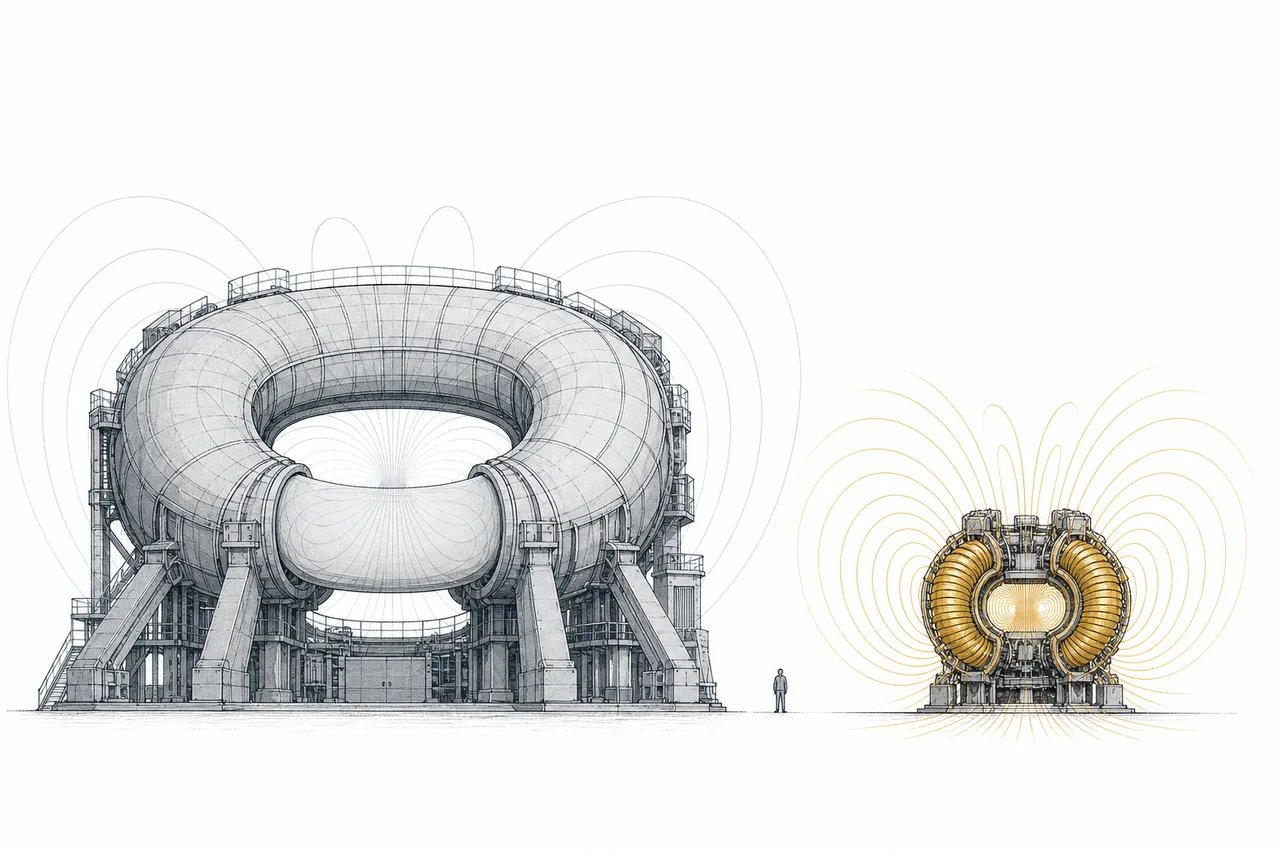
This is the whole bet of CFS: the SPARC reactor being built in Devens, Massachusetts, aims for performance close to ITER but 10× smaller and finished far sooner — all of it made possible by this one REBCO tape.
And REBCO tape is no longer a lab toy — CFS's single 20-tesla prototype magnet uses 267 kilometers of tape (about the distance from Boston to Albany). The full SPARC reactor needs roughly 10,000 kilometers of superconducting wire. That's why "who can make enough tape" has become the question that decides the fate of the whole fusion industry.
03How it works — the "magnetic bottle" that catches the sun
Let's look at the real mechanism. The core is three steps: (1) take REBCO tape and wind it into a coil, then push a massive current through it (2) the coil creates a high-intensity magnetic field (3) that field forms a "magnetic bottle" that squeezes and suspends the 100-million-degree plasma in the center of the reactor, never letting it touch the walls.
The key is in step 2. Because REBCO withstands far more current and field than the old materials, the field it makes is stronger — and a stronger field = a thicker, denser "wall" that squeezes the plasma hot enough for fusion in a much smaller reactor. To picture it: a weak-field magnet (LTS) needs a huge reactor to confine the plasma, while a strong-field magnet (HTS) confines the same plasma in a much smaller one.
The real tape is very thin — about 0.1 mm thick and a few millimeters wide — with the actual "superconductor" layer just microns thick, the rest a supporting metal strip. Making this ultra-thin layer uniform over hundreds of kilometers with no defects is exactly why it's still expensive and hard to make (more on that in the later chapters).
04Where it sits in fusion — the bottleneck everyone passes through
The best way to understand this node is to see it as "the picks and shovels of the fusion gold rush." In a gold rush, the ones who got rich for sure weren't the gold diggers — they were the people selling picks and shovels, because they sold to everyone who came to dig, no matter who actually struck gold.
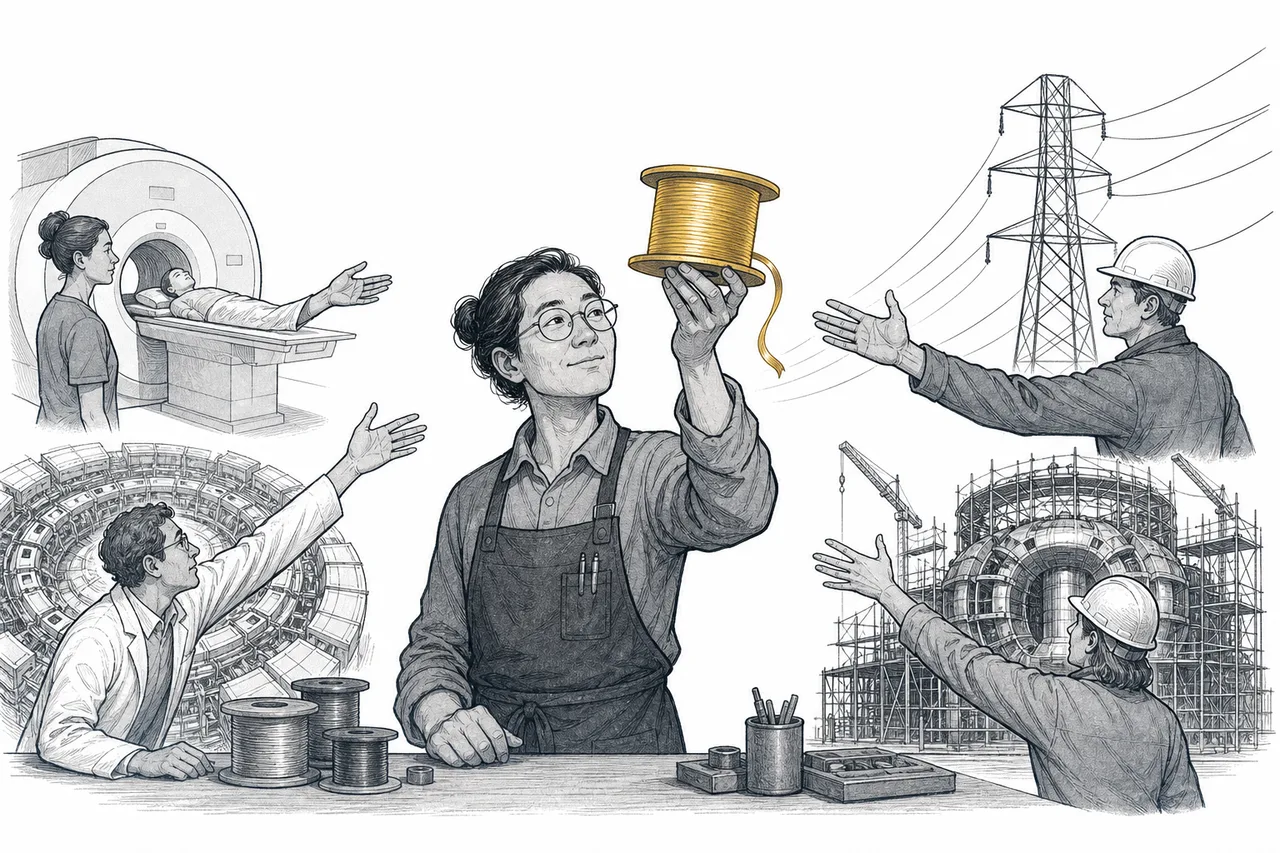
How it connects to the rest of the fusion trend:
- Feeds the reactor developers (Developers): every company that uses magnets to squeeze plasma (called magnetic confinement) — CFS, Tokamak Energy, and many more — has to buy or build HTS magnets. This is the core customer base
- Pairs with vacuum, cryogenics, and the reactor wall: a superconducting magnet has to be kept ultra-cold at all times, so a cryo system (helium cooling) is its indispensable partner
- Depends on key raw materials: REBCO uses rare earths and special materials, tying its supply chain directly to the rare-earth question
- Feeds demand for clean energy and is pushed by AI: if fusion works, it's clean energy that could replace fossil fuels — and the massive electricity hunger of AI data centers is the new force pulling investors back to fusion
But what makes this node more interesting than its fusion-family siblings is that it has "customers outside fusion" paying real money today — MRI machines in hospitals, superconducting power lines, high-efficiency motors and generators, maglev trains, and particle accelerators in research. All of them use superconducting magnets. That means this business can earn now and will grow even more once fusion arrives.
05Where it stands now
2026 is a pivotal moment. On the technology side, it's proven — in March 2024, MIT confirmed CFS's HTS magnet is "ready for fusion," and in December 2025, CFS delivered the first real fusion magnet (weighing 24 tons) from the factory to the SPARC reactor, which is already about 75% built. The targets: start running in 2026 and prove net energy (Q>1) in 2027.
On the market side, it's still small but growing fast. The overall high-temperature superconductor (HTS) market sits at about $0.73 billion in 2024, projected to reach ~$1.6 billion by 2034 (CAGR ~8.5%). But the hottest part is REBCO tape specifically for fusion magnets, estimated at ~$412 million in 2024 and projected to grow at a CAGR as high as ~21%.
The real battleground is production capacity. Global superconducting-tape output just expanded from under 1 ton/year to over 3 tons/year in the past five years, and it has to climb to over 50 tons/year to support commercial fusion — that's the gap every maker is racing to fill.
So who are the real players? Interestingly, many are public companies with an existing "leg" already making money — selling magnets to MRI, power lines, or scientific instruments — and then extending into fusion. Meanwhile the fusion front-runners like CFS and Tokamak Energy are still private companies (not yet on the stock market) that are the big customers.
Off the stock market, the real demand drivers are CFS and Tokamak Energy (UK), both still private. Tokamak Energy recently raised $125 million to spin its HTS magnet business (TE Magnetics) out as a product — a signal that even reactor developers themselves see "magnets" as something they can sell, not just an internal part.
06The road ahead
The first direction is the cost game. This is the most important variable. REBCO tape today costs about $150–200 per kA-m (a unit of current-carrying capacity per length). But for fusion to be commercially viable, the price has to fall to around $10–20 per kA-m — nearly 10× cheaper. The good news: fusion demand, which jumps tape needs from "hundreds of km/year" to "thousands of km/year," is starting to push costs down with scale.

The second direction is a step-change in production capacity. As CFS, Tokamak Energy, and others start making magnets in "serial production," demand for REBCO tape will surge. Makers like AMSC, Furukawa/SuperPower, and Fujikura are all racing to expand factories — the 50+ tons/year level is the finish line they have to reach.
The third direction is the growth of the non-fusion leg. While waiting for commercial fusion (still years away), demand for HTS magnets from new MRI machines that don't need liquid helium, power lines in big cities, and particle accelerators will be the "sustaining revenue" that keeps makers alive and developing the technology — which is why this node is more durable than a pure-play fusion stock.
07Challenges & risks
Let's be straight: this is not a business where profit flows in easily. There are three real walls.
The first wall is the price is still too high. REBCO tape today is still nearly 10× above the point where fusion pays off. Cutting costs that much takes both scale and manufacturing progress, and there's no guarantee it arrives on schedule. If costs fall slower than expected, the economics of fusion as a whole stumble too.
The second wall is production capacity is a bottleneck. The world can only make tape at the "few tons a year" level, but it has to climb to over 50 tons/year. Coating a micron-thin superconducting layer uniformly over hundreds of kilometers with no defects is extremely hard and scales slowly — if production can't keep up, reactor developers can't build their magnets, and the whole supply chain jams.
The third wall is fusion demand is still "the future" and a niche market. Commercial fusion that actually puts power on the grid is still years away, and no one guarantees it succeeds on time. So the big revenue from fusion is still a "promise," not a number on today's books. Anyone investing in this theme purely on fusion has to understand they're betting on a timeline that can slip.
In short: a tape thinner than paper, coated with a rare-earth oxide, is the quietest yet most indispensable part of the fusion dream. It's the reason new reactors are 10× smaller, and it's that rare business in the fusion world that "can earn before the last gear clicks into place" — but it still has to clear the toughest gates of cost and capacity before it becomes the tens-of-billions business many people dream of.