Megatrend · whole-trend overview
The bet on building a "sun" on Earth
Fusion is the dream of almost-unlimited clean energy — but let's be honest up front: nowhere in the world is there a fusion plant actually selling electricity yet. The first ones are expected in the early 2030s at the earliest, which makes this a "pre-commercial," high-risk trend. This lesson is the map that strings the 5 categories of the fusion ecosystem together — so you can see that the smart way to look isn't guessing "which company wins," but finding the "people selling picks and shovels" who get paid no matter who wins (each category has its own deep-dive chapter).
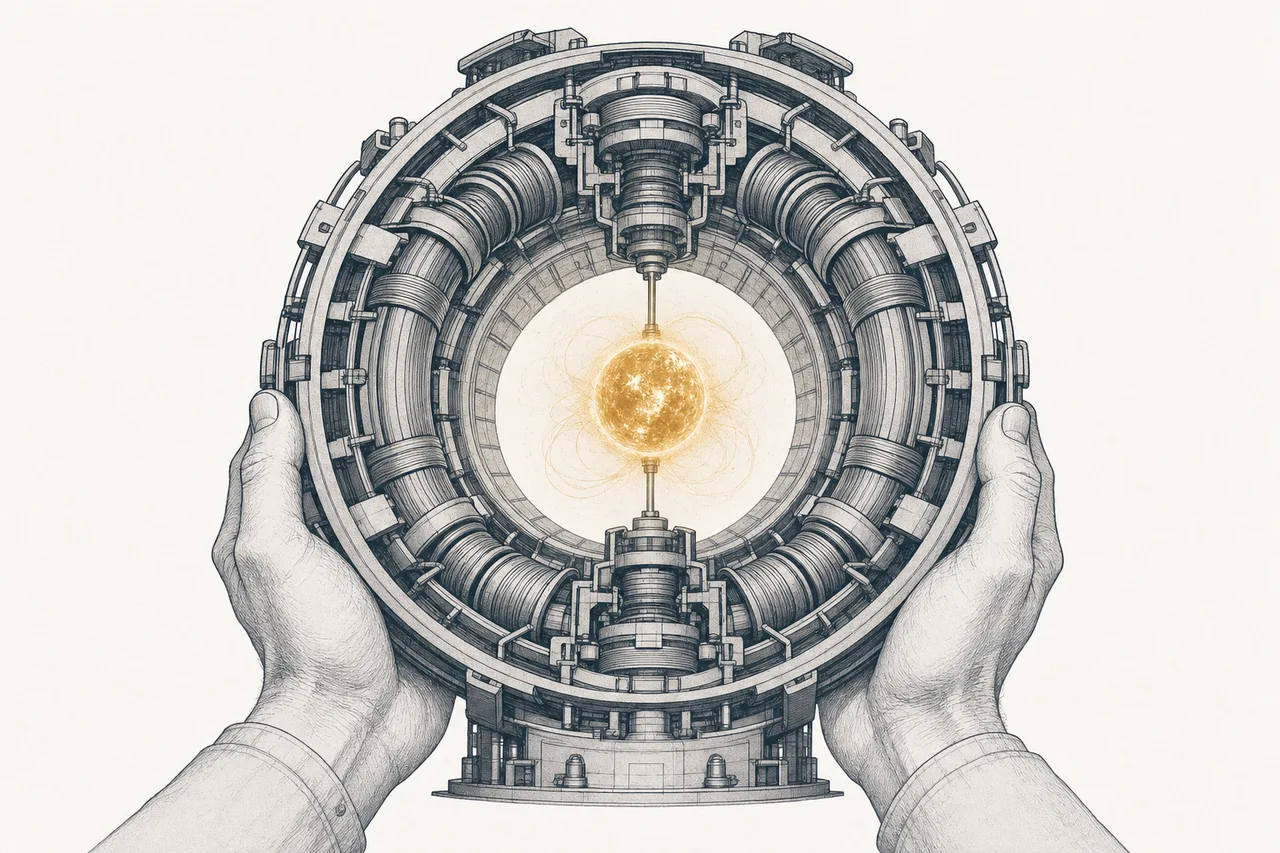
01The big picture: a bet on unlimited energy
Picture an energy source fueled by seawater, emitting no carbon, leaving none of the long-lived radioactive waste of a normal nuclear plant, and producing power 24/7 regardless of sun or wind — that's the promise of fusion (nuclear fusion). It's the same reaction that powers the sun: squeezing hydrogen nuclei together until they "merge" and release energy (the opposite of today's nuclear plants, which use fission — "splitting" heavy atoms apart).
But here's the truth worth stating clearly — fusion hasn't earned a single cent from selling electricity. The whole industry is still at the "prove it works in engineering" stage. The big scientific milestone came only in December 2022, when the NIF lab in the US fired lasers at a fuel pellet and got out 3.15 megajoules of energy from 2.05 megajoules of laser input — the first time in history a reaction returned more energy than was put in (what's called Q > 1).
Q is the ratio of "energy fusion releases ÷ energy put into the fuel." Q > 1 means an energy gain at the reaction level, but it isn't break-even for the whole plant — because firing that one NIF laser shot alone drew about 300 megajoules from the wall. To "actually sell electricity" you have to reach what's called engineering break-even, and that's still far off.
Even though it's still far off, money is pouring in like never before. Cumulative private investment in fusion has passed ~$9.7 billion (across 53 companies that answered the Fusion Industry Association's 2025 survey), and counting every source including governments, the global figure tops $15 billion — what changed the game is the wave of AI power demand (data centers are starving for vast amounts of clean power), plus big private capital willing to bet long.
To understand how to "look at this trend without getting lost," you can't see it as one company — you have to see it as an ecosystem — and that's the map we're about to lay out.
02The map: what the 5 sub-categories are
The fusion ecosystem splits into 5 categories, which group into 3 "roles" — the people who build the machines, the people who feed in critical parts, and the people who'll buy the electricity later. Each category has its own deep-dive lesson (tap to read):
Role 1 — the people who build fusion machines (Developers)
- Fusion Pure-plays (Developers): companies whose core business is "building a fusion plant" — Commonwealth Fusion, Helion, TAE and others — almost all still private companies not listed on any exchange. The heart of the trend, but also the riskiest.
Role 2 — the people who feed in critical parts (picks and shovels)
- Magnets & HTS Superconductors: high-temperature superconducting (HTS) magnets and REBCO tape used to "trap" plasma hotter than the center of the sun — both the core technology and the "bottleneck" of magnetic fusion.
- Lasers & Pulsed Power: high-power lasers, lenses/optics, and pulsed-power supplies used in "inertial confinement" fusion — NIF's lineage.
- Vacuum, Cryogenics & Plasma-Facing Components: ultra-high vacuum systems, helium cryo-plants, and heat-resistant tungsten components facing the plasma — the "plumbing and pipes" of every fusion machine.
Role 3 — the people who'll buy the electricity later (Demand)
- Utility Off-takers & Grid Integration: utilities and giant tech companies (hyperscaler) signing contracts to buy fusion power in advance — Microsoft, Google and the like. Not technology-makers, but the "demand pull" that gives the whole field real customers already waiting.
03How it all connects (the fusion chain)
The core of this map is to see it like this — upstream supply parts flow into the "fusion machine" in the middle, and the electricity it produces flows out to downstream buyers. Look at the whole flow:
The most important point in this chain is the uncertainty in the middle — nobody yet knows which kind of "fusion machine" will win. It could be the magnet approach (a tokamak like Commonwealth Fusion), the pulsed magnetic-compression approach (Helion), or the laser approach (NIF's lineage). Each makes a very different bet, and most are still private companies whose shares retail investors can't buy directly.
That's exactly why the supply-chain side — especially HTS magnets — is interesting. No matter which magnet-based machine wins, every one of them has to order the same superconducting magnets. This is the "sell picks and shovels in a gold rush" idea, which we dig into next.
04Where the value is: picks and shovels
When a trend is still "pre-commercial" and full of risk over who wins, the safest way to look is this — don't bet on one "gold miner," sell equipment to every miner. In fusion, the clearest "picks and shovels" are high-temperature superconducting (HTS) magnets and REBCO tape.
An ultra-thin tape coated with a superconducting material (Rare-Earth Barium Copper Oxide) that conducts electricity with zero resistance when chilled deeply. It's wound into ultra-powerful magnets to "trap" plasma at hundreds of millions of degrees in the middle of the machine without it touching the walls — progress on this tape is what let Commonwealth Fusion build a smaller, cheaper machine.
Why is there power here? Because it's a bottleneck, and scarce. Global HTS tape production capacity is now around 10,000 km a year, but the FIA estimates that just building several prototype machines will consume about 300,000 km of HTS tape — dozens of times current capacity. Demand outstripping supply like this is the formula for "pricing power."
By comparison, the "machine-builders" (developers), though they're the heart of the trend, are far riskier — pick the wrong company and your money can vanish, and most are hard-to-reach private firms. The "electricity buyers" (Microsoft, Google) are giants for whom fusion is a sliver of the business, not a pure-play bet.
The lesson for looking at this trend: don't just ask "does this company do fusion," ask "does it get paid only if the company I'm rooting for wins, or does it get paid no matter who wins" — the latter is where cautious investors tend to stand.
05Forces that move the whole trend
Four big forces move the whole fusion field at once:
1. AI's hunger for power — this is the most powerful new accelerant. AI data centers eat huge amounts of power and need clean electricity running 24/7, which is exactly what fusion can answer. That's why giant AI/cloud companies sign contracts to buy power in advance, even before the plant is built — Google signed for 200 megawatts from Commonwealth Fusion (June 2025), and Microsoft signed for 50 megawatts from Helion (targeting delivery in 2028).
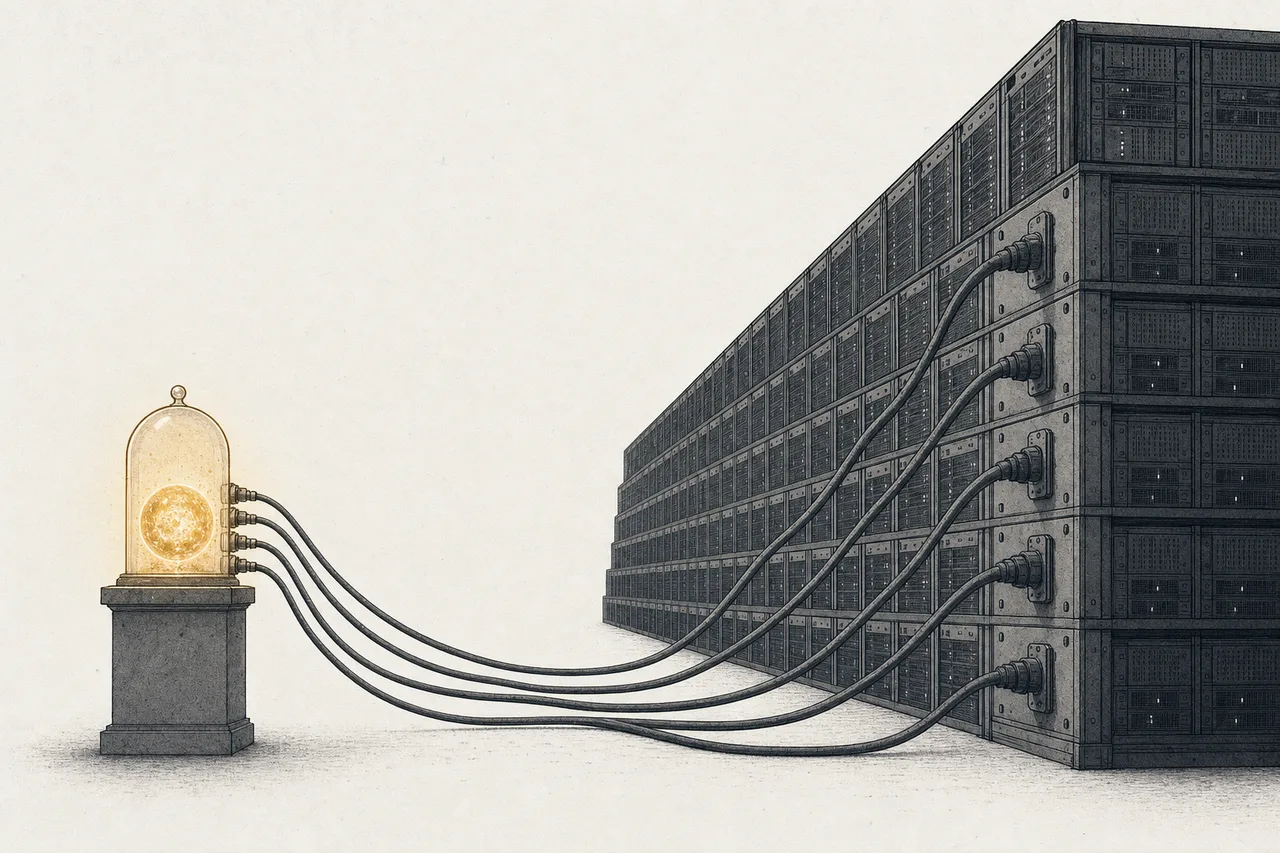
2. The wave of private capital — big money is flowing in like never before. In the year to July 2025 the field raised ~$2.6 billion (the second-highest ever), led by large rounds like Pacific Fusion ($900M), Helion ($425M), and Commonwealth Fusion ($863M Series B2) — and notably, many of the backers are tech giants (NVIDIA, Google, Bill Gates).
3. Scientific milestones — each one cleared (NIF hitting Q>1 in 2022, Helion bringing its Polaris prototype online at the end of 2024) lowers the "can it actually work" risk and unlocks the next round of funding. Fusion is a trend whose prices move on experiment news more than on financials (because there's no revenue yet).
4. The timeline is still far off (the drag you have to accept) — this is the force holding the trend down. Global state projects like ITER keep slipping (its full-power plasma target has moved to 2034, with the budget ballooning past €25 billion). The private side is more confident, but ~35 of 45 companies still believe a commercial pilot plant arrives in 2030–2035 — meaning "several years out," full of technical and financial risk.
06Where things stand now + each category's champion
2025–2026 is when fusion moves "from the lab to the construction site" — Commonwealth Fusion is assembling its SPARC demo machine (aiming for Q>1 around 2027) and breaking ground on its commercial ARC plant in Virginia, while Helion has just started building its first plant to send power to Microsoft. But to repeat once more: nobody is actually selling electricity yet, and the "machine-builder" champions are almost all private companies that ordinary investors can't reach directly — most of what's actually investable on the market is on the supply-chain side.
07The future and the risks
Looking ahead, fusion holds both enormous potential and risks worth stating plainly.
On the opportunity side: if it really works, a huge market awaits — some research shops estimate the fusion energy market could reach hundreds of billions of dollars by 2040 (a very widely-spread estimate that rests on the assumption the technology succeeds). And AI's pull means there are customers willing to pay in advance before any product exists. The supply-chain side (HTS magnets) is getting real demand from today, without waiting for any plant to open.
On the risk side there are several layers to watch especially closely, because this is still a pre-commercial trend:
- No real revenue yet: no plant anywhere is selling electricity. Today's value rests purely on "expectation" — miss a key milestone and the confidence (and the capital) can vanish fast.
- Hard to access: almost all the true players are private, and retail investors can't buy in directly. The stocks you can buy are usually giants for whom fusion is just a sliver — watch out for "stocks claiming to be fusion" that actually have almost no exposure.
- The timeline can always slip: fusion has a long history of "30 years away." Even if this round is different, the ITER-style delays warn that slipping timelines are normal.
- Technical risk: controlling the plasma, materials that survive neutron bombardment, and reaching "break-even for the whole plant" (not just at the reaction level) — all still problems no one has proven they can solve.
And that's why this chapter is a "map," not an "investment guide" — the real value of looking at the whole trend is seeing how all the pieces string together, and where the risk concentrates before you walk in to explore each room in detail — just tap into the deep-dive chapter of whichever category interests you.