Megatrend · Space Economy
When satellites stopped being art and started rolling off the line
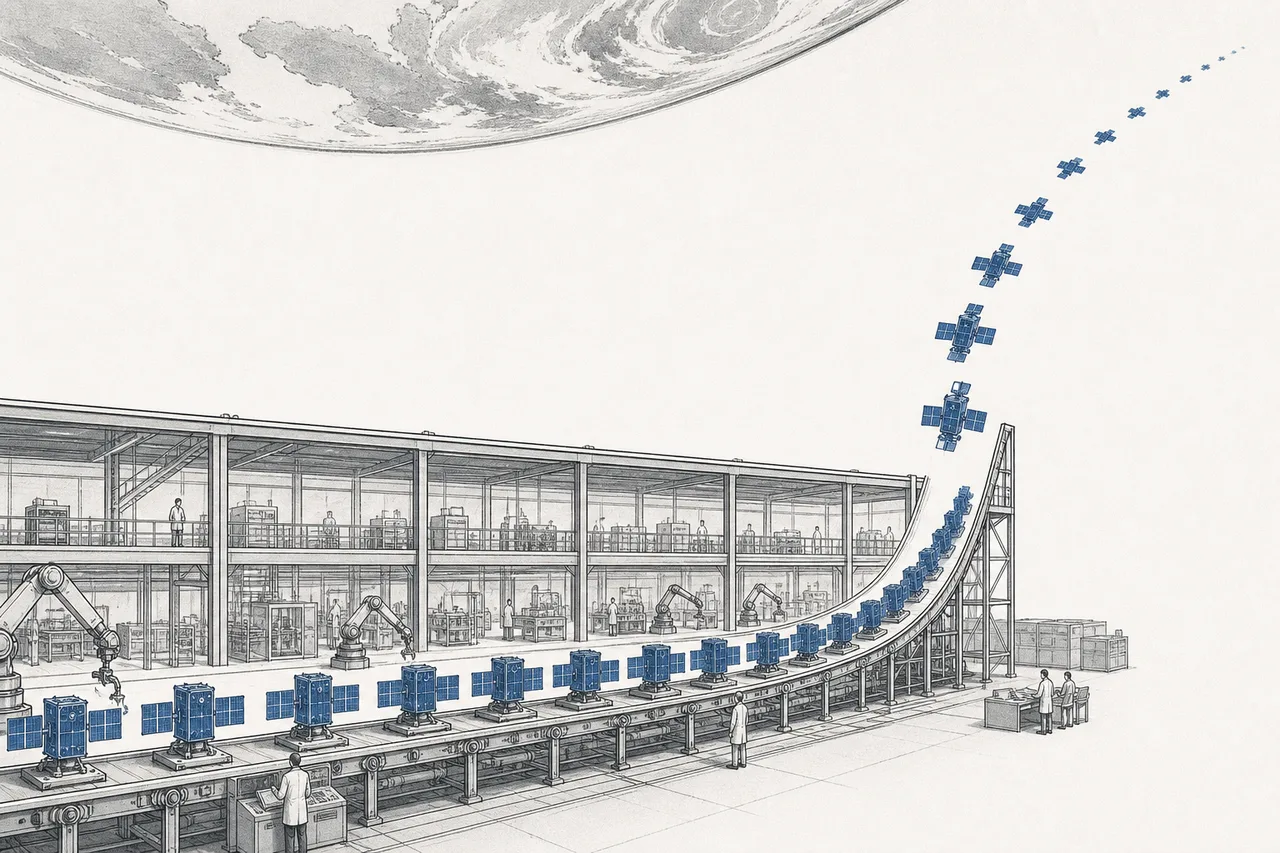
Satellites used to be rare objects built by hand — hundreds of millions of dollars each, years in the making. But once the world wanted "thousands, even tens of thousands" of satellites to weave a network in orbit, the way to build them had to change — from "polishing one gem at a time" to "a factory stamping units off a line." This is the story of an industry that turned from a cathedral into a factory, and of the companies that build the hardware to fill orbit.
01What it is
When we say "space," people usually picture a rocket shooting into the sky. But a rocket is just the "truck" that carries things up. What it actually carries — the thing that works in orbit and sends value back to Earth — is the satellites and spacecraft, and this node is the story of the people who build them.
Satellite & Spacecraft Manufacturing is the business of building the satellite itself — from its "skeleton," called the bus (the body that holds the power, control, and basic communications), down to the smaller parts inside: solar panels, structure, navigation systems (avionics), propulsion, and robotic arms. Think of it simply: if a satellite is a car, the bus is the "chassis plus engine," and the payload (cameras, antennas, sensors) is "what it carries to do the job." This node builds both the body and the engine parts.
On the megatrend map, it's a sub-branch under Space Economy — the "infrastructure layer" of the entire commercial space supply chain. Because whether the mission is satellite internet, Earth imaging, or missile warning, everything always starts with "having a satellite to use" first.
Satellite bus = the standard body of a satellite, bundling the systems every satellite must have (power, attitude control, propulsion, communication with the ground) · Payload = the mission-specific equipment that rides on the bus, like an imaging camera, a broadband antenna, or a heat-detecting sensor · A strong maker is one that can build standard buses cheaply and fast in volume, then swap the payload to suit each customer.
02Why it matters
One number explains everything: at the end of 2020, the world had about 3,371 active satellites. By the end of 2024 that number had surged to 11,539 — more than tripling in just four years. And in 2024 alone, 2,695 satellites were launched into orbit, the highest on record.
The ones who benefit directly are "the people who build the things." Global revenue from satellite manufacturing reached ~$20 billion in 2024, up 17% from the year before, and market researchers expect the satellite-manufacturing market to grow from about $22.5 billion (2024) to ~$57 billion in 2030, or roughly 16% a year.
But the heart of it isn't just that the market is "getting bigger" — it's also changing "shape." The engine of the growth is small satellites. The small satellite market is projected to grow from ~$9.35 billion (2025) to ~$32 billion (2030), or nearly 28% a year — almost twice as fast as the overall market. And today, about 61% of the satellites working in orbit are already small ones. That's the sign that the industry's weight is shifting from "a few big ones" to "a vast number of small ones."
03From cathedral to factory
Here's the mechanism at the heart of this lesson. Let's compare two worlds.
The old world — the "cathedral": a traditional communications satellite (geostationary orbit, GEO) is a single object the size of a bus, assembled by hand piece by piece in a cleanroom. Each one costs ~€200–300 million (about $250–350 million), takes years to design and build, then flies for 10 years or more. Because each one is expensive and rare, every single one has to be "perfect" — no mistakes allowed. It's craftsmanship, not manufacturing.
The new world — the "factory": once the business model becomes a "satellite network (constellation)" that needs thousands or tens of thousands of satellites orbiting at once, the math breaks instantly — at $300 million each, having 5,000 of them is impossible. The answer is one standard design, mass-produced over and over on a line, like a car factory. The result: the cost per satellite plunges to the hundreds of thousands to a few million dollars range instead of hundreds of millions.
The clearest example is SpaceX's Starlink. In 2024 the company built about 2,880 satellites, and by 2026 its production rate had climbed to over 4,000 a year (~340 a month) — a pace the old world couldn't even imagine. The first Starlink cost about $200,000 each, and the V2 Mini about $800,000 — hundreds of times cheaper than a traditional GEO satellite. The effect of this mass production shows up in real orbit: by mid-2026, Starlink had over 10,000 satellites, about 69% of all the satellites working in orbit.
A large satellite network = a system using hundreds to thousands of satellites in low Earth orbit (LEO), working together as a single network, like Starlink (internet) or a military warning grid · It's the "demand engine" that forces satellite manufacturing to become a factory — because you can't build thousands of things by hand, one at a time.
04Where it sits in the Space Economy
This node is the "parts factory" sitting in the middle of the entire space supply chain. Let's see how it connects to its neighbors.
- Depends on Launch Services: once a satellite is built, you still need a rocket to carry it up. Cheaper launch costs (thanks to the reusable rocket) are exactly what made sending thousands of satellites economically possible — the two fields grow together
- Supplies Satellite Connectivity: the biggest customer of the satellite factory is the satellite-internet network — Starlink builds its own to feed its own network, while OneWeb outsources
- Supplies Earth Observation: satellites that image Earth and gather geospatial data are another big market for the small bus
- Demand from defense: the "proliferated" idea (spreading risk across many satellites) makes the military a major customer. Many satellites are designed from the same layer as Defense Electronics
- Depends on key materials: high-efficiency solar panels, special metals, and radiation-hardened chips all come from the materials and semiconductor supply chains
What's interesting is that this node differs from siblings like Lunar Logistics or In-Space Manufacturing in that it "actually makes money today" — it's not a future story. It's the infrastructure layer every space mission has to pass through.
05Where things stand now + the players
This field is splitting into two cultures that collide. On one side are the traditional makers (primes) like Lockheed Martin, Northrop Grumman, and Airbus, who are good at big, expensive, complex missions. On the other are the new-generation makers, built for "volume" from the start — and their speed is forcing the first group to adapt.
You could see it clearly in the August 2024 deal where Lockheed Martin bought Terran Orbital (a factory-style maker of small satellites) for about $450 million — a traditional giant paying to "buy mass-production capability" in-house, because it couldn't build that fast on its own.
Another big driver is defense. In December 2025, the U.S. Space Development Agency awarded about $3.5 billion in contracts to four companies to build 72 missile-warning satellites — Lockheed, Northrop, L3Harris, and Rocket Lab each got 18. Notice that Rocket Lab, a newcomer, got the same share as all three giants. That tells you this field is genuinely open to new players.
06The road ahead
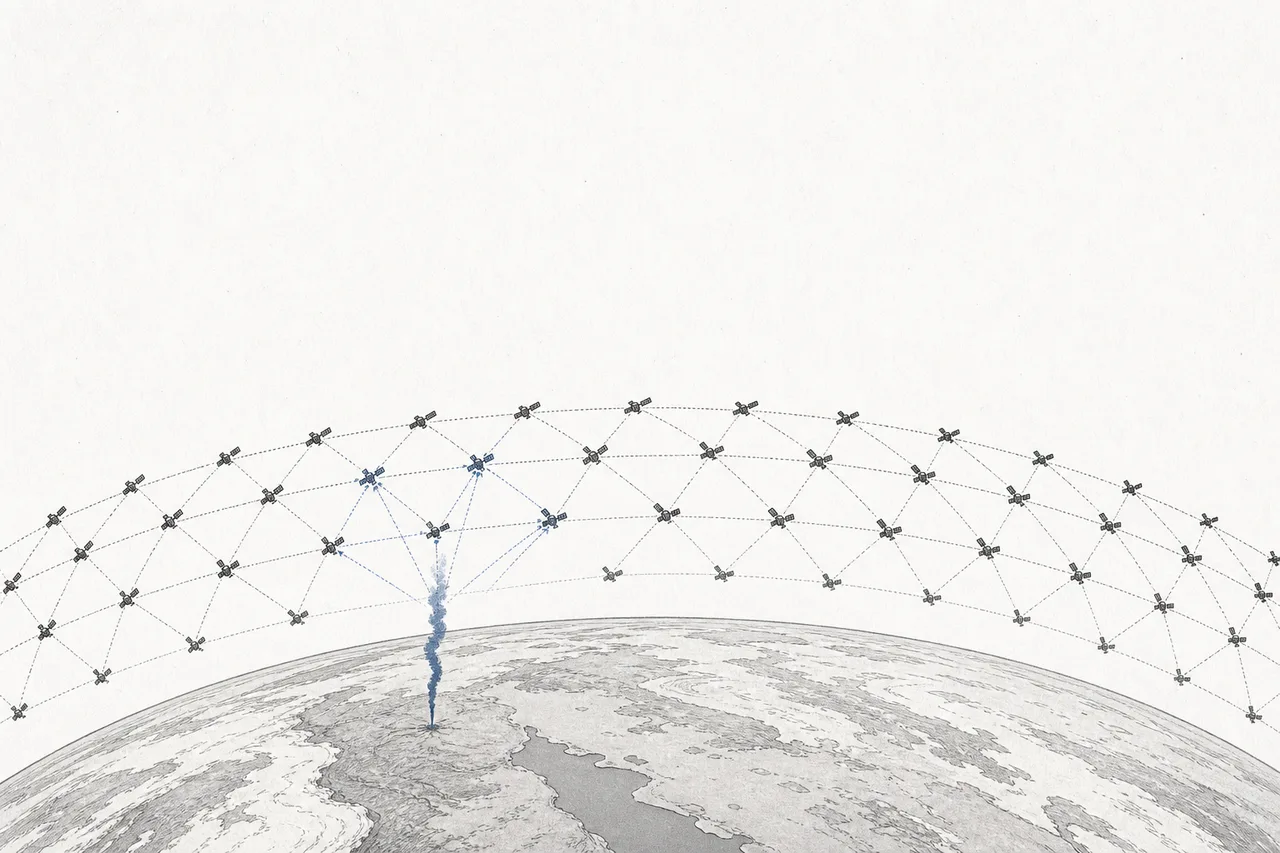
The first direction is manufacturing becoming even more of a factory. The small-satellite market is expected to grow about 28% a year through 2030, and annual production will climb from around 2,800 (2025) to over 5,000. Whoever designs a standard bus to be reproduced the cheapest and fastest wins — like the unit-cost war in the auto industry.
The second direction is the line between builders and users blurring. Starlink builds its own satellites to feed its own network (vertical integration), which pressures independent contract manufacturers — the industry's biggest customer becomes a direct competitor. The question is where independent makers find customers when the biggest player builds its own.
The third direction is defense becoming a long-term pillar of demand. The proliferated-LEO idea (spreading many small satellites to survive an attack) keeps the military ordering in large, continuous batches — and even though some programs get reviewed and restructured, the direction of "more satellites, smaller, replaced faster" is still the mainstream.
07Challenges & risks
The appeal of this node comes with risks you need to understand.
The first risk is dependence on a few networks. The enormous demand for satellite manufacturing today is tied to just a handful of mega-constellation projects. If any one of them slows down, gets canceled, or switches makers, the big orders vanish — and we've already seen that even defense programs can be reviewed and reassigned. Demand that looks endless is more fragile than it seems.
The second risk is commoditization. When everyone produces standard buses on a line, the differences shrink and competition drops to price — many small-satellite makers lost money undercutting each other. The lesson from Terran Orbital (which had to sell itself) is that "mass production" doesn't automatically mean "profit."
The third and biggest risk is the giant integrating everything in-house. SpaceX builds, launches, and operates its own satellites end to end. When the biggest and cheapest player buys from no one, the structure of the "contract manufacturer" market is challenged directly. Independent makers have to find niches SpaceX won't compete in — like specialized defense missions, science satellites, or customers who don't want to depend on a rival.
In short: the story of this node is that satellites stopped being "expensive art" and became "things rolling off a line," because the world wants them by the thousands and tens of thousands. Understanding who controls the factory, who controls the cost, and who controls the hard-to-copy technology is understanding that the real value in the space supply chain is hidden in "the people who build the things," not just the rocket we watch shooting into the sky.