Megatrend · Space Economy
When the internet beams down from the sky — and satellites start talking straight to the phone in your pocket
For a hundred years, communication satellites were just a handful of machines hovering far overhead, sending slow and expensive signals. But in just the last few years, the sky has been packed with thousands of satellites flying low and fast, beaming high-speed broadband down to every square inch of Earth — and the newest frontier is "direct-to-device": satellites that can talk straight to your ordinary phone, possibly erasing the word "no signal" from the world. This is the single biggest revenue engine of the space economy.
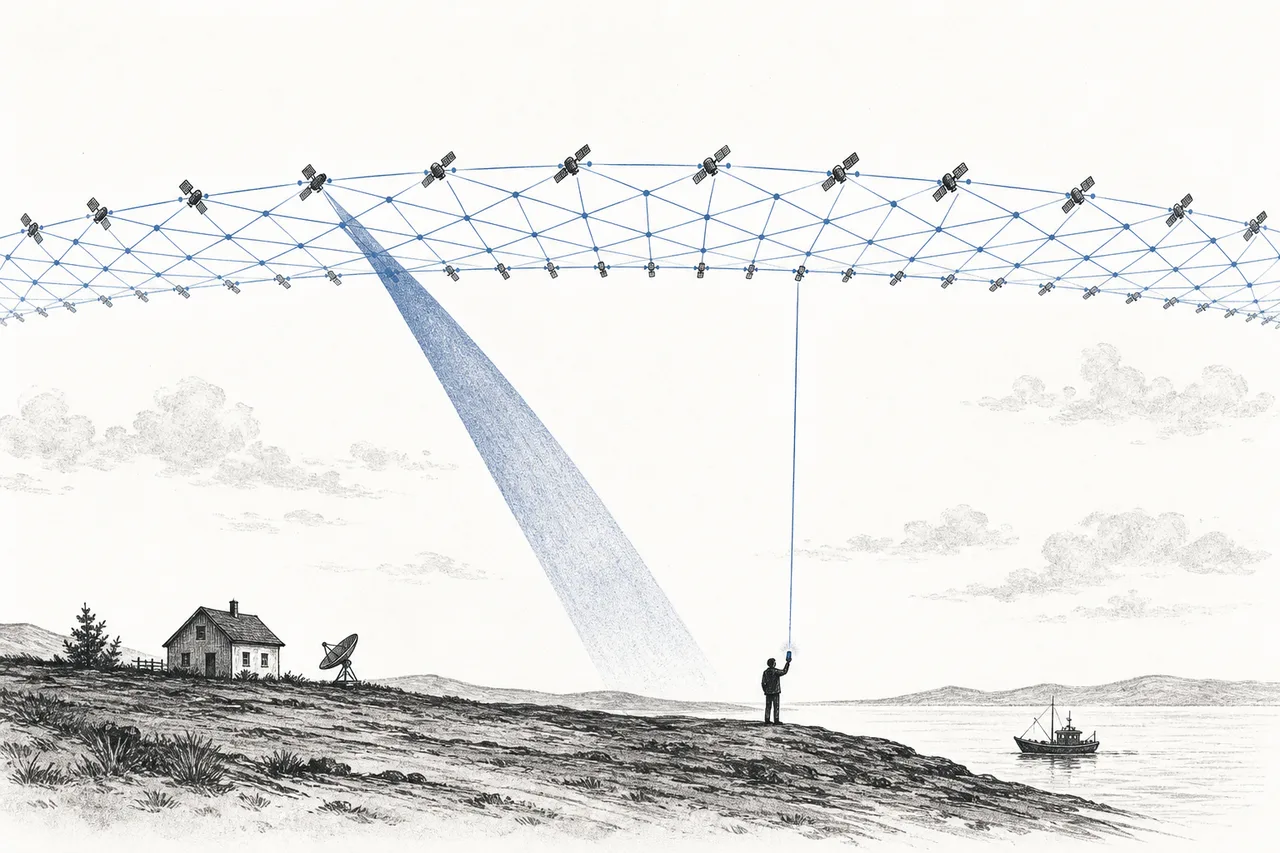
01What it is (two frontiers of one story)
Think of the places where you've gone "no signal" — the middle of the sea, up a mountain, deep in a forest, or a village with no cell tower. About 2.6 billion people worldwide still can't get online, and over 90% of the Earth's surface (oceans, deserts, mountains) has no mobile signal at all, because running fiber or putting up a tower somewhere remote just "doesn't pay." This node is about solving that problem by beaming the signal down from space instead.
The node "Satellite Connectivity & Direct-to-Device" is a sub-branch of the megatrend Space Economy, and it splits into two frontiers — the same story at different stages of the technology:
- 1) Broadband from space (Satellite Broadband, MSS & Ground): beaming high-speed internet down to a receiving dish at home, on a ship, on a plane, or on a temporary tower — this is the Starlink you know, and it's a business that really makes money today. The half people overlook is the "ground equipment" (dishes/gateways ~$59 billion), which is even bigger than the service market, and it's where Starlink is squeezing GEO incumbents like Viasat and Hughes
- 2) Direct-to-Device, or D2D (satellite-to-cell): the newest frontier — satellites talk straight to the ordinary phone in your pocket, with no dish and no special gear, to send a message, make a call, or get online where there's no tower
The key difference is the customer: broadband sells to people willing to install a dish (millions of households), while D2D's "potential customer" is every phone on Earth — billions of them. That's why every big mobile carrier is jumping in.
GEO (Geostationary Orbit) = the old-school satellite, hovering high at ~36,000 km, covering a wide area with a single craft — but the signal travels so far that it "lags" (high latency, ~600 milliseconds) · LEO (Low Earth Orbit) = a low orbit at ~550 km that needs thousands of satellites to cover the whole planet, but the signal is much closer, so it's fast and low-latency (~20–30 milliseconds) — fast enough to game or do a video call. The whole revolution of this node is the move from GEO to LEO.
02Why it's the biggest revenue engine in space
When people talk about the "space economy," many picture rockets, moon landings, or space tourism. But the truth is the biggest money is in communications. A report from the World Economic Forum and McKinsey estimates the space economy will grow from $630 billion in 2023 to $1.8 trillion in 2035, and the fastest-growing piece is the "reach" group — applications that bring space into services for ordinary people, with communications/connectivity at the core.
Why is this so? Because there are people "ready to pay" already there: rural residents with no internet, shipping and aviation businesses, oil and mining companies, militaries and governments — and in the D2D case, everyone with a phone. The satellite broadband market is growing from ~$14.6 billion in 2025 to ~$33.4 billion in 2030 (about 18% a year), driven mainly by the LEO group.
And here's what just changed in a big way: the real market leader is now on the stock market — Starlink sits under Elon Musk's SpaceX, which listed on the Nasdaq in June 2026 under the ticker SPCX (one of the largest IPOs in the history of capital markets, priced at $135 a share, valuing the company at about $1.75 trillion, with the stock closing its first day up about 19%) — and crucially, Starlink did not IPO on its own; it trades bundled inside SpaceX (SPCX). So buying SPCX is a bet on both the "rockets" and the "satellite-internet group" at once. In 2025, Starlink brought in about $11.4 billion and became SpaceX's most profitable business, with some estimates that 2026 revenue could jump to $18–20 billion — where investors could once only touch this leader through "challengers," the leader itself can now be traded directly on the market.
03How it works — from the sky to the palm of your hand
The heart of the revolution is one phrase: "fly lower, and use more of them". A single old GEO satellite can cover a huge area, true, but it sits 36,000 km away, and the signal's round trip takes so long you can barely game or video-call. The answer is to move down to LEO (~550 km), 65 times closer — but the trade-off is that one craft sees only a tiny patch of Earth and moves very fast, so you need thousands of them handing off the signal so it never drops. That's where the term "mega-constellation" (a giant satellite group) comes from.
Doing D2D is much harder, because an ordinary phone is designed to talk to a tower just a few kilometers away, not to a satellite hundreds of kilometers up flying at thousands of kilometers an hour. So the signal from a phone is "very faint" by the time it reaches space. The fix is to build satellites with giant antennas to "hear" the tiny signal from a phone — AST SpaceMobile's BlueBird 6 satellite, launched in late 2025, carries the largest antenna array ever sent to LEO for exactly this purpose.
04Direct-to-Device: when every phone is a customer
If broadband is the business making money today, D2D is the big wave that's coming, and the reason is simple: its market is every phone on Earth. The best-known starting point is the Emergency SOS via satellite feature on the iPhone (since iPhone 14), which lets you send a message for help even with no signal — behind it are the satellites of Globalstar, in which Apple invested about $1.5 billion and holds roughly a 20% stake.
From there the game changed fast. Starlink teamed up with T-Mobile to launch "T-Satellite" commercially in July 2025, putting up more than 650 direct-to-cell satellites — starting with messaging, then expanding to apps like WhatsApp and maps. The deal's power shook the industry so much that AT&T and Verizon, two forever-rivals in the U.S., had to join forces to back AST SpaceMobile against Starlink.
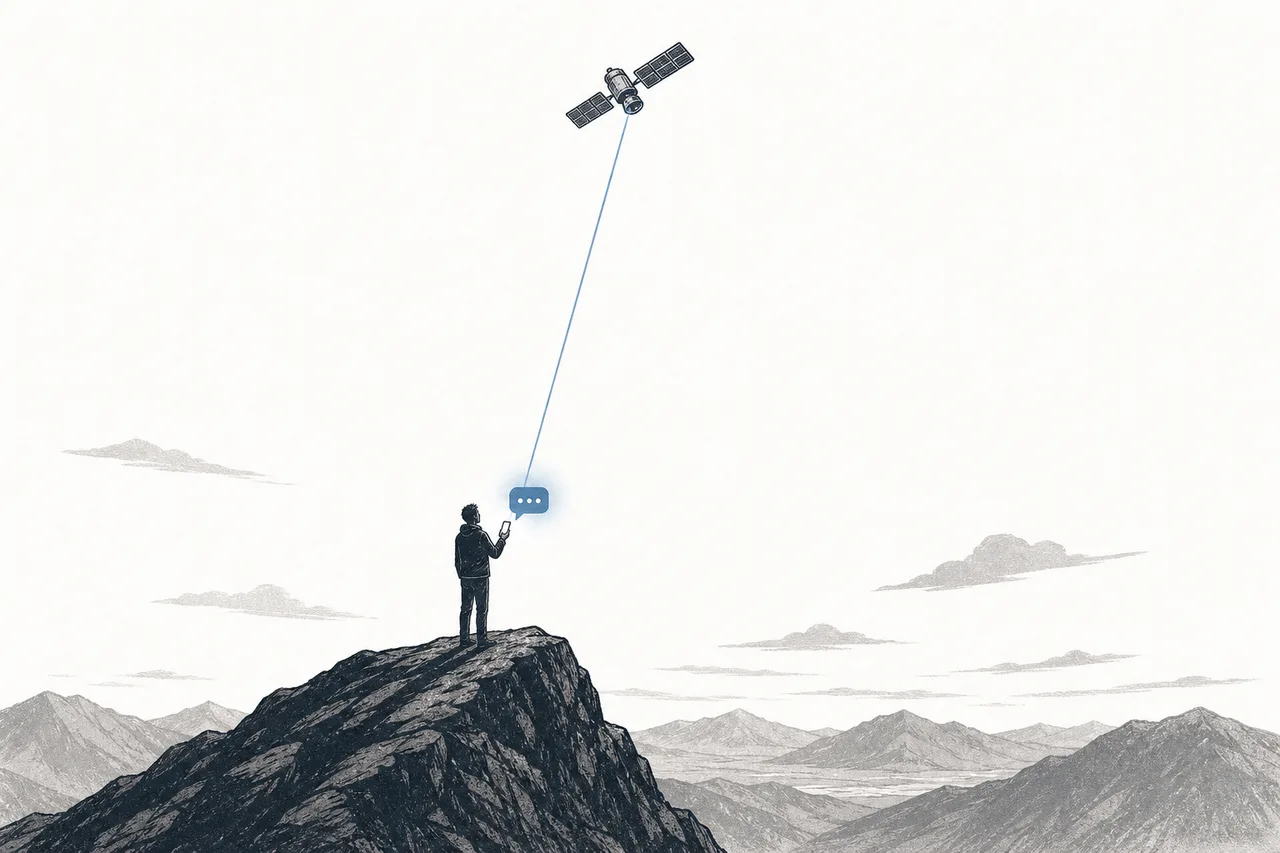
AST SpaceMobile (ticker ASTS) = the pure-play D2D challenger that has "bet the whole company on D2D," aiming to have 45–60 satellites in orbit by the end of 2026 to start service covering all of the U.S. (for the deep dive — speed/partners/giant antennas → read it in full in the D2D child node).
The D2D market is still small in revenue today, but the growth curve is very steep. Research firms estimate differently depending on the definition: MarketsandMarkets sees the D2D market growing from ~$0.57 billion in 2025 to ~$2.64 billion in 2030 (about 36% a year), while Omdia takes a broader view, projecting D2D service revenue on smartphones to hit ~$12 billion and about 411 million monthly users by 2030.
NTN (Non-Terrestrial Networks) is a standard that the neutral body 3GPP (the same one that sets the 4G/5G standards) added so that phones, networks, and satellites can "speak the same language" without modifying the device — which is why newer phones are starting to connect to satellites on their own, almost without you noticing, and it's the key that unlocks D2D for the mass market.
05Where it sits in the space economy
This node is the "downstream" of the space economy — the point where space turns into real revenue from real customers. But it only stands up because of other branches in the same megatrend:
- Leans heavily on Launch Services: to have thousands of satellites in orbit, you have to launch rockets often and cheaply — the massively cheaper launch costs (especially SpaceX's reusable rockets) are what make a mega-constellation economically possible
- Feeds on the output of Satellite Manufacturing: you have to build thousands of satellites "assembly-line" style, not one craft at a time by hand like the old days
- Extends into AI and digital infrastructure: anytime-anywhere connectivity is the "lifeline pipe" for AI and cloud services — and it links to Edge & CDN in putting content/processing closer to the user
What's interesting is that this node both competes with and complements ground infrastructure — it competes with rural home internet, but at the same time mobile carriers use it to "plug the holes" in their own dead zones (more partner than rival). And on the security side, demand from militaries and geopolitics pushes this market hard — the war in Ukraine showed the world that hard-to-knock-out satellite communication is a strategic asset. Government/military revenue makes up a large share for players like Iridium (the U.S. government is ~29% of revenue).
06Where things stand now + who the players are
The 2026 picture is clear: Starlink dominates the broadband game by a mile, with over 9,600 satellites in orbit (more than half of all the active satellites in the world) and ~12 million users. The D2D frontier is just opening — Starlink+T-Mobile already in service, AST SpaceMobile racing to launch satellites, and Globalstar+Apple steadily expanding.
The competition is heating up from two directions: Amazon is racing to build its "Amazon Leo" satellite group (formerly Project Kuiper), having launched about 331 craft to become the world's third-largest constellation, with reports that Amazon is interested in buying Globalstar (a deal valued at around $9 billion). On the spectrum (frequency) side there's a big deal too: EchoStar is selling frequencies to AT&T and SpaceX for a combined over $40 billion to fix its debt — a sign that "spectrum" has become a prized asset in the D2D game.
On the Asia side, the players to watch are China, building its own satellite groups (like Guowang/Qianfan) through companies like China Satellite Communications, and Japan's SKY Perfect JSAT, a major regional satellite operator — a sign that this game isn't just the U.S.'s, but has become a geopolitical race where each nation wants its own "internet from the sky."
07The future
The first direction is D2D becoming a standard feature of phones. As the 3GPP NTN standard spreads and there are enough satellites, "connecting to a satellite on your own" will become as normal as roaming signal — starting with messages, moving to calls and getting online. Carriers will sell it as an add-on package. This is why Omdia sees D2D users hitting 400+ million by 2030.
The second direction is competition getting much fiercer. Right now Starlink nearly monopolizes LEO broadband, but Amazon Leo is racing to catch up with an equally deep wallet, plus the satellite groups of China and Europe (Eutelsat/OneWeb). Having multiple players will push prices down — good for consumers, but squeezing providers' profits.
The third direction is "spectrum" becoming the new battlefield. D2D needs to use ground-based mobile frequencies, and tens-of-billions-of-dollars spectrum deals like EchoStar's are a signal that whoever controls more spectrum holds high bargaining power in an era when the sky and the cell tower are merging.
08Challenges & risks
This node's appeal comes with risks just as heavy.
The first risk is it devours enormous capital. Building and launching thousands of satellites, then having to keep sending up new ones to replace the old that expire every ~5 years, is burning money without end — which is why only the very deep-pocketed players (SpaceX, Amazon, the Chinese government) can play the broadband game full-on, and why many small challengers of the past went bankrupt (OneWeb, for instance, collapsed once before it was bought).
The second risk is Starlink's market dominance. When one company controls more than half the world's satellites and the cheapest rocket-launch prices, challengers have to chase at a higher cost. Relying on "one company's sky" is also a security concern that worries many countries, which is why they want their own satellite groups.
The third risk is spectrum and regulation. D2D needs permission to use mobile frequencies from a satellite, which has to pass each country's regulator and must not interfere with ground networks — a slow and complex process. Add the problem of "space junk" and the congestion of low orbit, where tens of thousands of satellites are starting to risk collisions.
In short: the story of this node is space ceasing to be something distant and becoming a signal on the phone in your hand out in the wilderness. Satellites being able to talk straight to an ordinary phone could erase the word "no signal" from the world within this decade — and whoever controls the sky may control the connectivity of all of humanity.