Megatrend · Defense & Geopolitical Fragmentation
When the real “high ground” of war moved into space
Everything a modern military relies on — GPS navigation, communications, seeing the enemy, missile warning — runs through satellites over our heads. Today space is officially a “battlefield,” and the US is pouring trillion-dollar money into a space-based missile shield called “Golden Dome.” This is the story of an industry that watches the sky for us — and is turning into a new investment arena.
01What is it?
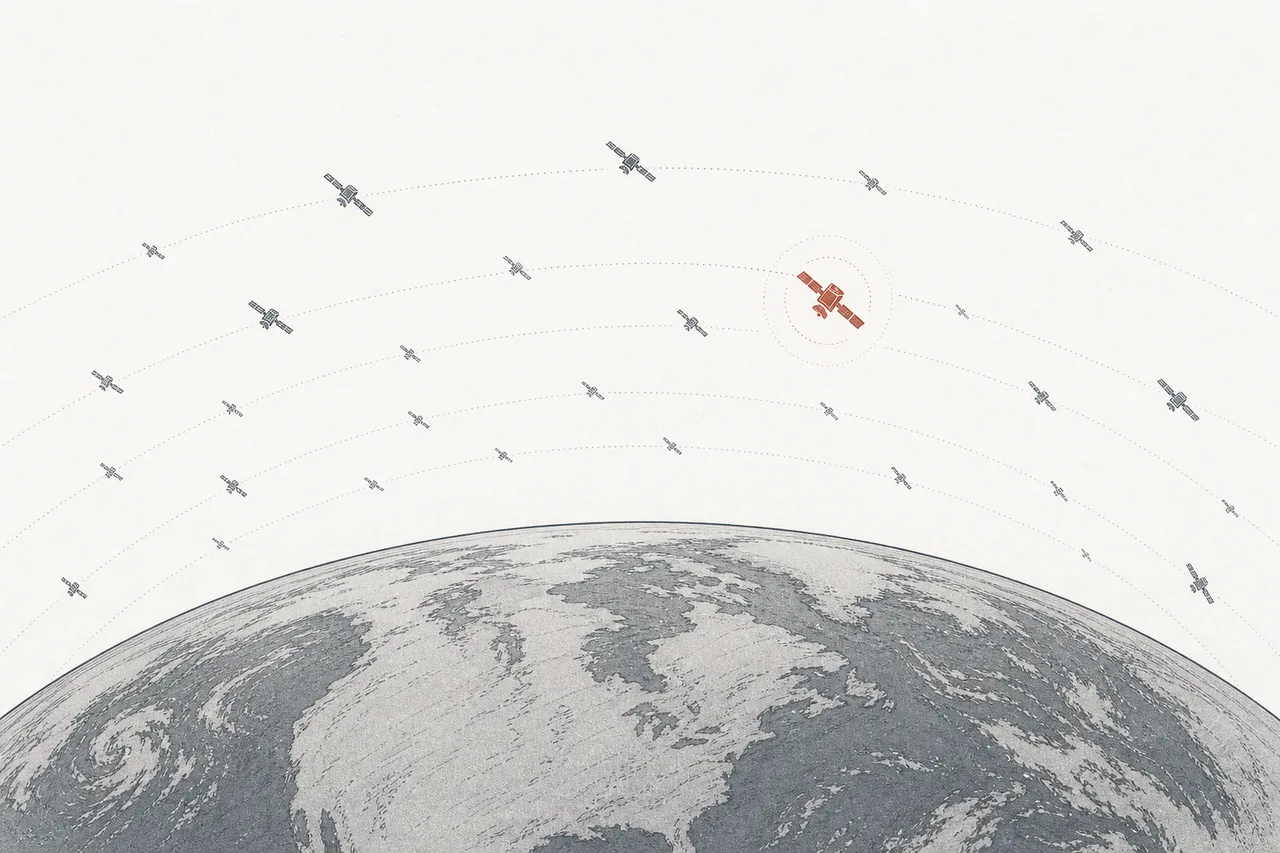
Imagine if one day the GPS in your phone went dark, the navigation in a plane scrambled, and the comms signal dropped — just that would throw daily life into chaos. Now think about it from a military's point of view: fighter jets, ships, guided missiles — all of them lean on the “eyes and ears” floating above us. Those are military satellites, and this node is specifically about “the military's piece of space.”
It's clearly different from Space Economy (the commercial space economy — satellite internet, space tourism, cargo rockets). This node is purely military and security, and its core is just a few things:
- Missile Warning & Tracking: satellites that detect the heat of a missile launch the instant it fires and stay locked on it all the way to its target — buying the defending side time to react
- Military communications (MILSATCOM): encrypted channels a military uses to talk worldwide, without relying on civilian networks
- Space Domain Awareness: “watching space itself” — knowing whose satellite or object is moving in close to yours
ISR (Intelligence, Surveillance, Reconnaissance) = using satellites to “see” the enemy, photograph, and intercept signals · Missile Warning = detecting a launch from the light/heat coming out of the rocket's nozzle, then sending an alert within seconds · Space Domain Awareness (SDA) = knowing “what's where in space right now” to protect your own satellites from jamming or collision
On the megatrend map, Space Defense sits under Defense & Geopolitical Fragmentation, and it's literally the highest “platform layer” — because it's the network that lets every weapon on land, at sea, and in the air “see” and “talk.” If this layer goes down, the whole military is effectively blind.
02Why it became a big deal
For decades, space was an unspoken “safe zone” — every nation parked its satellites up there and nobody touched anyone else's. But that scene is over. In 2026, the US officially declared that space is a “battlefield” (a contested warfighting domain), just like land, sea, air, and cyber.
What changed? The answer is that rivals are catching up fast. China's satellite fleet broke past 1,060 satellites by mid-2025 (hundreds of them doing direct military reconnaissance), and a 2026 report identifies 13 nations developing “capabilities to attack an adversary's satellites” — from ground-based lasers and GPS jamming to “inspect-and-repair” satellites that can actually pull up close to someone else's.

The economic upshot is a huge wave of money flowing into this industry. The US requested a record-high Space Force budget for 2026 of about $39.9 billion, up ~30% from the year before, most of it going to missile-defense satellites. And that doesn't even count the biggest new megaproject in the history of national defense — “Golden Dome.”
Golden Dome is a plan to build a “missile-defense shield” covering the entire US, with its space-based layer at the core. President Trump announced it in mid-2025, with an initial White House figure of ~$175 billion (later nudged to ~$185 billion). But the Congressional Budget Office (CBO) re-estimated in May 2026 that the real cost could run as high as $1.2 trillion over 20 years — and the most expensive piece is the “space-based interceptor layer,” which eats about 70% of the acquisition cost.
Wherever the real number lands, one thing is clear: this is a multi-year spending wave big enough to wake the entire military-satellite industry.
03How it works
The heart of this node is the “space watch layer,” which does two jobs at once: detect & track the enemy's missiles, and protect its own satellites — then feed all of it down to the ground-based defense system (the core of Golden Dome) to decide. Let's walk through the whole picture step by step.
The single biggest game-changer of this era is “where you put these eyes.” The US used to rely on a few missile-warning satellites — huge and ultra-advanced, parked still at about 36,000 km up (geostationary orbit, or GEO). The problem: there were few of them, they were expensive, and they sat in one place — making them “big, stationary targets” that an enemy could aim at easily.
The new answer is what's called “proliferated LEO” (spreading a large number of satellites across low orbit). Instead of a few giant satellites, you switch to a swarm of hundreds of cheap small satellites flying low at about 1,000 km. If one gets shot down, the system barely flinches — like splitting your eggs across many baskets. The average cost per satellite drops to just ~$14 million, versus a GEO satellite costing billions apiece.
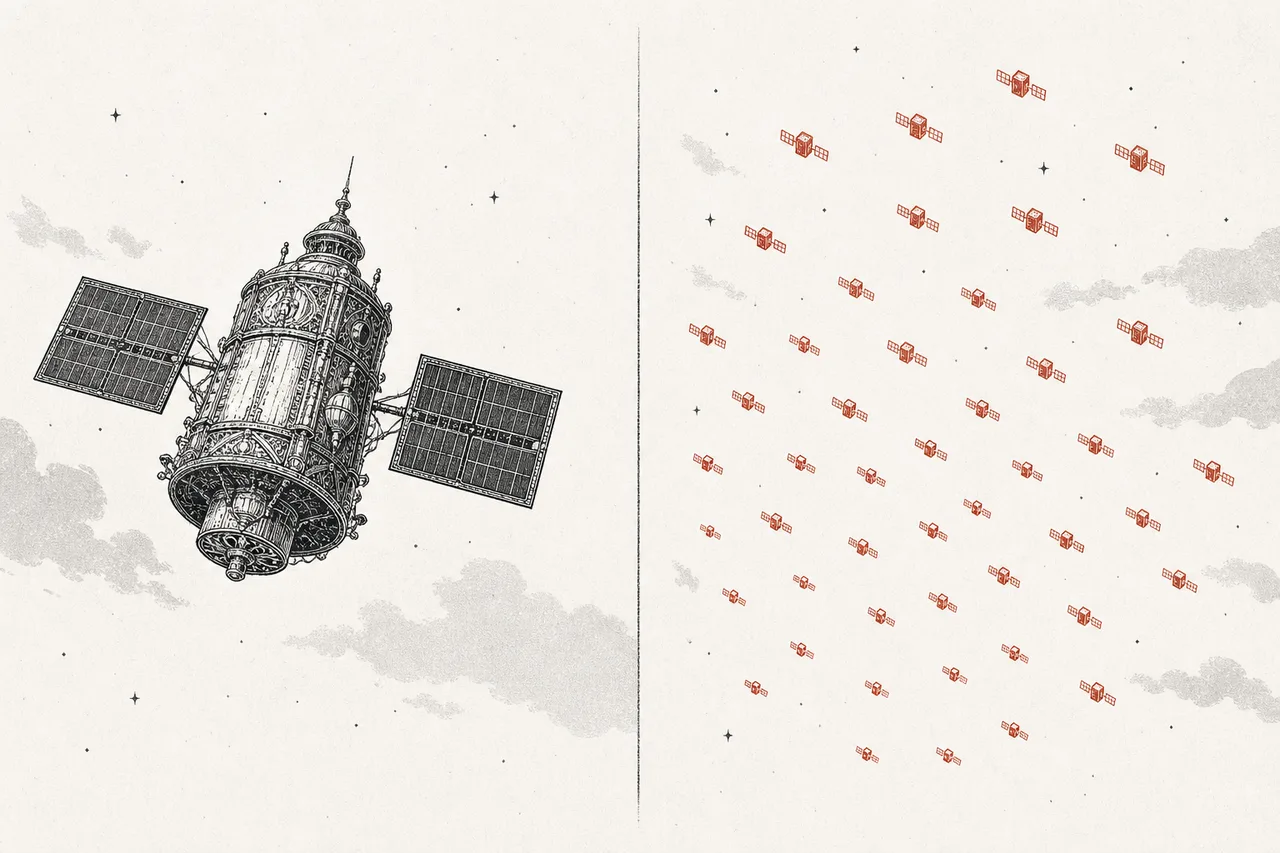
“Exquisite” = the old philosophy: ultra-advanced satellites, very expensive, but few of them · “Proliferated” = the new philosophy: small, cheap satellites, but lots of them — prioritizing “tough” over “best” · LEO/MEO/GEO = orbital altitude (low/medium/geostationary) — the lower it is, the sharper the detail and the faster the comms, but you need many satellites to cover the whole planet
04How it connects in the ecosystem
This node is the “top layer” that looks down on the entire battlefield. So it connects to almost every part of defense — and reaches across into other technology trends too:
- Next to (but not overlapping) Space Economy: this is a key dividing line — Space Economy is “commercial space” (satellite internet, cargo rockets, space tourism), while this node is “the military's space.” The two share technology and launch rockets, but their customers and logic live in different worlds
- Gives eyes to missiles and guided weapons: this node's “missile warning and tracking” is what tells the ground-based interceptors where to fire — these two are the offense and defense of the same equation
- Fuses with Defense Software & C4ISR: satellites capture an enormous amount of data, but it's meaningless without the software to connect it and decide — Golden Dome is as much a software project as a hardware one
- Depends on Defense Electronics & Sensors: the heart of a warning satellite is the “infrared sensor” that catches a missile's heat — a high-tech part that decides how fast you can lock onto a target
- Depends on AI and critical materials: AI helps separate the real signal from decoys in a split second, and building satellites by the swarm takes a huge supply chain of parts and rare earths
05Where it stands now
The whole industry is in “build fast” mode. The number that tells the story best is the huge contract the Space Development Agency (SDA) put out in late 2025 — a $3.5 billion contract to build 72 missile-warning and tracking satellites (Tranche 3) in one go. It's the largest missile-warning satellite contract in the history of this network.
The most striking thing about this contract is a “newcomer” muscling in to stand shoulder-to-shoulder with the old giants. Rocket Lab, a new space company, grabbed an $816M contract — on par with L3Harris and more than Northrop. Five years ago that was almost impossible, because this field was monopolized by a handful of big defense primes.

At the same time, the old giants still hold a key card. Lockheed Martin just announced that its new missile-warning satellite (Next-Gen OPIR GEO-1) is now operational in orbit — a satellite that catches “hypersonic” missiles, which fly low and maneuver and are hard for older satellites to track. So this market is a two-tier game: a cheap small swarm in low orbit + a few ultra-advanced satellites in high orbit, working together.
All of this sits on a fast-growing market — the global military-satellite market was about $32 billion in 2025 and is expected to grow to ~$80 billion by 2035 (about 10% a year on average), with “missile warning” the fastest-growing segment.
Note: Some of the most powerful players in this field are still private companies not listed on the stock market — especially SpaceX (the world's largest satellite launcher and the company that proposed the warning-satellite swarm concept) and Anduril (a defense startup pushing into space-military work). Both are major pressure on the old giants, even though ordinary investors still can't access them directly · Not investment advice
06The road ahead
The first direction is Golden Dome becoming a multi-year money-sucking engine. Whether the final number is $175 billion or $1.2 trillion, it means a steady stream of orders for warning satellites, sensors, and interceptors all decade long — the “space-based interceptor layer,” which eats 70% of the cost, will be a new money field no one has claimed yet.
The second direction is “cheap small swarms” becoming the standard. With SDA clearly betting on proliferated LEO, the game shifts from “who can build the most advanced satellite” to “who can build a good-enough satellite in large numbers and cheaply enough” — which opens the door for fast, cheap newcomers like Rocket Lab to take share from the old giants.
The third direction is the “protect the satellite” race heating up. As 13 nations develop anti-satellite weapons, investment won't just be about “seeing the enemy” but about “watching and protecting your own satellites” (Space Domain Awareness) — a segment that's only just getting started and will grow with the tension in space.
07Challenges & risks
This hot-looking trend has shadows you need to see in full.
The first risk is “budget and program-reality risk.” Golden Dome is still just an “architecture” whose details aren't settled — the cost estimate range is as wide as 7x (from $175 billion to $1.2 trillion), and many analysts question whether the announced 3-year timeline is “really possible.” Defense projects this size usually run late and balloon. If the politics shift or the budget gets cut, the orders that look pretty today could slow.
The second risk is “newcomer vs old giant” — nobody knows who wins yet. Companies like Rocket Lab have momentum and really did land big contracts, but delivering dozens of military satellites on time and to quality is a different problem from launching commercial rockets. Meanwhile the old giants like Lockheed/Northrop have deep experience and relationships — this share war isn't over, and the loser could lose an enormous investment.
The third risk is escalation of tension in space. The harder every nation races to build both “defensive satellites” and “anti-satellite weapons,” the higher the odds that space becomes a real conflict zone — which could hit the civilian satellites (GPS, internet) everyone uses, and debris from collisions/destruction in orbit could create long-term problems for the entire space economy.
In short: this node is a lesson that the “high ground” of modern war is no longer on a mountain — it's over our heads in space. Whoever controls the seeing and the warning from space controls the rhythm of the whole conflict — and that has lit off the biggest investment rush in the history of military space.